This site is supported by our readers. We may earn a commission, at no cost to you, if you purchase through links.

Most snake keepers spend years chasing stable humidity with spray bottles and guesswork, never realizing the enclosure itself could do the work.
A well-planted snake habitat with live plants functions more like a self-regulating ecosystem than a static box—plants transpire moisture into the air, roots anchor the substrate, and layered foliage gives even the most anxious snake somewhere to disappear.
The difference in animal behavior alone can surprise keepers who make the switch: less pacing, more natural exploration, and a visible drop in stress-driven responses.
Getting there requires the right species selection, substrate engineering, and setup sequence—all of which are more straightforward than the planted-tank hobby would have you believe.
Table Of Contents
- Key Takeaways
- Why Add Live Plants to Your Snake Habitat?
- Step-by-Step Snake Habitat Setup With Live Plants
- Choosing The Right Snake Species and Natural Habitat
- Building a Drainage Layer to Prevent Root Rot
- Selecting a Bioactive Substrate Mix for Plant Roots
- Installing Heating and Full-Spectrum Lighting
- Arranging Hides, Driftwood, and Plant Anchors
- Quarantining and Rinsing Plants Before Installation
- Planting Directly Vs. Using Concealed Pots
- Best Live Plants for Snake Enclosures
- Top 5 Live Plant Products for Snake Habitats
- Frequently Asked Questions (FAQs)
- Can you put live plants in a snake enclosure?
- How to keep plants alive in a snake enclosure?
- What is the best habitat for a snake?
- Can my dog be in the same room as a snake plant?
- Can snakes eat or damage live plants?
- How often should I replace bioactive substrate?
- What if my snake digs up plants?
- Do live plants attract pests or mites?
- Can I use artificial plants instead?
- How often should live plants be replaced?
- Conclusion
Key Takeaways
- Live plants don’t just decorate your snake’s enclosure — they actively regulate humidity through transpiration, filter air via photosynthesis, and create microclimate zones that reduce chronic stress behaviors like pacing.
- Species-matching is the foundation of every other decision: your snake’s native temperature range, humidity needs, and climbing preferences should determine plant selection, substrate composition, and heating placement before anything else.
- A proper drainage layer, bioactive substrate mix (coco coir, perlite, bark, and biochar), and full-spectrum lighting aren’t optional upgrades — they’re the structural prerequisites that keep both plants and animals thriving long-term.
- Before any live plant enters the enclosure, a 2–4‑week quarantine with a pest inspection and chemical-free rinse is non-negotiable, since unquarantined plants are the most common vector for mites, fungus gnats, and toxic fertilizer residues.
Why Add Live Plants to Your Snake Habitat?
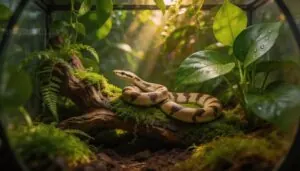
Live plants do more for a snake enclosure than just make it look good.
They actually regulate humidity and filter the air—a deeper look at live plants vs. artificial options for snake enclosures shows just how much that difference matters.
They actively shape humidity, air quality, stress levels, and behavior in ways that artificial decor simply can’t replicate.
Here’s why keepers who go live rarely go back.
Regulating Humidity Through Natural Transpiration
Live plants regulate humidity in your snake habitat through transpiration — a process in which water vapor exits leaves via stomata, steadily raising ambient moisture without a spray bottle every hour. Leaf surface area and stomatal density determine how much each species contributes, which means a trailing pothos outperforms a succulent considerably.
Live plants raise enclosure humidity naturally through transpiration — no spray bottle required
- Vertical foliage increases air moisture pockets along tank walls
- Soil moisture reservoir releases humidity slowly between misting cycles
- Microclimate zoning concentrates humidity near hides and basking gradients
- Humidity regulation with foliage stabilizes levels during heating-driven fluctuations
Providing Shelter and Reducing Snake Stress
Beyond humidity, leaf density and vertical complexity do something equally valuable — they give your snake somewhere to disappear.
Dense shade canopy creates microclimate zones where snakes retreat when alarmed, reducing pacing and restless behavior that signals chronic stress.
Camouflage cover mimics natural habitat simulation closely enough that snakes genuinely settle, moving with purpose rather than anxiety.
Providing shelter and climbing structures through strategic planting is environmental enrichment that works.
Improving Air Quality Inside The Enclosure
Plants don’t just calm your snake — they actively clean its air. Through photosynthesis, live plants absorb CO₂ and metabolic off‑gassing while releasing oxygen, functioning as a soft first layer of air purification before your filtration systems take over.
In a bioactive setup, the nitrogen cycle processes biological waste processing at the substrate level, while carbon filters and UV sterilization handle airborne pathogens, and air circulation fans prevent stagnant pockets from forming.
Encouraging Natural Climbing and Hiding Behaviors
Clean air sets the stage, but structure gives your snake somewhere to actually go. Vertical plant anchors, branching vines, and canopy layering work together to create a naturalistic enclosure with genuine climbing structures and hiding spots.
Moss ground cover deepens low retreats, while arboreal climbing plants and microclimate shade zones let snakes self-regulate and explore — the way live plants were always meant to function.
Enhancing Visual Appeal and Mimicking Native Habitat
When done right, a planted enclosure stops looking like a tank and starts looking like a habitat.
Naturalistic design depends on layering — Vertical Greenery Placement draws the eye upward through arboreal climbing plants, while ground cover and vertical planting ideas fill depth below.
- Substrate Color Contrast makes foliage appear richer and shadows more defined
- Plant Texture Variety breaks visual monotony across the enclosure floor
- Lighting Color Temperature reveals true leaf coloration, sharpening overall habitat aesthetics through Layered Canopy Design
Step-by-Step Snake Habitat Setup With Live Plants
Getting the setup right from the start saves you a lot of headaches down the road. Every decision you make — from drainage to lighting — builds on the one before it, so the order matters more than most people expect.
Here’s how to put it all together, step by step.
Choosing The Right Snake Species and Natural Habitat
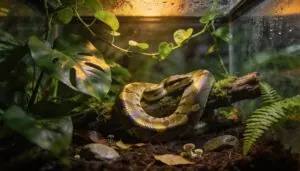
Your choice of snake species sets the foundation for every plant decision that follows. Corn snakes tolerate moderate conditions, while ball pythons, garter snakes, and arboreal snake species each demand distinct temperature, humidity, and climbing preferences rooted in their geographic range and behavioral traits.
Match your enclosure’s climate compatibility to the snake’s natural habitat first — size constraints and plant selection follow naturally from that single, defining choice.
Building a Drainage Layer to Prevent Root Rot
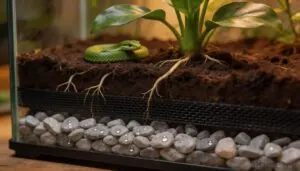
Before a single plant goes into your enclosure, a proper drainage layer is what stands between thriving roots and the waterlogged conditions that cause scale rot and substrate contamination.
Lay 2–4 inches of gravel or pumice as your Material Selection, apply a mesh barrier for Barrier Placement, then confirm Water Flow paths are clear.
Schedule routine Maintenance Inspection to preserve soil health in vivarium long-termtermA drainage layer keeps roots out of oxygen‑poor conditions and reduces the risk of root rot.
Selecting a Bioactive Substrate Mix for Plant Roots
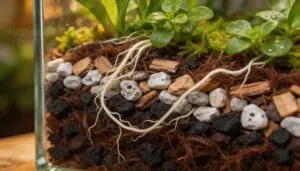
Your substrate is the foundation everything else depends on. A coco coir base maintains moisture retention reliably, while perlite and bark open up root zone aeration so roots don’t suffocate.
Biochar inclusion adds microbial habitat and buffers nutrient cycling and nitrogen processing in bioactive setups. Mind the particle size — 2 to 8 millimeters keeps soil composition breathable.
These substrate considerations for planted snake tanks directly determine long-term soil health in vivarium environments.
Installing Heating and Full-Spectrum Lighting
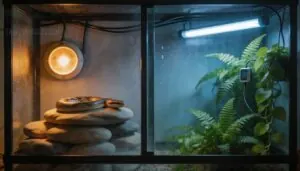
Heat source placement determines whether your snake thrives or merely survives. Mount your ceramic emitter or radiant heat panel on one side, targeting a basking zone of 28–32°C, while cooler areas hold 22–26°C. Thermostat calibration keeps swings within ±2°C.
Position full-spectrum bulbs and UVB lighting 15–20 cm above substrate — critical for lighting requirements for different vivarium plants.
Use a lighting timer setup for consistent 10–12 hour cycles, and never skip cable safety inspection.
Arranging Hides, Driftwood, and Plant Anchors
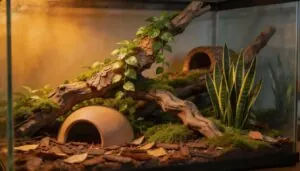
Arrangement isn’t decoration — it’s microclimate engineering. Vertical Hide Placement across multiple levels gives your snake thermoregulation choices, with a primary hide anchored near the warm zone and secondary hides tucked behind driftwood for concealed retreats.
Driftwood Anchor Safety requires securing every piece to prevent toppling during climbs. Use inert Anchor Material Selection — fishing line or twist ties — to fasten climbing and hiding structures for captive snakes without chemical leaching.
Quarantining and Rinsing Plants Before Installation
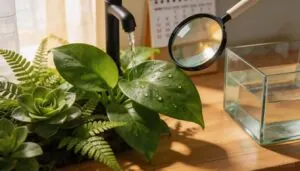
Before any plant crosses into your snake’s space, a 2–4 week Quarantine Duration is non-negotiable.
During that window, run a thorough Pest Inspection — checking for scale, aphids, and mites — then perform a Sanitizing Rinse with lukewarm water, scrubbing sturdy leaves gently.
Chemical-Free Cleaning matters here; soaps leave residue that risks plant toxicity to snakes. Keep Health Documentation throughout.
Planting Directly Vs. Using Concealed Pots
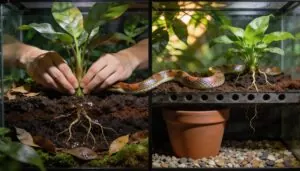
Once quarantine’s done, you face a straightforward fork: plant directly into the substrate or hide pots beneath the surface.
Direct planting improves Root Exposure and Soil Aeration, giving roots continuous moisture exchange and structural stability — no capsizing during your snake’s nightly patrol. Concealed pots, by contrast, offer a soil‑free solution with easier Maintenance Access and cleaner potting mix replacement when roots outgrow the space.
Here’s how each approach breaks down:
- Direct planting anchors roots firmly, supporting natural Growth Control through substrate depth.
- Concealed pots function as soil‑free planting options for vivariums when substrate considerations for planted snake tanks require compartmentalization.
- Water Drainage stays more consistent with pots that have drainage holes sitting above a gravel layer.
- Planting techniques for reptile enclosures benefit from concealed containers when snake movement risks uprooting delicate species.
- Soil Aeration degrades faster in direct setups, requiring occasional substrate loosening to prevent compaction.
Best Live Plants for Snake Enclosures
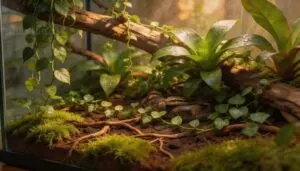
Not every plant belongs in every enclosure, and getting the match right makes a bigger difference than most keepers expect. The right species depends on your snake’s native climate, your tank’s lighting setup, and how much maintenance you’re actually willing to do.
Here’s a breakdown of the best options, organized by habitat type.
Pothos and Snake Plant for Low-Light Tanks
When low light is your limiting factor, pothos and snake plant are your most reliable options. Both tolerate fluorescent and LED tank lighting without significant growth rate reduction, keeping pruning strategies minimal.
Pothos trails naturally for humidity regulation using foliage transpiration, while snake plant’s upright form creates built-in hides. Watering frequency stays low, root management is straightforward, and both are practically non‑toxic to snakes.
Boston Fern and Bromeliads for Humid Rainforest Setups
Where pothos and snake plant handle the dry side of the spectrum, Boston fern and bromeliads take humidity regulation using foliage to a different level entirely.
Fern frond density creates microclimate stratification across vertical space, while bromeliad cup moisture acts as a slow-release reservoir, together raising enclosure humidity 5–15 points.
Substrate moisture retention stays consistent with misting every 6–8 hours.
Succulents and Cacti for Desert-Dwelling Snakes
Desert-adapted setups demand drought-tolerant succulents that match your snake’s arid native range without creating moisture hazards. For Spine Safety Management, select Opuntia pads or trimmed Haworthia over sharp-spined Ferocactus varieties.
- Water Storage Benefits: Aloe and Echeveria tissues release mild humidity passively.
- Basking Surface Design: Opuntia pads trap heat gradients effectively.
- Light Exposure Requirements: All these species need bright, direct light with fast-draining substrate.
Air Plants and Moss for Vertical and Ground Coverage
When you’re working with vertical space, Epiphytic Air Plants — especially Tillandsia species — offer coverage that soil-based plants simply can’t match. Air Plant Mounting onto driftwood or mesh creates Vertical Green Walls without displacing substrate.
| Feature | Air Plants | Moss |
|---|---|---|
| Substrate Needed | None | Minimal |
| Moss Moisture Retention | Low | High |
| Light Requirement | Bright indirect | Low Light Moss |
| Mounting Style | Wire/adhesive | Sheet/mat |
| Best Use | Vertical walls | Ground cover |
A Live Moss Duo Pack or Real Moss carpet underneath stabilizes humidity at floor level while air plants handle the canopy layer.
Plants to Always Avoid for Snake Safety
Not every houseplant that looks harmless actually is.
Philodendrons and Dieffenbachia — both Araceae family toxicity concerns — contain calcium oxalate crystals that irritate oral tissue and cause drooling if chewed. Aloe vera irritation and jade plant ingestion carry similar risks.
Even nontoxic species pose fertilizer residue hazards and leaf shedding hazards if unquarantined.
Choosing safe plants for snake enclosures means eliminating plant toxicity risks before anything enters the tank.
Species-Specific Plant Recommendations by Habitat Type
Matching plants to habitat type is where species-specific plant selection for reptiles stops being guesswork and becomes a system.
- Tropical snakes: Rainforest Canopy Vines like pothos and philodendron thrive under filtered light
- Arid snake habitats: Desert Snake Flora — agave, aloe, yucca — tolerates heat without complaint
- Arboreal setups: Arboreal Climbing Plants such as hoya and ivy support vertical movement
- Temperate enclosures: Temperate Groundcovers like creeping thyme fill floor space without blocking basking zones
- Marsh species: Aquatic Edge Moss and water moss mirror wetland conditions while absorbing excess moisture
Top 5 Live Plant Products for Snake Habitats
Choosing the right plants matters, but so does knowing which specific products are actually worth putting in your enclosure. The five options below have been selected for their reptile compatibility, ease of care, and how well they hold up inside a vivarium long-term.
what made the cut.
1. Essential Indoor Houseplant Assortment
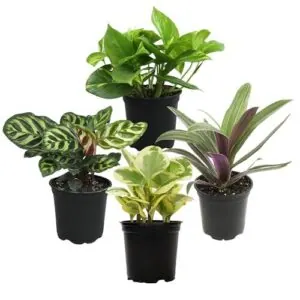
The Plants for Pets Essential Indoor Houseplant Assortment gives you four greenhouse-grown specimens in 4.25-inch nursery pots for $26.94 — a reasonable starting point if you’re building a bioactive enclosure on a budget. The rotating mix includes low-maintenance varieties like Pothos, Peperomia, and Ferns, each shipped with moist soil to reduce transplant shock.
Before placement, quarantine every plant for two weeks and swap the original soil for a reptile-safe substrate blend to eliminate pests and residues.
| Best For | Beginners and new plant parents looking for an easy, affordable way to bring some greenery indoors — or anyone wanting a thoughtful, ready-to-gift set that also supports pet adoption. |
|---|---|
| Plant Type | Live plants |
| Quantity | 4 plants |
| Pot Material | Biodegradable |
| Price | $26.94 |
| Habitat Use | Home/office decor |
| Maintenance Level | Low |
| Additional Features |
|
- Four mature, greenhouse-grown plants for under $27 is genuinely good value — you’re not getting tiny starter plugs.
- Ships with moist soil straight from the grower, so there’s less transplant shock and you won’t need to water right away.
- Every purchase supports a pet-adoption charity, which is a nice bonus on top of a straightforward buy.
- You don’t get to pick your plants — the mix rotates by season, so what shows up is what you get.
- Shipping can be rough on these; some buyers have reported crushed packaging, leaf loss, or root rot from overly wet soil in transit.
- Not every variety in the mix is confirmed pet-safe, so if you have cats or dogs, you’ll want to verify each plant before letting them roam near it.
2. Easy to Grow Indoor Houseplants
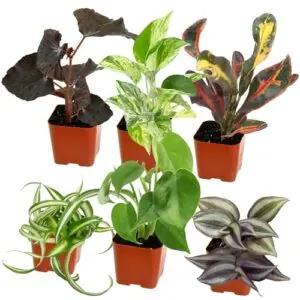
If you want a low-stakes entry into bioactive keeping, the Plants for Pets assortment — six live specimens in biodegradable 2‑inch pots for $18.91 — is hard to argue with.
You get a rotating mix of Pothos, Spider Plant, Peperomia, and others, all compact enough to tuck into tight enclosure corners.
Spider plant tolerates irregular watering, Peperomia thrives between 65 and 75°F, and Pothos roots in water within weeks.
Quarantine each specimen before placement and swap the original soil for a reptile‑safe substrate blend.
| Best For | Beginners who want easy, low-maintenance greenery for small spaces like desks, shelves, or terrariums without spending a lot. |
|---|---|
| Plant Type | Live plants |
| Quantity | 6 plants |
| Pot Material | Biodegradable |
| Price | $18.91 |
| Habitat Use | Terrarium/small spaces |
| Maintenance Level | Low |
| Additional Features |
|
- Six plants for under $19 is genuinely great value — hard to beat for the price.
- Species like Pothos and Spider Plant are forgiving, so they’re perfect if you tend to forget watering days.
- Biodegradable pots make repotting simple, and the compact size fits just about anywhere.
- Plants aren’t labeled, so you’ll have to do a little guesswork figuring out what you’ve got.
- Shipping can be rough on live plants, especially in cold weather — some arrive stressed or worse.
- You can’t pick your mix, so what shows up might not match what you were hoping for.
3. Altman Assorted Live Indoor Houseplants
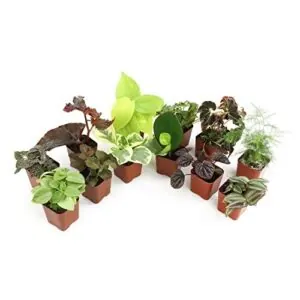
If 6 plants feel light, the Altman Assorted pack steps it up to 12 specimens per order — each arriving in a 2-inch grower pot for around $23.77.
You’re working with a rotating mix that usually includes Pothos, Spider Plant, Peperomia, Ficus, and Syngonium, giving you enough variety to layer ground cover, vertical climbing structure, and visual breaks across a single enclosure. Roots arrive developed and ready for immediate transplanting, though note that Dieffenbachia appears in the rotation and must be excluded.
| Best For | Beginners or hobbyists who want to quickly build a diverse indoor plant collection without spending a lot. |
|---|---|
| Plant Type | Live plants |
| Quantity | 12 plants |
| Pot Material | Compostable |
| Price | $23.77 |
| Habitat Use | Terrarium/DIY projects |
| Maintenance Level | Low |
| Additional Features |
|
- You get 12 plants for under $24 — that’s a solid deal for the variety you’re getting.
- Roots come developed, so you can transplant right away and skip the waiting game.
- The rotating mix covers a good range of foliage types, great for layering texture across a space.
- Plants arrive unlabeled, so you’ll need an ID app — and those aren’t always accurate.
- You might end up with duplicates; no guarantee you’ll get 12 different species.
- Cold weather shipping is risky — even with a heat pack, freezing temps can damage plants in transit.
4. SLSON Hanging Reptile Terrarium Plant

Not every addition to your enclosure needs roots and soil. The SLSON Hanging Reptile Terrarium Plant — priced at $6.99 — gives you a 12‑inch artificial vine with soft, non‑toxic silk leaves that mount directly onto glass via suction cup, no substrate required.
It’s a practical overhead layer for corn snakes and king snakes that appreciate vertical cover without demanding maintenance.
One honest caveat: keep it away from heat lamps, since the suction cup warps under sustained heat.
| Best For | Snake and reptile keepers who want low-maintenance vertical cover for species like corn snakes or king snakes. |
|---|---|
| Plant Type | Artificial plant |
| Quantity | 1 plant |
| Pot Material | Plastic with suction cup |
| Price | $6.99 |
| Habitat Use | Reptile/aquarium habitat |
| Maintenance Level | None |
| Additional Features |
|
- Dead simple to install — just press the suction cup to the glass and you’re done
- Non-toxic materials, so it’s safe around fish, turtles, amphibians, and reptiles
- No watering, lighting, or soil needed, and it cleans up with a quick rinse
- Suction cup can warp or lose grip near heat sources, so keep it away from heat lamps
- Leaves may fray, thin out, or pick up an odor over time with repeated use
- Animals that like to chew or tug at plants could ingest plastic filaments, so it needs monitoring
5. Altman Variegated Snake Plant Laurentii
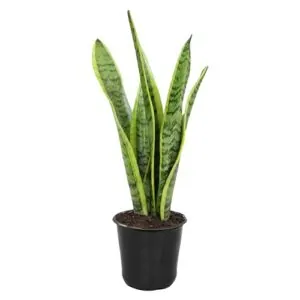
Where the SLSON delivers artificial convenience, the Altman Variegated Snake Plant Laurentii brings something no synthetic vine can — living air filtration paired with genuine structural presence.
Arriving in a 4.25-inch biodegradable grower pot at 14–19 inches tall, its upright, sword-shaped leaves with bright yellow margins create vertical cover behind hides without crowding the floor.
Water it once every two to three weeks, keep it in low to moderate light, and it manages the rest reliably.
| Best For | Reptile or vivarium keepers who want a low-maintenance living plant that adds height and filters the air without demanding much attention. |
|---|---|
| Plant Type | Live plant |
| Quantity | 1 plant |
| Pot Material | Biodegradable |
| Price | ~$15–20 |
| Habitat Use | Home/vivarium decor |
| Maintenance Level | Very low |
| Additional Features |
|
- Thrives in low to moderate light, so it fits almost any tank setup without special grow lights.
- The bright yellow-edged leaves add real visual structure and color that no fake vine can replicate.
- Barely needs watering — once every couple of weeks is plenty, even if you forget sometimes.
- Some shipments arrive dry, sparse, or with damage from transit — condition can vary quite a bit.
- The 4.25-inch pot is small and will likely need an upgrade within a few months.
- Visual fullness isn’t guaranteed; your plant may look leaner than the photos suggest.
Frequently Asked Questions (FAQs)
Can you put live plants in a snake enclosure?
Yes, you can — and it’s a genuinely practical choice.
Live plants regulate humidity, reduce stress, and improve air quality, making your enclosure function more like a real ecosystem than a decorated box.
How to keep plants alive in a snake enclosure?
Keep plants alive by matching light and humidity to species needs, misting one to two times daily, pruning dead foliage regularly, and using a well-draining substrate to prevent root rot.
What is the best habitat for a snake?
As the old saying goes, home is where the heart is.
For a snake, the best habitat mirrors its native environment — the right temperature gradient, humidity, hides, and space to move freely.
Can my dog be in the same room as a snake plant?
Your dog can share a room with a snake plant safely, as long as it can’t chew the leaves.
Direct ingestion causes mild to moderate symptoms; airborne exposure alone poses no real risk.
Can snakes eat or damage live plants?
Most snakes won’t touch live plants — they’re carnivores focused on prey, not foliage.
Occasional rubbing or slithering through dense growth can dislodge leaves or topple lightweight pots, so anchor everything securely.
How often should I replace bioactive substrate?
Bioactive substrate rarely needs full replacement — in stable setups, it can last over a decade. Replace only when you notice foul odors, black sludge, persistent mold, or compacted, lifeless soil.
What if my snake digs up plants?
It happens. Try securing plants in heavy concealed pots, maintaining a 4–6 inch substrate depth, and adding extra hides so your snake isn’t uprooting plants just to feel safe.
Do live plants attract pests or mites?
Yes, live plants can attract pests like fungus gnats, spider mites, and mealybugs.
Quarantining new plants for two to four weeks and using sterile soil eliminates most risks before they reach your enclosure.
Can I use artificial plants instead?
Artificial plants are a legitimate option — they’re low maintenance, pest-free, and durable.
What they can’t do is regulate humidity, support bioactive substrates, or contribute anything biologically meaningful to your enclosure’s ecosystem.
How often should live plants be replaced?
Most live plants hold up well for 6 to 12 months before needing replacement, though hardy species like pothos or sansevieria can last 1 to 2 years with consistent care.
Conclusion
Like a master gardener cares for their lush oasis, you’ve cultivated a thriving snake habitat with live plants, where your pet can flourish. A well-designed snake habitat with live plants is more than just a pretty enclosure – it’s a self-sustaining ecosystem that promotes natural behavior and reduces stress.
With patience and dedication, you’ve created a harmonious balance between plant and animal, showcasing the beauty of nature’s interconnectedness, and setting a new standard for reptile care.