This site is supported by our readers. We may earn a commission, at no cost to you, if you purchase through links.

A ball python spends up to 22 hours a day in hiding, so the wrong hide turns your bioactive masterpiece into a source of stress. Get the fit right, and your snake eats, sheds, and thrives. Get it wrong, and you’ll see refusal to feed and stuck shed within weeks.
Bioactive setups add a wrinkle: live plants, moisture-loving substrate, and cleanup crews all change how a hide performs. Resin, cork bark, and charcoal foams each behave differently under 60–80% humidity.
Below you’ll find the top 10 ball python hides for bioactive setups, with exact sizing numbers and placement coordinates for your warm and cool zones.
Table Of Contents
- Key Takeaways
- Why Ball Pythons Need Bioactive Hides
- How to Choose Bioactive Ball Python Hides
- Top 10 Ball Python Hides for Bioactive Setups
- 1. Repticircle Reptile Hide Medium Resin
- 2. Reptile Hide Cave Large 9.5
- 3. JIHAQUA Medium Reptile Hide Cave
- 4. Homoyoyo Cork Bark Reptile Hide Cave
- 5. MACS Reptile Hideout Half Log XL
- 6. Natural Cork Bark Reptile Hide
- 7. Veemoon Reptile Hide Cave 7.8×3
- 8. Zilla Rock Lair Naturalistic Reptile Hide
- 9. Natural Cork Bark Reptile Hide Set
- 10. Galápagos Natural Cork Bark Reptile
- Where to Place Bioactive Ball Python Hides
- How to Maintain Bioactive Ball Python Hides
- Frequently Asked Questions (FAQs)
- Do ball pythons like bioactive enclosures?
- How many hides does a ball python need?
- What is a good bioactive substrate for a ball python enclosure?
- How to setup a bioactive ball python enclosure?
- Can a ball python have a bioactive enclosure?
- What hides are best for ball pythons?
- Can I put isopods in a ball python enclosure?
- How long do bioactive terrariums last?
- Can hides be too small or too large?
- What materials are unsafe for bioactive hides?
- Conclusion
Key Takeaways
- Your ball python spends most of the day hiding, so a snug hide sized to its girth (about 1.5–2 times its body width) is what keeps it eating, shedding well, and calm.
- Cork bark and sealed, fully cured resin are your best materials for bioactive setups, but cork can crack and resin softens, so inspect them often and replace resin hides after about 12–18 months.
- You’ll want at least three hides: a warm one over the heat zone, a cool one on the opposite side, and a damp sphagnum-lined humid hide for shedding, all anchored firmly so they can’t tip.
- Spot-clean weekly, sanitize the hides every 4–6 weeks, and watch for constant condensation or mold inside them, since that signals a ventilation problem.
Why Ball Pythons Need Bioactive Hides
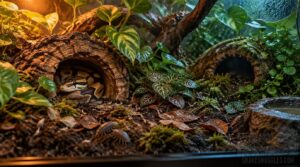
Because ball pythons are shy burrowers, they feel safest when they can tuck into a snug, enclosed space. A hide isn’t decor. It’s your snake’s security blanket.
If you’re unsure whether your snake’s hide is snug enough, this guide on whether ball pythons prefer tight or spacious hides walks you through sizing it by weight and length.
For a shy burrowing ball python, a snug hide isn’t decor—it’s a security blanket
In a bioactive setup, a good hide does more than cover your snake. It holds steady temperature and moisture cues, much like a real burrow. Put a warm hide on the heated side to support digestion. Add a cool hide opposite it so your snake can escape overheating. Then offer a humid hide, kept around 60–80% humidity, to help shedding go smoothly and prevent stuck skin.
Plants and microfauna keep the hide’s microclimate steady and help break down waste, so ammonia stays low. A secure snake eats better, sheds cleaner and stresses less.
How to Choose Bioactive Ball Python Hides
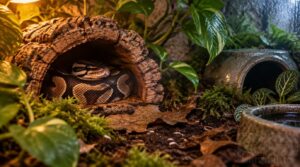
Choosing the right hide comes down to a handful of key criteria, and getting them right makes all the difference for your snake’s comfort.
You’ll want to match Snug Hide Sizing to your python’s weight, pick Bioactive Hide Materials that resist mold, and plan your Warm And Cool Placement before you buy.
Nail these basics, and the perfect hide for your setup is waiting in the list below.
Snug Hide Sizing
When your ball python curls up, the hide snug fit matters more than size alone. Measure girth, then follow this:
- Snug fit width: 1.5–2.0 times body diameter.
- Interior height: 1.0–1.2 times your snake’s width.
- Clearance above substrate depth: 0.5–1.0 times girth.
- Add 15–25% extra volume for shedding cycles.
Check fit seasonally.
Bioactive Hide Materials
Now match the material to your bioactive substrate. Resin composites cure rigid and shrug off humidity, but cure them under airflow for 72 hours to stop VOC off-gassing.
Cork bark compresses under your snake’s weight, forming microindents that mimic wild crevices. Hollowed driftwood? Seal it, or toxins leach into moisture. Skip uncured charcoal foams; they risk chemical leaching.
Warm And Cool Placement
Once your resin or cork hide is cured, placement drives everything. Set the warm hide 1–3 inches from your heat source, targeting a 28–32°C basking zone. Park the cool hide opposite, holding 22–26°C. Aim for a 6–8°C differential across the temperature gradient.
In a bioactive setup, deepen substrate under the cool side; your enclosure design should keep the warm hide in the mid-30s°C by day.
Humid Hide Design
When your ball python gets ready to shed, a humid hide becomes non-negotiable. Target 75–90% RH inside.
- Line the cavity with damp sphagnum moss
- Keep substrate moisture damp, never soaked
- Position vents high to prevent drowning
- Refill moss every 24–48 hours
- Check daily for mold
This boosts moisture retention in your bioactive setup.
Plant Cover And Stability
Layering live plants around your hide creates visual barriers that calm your ball python fast.
If you’re going bioactive, a guide to boa constrictor hides for bioactive terrariums shows how to blend natural cover with proper thermal zones.
Tuck broad-leafed species against the hide’s base for stability anchoring, so shifting snakes can’t tip it.
Aim for substrate blending: roots gripping mesh, mulch buffering moisture.
Vary plant heights for microhabitat variety, but prune canopy so airflow keeps humidity steady and mold away.
Cleaning And Inspection
You might think bioactive setups clean themselves, but hides still need your eyes.
Do WEEKLY SPOTCLEANING: remove waste, shed, and detritus. Schedule a MONTHLY DEEPCLEAN with a diluted BLEACH SOLUTION, rinse thoroughly, dry fully.
Every 4–6 weeks, run a STRUCTURAL INTEGRITY TEST on hides, checking hairline cracks. Watch condensation patterns, plan your MOSS REFRESH, and your enclosure stays odor-free.
Top 10 Ball Python Hides for Bioactive Setups
Ready to pick the best Ball Python hides for your bioactive build? You’ve sized your snake, planned your thermal gradient, and picked your materials. Now here are the top 10 picks that check every box.
1. Repticircle Reptile Hide Medium Resin
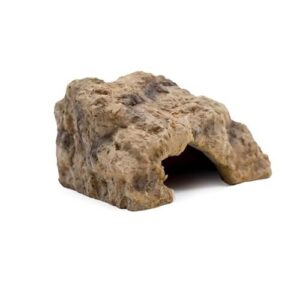
Meet the Repticircle Reptile Hide Medium Resin, a compact powerhouse for your bioactive setup. This non-toxic resin cave mimics natural rock, giving your ball python a secure, snug retreat.
It measures 2 x 2 x 1.99 inches and weighs 1.1 pounds, so it anchors firmly without wobbling. Smooth edges protect your snake’s scales, and the sealed resin surface resists mold and biofilm.
| Best For | Juvenile or slim adult reptiles like leopard geckos, ball pythons, and bearded dragons that need a secure, naturalistic hide in a compact tank corner. |
|---|---|
| Material | Non-toxic resin |
| Dimensions | 2 x 2 x 1.99 in |
| Weight | 1.1 lbs |
| Color | N/A |
| Humidity Support | Works as humid hide |
| Suitable Animals | Leopard geckos, bearded dragons, ball pythons, tortoises |
| Additional Features |
|
- Non-toxic resin construction is safe for both dry and humid environments
- Realistic rock-like design blends into naturalistic or bioactive setups
- Smooth edges and a solid 1.1-pound build keep reptiles safe and the hide stable
- Runs smaller than many buyers expect, especially for larger reptiles
- Limited internal space may restrict movement or burrowing for bigger snakes
- Size labeling is inconsistent, with no intermediate option between small and medium
2. Reptile Hide Cave Large 9.5
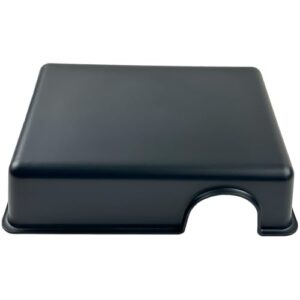
Need a hide that disappears into your bioactive floor? The Reptile Hide Cave Large 9.5 delivers. Built from high-density non-toxic resin, it shrugs off bites and scratches while the natural rock-textured finish blends into soil mixes and coconut fiber beds.
Dimensions run 9.5" L x 6.7" W x 2.2" H, weighing just 0.4 lbs. Smooth edges protect scales. Use it as a humid hide, basking cave, or secure shelter. Heads up: some keepers find it snug for large adult snakes, so measure first.
| Best For | Reptile keepers with leopard geckos, bearded dragons, or juvenile ball pythons who want a durable, natural-looking hide that blends into bioactive or coconut fiber setups. |
|---|---|
| Material | Non-toxic high-density resin |
| Dimensions | 9.5″ L x 6.7″ W x 2.2″ H |
| Weight | 0.4 lbs (5.43 oz) |
| Color | N/A |
| Humidity Support | Works as humid hide |
| Suitable Animals | Ball pythons, leopard geckos, bearded dragons, tortoises |
| Additional Features |
|
- Smooth-edged, non-toxic resin construction protects scales and resists bites and scratches
- Natural rock texture blends seamlessly with terrarium decor and soil mixes
- Versatile design works as a humid hide, basking cave, or secure shelter
- May be too small for large adult snakes, so measuring beforehand is recommended
- Mixed customer feedback on fit for larger reptiles
- Only one hide included per unit
3. JIHAQUA Medium Reptile Hide Cave
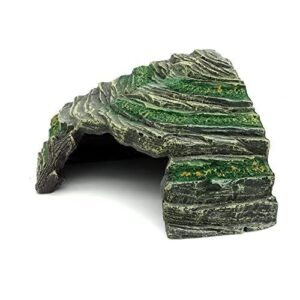
Your snake deserves a hide that looks like it was carved by nature itself. The JIHAQUA Medium Reptile Hide Cave delivers exactly that, with a naturalistic rock texture and neutral gray-brown finish that blends into mossy bioactive substrate.
It measures 6.7 x 6.7 x 4 inches and weighs just over a pound, so it stays put on deep soil layers. The resin construction resists tipping, and the interior allows for natural hiding, shedding, and egg-laying behaviors.
Watch the opening, though. Some buyers report sharp edges, so run your fingers around the entrance before introducing your python. Full-grown adults may also find it snug.
Inspect it every few months for cracks and odor, since resin wears down after 12–18 months in humid setups.
| Best For | Owners of small to medium reptiles, amphibians, or small pets like hamsters and fish who want a naturalistic-looking hide that supports hiding, shedding, and egg-laying behaviors. |
|---|---|
| Material | Natural rock |
| Dimensions | 6.7 x 6.7 x 4 in |
| Weight | 1.01 lbs |
| Color | N/A |
| Humidity Support | Creates humid microclimate |
| Suitable Animals | Small to medium reptiles, amphibians, small pets |
| Additional Features |
|
- Naturalistic rock texture and neutral gray-brown finish blend seamlessly into terrestrial or aquatic setups
- Stable, weighted design resists tipping by larger reptiles
- Creates a humid microclimate that supports natural shedding, hiding, and egg-laying behaviors
- Some customers report sharp edges around the opening, raising safety concerns
- Size may be too small for full-grown adult bearded dragons or large reptiles
- Mixed feedback on edge smoothness, and resin may wear down after 12–18 months in humid environments
4. Homoyoyo Cork Bark Reptile Hide Cave
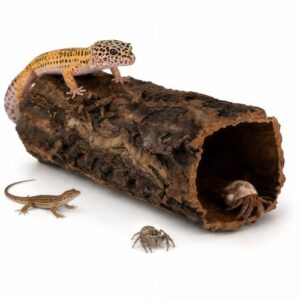
Resin caves like the JIHAQUA offer durability, but cork bark hides bring the real forest floor feel. The Homoyoyo Cork Bark Hide measures about 7.86 x 3.14 x 3.14 inches and weighs only 3.52 ounces, so it sits lightly on your substrate without compacting soil around plant roots.
Its smooth inner surfaces make spot cleaning easy, and the coffee-colored bark blends beautifully into bioactive layouts. Use it as a shelter, climbing feature, or décor.
One caution: this hide suits small reptiles and invertebrates, not full-grown pythons. Natural bark also varies in shape, so inspect each piece for cracks before placing it.
| Best For | Keepers of small reptiles and invertebrates like geckos, spiders, and hermit crabs who want a natural-looking, lightweight hide for a standard terrarium. |
|---|---|
| Material | Natural wood bark |
| Dimensions | 7.86 x 3.14 x 3.14 in |
| Weight | 3.52 oz |
| Color | Coffee |
| Humidity Support | N/A |
| Suitable Animals | Geckos, snakes, lizards, tortoises, invertebrates |
| Additional Features |
|
- Lightweight design sits on substrate without compacting soil around plant roots
- Smooth inner surfaces make spot cleaning quick and easy
- Natural coffee-colored bark blends well into bioactive layouts and doubles as climbing décor
- Only suitable for small reptiles and invertebrates, not large or strong species
- Natural material varies in shape and texture, so quality may differ between pieces
- Bark can crack, requiring inspection before placement
5. MACS Reptile Hideout Half Log XL
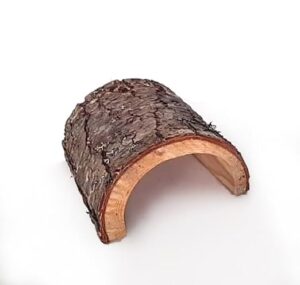
If cork feels too small, step up to the MACS Half Log XL. You get genuine fir wood with authentic bark and grain, sized at 11 x 8 x 4.5 inches. The open-ended design lets your python enter, explore, and exit freely.
Want a humid shelter? Tuck terrarium moss inside (sold separately) during shedding season.
Remember, each log shows unique natural variation, so dimensions differ slightly. Also, "XL" doesn’t guarantee fit for large adults. Check your snake’s girth first. Made in the USA, model XLHO.
| Best For | Snake and reptile owners who want a spacious, natural fir wood hide with an open-ended design for their terrarium. |
|---|---|
| Material | Fir wood |
| Dimensions | 11 x 8 x 4.5 in |
| Weight | N/A |
| Color | N/A |
| Humidity Support | Humid shelter with added moss |
| Suitable Animals | Reptiles and amphibians |
| Additional Features |
|
- Made from genuine fir wood with authentic bark and grain for a natural look
- Open-ended half-log design encourages hiding, exploration, and easy entry and exit
- Can hold terrarium moss (purchased separately) to create a humid shelter for shedding
- Terrarium moss is not included and must be bought separately
- Natural variation means dimensions and appearance differ between units
- Despite the "XL" label, it may not fit larger adult snakes, so check your snake’s girth first
6. Natural Cork Bark Reptile Hide
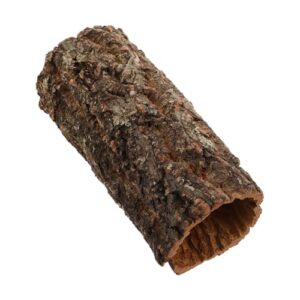
Prefer natural bark over wood logs? This cork hide measures 3.94 x 9.06 x 3.54 inches and weighs just 7.84 ounces, so it won’t crush your bioactive substrate. The light brown texture gives your python real grip for climbing and rubbing.
Cork’s porosity creates healthy moisture gradients, making it ideal for high-humidity terrariums. It experiences misting without warping.
One caution: natural cork can arrive cracked. Inspect it before placement, and skip it if you need a fully sealed, non-porous hide.
| Best For | Reptile keepers with geckos, snakes, or bearded dragons in high-humidity or bioactive terrariums who want a lightweight, natural-looking hide that supports climbing and moisture regulation. |
|---|---|
| Material | Natural cork bark |
| Dimensions | 3.94 x 9.06 x 3.54 in |
| Weight | 7.84 oz |
| Color | Light brown |
| Humidity Support | Regulates moisture |
| Suitable Animals | Geckos, lizards, snakes, bearded dragons, turtles, spiders |
| Additional Features |
|
- Made from natural cork bark that’s lightweight yet durable, so it won’t crush bioactive substrate
- Porous texture creates healthy moisture gradients and withstands misting without warping
- Supports natural behaviors like climbing, rubbing, and hiding for a wide range of species
- Natural cork can be fragile and may arrive cracked or broken
- Requires careful handling during shipping and placement
- Not suitable for species needing fully enclosed, non-porous hides
7. Veemoon Reptile Hide Cave 7.8×3
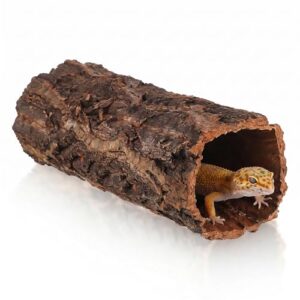
Looking for something more compact? The Veemoon Reptile Hide Cave measures 7.8 x 3 inches and weighs just 3.04 ounces, so it slots into tight vertical layouts without crowding your substrate. The snug interior suits juvenile-to-subadult pythons, and the hollow design holds moist substrate pockets for shedding.
But here’s the catch: it’s wood with a coffee-colored finish, built from glued materials with sawdust filler. Reviewers report crumbling and dust, so inspect it regularly and replace it if it starts breaking down.
| Best For | Keepers of juvenile-to-subadult pythons or small geckos who need a compact hide for tight vertical layouts and want to maintain moist substrate pockets for shedding. |
|---|---|
| Material | Wood with coffee finish |
| Dimensions | 7.8 in L x 3 in diameter |
| Weight | 3.04 oz |
| Color | Coffee |
| Humidity Support | Resists moisture absorption |
| Suitable Animals | Geckos |
| Additional Features |
|
- Compact 7.8 x 3 inch size and light 3.04 ounce weight fit easily into tight vertical layouts without crowding substrate
- Spacious hollow interior gives geckos room to turn and rest comfortably, and holds moist substrate pockets for shedding
- Textured exterior provides grip for climbing reptiles and amphibians, with a stable base that resists tipping
- Built from glued-together materials with sawdust filler that may crumble under pressure
- Breaking down material can generate respiratory dust, posing a health risk to animals
- Multiple reviewers report it is not pet-safe for live animals, requiring regular inspection and replacement
8. Zilla Rock Lair Naturalistic Reptile Hide
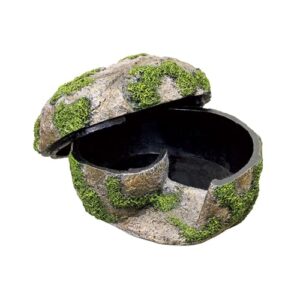
When you want a hide that looks like it grew there, the Zilla Rock Lair delivers. Its grey resin shell mimics natural rock, and the textured exterior helps your ball python grip and rub off stuck shed during sloughing. The dark interior encourages natural denning behavior, which lowers stress.
Measuring 5.5 x 5 x 4 inches, it suits small reptiles only, so test the fit before buying. It holds humidity well, making it useful as a humid egg-laying hide, though it may over-humidify in arid setups. One hide per purchase.
| Best For | Small reptiles like ball pythons and lizards that need a naturalistic, humidity-friendly hide for shedding or egg-laying. |
|---|---|
| Material | Resin |
| Dimensions | 5.5 x 5 x 4 in |
| Weight | N/A |
| Color | Grey |
| Humidity Support | Maintains humidity for shedding |
| Suitable Animals | Snakes and lizards |
| Additional Features |
|
- Textured exterior helps reptiles slough off stuck shed
- Dark interior encourages natural denning and lowers stress
- Holds humidity well, making it ideal as a humid or egg-laying hide
- Sized for small reptiles only, so larger pets won’t fit
- Only one hide included per purchase
- May retain too much humidity in arid setups
9. Natural Cork Bark Reptile Hide Set
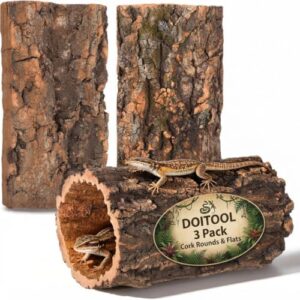
The Natural Cork Bark Reptile Hide Set gives you three pieces: one cork round (8.06" x 4.72") and two flats (7.86" x 0.93"), totaling 1.36 pounds. Everything’s 100% chemical-free bark, so it’s safe for your python and your cleanup crew.
The porous surface helps your snake shed cleanly, and the hollow round doubles as a secure hideout. Mist lightly, inspect for mold, and remember each piece varies in shape.
| Best For | Snake, lizard, turtle, and tarantula keepers who want a natural, chemical-free hide and climbing setup for small to medium reptiles. |
|---|---|
| Material | Natural tree bark (cork) |
| Dimensions | Round 8.06″ x 4.72″; flats 7.86″ x 0.93″ |
| Weight | 1.36 lbs |
| Color | N/A |
| Humidity Support | Balances humidity |
| Suitable Animals | Leopard geckos, bearded dragons, snakes, turtles, tarantulas |
| Additional Features |
|
- Made from 100% chemical-free natural tree bark, safe for reptiles and cleanup crews
- Porous surface supports clean, safe skin shedding
- Versatile three-piece set works as hides, climbing, and basking surfaces while helping balance humidity
- Each piece varies in shape and size since it’s a natural material
- Not suitable for large reptiles needing bigger enclosures
- Requires periodic inspection for wear or mold in high-humidity setups
10. Galápagos Natural Cork Bark Reptile
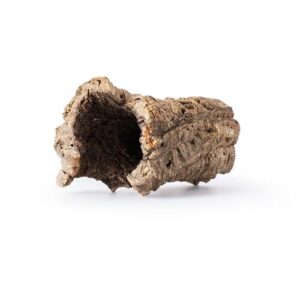
Picture a python sliding into a deep cork crevice, cool bark outside, warm pocket inside. That’s the Galápagos Natural Cork Bark Reptile hide.
It measures 10.47 x 4.41 x 3.54 inches and weighs 0.39 kg, thick enough to hold 60–70% humidity with steady airflow. The all-natural cork is chemical-free, so it’s safe in bioactive setups.
Size it right: interior space should fit a coiled adult snugly. Expect natural variation; some pieces run smaller than listed. Check the outer diameter before buying.
| Best For | Reptile keepers with bearded dragons, snakes, geckos, turtles, or birds who want a natural, chemical-free hide for climbing, basking, and humidity control in bioactive or desert-style terrariums. |
|---|---|
| Material | Natural cork bark |
| Dimensions | 10.47 x 4.41 x 3.54 in |
| Weight | 0.39 kg (13.76 oz) |
| Color | N/A |
| Humidity Support | Helps regulate humidity |
| Suitable Animals | Bearded dragons, snakes, geckos, turtles, birds |
| Additional Features |
|
- All-natural cork bark with no chemicals, safe for bioactive setups
- Encourages natural behaviors like climbing, basking, and hiding
- Helps regulate heat and humidity while blending into any terrarium style
- Each piece varies in shape and size, so there’s no uniformity
- Some customers report receiving pieces smaller than expected
- Outer diameter may be under 2.5 inches, limiting internal space for larger reptiles
Where to Place Bioactive Ball Python Hides
Take a 1,200-gram ball python in a 4x2x2 bioactive enclosure. She spends her days wedged under a cork slab on the warm side, then slides to a moss-lined cave at night. That’s the temperature gradient doing its job.
Here’s your placement blueprint. Set your warm side hide over the heat zone at 28–32°C, and your cool side hide at 25–28°C. Never stack them. Your humid hide belongs mid-enclosure, packed with damp sphagnum at 70–90% for clean sheds.
Space hides across quadrants so your snake never fights for cover. Anchor each one on firm substrate or root wads so it won’t shift. Keep hides away from glass doors and climbing branches, and make sure your snake can coil fully inside without a limb sticking out. Placement is security, not decoration.
How to Maintain Bioactive Ball Python Hides
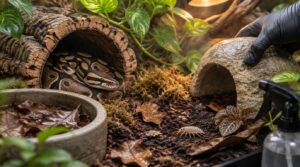
Your bioactive enclosure does most of the daily work, but your hides still need a routine. Think of it as a hide rotation system: swap, clean, return.
Follow this simple maintenance schedule:
- Weekly: spot-check substrate moisture, remove fecal matter and shed debris.
- Every 2–4 weeks: rinse bioactive hides, run a microbe check, refresh leaf litter and sphagnum moss.
- Every 4–6 weeks: full sanitation. Wipe hides with 3% hydrogen peroxide, rinse, air-dry completely, then reintroduce.
Mold prevention hinges on airflow. Persistent condensation inside a hide signals a ventilation imbalance, so adjust before fungi take hold. Resin hides soften over time, replace around 12–18 months. Cork and limestone? Inspect monthly for cracks. Your python’s skin health depends on it.
Frequently Asked Questions (FAQs)
Do ball pythons like bioactive enclosures?
Yes. A keeper’s ball python in a bioactive enclosure often explores more, strikes food eagerly, and sheds cleanly because natural habitat mimicry helps with humidity control and a proper temperature gradient. You’ll see calmer, more confident behavior.
How many hides does a ball python need?
Your ball python needs two hides minimum: one warm, one cool. Add a humid hide for shedding support, keeping humidity 60 to 80 percent. Three secure hiding spots make your bioactive enclosure comfortable.
What is a good bioactive substrate for a ball python enclosure?
You might worry bioactive setups are messy, but the right mix works. Use substrate layering: a drainage base, then coco fiber blended with cypress mulch and sphagnum. This helps moisture retention, microfauna support, and lasting bioactive balance.
How to setup a bioactive ball python enclosure?
Start with substrate layering: drainage, soil, leaf litter. Add microfauna, then build a humidity gradient with warm and cool hides. Finish with natural decor connection and plants, then schedule regular bioactive vivarium maintenance.
Can a ball python have a bioactive enclosure?
A bioactive enclosure suits your ball python perfectly. Use live plants, springtails, and a naturalistic substrate. Add a warm hide, a humid hide, and solid humidity control for a thriving, self-sustaining habitat.
What hides are best for ball pythons?
You don’t need expensive custom builds. The best ball python hides are snug resin caves, cork bark, or half-logs sized to your snake. Prioritize a snug fit, moisture resistance, and easy cleaning in your bioactive enclosure.
Can I put isopods in a ball python enclosure?
Funny, isn’t it? You’re asking whether to add janitorial staff to your snake’s home. Yes! Isopods make excellent cleanup critters in a bioactive enclosure, handling enclosure sanitation and soil aeration beautifully.
How long do bioactive terrariums last?
Worried it’ll collapse fast? Don’t be. A healthy bioactive enclosure usually runs 12–18 months. Top up your substrate every 3–6 months, feed your cleanup critter, and monitor your drainage layer to preserve environment balance longer.
Can hides be too small or too large?
Yes, hides can be wildly wrong.
Too small restricts breathing; too large steals security. Choose a snug fit: interior fit near 25× girth, entrance size closable by one coil, hatchling hide size, adult hide size.
What materials are unsafe for bioactive hides?
A hide is your python’s tiny fortress. Skip treated wood, oil paint, and raw cedar. Choose nonporous plastic with BPAfree construction, chemicalresistant coating, and rounded edge design. That’s real material safety for your snake, always.
Conclusion
One keeper swapped a roomy cave for a snug cork hide, and her ball python ate within three days.
That’s the power of the right fit. The best ball python hides for bioactive setups are snug, stable, and easy to inspect. Put one in the warm zone and one in the cool zone, then add a humid hide for shedding.
Inspect monthly, let your cleanup crew handle the rest. Hide well, and your snake thrives.