This site is supported by our readers. We may earn a commission, at no cost to you, if you purchase through links.

A boa that won’t settle — constantly repositioning, refusing food, or shedding in ragged patches — is often missing one thing: a hide that fits. Not decorative cover, but a snug, secure retreat that lets the snake compress its body, regulate temperature, and drop its guard.
In bioactive terrariums, the stakes are doubled; the wrong hide disrupts humidity gradients, crowds out your cleanup crew, and turns a carefully balanced ecosystem into a maintenance headache.
The right boa constrictor hides do more than look natural — they work with your substrate, your microfauna, and your snake’s thermoregulatory needs simultaneously. What follows cuts straight to the options worth your money and the placement logic that makes them actually function.
Table Of Contents
- Key Takeaways
- Top 8 Boa Constrictor Bioactive Hides
- Choosing Bioactive-Safe Boa Hides
- Proper Hide Size for Juvenile and Adult Boa Constrictors
- Snug-fit Hides Versus Oversized Caves
- Natural Materials Versus Resin Hides
- Mold Resistance in Humid Bioactive Setups
- Smooth Edges and Safety for Heavy-bodied Snakes
- Easy Cleaning Without Disrupting The Cleanup Crew
- Stability, Weight, and Tip-over Prevention
- Hide Placement in Boa Terrariums
- Warm-side Hide Placement for Thermoregulation
- Cool-side Hide Placement for Retreat Behavior
- Humid Hide Placement for Shedding Support
- Using Hides to Create Visual Security
- Positioning Hides Around Branches and Plants
- Avoiding Exposed, High-traffic Enclosure Areas
- Keeping Hides Accessible for Health Checks
- Humid Hides for Shedding Support
- Best Hide Styles for Damp Sphagnum Moss
- Maintaining 75–85% Humidity Inside The Hide
- Preventing Stagnant Moisture and Mold Buildup
- Refreshing Moss Without Disturbing Bioactive Layers
- Cool-side Humid Hides Versus Warm-side Humid Hides
- Signs Your Boa is Using The Humid Hide Properly
- Common Shedding Problems Linked to Poor Hides
- Integrating Hides With Bioactive Design
- Blending Hides With Leaf Litter and Cork Bark
- Supporting Live Plants Around Hide Entrances
- Protecting Springtails and Isopods Near Hides
- Creating Secure Pathways Between Hide Zones
- Combining Hides With Climbing Branches
- Managing Substrate Depth Beneath Heavy Hides
- Designing a Naturalistic Layout for Adult Boas
- Frequently Asked Questions (FAQs)
- Conclusion
Key Takeaways
- A snug hide — interior width roughly 1.5–2× your boa’s body diameter — is the single biggest factor in reducing stress and supporting healthy thermoregulation in a bioactive setup.
- Material matters: cork bark buffers humidity naturally and supports your cleanup crew, while non-porous resin resists mold and wipes clean fast — pick based on your enclosure’s moisture demands.
- Hide placement does real work: warm-side hides should hit 85–92°F for digestion, cool-side hides anchor retreat behavior, and humid hides (75–85% RH, packed with damp sphagnum) make or break shed cycles.
- A bioactive hide isn’t just a shelter — when positioned near cork bark, leaf litter, and live plants, it actively manages microclimates, protects your isopod and springtail colonies, and keeps the whole ecosystem running without constant intervention.
Top 8 Boa Constrictor Bioactive Hides
Not every hide cuts it in a bioactive setup — the wrong material can mold, stress your boa, or wreck your cleanup crew.
These eight options were picked with live substrate, snug fit, and heavy-bodied snakes in mind. Here’s what made the list.
Each pick was also weighed against safe water bowl options for snakes, since hydration setup matters just as much as substrate for heavy-bodied species.
1. Zoo Med Rock Corner Water Dish
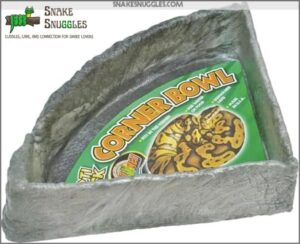
The Zoo Med Rock Corner Water Dish pulls double duty in a bioactive setup. Its triangular footprint tucks snugly into a corner, freeing up floor space for substrate depth and hide placement.
At roughly 1 gallon capacity and 13.8 × 13.2 inches, it gives adult boas a genuine soak without dominating the enclosure.
Constructed from heavy-duty plastic that resists cracking, the dish is dishwasher-safe for easy cleaning.
Its high sides cut down on spillage, preventing substrate oversaturation and reducing stress on the cleanup crew.
| Best For | Reptile owners keeping large snakes, bearded dragons, or turtles who need a roomy soak dish that stays out of the way. |
|---|---|
| Material | Rigid plastic |
| Species Suitability | Snakes, turtles, lizards |
| Ease of Cleaning | Dishwasher safe |
| Dimensions (L×W×H) | 13.8×13.2×3.2 in |
| Stress Reduction | Stable soaking space |
| Natural Aesthetic | Assorted solid color |
| Additional Features |
|
- Corner-fit design saves floor space and keeps the enclosure layout flexible
- Holds about a gallon of water, plenty for a real soak session
- Dishwasher safe and tough enough to handle repeated cleanings without cracking
- High sides can make it tricky for smaller or less mobile reptiles to climb in
- You don’t get to pick the color, so it might clash with your setup
- Heavy when full, which makes moving or cleaning it a bit of a chore
2. Naturalistic Terrarium Reptile Hide Cave
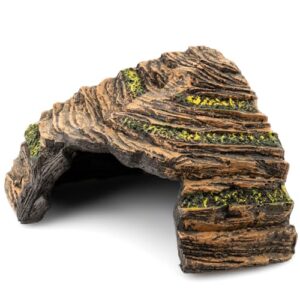
Where the water dish manages soaking, your boa still needs a solid place to disappear. The Naturalistic Terrarium Reptile Hide Cave fills that role well.
Its pebble-textured exterior and irregular entryway blend naturally into leaf litter and cork bark, reducing visual stress for a heavy-bodied snake that prefers feeling hidden rather than on display.
Ceramic or resin construction retains ambient humidity around the hide opening — useful during shed cycles.
Interior walls are smooth enough to prevent snag injuries, and the low-profile footprint won’t crowd your bioactive layout.
| Best For | Reptile and amphibian owners who want a functional hide that looks natural and fits neatly into a corner without eating up floor space. |
|---|---|
| Material | Non-toxic resin |
| Species Suitability | Reptiles, amphibians, fish |
| Ease of Cleaning | Rinse and wipe |
| Dimensions (L×W×H) | 6.7×6.7×4 in |
| Stress Reduction | Enclosed hide spot |
| Natural Aesthetic | Multicolor rock finish |
| Additional Features |
|
- Blends right into a naturalistic setup — the rock-like finish looks genuinely good next to bark, moss, and leaf litter
- Safe for wet and dry environments, so it works whether you’ve got a bioactive boa build or a simple shrimp tank
- Corner design is smart; it frees up the middle of the enclosure and gives shy animals a snug, enclosed feel
- Interior edges can be sharp, especially on pieces damaged in shipping — worth running your hand inside before you let your animal near it
- The ridged inner walls may bother sensitive reptiles like bearded dragons or very small species
- At 6.7 × 6.7 inches, it may feel cramped for larger snakes that need more room to coil up and feel fully covered
3. Zilla Bark Bends Terrarium Hide
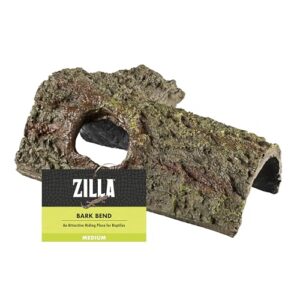
Bark texture matters more than you’d think. The Zilla Bark Bends hide pulls it off with molded synthetic resin shaped to look like real wood — without the rot risk that comes with actual bark in a humid bioactive setup.
It measures roughly 8.3 × 3.6 × 3 inches, which fits juvenile to subadult boas comfortably. The open-ended design lets you press one side against the glass for easy observation.
The non-porous surface wipes clean without disrupting your springtails or isopod colonies underneath.
| Best For | Reptile keepers who want a realistic-looking hide that’s easy to clean and lets them observe their snake or lizard without lifting a lid. |
|---|---|
| Material | Synthetic resin |
| Species Suitability | Snakes, lizards, reptiles |
| Ease of Cleaning | Mild soap wash |
| Dimensions (L×W×H) | 8.3×3.6×3.0 in |
| Stress Reduction | Private overhead cover |
| Natural Aesthetic | Wood bark appearance |
| Additional Features |
|
- Looks like real bark but won’t rot — safe for humid or bioactive setups
- Open-ended design lets you watch shedding and nesting right through the glass
- Non-porous surface wipes clean fast without disturbing tank inhabitants
- Some units arrive with rough or jagged edges that need sanding before use
- Actual dimensions don’t always match what’s advertised
- A bit heavy for smaller tanks and can be awkward to reposition during setup
4. Orchid Valley Large Reptile Hide Log
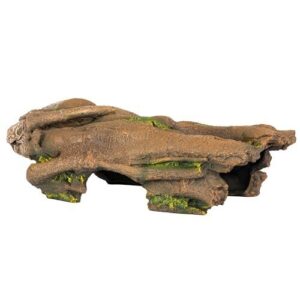
When your boa hits the 1.5–2-meter mark, hide options narrow fast. The Orchid Valley Large Reptile Hide Log fills that gap well — it is about 40 cm long with a wide interior chamber that fits adult-sized bodies without forcing awkward coiling.
Two entry points let your snake choose how it enters, which matters for stress reduction. The sealed, moisture-resistant resin holds up in high-humidity bioactive setups, and the smooth interior won’t snag scales during movement.
| Best For | Reptile and small animal owners looking for a realistic-looking hide that doubles as a climbing surface for medium-sized snakes, geckos, bearded dragons, and other small pets. |
|---|---|
| Material | Resin |
| Species Suitability | Reptiles, amphibians, invertebrates |
| Ease of Cleaning | Warm water rinse |
| Dimensions (L×W×H) | 15.55×7.36×5.75 in |
| Stress Reduction | Secure dual-end tunnel |
| Natural Aesthetic | Twisted bark texture |
| Additional Features |
|
- The textured bark-like exterior gives reptiles something to climb on, while the smooth inside keeps them safe during rest.
- Open ends and a side peek hole make it easy to check on your pet without disturbing them. A secure hiding spot helps your snake feel safe between meals, and this guide to choosing reptile hides for beginners explains what to look for.
- Resin construction holds up well in humid setups and cleans up fast with just warm water.
- Interior edges can be sharp out of the box, so you may need to file them down before use — especially for snakes.
- At just over 15 inches long, it’s going to feel cramped for larger adult lizards or bigger snake species.
- Some animals may not take to resin hides, and you’ll need to wash it before first use to get rid of any packaging residue.
5. Zilla Medium Rock Lair Hide
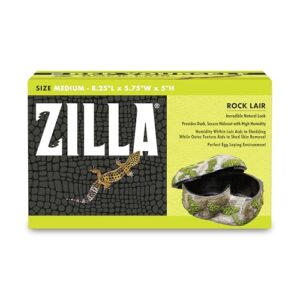
The Zilla Medium Rock Lair measures 8.5 inches wide by 5.75 inches long by 5.25 inches high, making it ideal for juvenile to sub-adult boas. Its size ensures a snug fit, triggering the buried-in security response without restricting movement.
The side entrance minimizes light exposure, helping maintain elevated humidity levels inside. Lining it with damp sphagnum moss transforms the hide into a functional humid hide, priced at $29.49.
Additionally, the textured exterior provides a rubbing surface during shed cycles, supporting your boa’s natural behaviors.
Pairing this feature with a rosy boa enclosure setup that includes a humid hide makes shed cycles smoother and far less stressful for your snake.
| Best For | Juvenile to sub-adult snakes and egg-laying lizards that need a humid hide to support healthy shedding and nesting. |
|---|---|
| Material | Rigid plastic |
| Species Suitability | Snakes, geckos, lizards |
| Ease of Cleaning | Removable top access |
| Dimensions (L×W×H) | 8.3×5.8×5.0 in |
| Stress Reduction | Dark interior refuge |
| Natural Aesthetic | Moss-like rock texture |
| Additional Features |
|
- The textured exterior doubles as a shedding aid, so your reptile can rub off loose skin naturally.
- A side entrance keeps the interior dark and cozy, which helps reduce stress and hold humidity well.
- The removable top makes cleaning quick and easy — no wrestling with stuck lids.
- At $29.49, it costs more than basic foam or cork hides, which do a similar job for less.
- The medium size can be too small for larger adult snakes, so you may need to size up sooner than expected.
- A few buyers have noted a noticeable plastic smell out of the box — it fades, but needs some airing out first.
6. Jihaqua Aquarium Resin Bark Hide
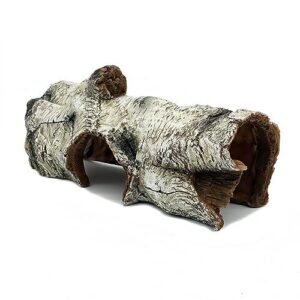
The Jihaqua Aquarium Resin Bark Hide earns its spot here for one simple reason: it fits right into it. Measuring roughly 11.8 in × 4.5 in × 5 in, it suits juvenile to sub-adult boas well.
The non-porous resin resists bacterial buildup and won’t degrade in high humidity, which matters when your isopod and springtail colonies are doing their job nearby.
One textured side enhances grip; the other wipes clean in seconds.
Solid, practical, and unobtrusive.
| Best For | Reptile and fish keepers who want a natural-looking hide that’s easy to clean and holds up in humid or aquatic setups. |
|---|---|
| Material | High-density resin |
| Species Suitability | Reptiles, fish, arachnids |
| Ease of Cleaning | Smooth surface wipe |
| Dimensions (L×W×H) | 11.8×4.5×5 in |
| Stress Reduction | Cave-like enclosure |
| Natural Aesthetic | Natural bark brown finish |
| Additional Features |
|
- Non-porous resin won’t absorb bacteria or break down in high humidity — great for bioactive tanks
- One textured side gives animals a solid grip, while the smooth side makes cleanup quick
- Stable enough to stay put on the tank floor without shifting around
- Edges can be sharp right out of the box, so you may need to do a little sanding before use
- The interior opening runs narrow, which could be a problem for larger fish or chunkier reptiles
- A few users found it didn’t fit well in certain enclosures — worth double-checking before you commit
7. TkoYuHm Resin Reptile Skull Hideout
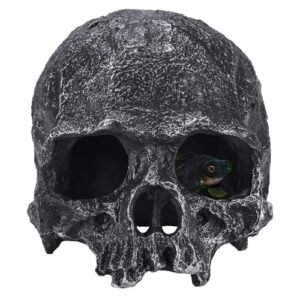
At 4.53 × 3.35 × 3.62 inches, the TkoYuHm Skull Hideout is better suited for juveniles or smaller colubrid species than a full-grown boa. That said, it earns a spot here for novelty and niche use.
The UV-stable black resin resists humidity, won’t leach into your substrate, and the smooth interior won’t snag shed skin. Setup is instant—just drop it in. For a grow-out setup or a secondary accent hide, it works.
| Best For | Small reptiles, juvenile snakes, axolotls, or tarantulas that need a compact hide with a cool aesthetic. |
|---|---|
| Material | UV-stable resin |
| Species Suitability | Reptiles, fish, tarantulas |
| Ease of Cleaning | Rinse and wipe |
| Dimensions (L×W×H) | 4.53×3.35×3.62 in |
| Stress Reduction | Secure skull cavity |
| Natural Aesthetic | Detailed skull motif |
| Additional Features |
|
- UV-stable resin holds up in humid setups and won’t cloud your water or leach into substrate
- Zero setup — just drop it in and you’re done
- The skull detail actually looks good, not cheap or cartoonish
- Too small for adult or larger snake species — don’t expect a grown boa to squeeze in
- Hard resin can’t be trimmed or modified if the fit isn’t right
- Heavy enough to chip delicate glass tanks if it takes a tumble
8. Hollima Yellow Mossy Cave Hide
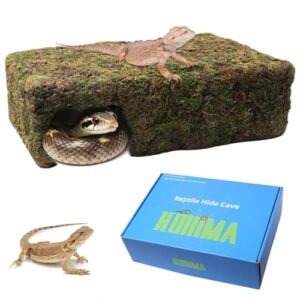
The Hollima Yellow Mossy Cave is a compact novelty pick—dimensions of 11.02 × 7.68 × 3.15 cm make it genuinely useful only for neonates or very small juveniles.
The dried natural moss exterior over a steel wire frame holds humidity well and blends cleanly into bioactive setups.
That yellow coloration is a bit bold, but it won’t stress your snake.
Mist it lightly, remove loose moss before first use, and it holds its shape reliably.
| Best For | Small reptiles and rodents like neonates, geckos, and gerbils who need a snug, humid little hideout. |
|---|---|
| Material | Dried moss & polyester |
| Species Suitability | Snakes, lizards, rodents |
| Ease of Cleaning | Spot clean only |
| Dimensions (L×W×H) | 11.02×7.68×3.15 cm |
| Stress Reduction | Sheltered front-entry hide |
| Natural Aesthetic | Real moss exterior |
| Additional Features |
|
- Natural moss holds moisture well, making it great for reptiles that need help shedding
- Steel wire frame keeps it sturdy and tip-resistant on the terrarium floor
- Blends nicely into bioactive setups and won’t stress out shy animals
- Very small — only really works for tiny or young animals, not adults
- Loose moss sheds at first and needs to be cleaned out before use
- The single side opening can be awkward for more active or larger small pets
Choosing Bioactive-Safe Boa Hides
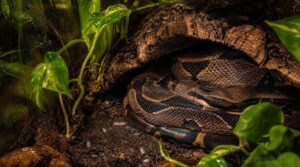
Not every hide works in a bioactive setup — the wrong material, size, or shape can stress your boa or quickly wreck the microfauna colony you spent weeks building.
Before you grab the first cork bark you see, it’s worth knowing exactly what separates a smart pick from a costly mistake.
Here’s what to look for.
Proper Hide Size for Juvenile and Adult Boa Constrictors
Size is where most setups quietly go wrong. For juveniles—generally 2–4 feet long, aim for a 6×4-inch hide using girth calculations to ensure a proper fit: interior width should be roughly 1.5–2× the snake’s diameter.
Adult boa enclosures demand 10–14-inch hides with adequate coil space allowance. Never force heavy-bodied snakes to contort just to get comfortable.
Entrance opening size matters too. Follow the minimum enclosure dimensions guideline to ensure the habitat accommodates the snake’s full length.
Snug-fit Hides Versus Oversized Caves
Think of a snug hide as a crevice, not a room. In a bioactive terrarium setup for boa constrictors, hide box selection and placement strategies directly affect thermal retention, stress indicators, and airflow dynamics. Oversized caves diffuse heat and create humidity dead zones.
Snug hides win because:
- Thermal retention improves by 1–3°C inside tight-fitting hides
- Stress indicators drop when boa constrictors feel fully enclosed
- Airflow dynamics stay controlled, preventing mold without sacrificing humidity
Natural Materials Versus Resin Hides
Once you’ve nailed the snug fit, the next call is material. Cork bark and hollow logs bring real thermal conductivity — they warm gradually and hold that warmth longer than resin. They also support microhabitat support naturally, letting springtails colonize microcrevices.
Resin wins on structural integrity and resistance to moisture absorption, though.
For hide box selection and placement strategies, match the material to your aesthetic integration goals.
Mold Resistance in Humid Bioactive Setups
Mold prevention is where material choice becomes critical. In a humid bioactive enclosure maintained at 70–85% RH, hides bear the brunt of daily moisture exposure. Cork bark naturally resists fungal colonization, while resin hides dry rapidly after misting.
Three key strategies that significantly impact mold prevention are:
- Drainage layer design beneath hides
- Airflow optimization with mesh venting
- Humidity sensor integration for RH feedback
Use non-toxic cleaning solutions between maintenance cycles.
Smooth Edges and Safety for Heavy-bodied Snakes
Heavy-bodied snakes are unforgiving judges of hide quality. Rounded entrance rims, burr-free finishes, and non-snag surfaces aren’t optional extras in a bioactive terrarium—they’re baseline requirements. Recessed hardware and edge-gap sealing prevent scale snags as your boa moves through large enclosures.
Safe materials and DIY enclosure construction demand the same attention to enclosure security that commercial hides sometimes skip.
Baseline requirements ensure a functional and safe environment for reptiles, prioritizing both comfort and health in captivity.
Easy Cleaning Without Disrupting The Cleanup Crew
Cleaning a bioactive hide shouldn’t mean evicting your isopod cleanup crew or bulldozing your springtail colony. Look for hides with these features:
- Drainage channels that wick moisture away automatically
- Removable liners for spot sanitation without substrate disruption
- Quick-access lids for microfauna checks
- Non-porous surfaces that resist biofilm buildup
- Modular interlocking designs that stay stable during bioactive setup maintenance
Stability, Weight, and Tip-over Prevention
A boa repositioning mid-enclosure can topple a poorly placed hide instantly. That’s why center of gravity matters — keep heavy hides low, with a wide base footprint that distributes load evenly across substrate.
Natural cork bark and slate offer real surface friction, unlike polished resin. Options like the Exo Terra Reptile Cave and large show-grade cork tub use anchor mechanisms and smart load distribution to stay put.
Hide Placement in Boa Terrariums
Where you place a hide matters just as much as which one you choose. Each spot in your boa’s enclosure fulfills a different purpose — thermoregulation, retreat, shedding, security.
Here’s how to get every hide working in the right place.
Warm-side Hide Placement for Thermoregulation
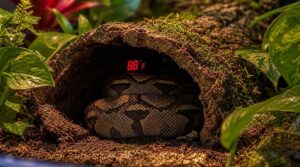
Your warm hide is only as good as its position. Place it directly over the heat source — heat source alignment is everything here. The interior should hit 85–92°F, giving your boa a thermal conductivity base that facilitates digestion and thermoregulation without exposure.
- Anchor it flush to the warm end for a true temperature gradient access
- Keep the thermal gradient unbroken — no drafts, no gaps
- Stable placement prevents tip-overs during thermal regulation sessions
Cool-side Hide Placement for Retreat Behavior

Unlike the warm side, your cool hide is where your boa actually retreats — it’s the Temperature Gradient Anchor for rest, not digestion. Position it at the enclosure’s far end, in Quiet Corner Placement away from feeding zones.
Ground-Level Concealment matters here; keep it floor-level, tucked against Background Concealment features like driftwood or plants within your bioactive enclosure’s Edge-of-Heat Zone boundary.
Humid Hide Placement for Shedding Support
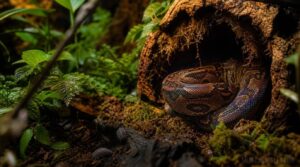
Shedding success depends on where you position your humid hide. Warm-side placement is optimal for evaporation control and localized temperature boost, as heat draws moisture upward, creating a reliable humidity gradient inside the enclosure without saturating the entire space.
Use moss moisture gauges to monitor the microclimate, targeting humidity levels of 75–85%. This ensures precise tracking of conditions critical during every shed cycle.
Implement airflow channeling to eliminate stagnant pockets, which can foster mold growth. This practice maintains a healthy environment while preserving the enclosure’s humidity balance.
Using Hides to Create Visual Security
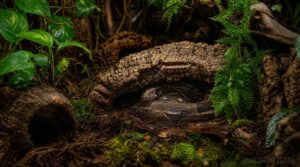
Visual security isn’t just aesthetics — it’s stress reduction techniques made physical. Strategic hide clustering breaks open sightlines across a bioactive enclosure, giving your boa constrictor’s care setup the layered cover wild habitats naturally provide. Concealed entrance design, natural texture integration, and camouflage color matching ensure hides don’t stand out as foreign objects.
Contrast reduction techniques using cork and leaf litter make every hide feel inevitable rather than installed, preserving the illusion of a cohesive, natural environment.
Positioning Hides Around Branches and Plants
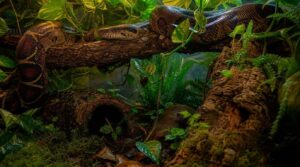
Position hides within 15–25 cm of sturdy horizontal branches so your boa can coil and retreat naturally. This proximity allows for instinctive behavior and structural support.
Utilize foliage shadow placement and leaf canopy camouflage—dense vines and branches overhead obscure entrances and reduce ambient stress. Ensure strategic layering to mimic natural habitats while maintaining accessibility.
Keep at least 5 cm clearance around entrances to prevent obstruction, and consider a tiered hide arrangement for easy movement between thermal and security zones. This design promotes comfort and reduces anxiety through controlled spatial transitions.
Avoiding Exposed, High-traffic Enclosure Areas
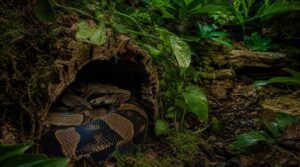
Once branches and plants frame your hides naturally, consider where foot traffic occurs. Peripheral hide placement—tucked into corners or behind cork bark—keeps your boa in traffic-free zones, minimizing daily disturbances.
A staggered hide layout with visual barrier integration provides multiple retreat options, enhancing habitat complexity. This approach ensures your boa has varied, stress-reducing spaces to choose from.
Concealed entrances significantly reduce stress, fostering a healthier bioactive terrarium through thoughtful design. Prioritizing these elements supports both your boa’s well-being and the ecosystem’s balance.
Keeping Hides Accessible for Health Checks
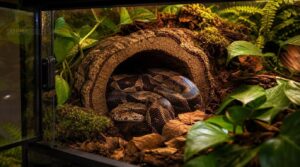
Concealment matters, but so does access. Look for hides with wide entrances (9–12 cm), removable panels, and rounded corners — these make health checks fast without pulling your boa fully out.
Non-slip bases keep things stable when you lean in, ensuring safe handling during inspections or maintenance.
Some keepers prefer hides with clear observation windows built into the walls, allowing monitoring without disturbing the snake.
Practical design beats aesthetics every time. Prioritize functionality over decorative features for your boa’s habitat.
Humid Hides for Shedding Support
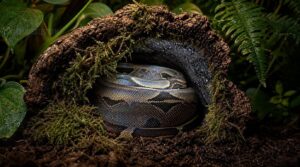
A humid hide isn’t just a nice extra — during shedding, it’s the one spot your boa will actually trust.
Getting it right comes down to hide style, moss management, and knowing where moisture belongs.
Best Hide Styles for Damp Sphagnum Moss
Not every hide works with damp sphagnum moss — shape and material matter more than looks.
For a solid bioactive terrarium setup, these five styles hold up best:
- Large Show Grade Cork Tubes — natural fit for layered substrate integration; moss packs in cleanly
- Hollow log hides — textured walls grip moisture without pooling
- Ceramic caves — resist mold, maintain temperature-humidity synergy reliably
- Flat-entry resin hides — camouflage color-matching blends with leaf litter naturally
- Open-base cork bark — Ease of inspection without disturbing your cleanup crew
Maintaining 75–85% Humidity Inside The Hide
Once your hide style is sorted, maintaining interior humidity between 75 and 85 percent hinges on a few non-negotiable habits.
Place your humidity sensor inside the hide—not near it—and adhere to a consistent moss hydration schedule, topping up damp sphagnum weekly.
During shedding cycles, reduce ventilation aperture size, position the heat source beneath the cool-side hide, and let moisture-port adjustments fine-tune the rest.
Preventing Stagnant Moisture and Mold Buildup
Stagnant moisture is mold’s best friend — and mold doesn’t negotiate. Keep ventilation strategies active by opening airflow ports daily, and don’t neglect humidity monitoring inside the hide itself.
Rapid drying of any saturated spots within 24–48 hours cuts off mold before it establishes. Substrate drainage beneath the hide prevents pooling, ensuring excess moisture is efficiently managed.
Routine maintenance of sealants around hide edges stops moisture from creeping into problem zones, reinforcing long-term protection against mold infiltration.
Refreshing Moss Without Disturbing Bioactive Layers
Revitalizing moss bedding doesn’t have to disrupt your bioactive terrarium setup. Mist lightly—two to three times daily works well for moss mist frequency during acclimation—using dechlorinated water and a fine-spray bottle to protect microfauna safety. This approach maintains balance while supporting moss health.
Josh’s Frogs Chilean Sphagnum Moss anchors effectively to cork and hardscape, simplifying moss anchoring techniques. Its structure integrates seamlessly with terrarium elements, ensuring stability without compromising aesthetics or function.
Time refreshes during routine checks; this combines humidity calibration protocol and refresh timing integration in one efficient pass. Aligning maintenance with existing care routines optimizes both moss vitality and terrarium harmony.
Cool-side Humid Hides Versus Warm-side Humid Hides
Both sides have a role, and your boa’s behavior tells you which matters more.
Cool hide placements stabilize moisture retention around 75–85%, with slower evaporation supporting reliable humidity levels during shedding cycles.
Warm hide spots accelerate temperature influence, raising internal humidity fast but dropping it just as quickly.
Mold risk increases on the warm side without proper airflow balance — so most bioactive terrarium setup guidelines recommend prioritizing the boa’s preference for a cool hide first.
Signs Your Boa is Using The Humid Hide Properly
Your boa’s body language tells the whole story. Look for a slack entrance posture as it retreats—no forced squeezing. A moist snout after emergence signals real humidity exposure, not just surface contact.
Frequent emergence during active hours, paired with humidity spikes near 85% inside damp moss, confirms the hide is working.
Consistent use correlates directly with cleaner shed cycle management and fewer complications.
Common Shedding Problems Linked to Poor Hides
Poor hides don’t just cause discomfort — they derail the entire shedding cycle management process. Five problems show up repeatedly:
- Skin tearing from rough hide edges during sloughing
- Eye cap retention caused by insufficient humidity control
- Uneven moisture distribution leading to patchy sheds
- Stress‑induced shedding delays from ill‑fitting or exposed hides
- Bacterial buildup in dirty moss, complicating clean sloughs
Integrating Hides With Bioactive Design
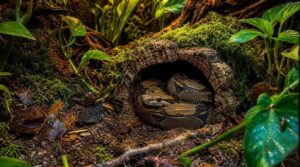
A hide sitting in the middle of a bioactive setup is only half the job done.
How you place it, anchor it, and build around it shapes whether the whole enclosure actually works as a living system.
Here’s what to think through before you start arranging.
Blending Hides With Leaf Litter and Cork Bark
Think of your hide placement as the foundation of a miniature forest floor. Partially burying a cork bark hide in the substrate and surrounding it with coarse leaf litter creates a tunnel-like retreat that delivers real microclimate creation — cork’s surface retains moisture and releases it slowly, directly supporting shedding health and moisture retention without daily intervention.
Cork bark buried in leaf litter doesn’t just hide your boa — it quietly manages moisture, shedding, and microclimate for you
| Element | Function | Bioactive Benefit |
|---|---|---|
| Cork bark hide | Humidity buffer | Moisture retention near retreat zone |
| Coarse leaf litter (base layer) | Camouflage effect | Microfauna access and organic decomposition |
| Sphagnum moss patches | Localized humidity spike | Shedding support at 75–85% |
| Mixed leaf litter (oak, magnolia) | Seasonal leaf collection integration | Substrate selection and cleanup crew habitat |
| Naturalistic décor layering | Habitat enrichment with cork moss and slate | Enrichment practices in professional zoos applied to home hobbyists |
Isopods and springtails concentrate around hide edges where organic matter accumulates — that’s exactly where you want them. This layout mimics what professional zoo curators call deliberate habitat zoning: every material earns its spot by pulling double duty aesthetically and functionally.
Supporting Live Plants Around Hide Entrances
Live plants around hide entrances do more than look good — they actively stabilize localized humidity and reinforce the naturalistic terrarium feel that keeps captive boas mentally engaged. Root Zone Isolation matters here: containerized plants with drainage tray integration prevent substrate migration into the hide and reduce mold risk near entry points.
- Use slip-resistant pots for Plant Pot Stability; boas push against everything
- Maintain Leaf Litter Clearance of 6–8 inches at the entrance
- Prioritize Airflow Optimization by leaving gaps between foliage and the hide mouth
- Choose pothos or bromeliads — proven performers for Incorporating Live Plants for Humidity and Aesthetics
Protecting Springtails and Isopods Near Hides
Your cleanup crew is the invisible engine behind a healthy bioactive setup — protect it deliberately.
Near hides, maintain microfauna moisture zones at 70–85% humidity and prioritize aerated substrate edges to prevent anaerobic pockets.
Rough hide surfaces, like cork bark, let Dairy Cow and Powder Blue Isopods move freely. Use non-toxic sealants on any resin hides.
Keep shallow water films near the warm hide without flooding.
Creating Secure Pathways Between Hide Zones
Corridors connecting your hide zones deserve the same attention as the hides themselves. Keep corridor width at a minimum of 6 inches so your boa can coil and redirect without compression stress.
- Lay non-slip surfaces using cork flats or smooth substrates
- Add visual cover with overhanging plant leaves along the route
- Use modular bridges of driftwood secured with fasteners
- Maintain a steady temperature gradient from warm to cool zones throughout
Combining Hides With Climbing Branches
Once your pathways are set, anchoring hides directly onto climbing branches completes the vertical structure. Branch hide integration works best when mopani or manzanita branches—2–4 inches in diameter—carry hides at various heights, creating camouflaged hide perches your boa will actually use.
| Branch Placement | Hide Benefit |
|---|---|
| Low, ground-level branch | Cool retreat access |
| Mid-height junction | Variable temperature pathways |
| Vertical climbing routes | Canopy exploration support |
| Angled limb near basking zone | Thermoregulation efficiency |
Secure every branch-hide junction with hidden bolts—wobble discourages use.
Managing Substrate Depth Beneath Heavy Hides
Heavy hides shift substrate faster than you’d expect. Beneath each one, maintain 4–6 inches for adults and 2–4 inches for juveniles — enough for burrowing, stability, and moisture layering without suffocation risk.
- Depth monitoring weekly prevents sudden sinking
- Compaction control using coco coir blends keeps pathways open for cleanup crew
- Base reinforcement with inert clay pebbles stabilizes heavy footprints
- Adjustable substrate layers let you restore depth without demolishing bioactive colonies
- Substrate selection matters — loose topsoil directly beneath heavy hides collapses
Designing a Naturalistic Layout for Adult Boas
Think of your enclosure as a living map. Adult boas need 8×4×4 ft minimum, with thermal zoning from 75°F cool to 93°F warm.
Prioritize material insulation through bamboo or PVC panels, vertical enrichment via anchored mopani branches, and plant diversity with pothos and bromeliads.
Strategic substrate selection and a thriving cleanup crew tie every environmental enrichment strategy together naturally.
Frequently Asked Questions (FAQs)
How often should boa hides be replaced?
Like good boots, hides don’t last forever. Plan on a replacement timing of 12–18 months for adults, following a quarterly inspection schedule.
Watch for cracks, mold, or wobble as your key wear indicators.
Can multiple boas share hides safely?
Technically yes, but it’s risky. Without enough hides and clear feeding zone separation, territorial conflict cues escalate fast.
Shared hide monitoring is non-negotiable — stress hormone indicators show up subtly before aggression does.
Do boas prefer enclosed or open hides?
Boas almost always lean toward enclosed hides. That security feeling matters — a snug space that covers three sides reduces stress.
Temperature preference and humidity needs drive the final call between a warm hide and a cool hide.
How do hides affect boa stress levels?
Hide by effectively reducing corticosterone levels through providing your boa with reliable retreat frequency, steady activity pacing, and scent retention.
These stress-reduction techniques collectively signal safety without requiring environmental enrichment upgrades.
Should hides change during breeding season?
Yes — seasonal hide relocation, breeding hide moisture adjustments, and pairing hide visibility matter. Shift hides toward warmth, increase humidity, and reduce traffic to support reproductive stress reduction and mating readiness.
Conclusion
Every hide decision you make ripples through the entire enclosure — get it wrong, and no amount of live plants or premium substrate will compensate.
The best boa constrictor hides for bioactive terrariums aren’t just shelters; they’re functional anchors that shape thermoregulation, shedding success, and cleanup crew survival simultaneously.
Snug fit, mold resistance, strategic placement — these aren’t optional upgrades. When the hide works with your setup instead of against it, your boa finally settles, and the whole system follows.
- https://www.reptiles.swelluk.com/help-guides/how-to-keep-a-common-boa/
- https://dubiaroaches.com/blogs/how-to-guides/how-to-set-up-a-boa-constrictor-terrarium?srsltid=AfmBOoo31QvNCnRuj6Of1LEb6zjWY_mY_QzguWNL6cfQy0vodqqTfM7k
- https://www.thebiodude.com/blogs/snake-caresheets/boa-constrictor-care-guide-and-bioactive-terrarium-maintenance?srsltid=AfmBOopn7j1uoyBq2PLAoYPqUeuFV-s6O1OGgP_VB3J_hSaA5X3zQ8Er