This site is supported by our readers. We may earn a commission, at no cost to you, if you purchase through links.
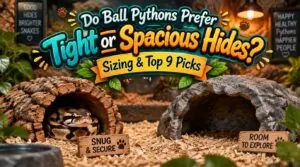
Your ball python just refused a third meal in a row, and the hide you picked looks like a luxury apartment. That might be the problem.
So do ball pythons prefer tight or spacious hides? Tight, and it isn’t close. A snug cave lets your snake press its coils against the walls and ceiling, the same way it would in a termite mound or abandoned burrow. That contact signals safety. An oversized hide does the opposite, leaving your python exposed, stressed, and off its food.
The right fit depends on your snake’s girth, its growth stage, and where the hide sits in the tank.
Table Of Contents
- Key Takeaways
- Do Ball Pythons Prefer Tight or Spacious Hides?
- How Do You Size Ball Python Hides?
- What Makes Ball Python Hides Feel Secure?
- Where Should Warm, Cool, and Humid Hides Go?
- When Should You Clean or Replace Hides?
- Top 9 Ball Python Hides to Consider
- 1. Exo Terra Large Snake Cave
- 2. Exo Terra Extra Large Reptile Cave
- 3. Zilla Bark Bends Terrarium Hide
- 4. Zilla Vertical Rock Cave Grey
- 5. Zilla X Large Terrarium Rock Den
- 6. Zilla Rock Lair Reptile Hide
- 7. Zilla Herp Hotel Terrarium Basking Hide
- 8. Pangea Medium Reptile Hide Box
- 9. Zoo Med Large Reptile Shelter Cave
- Frequently Asked Questions (FAQs)
- Can ball pythons share a hide safely?
- How many hides does one enclosure need?
- Do hides need ventilation holes drilled in?
- Should hides be elevated off the substrate?
- Can DIY hides replace commercial options effectively?
- How many hides does a ball python need?
- Can ball pythons use hides with multiple entrances?
- Why does my ball python never leave its hide?
- Do baby ball pythons need different hides?
- Can I use DIY hides for ball pythons?
- Conclusion
Key Takeaways
- Pick a tight, snug hide where your ball python’s coils touch the walls and ceiling, because an oversized hide leaves it feeling exposed, stressed, and more likely to refuse meals.
- Size the hide to your snake’s body, not its age, and move up as it grows, from small hatchling hides to extra-large ones for adult females.
- Give your snake at least two single-entrance hides, one on the warm side (88-92°F surface) and one on the cool side (75-80°F), then add a humid hide with damp sphagnum moss to help shedding.
- Spot clean daily, sanitize hides weekly, and replace any that are cracked, rough, or still smell after scrubbing, since those flaws harbor bacteria and can injure your snake.
Do Ball Pythons Prefer Tight or Spacious Hides?
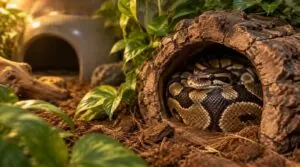
Why do ball pythons ignore a roomy, expensive hide and squeeze into a corner instead? Because they crave contact. Ball pythons prefer tight hides, where their coils touch the walls and ceiling at once. That’s thigmotaxis, and it’s hardwired.
Once a snake feels secure in a snug hide, you’ll notice smoother sheds too, so it helps to know the signs of a healthy ball python shedding.
Ball pythons ignore roomy, expensive hides because they crave contact, squeezing into tight spaces where their coils touch every wall
In the wild, they shelter in termite mounds and burrows, so a snug fit feels like home. An oversized hide signals danger. Your snake may avoid it, skip proper thermoregulation, and even refuse meals.
Don’t stress over exact numbers yet. Just know that a good hide has a modest entrance hole diameter, a small headroom buffer, and matches the measurements on any hide size chart you consult. Big enclosure? Fine. Security comes from tight hides and clutter, not raw square footage. Adults still need a minimum enclosure size of 4 feet long by 2 feet wide by 2 feet tall.
How Do You Size Ball Python Hides?
Sizing a ball python hide comes down to one question: does your snake touch the walls when it’s coiled inside? Below, you’ll find how to check the fit and what stress signals to watch for, then how to match hide size to your snake’s growth stage.
Get both right, and you’ll know exactly what to look for in the hides that follow.
Assessing Fit and Behavioral Warning Signs
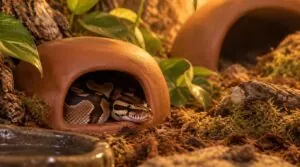
A good hide size lets your ball python touch both walls. That snug fit feels secure.
Check these four things:
- Body girth ratio: the hide’s interior should be roughly one and a half times your snake’s width.
- Entrance hole diameter: wide enough to enter, never gaping.
- Stress signals: glass surfing, tight coiling, constant hiding.
- Meal refusal means resize it today.
Sizing Hides by Growth Stage
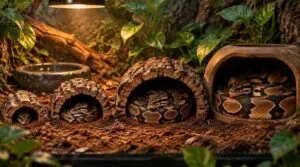
Match hide size to the body, not the birthday.
Hatchlings under 150 grams need a small hide, roughly 5.5 by 3 inches. Juveniles want a medium hide, about 6.8 by 9.4 inches. Subadults move up to 10 by 7 inches. Adult females need extra-large hides near 16.5 by 10.6 inches. Recheck the snug fit often; growth stage housing needs shift.
What Makes Ball Python Hides Feel Secure?
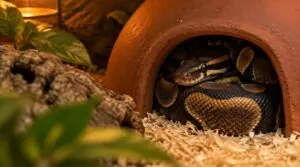
Once the size is right, the details decide whether your snake actually uses the hide. Security comes from a snug fit, tightfitting entrances, and dark enclosed spaces where your ball python can brace against the walls.
Check the interior dimensions, then look at stability. A hide that rocks or shifts when your snake enters won’t feel safe.
Picture what your snake feels when the hide gets it right:
- Calm, because nothing sees it
- Held, with walls pressing gently along its coils
- Steady, on a floor that never wobbles
- Unhurried, with one quiet way in and out
Aim for security vs hiding time balance: a secure hide shouldn’t keep your snake buried all day. Watch how often it emerges, and adjust.
Where Should Warm, Cool, and Humid Hides Go?
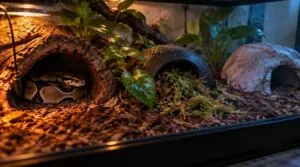
Where you put each hide matters as much as which hides you buy. Good hide placement strategy starts with thermal gradient alignment, so your snake can choose between heat and refuge without crossing open ground.
For hatchlings especially, a snug fit matters more than size, so browse these snake hide boxes for hatchlings to find one that keeps tiny snakes feeling secure.
Set the warm side hide over or beside your under-tank heater, where the surface reads 88-92°F. Run a thermostat probe inside it. You want 90-95°F at snake level. Your ball python will park there after meals.
Put the cool side hide at the opposite end, where ambient air stays 75-80°F. Keep it away from heat sources.
Place the humid hide on the warm side or in the middle, packed with damp sphagnum moss. Don’t set it over the heater, or the moss dries out fast.
When Should You Clean or Replace Hides?
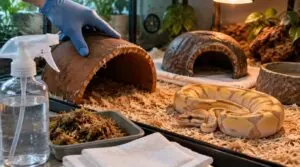
When does a hide go from cozy to contaminated? Faster than you’d think. Your spot cleaning frequency should be daily: remove feces, urates, and uneaten food the moment you spot them.
Build your hide cleaning schedule around three checkpoints:
- Weekly hide sanitation: scrub with reptile-safe disinfectant like F10SC, rinse well, and dry completely.
- Humid hide linings: swap paper towel every 1 to 3 days and sphagnum moss every 2 to 4 weeks.
- Full teardown: disinfect everything every 30 to 90 days.
Replace any hide that’s cracked, chipped, rough, or still smells after scrubbing. Those flaws harbor bacteria and can injure your snake.
Stick to this hide cleaning frequency and your hide cleaning and maintenance routine stays simple, predictable, and stress-free.
Top 9 Ball Python Hides to Consider
You’ve got the sizing rules, the placement tips, and the cleaning routine down, so now it’s time to pick the actual hides.
Every option below is a single-entrance hide that can give your ball python the snug, enclosed feel it craves. Match each one to your snake’s size and your setup, and you’ll land on the right fit.
1. Exo Terra Large Snake Cave
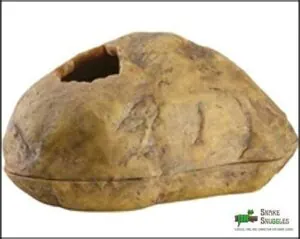
Tight beats roomy, and this cave knows it. At 9.8" x 7.4" x 4.7", the Exo Terra Large Snake Cave gives juvenile ball pythons a snug, secure hiding place where their bodies can touch the walls.
It’s heavy at 3.2 pounds, so it won’t tip over. The included moss can be dampened for a moist hideout, though reviews on its quality are mixed.
Watch two things. The top can pop off too easily, and adults may outgrow it fast.
| Best For | Owners of juvenile corn snakes, ball pythons, and leopard geckos who want a stable, natural-looking hide that gives their pet a snug, secure place to rest. |
|---|---|
| Dimensions | 9.8″ x 7.4″ x 4.7″ |
| Material | N/A |
| Weight | 3.2 pounds |
| Color | N/A |
| Design Style | Natural cave look |
| Best Snake Size | Juveniles |
| Additional Features |
|
- Natural look blends into any terrarium
- Heavy at 3.2 pounds, so it is very stable and not easily tipped over by larger reptiles
- Includes natural moss that can be dampened to create a moist hideout
- The top can come off too easily, according to some users
- May be too small for adult ball pythons or larger snakes
- Mixed feedback on the quality and usability of the moss
2. Exo Terra Extra Large Reptile Cave
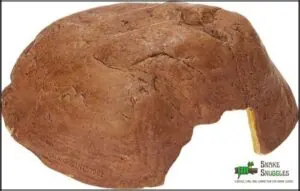
Picture a 4-foot adult ball python in a roomy cave with inches of dead space around her. She won’t feel secure. Tight fit matters, and this cave runs big.
The Exo Terra Extra Large Reptile Cave measures 10.23 x 11.02 x 4.33 inches and weighs 2.09 pounds, so it won’t tip. The black resin looks like natural rock and wipes clean. Add damp moss for a humid hide.
Inspect it first, though. Some units arrive cracked or with sharp edges.
| Best For | Keepers of small to mid-sized snakes and geckos who want a natural-looking, easy-to-clean hide that can double as a humid hide or egg-laying box. |
|---|---|
| Dimensions | 10.23 x 11.02 x 4.33 in |
| Material | Resin |
| Weight | 2.09 pounds |
| Color | Black |
| Design Style | Natural rock look |
| Best Snake Size | Small to mid-sized |
| Additional Features |
|
- Natural rock look blends into terrarium setups
- Durable resin is easy to clean and sturdy enough not to tip
- Works on the warm or cool side, and holds damp moss for humidity or egg laying
- Some units arrive cracked or with sharp internal edges that need filing
- Uneven height means the usable interior is smaller than the tallest point suggests
- May be too small for larger adult snakes or bearded dragons
3. Zilla Bark Bends Terrarium Hide
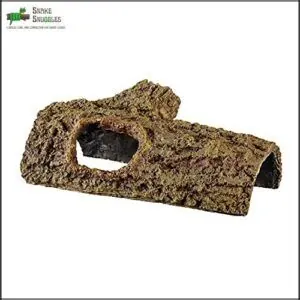
Does your ball python want a tight squeeze? Mostly, yes. The Zilla Bark Bends Terrarium Hide is a hollow, curved bark shelter with open ends, so your snake can slip in and feel enclosed.
Check proper hide dimensions first. The medium measures 8.3 by 3.6 by 3.0 inches and suits pythons up to about 700 grams. Apply the snugfit rule, and confirm fit with body condition scoring.
| Dimensions | 7.87 x 5.51 x 6.3 in |
|---|---|
| Material | Hard foam |
| Weight | Lightweight |
| Color | Grey |
| Design Style | Painted stone look |
| Best Snake Size | Small, young snakes |
| Additional Features |
|
4. Zilla Vertical Rock Cave Grey
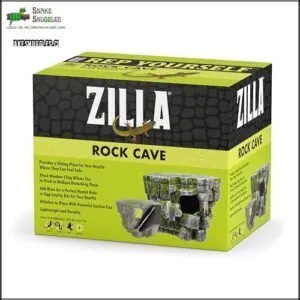
Want a hide that climbs the wall instead of eating floor space? This one does exactly that. The Zilla Vertical Rock Cave is a grey, hard foam hide measuring 7.87 x 5.51 x 6.3 inches, painted to look like real stone. It’s lightweight, durable, and blends into your setup.
Know the catch, though. The opening is roughly 2 x 2 inches, so only small, young snakes will fit. Suction cups can also slip on glass, so prop it if needed.
| Best For | Keepers of geckos, frogs, and other small arboreal reptiles and amphibians who want an elevated hiding spot that saves floor space in the terrarium. |
|---|---|
| Dimensions | 6″D x 5″W x 7″H |
| Material | Plastic |
| Weight | Heavy |
| Color | Orange |
| Design Style | Realistic rock look |
| Best Snake Size | Adults |
| Additional Features |
|
- Strong suction cups attach to glass, giving climbing species an elevated place to hide and rest
- Painted organic texture on hard foam blends naturally into terrarium setups
- Lightweight yet durable enough for climbing and daily use
- Suction cup adhesion can be inconsistent on glass
- The roughly 2 x 2 inch opening limits internal access
- May need propping or modification to keep it from falling off the glass
5. Zilla X Large Terrarium Rock Den
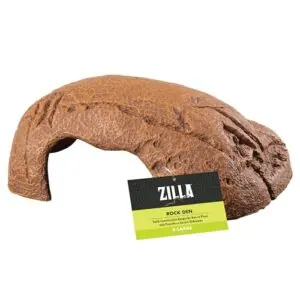
Need more room than that vertical cave offers? The Zilla X Large Terrarium Rock Den steps up. It’s an orange plastic hide, 6"D x 5"W x 7"H, with a realistic rock look that blends into desert setups. Heavy construction keeps it planted when your snake pushes through, and the dark interior blocks light so your ball python feels safe.
The non-porous surface resists water absorption and bacteria, so cleanup is easy. Watch for sharp edges needing sanding, and eventual cracks.
| Best For | Owners of adult reptiles, like a ball python or a similarly sized desert-dwelling pet, who want a dark, rock-style hide that blends into their terrarium and stays put. |
|---|---|
| Dimensions | 11″L x 7.75″W x 6″H |
| Material | Plastic |
| Weight | Heavy |
| Color | Grey |
| Design Style | Mossy rock look |
| Best Snake Size | Adults |
| Additional Features |
|
- Realistic rock design blends into desert terrarium setups
- Heavy construction keeps the den in place
- Dark interior blocks light and gives reptiles a secure place to hide, regulate temperature, and nest
- Size may be too small for juvenile geckos or large snakes
- Reports of sharp edges that need filing or sanding
- Some units arrive broken or develop cracks over time
6. Zilla Rock Lair Reptile Hide
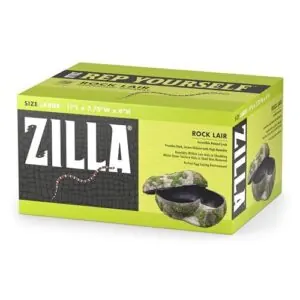
Want something that looks like a boulder from your snake’s perspective? The Zilla Rock Lair Reptile Hide is a grey plastic cave measuring 11"L x 7.75"W x 6"H, so it’s roomy enough for an adult ball python to coil up inside.
The mossy, rock-like texture isn’t just for looks. Your snake can rub against it during a shed, and the humid micro-environment helps skin come off cleanly. A side entrance keeps the dark interior secure.
Rinse it before first use.
| Best For | Snake, gecko, and other reptile owners who want a secure, dark hide that also helps with humidity and shedding. |
|---|---|
| Dimensions | 6.89 x 4.65 x 3.28 in |
| Material | N/A |
| Weight | N/A |
| Color | N/A |
| Design Style | Naturalistic rock |
| Best Snake Size | Hatchlings, juveniles |
| Additional Features |
|
- Textured, mossy rock surface helps snakes rub off skin during a shed
- Keeps humidity up to support shedding and egg-laying
- Side entrance and burrow-like walls give a dark, secure spot for daily rest
- Heavy construction means you’ll need to place it carefully in the enclosure
- Some buyers noticed an initial odor that needed rinsing
- Runs larger than some people expect, so check the 11"L x 7.75"W x 6"H size first
7. Zilla Herp Hotel Terrarium Basking Hide
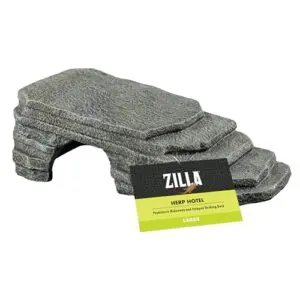
The Zilla Herp Hotel Terrarium Basking Hide works differently from a plain cave. It’s a naturalistic rock with a large flat platform on top and wide openings below, so your snake can bask and hide in one spot.
At 6.89 x 4.65 x 3.28 inches, it suits hatchlings and juveniles, not full-grown adults. Check the edges for sharp spots and sand them smooth. The paint can chip with heat, so keep it away from extreme basking temperatures. Plan to upgrade.
| Best For | Owners of small to medium reptiles, such as leopard geckos and young bearded dragons, who want a naturalistic rock that works as both a basking spot and a hide. |
|---|---|
| Dimensions | 10 x 7 x 2.25 in |
| Material | Plastic |
| Weight | 4.96 ounces |
| Color | N/A |
| Design Style | Plain box |
| Best Snake Size | Under 700 grams |
| Additional Features |
|
- Large flat platform on top gives reptiles a spot to bask and regulate body temperature
- Wide openings and shallow steps make it easy to climb onto and enter, and the hollow space below works as a hide
- Naturalistic rock design blends in with terrarium decor
- Customers report sharp edges that may need sanding before use
- Paint can wear or chip over time with heat exposure
- Not sturdy enough for extreme basking temperatures (around 130°F) or larger adult reptiles
8. Pangea Medium Reptile Hide Box
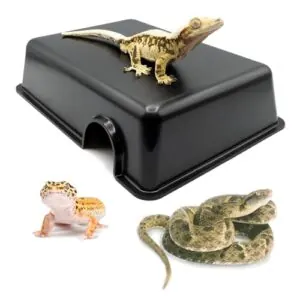
If your ball python is still under about 700 grams, the Pangea Medium Reptile Hide Box is a smart, snug pick. It measures 10 x 7 x 2.25 inches, so your snake can tuck in tight without feeling exposed.
The offset door placement limits light and helps reduce stress. Heavy 1/8-inch plastic wipes clean with hot water and sanitizer.
It’s light at 4.96 ounces, so weigh it down to stop tipping. It won’t win any beauty contests, and it’s smaller than some snakes need.
| Best For | Owners of young ball pythons under about 700 grams, or small terrestrial geckos, who want a snug, easy-to-clean hide that helps their reptile feel secure. |
|---|
- The offset door placement limits light and helps reduce stress in captive reptiles.
- The heavy 1/8-inch non-porous plastic wipes clean easily with hot water and sanitizer.
- The 10 x 7 x 2.25 inch size gives snakes and terrestrial geckos a snug space to tuck into.
- At only 4.96 ounces, it is light and may need extra weight to keep it from tipping.
- It may look less attractive than rock hides.
- It may be smaller than expected, so it won’t fit some larger reptiles.
9. Zoo Med Large Reptile Shelter Cave
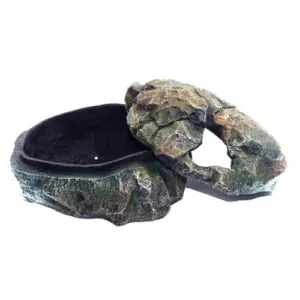
Ceramic gives the Zoo Med Large Reptile Shelter Cave (RC32) its 3-in-1 versatility, and it measures roughly 6″ x 12″ x 11″. That’s a solid fit for juvenile and subadult ball pythons.
Fill it with moist moss and it becomes a humid hide for shedding. The removable lid simplifies checking on your snake, and the ceramic washes and sterilizes easily.
In a compact enclosure, these ball python hides for small tanks make it easy to place one on both the warm and cool sides.
Some owners report cracking on heat sources, so skip direct heat. Others find the lid loose, so check its fit.
| Best For | Owners of leopard geckos, crested geckos, or small snakes who want one ceramic hide that doubles as a humid hide for shedding and egg incubation. |
|---|
- 3-in-1 design works as a hide, a shedding spot, and a nesting box
- Removable lid makes it easy to check on your pet and clean
- Washable, sterilizable ceramic holds humidity well when filled with moist moss
- Some customers report cracking when it is placed on heat sources
- The lid can fit loosely or insecurely
- Feedback is mixed on whether the size matches expectations
Frequently Asked Questions (FAQs)
Can ball pythons share a hide safely?
No. Ball pythons are solitary, so don’t share a hide. Even adult females with a roomy hide size and single entrance design compete, stress each other, and risk feeding refusal.
Give each snake its own.
How many hides does one enclosure need?
Wondering how many hides your snake really needs? Two is the minimum: one warm, one cool. Pick a snug single entrance design, keep hide size right for adult females, and add a humid hide.
Do hides need ventilation holes drilled in?
Why risk a cracked hide? Skip the drilling. Reptile hide ventilation needs are minimal, since your snake can leave for air, and holes ruin darkness. Put ventilation design in the enclosure. Prioritize hide temperature zones.
Should hides be elevated off the substrate?
Most ball pythons I’ve kept ignored elevated hides and buried themselves instead. Keep hide placement at substrate level. Elevated placement undermines thermal regulation in snakes across enclosure temperature zones. Hide size adjustment frequency follows growth.
Can DIY hides replace commercial options effectively?
Say you’ve got a juvenile ball python hiding in a $2 Sterilite tub with a doorway cut in the side. She’s in there every morning, coiled tight, feeding on schedule. That’s a successful hide fit assessment, and DIY hides can absolutely match commercial options.
How many hides does a ball python need?
Your ball python needs at least two hides, one on the warm side and one on the cool side. Most keepers add a third humid hide on the warm side, so three is the practical standard.
Can ball pythons use hides with multiple entrances?
A doorway is a promise of safety, and two doorways break it. Ball pythons can use dual-entrance hides, but they’ll choose a single-entrance design first.
Pick a snug, dark hide with just one side opening.
Why does my ball python never leave its hide?
Your ball python stays put because the hide delivers security. If it’s eating, shedding well, and alert, relax. Refusing meals? Check hide size, temperatures, and the stressfeeding correlation. Offer shedding support through a humid hide.
Do baby ball pythons need different hides?
Picture a tiny hatchling lost in a cavern. Baby ball pythons need no special hides, just snug, scaled-down ones. Match your hide size to snake length ratio, then resize every 26 months by growth stage.
Can I use DIY hides for ball pythons?
Yes, you can use DIY hides for ball pythons. Material safety matters most: choose easy-to-clean plastic with no sharp edges. Size it snugly, so your snake coils with minimal empty space. Check this against your ball python care guide.
Conclusion
Remember that skipped meal? The fix might cost less than a pizza and take five minutes. So, do ball pythons prefer tight or spacious hides? You already know the answer. Pick a snug, secure fit, match it to your snake’s girth, and swap it as it grows.
Place one hide on the warm side and one on the cool side. Your python will stop hiding from the room and finally start trusting its whole home.
Before arranging those hides, use a snake enclosure space calculator to see how much floor space or height your species needs.
If you’d rather not buy hides, DIY snake cave alternatives can work just as well, as long as they stay dark, clean, and easy to check.
A simple setup with a proper temperature gradient works just as well, and this ball python tank setup guide shows how to arrange it on a budget.
Hides with two openings let your snake slip out quickly if startled, and this guide to the best snake hides and caves shows what to look for.