This site is supported by our readers. We may earn a commission, at no cost to you, if you purchase through links.

A hatchling snake fresh out of the egg is wired for one thing: finding somewhere small, dark, and tight to hide. In the wild, that means a crack in a log or a pocket of loose soil. In your enclosure, it means you.
Get the hide box wrong—too big, too open, or too cold—and that little snake stays stressed around the clock. Chronic stress in hatchlings suppresses feeding response and immune function, which is why even experienced keepers lose otherwise healthy animals to husbandry mistakes they never see coming.
The good news? Nailing snake hide boxes for hatchlings comes down to a handful of decisions you can get right from day one.
Table Of Contents
Key Takeaways
- A hide box that’s too big is one of the sneakiest ways to stress out a hatchling — your snake needs to feel two or more walls at once to truly settle in.
- You’ll want at least two hides per enclosure, one on the warm side (28–32°C) and one on the cool side (22–26°C), so your hatchling can thermoregulate without stress.
- Offset door openings aren’t just a nice feature — they block direct sightlines into the hide, which is what actually helps skittish hatchlings calm down and start eating.
- Clean your hides within two hours of any waste, disinfect weekly with a reptile‑safe solution, and replace them the moment you spot cracks — rough edges can tear delicate hatchling scales during a shed.
Choose The Right Hatchling Hide Size
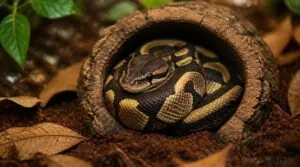
Getting the hide size right is honestly one of the most important things you can do for a hatchling’s confidence and health. A snake that feels snug and secure in its hide is far less stressed than one rattling around in a space that’s too big. Here’s what to look for when choosing the right fit.
A good rule of thumb is that the hide should just barely accommodate your snake’s coiled body — you can find species-specific hide sizing guidance to dial in the right fit for your particular snake.
Measure Your Hatchling Coiled
Before you can choose a size-appropriate hide, you need to know exactly how your hatchling actually sits when coiled. Gently encourage your snake to settle, then use a flexible measuring tape to capture its coil diameter — averaging three evenly spaced points around the curve keeps your reading honest.
Track these numbers weekly, since hatchlings can grow 20–40% wider in just a few months.
Pick Snug Interior Space
Once you have that coil diameter, the goal is simple: snug, not spacious.
A hide where your hatchling can touch at least two walls while coiled feels safe, not cramped — that gentle pressure is exactly what reduces stress.
Aim for an interior 3–5 cm smaller on every axis than the outer box, with rounded interior corners to prevent scale snagging during entry.
Ensure Easy Entrance Access
Even the snuggest fit means nothing if your hatchling can’t get inside comfortably. The entrance is the first test.
- Opening width should match your snake’s widest body point
- Offset door design reduces direct sightlines, lowering stress
- Low-profile entrances keep hatchlings from overextending during entry
- Smooth entryways prevent scale snags on rough edges
Avoid Oversized Hide Boxes
A hide that’s too big works against your hatchling in ways you might not expect. Interior wall contact is everything — when a snake can coil and touch two or more walls simultaneously, it feels sheltered rather than exposed. Too much open space and it stays tense, restless, and reluctant to settle. A 6‑inch entrance size may be excessive for tiny hatchlings, reducing their sense of security.
| Hide Problem | What It Costs Your Snake |
|---|---|
| Excess floor space | Constant stress, no sense of security |
| Tall interior | Lost thermal retention, cooler microclimate |
| Wide entrance gap | Reduced privacy, higher anxiety |
| No wall contact | Snake avoids the hide entirely |
| Oversized for stage | Feeding and shedding disruptions |
Size-appropriate hides aren’t just comfort features — they’re functional tools.
Match Growth Stage Carefully
Growth doesn’t pause, so your hide choices can’t either. Species growth curves vary widely — a young ball python and a hatchling corn snake don’t follow the same timeline.
- Measure coils monthly to catch size milestones early
- Swap to the next hide size before the current one feels cramped
- Watch for stress signals like refusing food or restless circling
Staying ahead keeps your hatchling thriving.
Top 4 Hatchling Snake Hide Boxes
Not all hide boxes are created equal, especially when you’re setting up for hatchlings that need just the right fit. These four options stand out for their quality, sizing, and how well they work in real rack setups. Here’s what’s worth your attention.
1. Pangea Large Reptile Hide Box
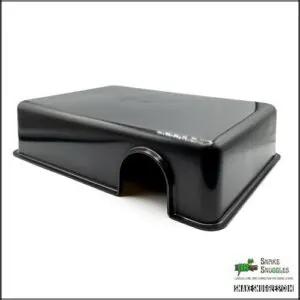
The Pangea Large Reptile Hide Box is built for adult-sized snakes, not hatchlings — but don’t dismiss it too quickly. At 13.25 × 9 × 3.25 inches, it fits comfortably inside 28–41 qt tubs, making it a smart long-term investment if you’re raising juveniles into adulthood.
Once your snake grows into this hide, double-check that the warm side surface hits 86–90°F — here’s why proper hide temperatures matter for ball python security.
Its 1/8-inch ABS plastic construction resists cracking, wipes clean in seconds, and the offset door keeps your snake feeling genuinely tucked away rather than exposed.
| Best For | Reptile keepers housing adult ball pythons, boas, kingsnakes, or geckos who need a practical, easy-to-clean hide that fits standard rack systems. |
|---|---|
| Door Design | Offset door |
| Wall Thickness | 1/8 in (3 mm) |
| Surface Finish | Smooth, non-porous |
| Color | Black |
| Rack Compatible | Yes |
| Primary Use | Ball pythons, boas, geckos |
| Additional Features |
|
- Smooth, non-porous ABS plastic wipes down in seconds and doesn’t harbor bacteria or waste buildup
- Offset door design gives snakes a greater sense of security by keeping them out of direct sightlines
- Versatile enough to double as a basking platform or feeding hide, and fits neatly into most rack setups
- Very lightweight, so it can tip or shift unless placed against a wall or weighted down
- The spacious interior may feel too open for small juveniles, potentially requiring a divider to make them feel secure
- Plain black plastic look won’t blend into naturalistic or decorative enclosure setups
2. Pangea Small Reptile Hide Box
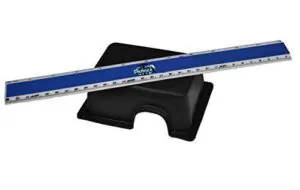
At 5.5 × 4 × 2.125 inches, the Pangea Small Reptile Hide Box hits the sweet spot for young hatchlings — snug enough that your snake feels genuinely sheltered, not lost in open space.
The offset door design does real work here. It mimics the narrow, winding entrances snakes seek in the wild, so your hatchling settles faster and strikes less.
Non-porous ABS plastic means cleanup takes seconds, not minutes — a win for any serious keeper.
| Best For | Hatchling ball pythons, leopard geckos, and other small reptiles — especially keepers running breeding racks who need a practical, easy-to-clean hide in bulk. |
|---|---|
| Door Design | Offset door |
| Wall Thickness | 1/8 in (3.2 mm) |
| Surface Finish | Smooth, non-porous |
| Color | Black |
| Rack Compatible | Yes |
| Primary Use | Hatchling ball pythons, small lizards |
| Additional Features |
|
- The offset door mimics natural burrow entrances, helping skittish hatchlings settle in faster and feel genuinely secure.
- Non-porous ABS plastic wipes clean in seconds — no scrubbing, no soaking, no hassle.
- Rounded edges make it safe for climbing species, and the low profile fits neatly into standard rack-unit shoe casings.
- It’s sized for hatchlings, so you’ll likely need to upgrade as your reptile grows into a juvenile or adult.
- The lightweight build can slide around the enclosure unless you weigh it down or secure it somehow.
- Bare plastic won’t win any style points if you’re going for a natural, bioactive-looking setup.
3. Pangea Mini Reptile Hide Box
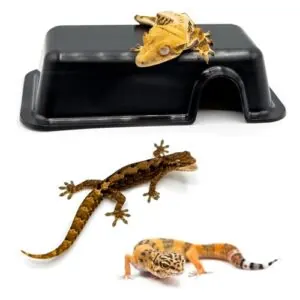
When you’re raising the tiniest hatchlings — think newborn ball pythons or freshly hatched leopard geckos — the Pangea Mini Reptile Hide Box is purpose-built for them.
At just 5.5 × 3 × 1.5 inches, it wraps snugly around a coiled hatchling, triggering that instinctive sense of safety. The offset door keeps sightlines blocked, so your snake stays calm rather than defensive.
Non-porous ABS plastic wipes clean in seconds — no excuses for skipping sanitation.
| Best For | Hatchling keepers and breeders who need a compact, easy-to-clean hide for newborn ball pythons, baby boas, leopard geckos, and other small reptiles. |
|---|---|
| Door Design | Offset door |
| Wall Thickness | 1/8 in (3.2 mm) |
| Surface Finish | Smooth, non-porous |
| Color | Black |
| Rack Compatible | Yes |
| Primary Use | Hatchling ball pythons, baby boas |
| Additional Features |
|
- Offset door design blocks sightlines and helps hatchlings feel genuinely secure, reducing stress-related defensive behavior
- Non-porous ABS plastic is a breeze to sterilize — perfect for breeding programs or rack setups where hygiene matters
- Low-profile shape slides right into standard shoe-rack units without wasting space
- Very lightweight, so it can shift or tip easily in larger enclosures unless anchored down
- Your reptile will outgrow it — once juveniles hit a certain size, you’ll need to upgrade to a bigger hide
- Plain black plastic won’t win any aesthetic points if you’re going for a naturalistic or decorated terrarium look
4. Heavy Duty Small Snake Hide
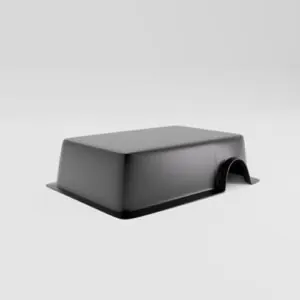
When a hatchling is actively curious and testing every corner of its enclosure, a flimsy hide won’t hold up. The Heavy Duty Small Snake Hide is built from thick, BPA-free plastic with reinforced walls that resist crushing and gnawing — because hatchlings are surprisingly persistent.
At 4.5 × 3.5 × 2 inches, the fit is snug without crowding. The offset, rounded entrance protects against injury during fast retreats, while the removable base plate makes full sanitation completely tool-free.
| Best For | Hatchling ball pythons and corn snakes that need a secure, private retreat in starter enclosures or rack systems. |
|---|---|
| Door Design | Offset door |
| Wall Thickness | 1/8 in |
| Surface Finish | Smooth, non-porous |
| Color | Black |
| Rack Compatible | Yes |
| Primary Use | Hatchling ball pythons, corn snakes |
| Additional Features |
|
- Built from tough, non-toxic polypropylene that’s nearly unbreakable — no worrying about curious hatchlings gnawing through it
- Smooth interior and exterior surfaces make cleaning quick and hassle-free, with no grooves for waste to hide in
- The offset door limits line of sight, giving hatchlings a genuinely dark, stress-reducing space to retreat to
- Only sized for small snakes and hatchlings — you’ll need to upgrade as your snake grows
- Not suitable for aquatic setups or high-humidity habitats, so it’s limited to drier enclosures
- The black finish can absorb heat, which may throw off temperature gradients in smaller enclosures if you’re not careful
Set Up Warm and Cool Hides
Getting the temperature setup right is one of the most important things you can do for a hatchling snake’s health and confidence. It’s not complicated, but it does require placing your hides intentionally and keeping a close eye on what’s actually happening inside the enclosure.
Here’s exactly how to set up your warm and cool hides so your hatchling always has the right spot to regulate.
Place Warm Hide Over Heat

Your warm hide’s job is simple but essential — sit it directly above the heat source to create a localized microclimate where your hatchling can thermoregulate safely.
| Setup Element | Target |
|---|---|
| Warm hide temperature | 80–90°F interior |
| Heat source type | Mat, panel, or UTH |
| Thermostat setting | Below 100°F |
| Probe placement | Inside warm hide |
Use a digital probe inside to confirm temperatures stay on target and prevent overheating risks.
Position Cool Hide Opposite
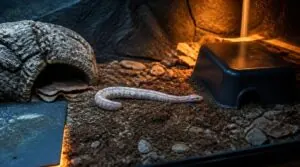
Once your warm hide is locked in over the heat source, the cool hide needs to anchor the opposite end of the enclosure — that’s what completes the thermal gradient your hatchling depends on.
Place it directly on the cool-side floor, away from the heat mat entirely. This spacing lets your hatchling snake move freely between zones, choosing warmth or cooler refuge on its own terms — a natural thermoregulatory pattern that mimics wild burrowing behavior.
- Opposite wall placement prevents retreat crowding at one end
- Low entry threshold suits small hatchling bodies
- Smooth interior surfaces prevent snagging during entry or exit
- Stable footing stops tipping when the snake repositions
- Distance from water bowls keeps interior humidity controlled
That freedom of movement also encourages exploratory behavior, reducing the stress that builds when hatchling snakes feel trapped between competing needs. A snake that can reach security and a cooler microclimate without choosing one over the other is a calmer, healthier animal.
A snake that can reach both security and cool refuge without compromise is simply a calmer, healthier animal
Check Temperatures With Probes
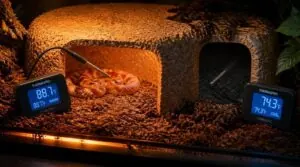
With both hides positioned, your next job is to verify what’s actually happening inside each zone — not guess. A snake that looks settled isn’t necessarily comfortable; the numbers tell the real story.
Use two probes per enclosure: one inside the warm hide, one on the cool side. Insert the warm-side probe about 1–2 cm deep so it reads core surface temperature rather than ambient air. Keep it away from the heat mat’s direct edge to avoid skewed readings.
| Zone | Target Temperature |
|---|---|
| Warm hide interior | 28–32 °C |
| Cool hide interior | 22–26 °C |
| Warm-side air (ambient) | 26–28 °C |
| Cool-side air (ambient) | 22–24 °C |
| Max safe warm-side limit | 32 °C |
When choosing between a thermocouple vs RTD, RTD probes (PT100) win for hatchling setups — they deliver accuracy within 0.1 °C and drift far less over time than thermocouples, which can wander by ±1–2 °C without warning. That margin matters when you’re managing a thermal gradient this narrow.
Preventing probe drift means calibrating weekly. Check readings at the same time each day, and swap out any probe showing more than 0.5 °C shift over 24 hours. Your digital thermometer should display stable readings to within 0.1–0.2 °C when conditions aren’t changing.
Don’t skip the digital hygrometer either — humidity inside the warm hide directly affects how your hatchling experiences heat.
Maintain a Safe Gradient
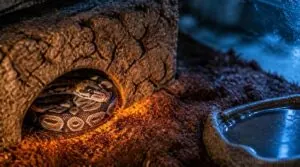
Once your probes are giving you reliable readings, the real work is keeping those numbers steady — not just at setup, but day after day.
Thermal gradient stability means holding your warm hide between 28–30 °C and your cool side between 22–26 °C, with a 4–8 °C differential separating the two zones. That range isn’t arbitrary. Your hatchling’s digestive enzymes, shedding cycles, and metabolic rate all depend on it staying consistent.
Substrate plays a bigger role here than most keepers expect. Deeper bedding retains heat longer, which smooths out minor fluctuations from the heat mat — think of it as thermal insulation between the mat and your snake’s belly. Uneven substrate depth, though, creates localized hotspots that skew your probe readings and push your hatchling into one zone without the ability to self-regulate.
Don’t overlook microclimate shade variations either. Small objects — a water dish, a décor piece, even the hide itself — cast slight shade that shifts the local temperature by a degree or two. Placed thoughtfully, these create a gentle microclimate buffer. Placed carelessly, they break the smooth temperature gradient your hatchling relies on to move freely between zones.
Day-to-night gradient consistency matters just as much. Hatchlings under a year old shouldn’t experience dramatic overnight drops — keeping heating stable through the night cycle prevents stress-driven defensive behaviors and helps maintain steady feeding routines. A redundant thermostat set below 38 °C gives you a reliable safety net on the warm end.
Log your readings daily. Trends matter more than single snapshots — a probe creeping 0.5 °C warmer each week signals drift before it becomes a problem.
Add Humid Hide When Needed
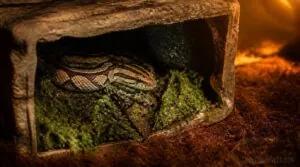
Your temperature gradient is dialed in — now think about shedding.
A humid hide box gives your hatchling a localized humidity pocket of 50–70% without saturating the whole enclosure. Pack sphagnum moss damp but never dripping, and place it on the warm side. Check moisture weekly, and watch for increased time inside — that’s your hatchling telling you a shed is coming.
Reduce Stress With Secure Design
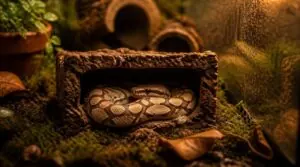
A hatchling that feels exposed is a hatchling under stress — and that stress shows up fast in refusal to eat, constant movement, and poor weight gain.
The good news is that smart hide design takes care of most of this before it becomes a problem.
Here’s what to look for when choosing hides that make your snake feel safe.
Use Offset Door Openings
A stressed hatchling isn’t just uncomfortable — it’s a snake that won’t eat. That’s where offset entry design makes a real difference in your snake hide boxes.
- Door swing clearance stays tight, so the hide sits flush against rack walls
- Pinch point prevention protects fragile hatchlings during entry
- Stress reduction geometry limits direct sightlines into the retreat
Hinge alignment maintenance keeps everything functioning smoothly.
Choose Low-profile Mini Hides
When a hatchling first explores its enclosure, a low-profile mini hide acts like a burrow — just enough space to feel buried, not lost.
With an inner height around 2.5 cm and an external footprint under 8 cm × 6 cm, these compact hides slip cleanly onto narrow rack shelves without wasting space or crowding your hatchling’s world.
Limit Direct Visibility
Think of it this way: a hatchling’s brain is wired to treat every open sightline as a threat.
Off-axis entrances bend the approach path, so no direct line exists between the entrance and the snake’s resting spot. Shadow and light scattering textures on interior walls diffuse brightness, softening any silhouette.
Three design details that cut visible exposure:
- Angled doorways that force body reorientation before entry
- Matte interior surfaces that scatter rather than reflect light
- Tapered entry lips that cast natural shadow across the opening
Keep Surfaces Stable
A hide that rocks or slides is a hide your hatchling won’t trust. Anti-slip coatings or textured rubber mats keep the base locked in place, while a level substrate — flat within 1/8 inch — prevents wobbling entirely.
Wipe surfaces weekly with a reptile-safe disinfectant and dry them completely, because moisture residue is the quiet culprit behind shifting hides.
Fit Racks and Tubs
Your rack is the backbone of everything — get it wrong, and even the best vivarium hide box works against you. Use 14-gauge steel frames with a five-bolt pattern for genuine rigidity.
Leveling feet correct uneven floors so tubs sit flat. Aim for 25 mm clearance between tubs, keeping airflow steady and your hatchling hides safely stable.
Clean Hatchling Hide Boxes Safely
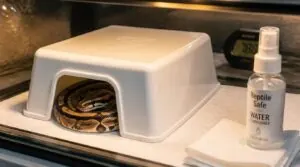
Keeping your hatchling’s hide clean isn’t complicated, but it does need to be consistent. A smooth, non-porous hide like ABS plastic makes the job easier — no hidden grooves for bacteria to hide in, no moisture soaking through the walls.
Here’s what a solid cleaning routine actually looks like, step by step.
Beyond regular spot-cleaning, picking the right base layer matters too, and this guide on choosing safe reptile substrates for classroom habitats breaks down options that hold up well between full changes.
Remove Waste Quickly
Waste doesn’t wait — and neither should you. Remove droppings from your hatchling’s hide within two hours to shut down bacterial growth before it starts.
The nonporous interior surface means nothing clings; a quick scoop leaves almost nothing behind.
A labeled waste port lets you clear the tray in one clean motion without disturbing your snake at all.
Wash With Reptile-safe Disinfectant
Once waste is gone, the real clean begins. A reptile-safe disinfectant at a 200–2000 ppm dilution eliminates bacteria, viruses, and fungi without putting your hatchling at risk. That nonporous ABS surface is your ally here — nothing hides in it.
Let the solution sit for the full recommended contact time. Don’t rush it. Ventilate the area while you work.
Rinse and Dry Completely
After disinfecting, rinse every surface thoroughly — no chemical residue should remain. Use a bright light to check corners and seams for hidden droplets.
Don’t stack hides while drying. Air dry at least 60 minutes in a ventilated spot. A clean towel absorbs surface moisture, but airflow finishes the job. Confirm the interior feels completely dry before returning it to your rack.
Sanitize Monthly for Hygiene
Even after a thorough rinse and dry, invisible biofilm can quietly rebuild over weeks. That’s why monthly deep sanitization matters — it resets your hide’s microbial load before problems develop.
- Use a broad-spectrum EPA-registered disinfectant with a contact time of at least five minutes
- Wear gloves and maintain ventilation during application
- Log the date each time you sanitize to stay consistent
Replace Cracked Hide Boxes
A cracked hide isn’t just an eyesore — those rough, jagged edges can tear delicate hatchling scales during a shed. Inspect edge sharpness every week while you clean. Run a finger along the interior; if anything catches, retire it immediately.
Durable hides made from thick ABS plastic last longer, but no hide survives forever. When in doubt, replace it.
Frequently Asked Questions (FAQs)
Do snakes like small hides?
Yes — snakes instinctively prefer snug enclosures where their body contacts multiple walls. That wall contact signals safety to their nervous system, reducing stress hormones and encouraging calmer, more settled behavior in size-appropriate hides.
Can hatchlings share a hide box safely?
They can, but it’s risky. Aggression and resource monopolization are real concerns — one hatchling often claims the hide entirely. Give each snake its own dedicated retreat whenever possible.
How often should hide boxes be replaced?
Replace hides every 12–18 months, sooner if you spot cracks, persistent odors, or mold. Growth spurts in the first year may push upgrades every 2–3 months as your hatchling outgrows snug fits fast.
Do hatchlings need multiple hides at once?
Yes — two hides minimum gives your hatchling genuine microclimate diversity. One warm, one cool. That simple setup lets them thermoregulate on their own terms, cutting stress before it ever starts.
What materials are reptile-safe for hatchling hides?
ABS plastic, ceramic, food-grade silicone, cork, and kiln-dried hardwood are all reptile-safe materials. Each is non-toxic, nonporous or low-absorption, and won’t offgas harmful chemicals inside your hatchling’s enclosure.
Are bulk hide box purchases worth the cost?
When you’re stocking dozens of enclosures, bulk hide box purchases genuinely pay off — unit prices drop 20–60%, shipping spreads thin, and your inventory stays predictable. For serious breeders, that math is hard to argue with.
Conclusion
A hatchling snake living in an oversized, poorly placed hide isn’t just uncomfortable—it’s surviving on borrowed time, its stress response quietly dismantling everything you’re trying to build. That’s not dramatic; that’s just biology.
Getting your snake hide boxes for hatchlings exactly right costs you almost nothing, but it pays off in feeding responses, clean sheds, and an animal that actually thrives.
Small space. Right temperature. Snug fit. That’s the whole formula.