This site is supported by our readers. We may earn a commission, at no cost to you, if you purchase through links.

When a male red-sided garter snake emerges from winter dormancy in Manitoba, he doesn’t waste time. Within hours, he’s already tracking a female through an invisible chemical signature—a trail of long-chain hydrocarbon pheromones she’s left across the ground. What follows unfolds as one of nature’s most intricate behavioral sequences, built not on brute force but on precision, endurance, and biochemical persuasion.
Male snake mating displays span a broad range: chin-rubbing rituals that chemically prime female receptivity, combat dances where rival rattlesnakes wrestle for dominance without landing a single venomous bite, and post-mating strategies so complex they include biochemical plugs designed to lock out competitors. These aren’t instinctive reflexes running on autopilot—they’re layered, adaptive behaviors shaped by millions of years of reproductive pressure. Understanding them changes how you see every snake you’ll ever encounter in the field.
Table Of Contents
Key Takeaways
- Male snakes track females using long-chain hydrocarbon pheromones that can persist for hours across terrain, guiding them from hundreds of meters away with remarkable chemical precision.
- Rival males don’t fight to the death — they perform ritualized combat dances that test strength and stamina, letting the strongest male win mating rights without either snake being seriously hurt.
- After mating, males form biochemical plugs through enzymatic hardening of seminal proteins, physically blocking rival sperm while also standing guard to deny competitors access to the female.
- Females can store viable sperm for months or even years inside specialized spermathecae, meaning a single mating event can produce offspring long after the encounter — and from multiple fathers within one clutch.
What Are Male Snake Mating Displays?

When male snakes enter breeding season, their behavior shifts into something almost theatrical — a precise choreography of chemical signals, physical displays, and, sometimes, ritualized combat. What drives these behaviors isn’t aggression for its own sake, but a finely tuned biological script aimed at one outcome: successful reproduction.
From subtle chin rubs to persistent tail-searching, the full sequence of snake breeding behavior signs reveals just how methodical this biological script truly is.
Here’s what that actually lookslike across the key dimensions of snake mating displays.
Breeding Season Behaviors
Each spring, as ambient temperatures cross species-specific thermal thresholds; something ancient awakens in male snakes. Rising warmth and lengthening days trigger hormonal cascades that sharpen aggression, expand roaming ranges, and align male readiness with female receptivity — a synchronization refined over millions of years.
Even modest warming of 0.3–0.6 °C can advance breeding season onset by weeks. Snakes can show heightened territorial aggression during this period.
Courtship Versus Combat
Once a male snake locates a receptive female, two distinct behavioral modes emerge: courtship versus aggression.
Courtship involves gentle chin-rubbing, body undulations, and chemical signaling directed toward the female.
Male combat dances, by contrast, occur exclusively between rivals — ritualized wrestling matches that test strength and stamina through non-lethal dominance, establishing hierarchical access to mates without drawing blood.
Species-Specific Displays
What sets one species apart from another isn’t just anatomy — it’s the species-specific courtship language each has evolved.
Ball pythons deliver rhythmic spur‑tapping near the female’s cloaca; garter snakes perform synchronized body undulations tuned to their species’ tempo; rattlesnakes pair rattle vibration patterns with scent marking into smooth multimodal sensory integration that leaves little room for misidentification.
Why Displays Matter
Every species-specific display you’ve just encountered fulfills a deeper purpose: survival of the fittest lineage.
Visual recognition and pattern differentiation allow males and females to identify appropriate mates rapidly, even in cluttered, low-light environments. Motion sensitivity determines reaction speed during rival combat dances, while display reliability signals genuine genetic fitness — because only a truly healthy male sustains hours of courtship without faltering.
- Visual clarity aids species recognition
- Pattern contrast accelerates mate selection
- Motion detection sharpens combat responses
- Display endurance signals reproductive fitness
- Environmental clarity maximizes mating success
How Male Snakes Find Females

Finding a mate isn’t luck for a male snake — it’s a precision-guided mission built on chemistry, instinct, and relentless drive. Before any courtship display begins, he first has to locate her, and nature has equipped him with a surprisingly intricate toolkit to do exactly that. Here’s what drives that search.
From tongue-flicking pheromone detection to competitive male displays, the full picture of what happens next is captured in this corn snake breeding behavior and courtship guide.
Female Pheromone Trails
Think of a female snake’s pheromone trail as an invisible highway — a chemically encoded message that can persist for hours across leaf litter, bark, and soil.
Species-specific epidermal secretions, deposited from cloacal and ventral glands, attract males from several hundred meters away, with long-chain hydrocarbons resisting evaporation to extend trail longevity under dry, sheltered microhabitat conditions.
Tongue-Flicking Signals
When a male snake encounters a female’s pheromone trail, his tongue becomes a precision instrument. Rapid tongue-flicking transfers scent particles directly to the Jacobson organ, where chemoreceptors decode the chemical message instantly.
- Males flick faster as pheromone concentration rises
- Flicking tempo reveals distance to the female
- Humidity affects scent retention and detection accuracy
- Neural circuits trigger courtship upon confirmed detection
- Behavioral state shifts visibly through flicking rhythm
Synchronized Female Shedding
Beneath the chaos of a mating ball, something quieter is happening across the landscape. Rising spring temperatures and lengthening days trigger hormonal shedding cascades in females almost simultaneously, renewing chemoreceptors and amplifying pheromone output.
This microclimate-driven synchrony spreads like a molt wave through the population — concentrating courtship windows, reducing predator exploitation of vulnerable individuals, and even facilitating communal parasite removal as cohorts shed skin together.
Following Rival Males
You can actually leverage rivals to find females. When a male tracks a competitor’s scent trail, he’s effectively outsourcing reconnaissance — following intel gathered at another male’s expense.
Rival proximity triggers faster courtship initiation and intensified body coiling. In dense vegetation, chemical cues replace visual tracking entirely.
Once a female is located, the follower repositions strategically, inserting himself between rival and female to monopolize cloacal access.
Courtship Signals Before Mating
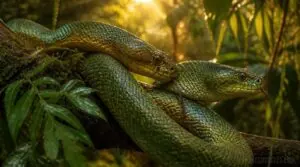
Before a male snake ever attempts to mate, he goes through a precise sequence of physical signals designed to win the female over — and it’s more intricate than most people realize. These courtship behaviors are finely tuned, species by species, to communicate readiness and build receptivity.
Here’s what that process actually looks like, from first contact to cloacal alignment.
Chin-Rubbing Behavior
When a male snake slides his chin deliberately along a female’s back, he’s doing something far more calculated than it appears.
Chin gland pheromones transfer directly onto her scales during this contact, a chemical conversation that signals his readiness and prepares her receptivity — a remarkably intimate exchange built entirely on scent and touch.
Body Waves and Undulations
When a male snake ripples his body in sinuous lateral waves, he’s broadcasting fitness in a language females instinctively read.
Wave initiation usually travels from head toward tail, building amplitude through the midbody before tapering — a propagation pattern that maximizes visual reach while conserving energy.
- Tight, rapid undulations signal vigor
- Broader, slower waves suit open terrain displays
- Wave tempo escalates when rivals are nearby
- Females respond with tail-lifting or posture shifts
Spur Tapping in Boas
Where body waves speak through motion, spur tapping speaks through touch.
In species like the boa constrictor, males possess keratinous ventral spurs — small paired projections near the cloaca — and use them to deliver brief, rhythmic taps against the female’s scales, generating low-amplitude vibrational cues that signal readiness and help the male assess her receptivity through her immediate postural response.
Cloacal Alignment
Once tactile contact has been established, the real precision begins.
Cloacal alignment demands exquisite muscular coordination — the male repositions his tail to orient his everted hemipenis directly toward the female’s cloacal opening, a momentary yet anatomically critical event where species-specific shaft geometry and cloacal musculature must synchronize perfectly to allow successful sperm transfer without leakage or misdirection.
Female Tail-Lifting
Once the male achieves cloacal alignment, the female’s response becomes decisive.
Female tail-lifting is a primary receptivity signaling cue — she arches her tail, exposing the cloacal region and enabling precise cloacal exposure mechanics that facilitate intromission. This posture functions as both invitation and mate selection filter, reducing wasted courtship time with unsuitable males while dramatically improving mating efficiency benefits for compatible pairs.
Male Competition and Combat Dances
When male snakes compete for a mate, things get surprisingly theatrical — and surprisingly restrained. What looks like a battle is really a carefully choreographed test of strength, stamina, and nerve. Here’s what’s actually happening when males square off for the right to reproduce.
Rattlesnake Combat Displays
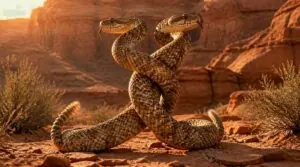
When two rival rattlesnakes meet during breeding season, what unfolds isn’t violence — it’s a masterclass in non-violent dominance.
Through acoustic rattle signals, defensive body collars, and visual threat postures, males choreograph an elaborate ritual that determines who mates.
The loser retreats. The winner proceeds toward the female. No fangs required.
Cobra and Kingsnake Wrestling
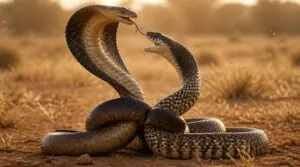
Wrestling begins the moment a cobra spreads its hood — hood flare intimidation at its purest, signaling dominance before contact. Kingsnakes counter with coiling balance tactics, anchoring low to resist displacement.
Both species maintain strike readiness dynamics, jaws slightly parted. Substrate grip influences every exchange — warm, bare ground intensifies the male combat dance, ultimately determining which cobra or kingsnake earns mate competition rights.
Dominance Without Serious Injury
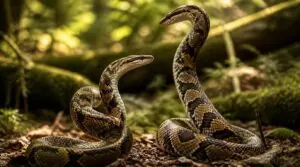
What’s striking is that the male combat dance resolves almost entirely through ritual — no torn scales, no venom exchanged. Subordinate males read ritualized posture signals and retreat a tail‑length, preserving energy rather than escalating.
This non-violent dominance system, rooted in intrasexual competition, selects the strongest male courtship display without casualties, keeping both rivals fit for future mate competition.
Mating Balls in Garter Snakes
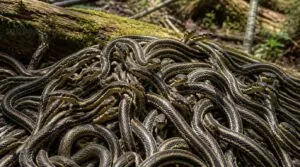
When dozens of male garter snakes converge on a single receptive female, the result is one of nature’s most intense breeding aggregations — a writhing mating ball that can last several hours.
Female pheromone influence is remarkable here: her estrogen-driven chemical signals draw males from considerable distances, collapsing individual courtship behavior into collective frenzy, where pushing, wedging, and endurance determine which male achieves cloacal alignment.
Selection of Dominant Males
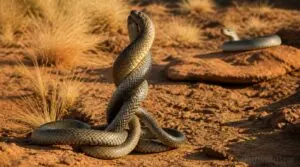
What separates a winner from a bystander comes down to body condition and stamina. Males with greater energy reserves outlast rivals in prolonged combat dances, securing dominance tenure long enough to guard receptive females against challengers.
This paternity skew — where a single dominant male sires the majority of offspring — reflects sexual selection at its most unforgiving.
Copulation and Post-Mating Strategies
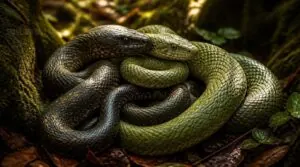
Once mating is secured, the biological chess match doesn’t end — it actually intensifies. Snakes have evolved a suite of post-mating strategies that are as intricate as anything that happens during courtship. Here’s what’s happening at the anatomical and genetic level when copulation occurs.
Paired Hemipenes
Male snakes possess paired hemipenes stored inverted inside the tail’s base, everting outward during copulation through erectile tissue swelling. Only one engages per mating event.
Their species-specific ornamentation — spines, hooks, ridges — anchors the organ within the female’s cloaca while a groove called the sulcus spermaticus channels sperm precisely into the female’s reproductive tract, enabling efficient fertilization.
Mating Plug Formation
Once the hemipenis withdraws, a extraordinary biochemical process begins. Seminal protein polymerization locks the ejaculate in place — seminal proteins mix with seminal plasma, then enzymatic cross-linking via transglutaminases hardens the mass into a stable, gelatinous plug.
Reproductive tract pH and temperature govern coagulation speed, while copulatory barrier efficacy scales with plug size, directly influencing fertilization rate and post-mating paternity competition.
| Factor | Variable | Effect on Plug |
|---|---|---|
| Enzymatic activity | Transglutaminase 4 | Accelerates hardening |
| Tract pH | Acidic vs. neutral | Alters coagulation speed |
| Plug size | Millimeters to centimeters | Correlates with fertilization success |
Rival Male Blocking
Even after a mating plug forms, a male’s reproductive work isn’t finished. Rival male blocking begins immediately — dominant males use their bodies as physical barriers, pressing between the female and approaching competitors to deny access entirely.
- Physical positioning against the female’s cloaca cuts off rival intromission attempts
- Tight shelters and habitat bottlenecks enhance blocking effectiveness dramatically
- Head-raising and coiling communicate dominance rank without escalating to combat
- Higher-ranking males sustain guarding longer, reducing rival fertilization chances
Post-copulatory vigilance can extend until the female moves away completely.
Female Sperm Storage
While rival males are being physically blocked, something equally strategic unfolds inside the female. Female sperm storage transforms a single mating event into a prolonged reproductive asset.
Specialized tubules called spermathecae — lined with secretory epithelium — supply stored sperm with antioxidants, protective proteins, and nutrients, maintaining viability for months or even years until conditions favor fertilization.
Inside spermathecae, a female snake preserves sperm for years, fertilizing offspring long after mating ends
Multiple Paternity Outcomes
The capacity for multiple paternity within a single clutch transforms reproductive success from a single event into a genetic lottery with significant stakes. When a female has stored sperm from several males, offspring within one litter can range from half- to full siblings, broadening genetic diversity in ways that single-sire broods simply can’t match.
Frequently Asked Questions (FAQs)
What do male snakes do during mating season?
When spring arrives, male snakes shift into overdrive — tracking pheromone trails, performing courtship rituals, competing through combat, and positioning for copulation to enhance reproductive success during nature’s narrowest mating window.
Can female snakes reject unwanted male suitors?
Yes — female snakes actively reject unwanted suitors. Through rapid dispersal, scent avoidance, and spatial site selection, females reduce harassment without necessarily choosing mates by quality.
How long does snake mating season typically last?
Snake mating season is fascinatingly short — and long, depending on where you look. Temperate zones compress it into 2–3 months; tropical species breed year-round, driven purely by favorable conditions.
What role does habitat destruction play in mating success?
Habitat destruction quietly dismantles the conditions reproduction depends on, shrinking encounter rates by up to 40 percent across fragmented landscapes and disrupting the pheromone trails that guide males toward receptive females.
Are male snake displays affected by predator presence?
Yes — predator presence forces males to shorten displays, suppress pheromone signals, and shift toward cryptic movement, trading elaborate courtship for survival, since vulnerability during mating creates real tradeoffs between reproductive success and staying alive.
Conclusion
Somewhere, a wildlife documentary narrator is gasping dramatically while a male garter snake simply chin-rubs his way to extraordinary reproductive success. Male snake mating displays don’t care about your expectations—refined across 100 million years of evolutionary pressure, they’ve outlasted every romantic comedy ever written.
Once you understand the biochemistry behind combat dances, plug formation, and pheromone trails, you won’t look at a snake the same way again.
Nature’s oldest courtship script still runs flawlessly.