This site is supported by our readers. We may earn a commission, at no cost to you, if you purchase through links.

A gravid female will stop eating weeks before she lays, pace her enclosure at odd hours, and press her body flat against the warmest surface she can find. These aren’t random behaviors. They’re your signal that something significant is happening inside her.
Timing a successful breeding depends on reading those signals correctly. Miss them, and you risk pairing snakes before they’re physiologically ready, stressing animals that aren’t cycling, or losing a clutch to poor preparation. The stakes are real.
Knowing the signs your snakes are ready to breed puts you in control of the outcome before problems develop.
Table Of Contents
- Key Takeaways
- Confirm Breeding Age, Sex, and Health
- Watch for Behavioral Readiness Signs
- Check Physical and Appetite Changes
- Match Species, Season, and Environmental Triggers
- Prepare Safely and Prevent Complications
- Frequently Asked Questions (FAQs)
- What month is breeding season for snakes?
- How long do snakes take to breed?
- How hard is it to breed snakes?
- What’s the easiest snake to breed?
- How long after mating do snakes lay eggs?
- Can snakes breed without a male present?
- What age should snakes be before breeding?
- How often can female snakes safely breed?
- Do all snake eggs need incubation equipment?
- How many times can a snake breed per year?
- Conclusion
Key Takeaways
- Confirm breeding readiness first through species-specific age thresholds, stable or increasing body weight, and a pre-breeding vet exam screening for parasites, infections, and reproductive abnormalities.
- Behavioral signals like restless pacing, substrate digging, and rapid tongue flicking can appear 2–14 days before mating, giving you your best window to time introductions correctly.
- Match your species’ natural cycle by dialing in temperature (28–32°C with a nighttime drop), 60–80% humidity, and photoperiod or brumation schedules, since roughly 80% of first-time breeding failures trace to missed readiness cues rather than genetics.
- Prepare the laying box and incubator before oviposition begins, monitor gravid females with regular weighing and calcium supplementation, and treat prolonged straining, open-mouth breathing, or pushing without progress as dystocia warning signs requiring immediate attention.
Confirm Breeding Age, Sex, and Health
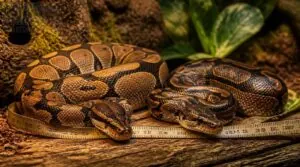
Before you attempt breeding, you need to confirm that your snakes are physically and developmentally ready. Age, sex, and health form the non-negotiable baseline. Here’s what to verify before proceeding.
Consulting a guide on snake species best suited for breeding can also help you gauge realistic maturity timelines before you commit to a pairing.
Sexual Maturity by Species
Maturity timelines vary by species. Smaller colubrids often reach breeding readiness at 9-12 months, while larger constrictors need 18-24 months or more.
Don’t rush it. Pairing snakes before they’ve hit species-specific reproductive thresholds risks failed copulation, stress injuries, and health setbacks.
Confirm males show active spermatogenesis and females have reached at least 60-70% of adult length before you introduce them.
Healthy Body Condition
Age thresholds matter, but so does physical condition. A snake that’s technically mature but underweight isn’t ready. Stable or increasing body mass in the weeks before pairing is your clearest indicator. Tracking this precisely is easy with a reptile gram scale, which lets you catch subtle weight trends long before they become visible.
Snakes entering breeding should show adequate midbody girth, no visible hollowing along the flanks, and consistent appetite. For a gravid female especially, poor reserves mean compromised follicle development and maternal health risks.
Pre-Breeding Veterinary Checks
Once body condition looks right, get a pre-breeding vet exam done. A reptile-experienced vet can confirm what you can’t see externally. Screening covers:
- Respiratory infection
- Internal and external parasites
- Cloacal or urogenital abnormalities
- Reproductive tract masses or lesions
- Hydration status and body mass trend
Catching any of these early, before pairing, protects both animals.
Watch for Behavioral Readiness Signs
Your snake’s behavior shifts before anything else does. Recognizing these early signals lets you act at the right time instead of guessing. Watch for three key changes that consistently appear when a snake is approaching breeding readiness.
Increased Activity and Restlessness
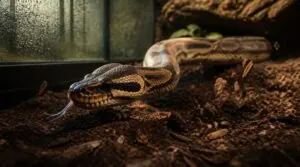
Studies show snakes can boost locomotion by up to 300% in the two weeks before breeding. Increased activity is your first signal.
This restlessness often coincides with heightened hunger, so tracking both behaviors together—as outlined in this guide to recognizing feeding cues in baby snakes—helps you stay one step ahead.
Watch for pacing, rapid enclosure exploration, and substrate disturbance. These courtship behaviors often surface 2 to 14 days before mating, well ahead of female receptivity. Spot increased restlessness early and you’ll time introductions to match mating season timing.
| Behavior | Onset Before Mating | Common In |
|---|---|---|
| Restless pacing | 2–14 days | Colubrids, boids |
| Substrate digging | 3–10 days | Terrestrial species |
| Daytime activity spike | 5–7 days | Most captive species |
Intensified Tongue Flicking
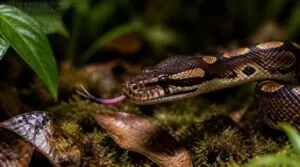
How often your snake flicks its tongue tells you more than you’d expect. Intensified tongue flicking, with bursts every few seconds, signals active mate searching. Your snake drives pheromone detection through its vomeronasal organ, also called Jacobson’s organ, reading chemical cues tied to female receptivity. Watch for shorter flick intervals and increased substrate contact. That shift is your clearest early indicator.
Rapid tongue flicking every few seconds is a snake’s clearest signal that it is actively searching for a mate
Courtship and Mating Behaviors
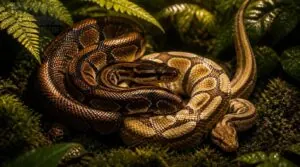
Once you introduce a male, watch for intensified tongue flicking as he traces pheromone signals along the female’s body. These mating rituals progress fast: he’ll align alongside her and follow persistently.
If she’s receptive, she’ll respond with tail elevation and allow mounting. Chin-rubbing and rhythmic movement confirm active courtship. Separate males immediately; male-male competition in snakes causes serious injury.
Check Physical and Appetite Changes
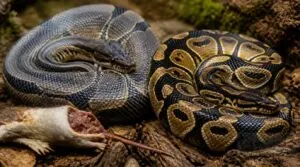
Beyond behavior, your snake’s body tells you just as much about breeding readiness. Physical and appetite changes follow a predictable pattern you can learn to recognize. Watch for these four signs in sequence as the cycle progresses.
Pre-Breeding Appetite Increase
Before courtship begins, many snakes eat more aggressively. This pre-breeding appetite surge usually appears 1-2 weeks before first courtship, driven by hormonal shifts that fuel energy accumulation.
Track your snake’s baseline intake closely and watch for a 20-30% uptick. When you spot it, switch to higher-calorie, easily digestible prey to meet nutritional needs during breeding without overloading the digestive system.
Adding a reptile calcium supplement for breeding to her feeding routine during this period helps support the extra physiological demands without straining digestion.
Reduced Interest in Food
Some gravid females experience complete appetite loss for 4 to 8 weeks before laying. That’s prelaying anorexia, a hormone-driven response you should anticipate.
Food refusal that coincides with follicle development and behavioral changes is normal.
But when reduced interest in food appears without other breeding signs, check for illness or stress before assuming your snake is reproductively ready.
Weight Gain and Thickening
Fat builds slowly. In the weeks before breeding, a pre-breeding fattening phase produces visible body thickening, especially through the abdomen, where coelomic fat deposits soften and widen the midline.
Your female’s profile shifts from lean and cylindrical to fuller, almost pear-shaped. A body condition score of 4 or higher signals she’s accumulating the energy reserves follicle development demands.
Visible Eggs or Follicles
When follicle development advances, you can feel it. Palpation for follicle development reveals pea-sized swellings along the lower body within 15 minutes. Confirm with ultrasound in reptiles to rule out feeding-related distension.
Watch for these gravidity indicators:
- Translucent oviductal swellings near the cloaca
- Rapid enlargement in the final 3-7 days
- Visible coelomic bulging as egg development nears ovulation
Match Species, Season, and Environmental Triggers

Not every snake breeds on the same schedule, and matching your setup to your species is what separates a successful pairing from a failed one.
Environmental cues like temperature shifts, humidity, and light cycles act as biological triggers that tell your snake when conditions are right.
These four factors will help you align your setup with your snake’s natural cycle.
Species-Specific Breeding Seasons
Because breeding season timing varies by species, you can’t apply a universal calendar to your collection. A ball python’s window differs from a corn snake’s or a boa constrictor’s. Research your species’ natural breeding window and replicate it.
Some taxa require brumation to activate reproductive cycling; others respond to photoperiod shifts alone. Match your setup to species-specific requirements.
Temperature and Humidity Cues
Once you’ve matched your species’ calendar, dial in temperature and humidity levels precisely. Climate is the trigger.
- Maintain 28-32°C with a 2-4°C nighttime drop
- Hold humidity at 60-80% to promote pheromone release
- Create temperature gradients across zones, not uniform heat
- Log sensors weekly to catch drift before it delays breeding
Moisture control matters as much as warmth.
Light Cycles and Brumation
Light works alongside temperature cycling. Photoperiod manipulation drives hormonal shifts that heat alone can’t produce. Increase daily light gradually from 8 to 14 hours over 2-3 weeks post-brumation.
| Phase | Temperature | Daily Light |
|---|---|---|
| Pre-brumation | 20-22°C | 10 hrs |
| Brumation | 12-16°C | 8 hrs |
| Early emergence | 18-22°C | 10-12 hrs |
| Pre-breeding | 26-28°C | 12-14 hrs |
| Active season | 28-32°C | 14 hrs |
For species with brumation requirements, hold the cool period for 8-12 weeks. Then ramp both light and warmth together. Light exposure effects accumulate over weeks, not days. Don’t rush the cycle.
Egg-Laying Versus Live Birth
Once your light and heat cycles are dialed in, egglaying vs livebearing changes everything else you’ll do.
- Oviparous species need a laying box and incubator ready well before eggs arrive.
- Viviparous species require sustained nutrition and low-stress conditions throughout gestation.
- Confusing the two always leads to preventable losses.
Know your snake’s exact species-specific requirements before reproductive readiness peaks, not after.
Prepare Safely and Prevent Complications
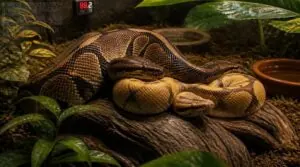
Once you’ve confirmed readiness, the real work begins. Getting your setup right before breeding starts can mean the difference between a successful clutch and a medical emergency. These four areas demand your attention.
Laying Box and Incubator
Don’t wait until she’s pacing. Have the laying box set before oviposition begins, with coconut fiber or sphagnum as your moisture-retentive substrate, kept lightly damp and layered 2-5 cm deep.
Target 70-90% humidity during laying, then pull back to 60-70% post-clutch to prevent mold. For egg incubation, dial your thermostat to the species-appropriate range and set high/low alarms within ±2°C.
Nutrition and Stress Reduction
A consistent feeding cycle in the weeks before breeding is non-negotiable. Nutritional deficiencies in protein, fatty acids, and vitamins compromise follicle development directly. Don’t alter her diet abruptly.
Chronic stress from unnecessary handling, enclosure changes, or loud disturbances suppresses appetite and undermines reproductive readiness. Minimize your interventions, keep the routine predictable, and let stress reduction work passively in your favor.
Gravidity Health Monitoring
Studies show up to 30% of captive egg-layers experience a reproductive complication. Monitor your gravid female actively throughout gravidity.
- Weigh her every 3–4 days to track trends
- Watch for cloacal swelling or abnormal discharge
- Maintain consistent calcium supplementation throughout
- Track appetite drops and body alignment shifts
- Use ultrasound to confirm reproductive readiness
These signals together reveal dysfunction, not normal variation.
Dystocia Warning Signs
Some breeders assume prolonged straining is normal. It isn’t. Egg binding and dystocia develop when a gravid female can’t complete oviposition, and the delay is dangerous.
Watch for open-mouth breathing, repeated cloacal pushing without progress, or cloacal swelling. Poor body alignment during contractions and low calcium both stall passage. Begin calcium supplementation several weeks before your breeding season starts.
Frequently Asked Questions (FAQs)
What month is breeding season for snakes?
It depends on your species. Most temperate colubrids hit spring breeding season from March through June, once post-brumation temperatures clear 70°F consistently. Tropical and desert species often breed year-round if humidity and heat stay aligned.
How long do snakes take to breed?
Breeding isn’t a single event you can rush. The full cycle, from initial courtship to successful egg-laying or live birth, takes weeks to several months, driven by species, your temperature gradient, brumation, and feeding cycles.
How hard is it to breed snakes?
Snake breeding isn’t particularly hard if you respect species-specific requirements and plan accordingly. Learn the environmental triggers, time the breeding season correctly, and confirm reproductive readiness before pairing. Your preparation separates breeding success from failure.
What’s the easiest snake to breed?
Like a gateway into a world of scales and cycles, the corn snake is your answer. Minimal care demands, reliable breeding seasons, forgiving temperature gradients, and predictable courtship behaviors make it the ideal beginner choice.
How long after mating do snakes lay eggs?
Most oviparous snakes lay eggs within 1 to 3 months of mating. After laying, incubation usually runs 45 to 65 days. Both species and ambient temperature shape exactly where your female lands in that range.
Can snakes breed without a male present?
Yes, rarely. Parthenogenesis lets some females produce young without a male, like the Brahminy Blind Snake (Indotyphlops braminus), which reproduces asexually. Most snakes still need fertilization.
What age should snakes be before breeding?
Age depends on species. Sexual maturity in snakes ranges widely: pinkies mature at 6–12 months, colubrids like corn snakes at 1–2 years, ball pythons at 2–3, large constrictors at 2–
How often can female snakes safely breed?
How often can female snakes safely breed? Ironically, the answer isn’t "as often as they’ll accept a male." Most species need 12 months between clutches; annual breeding intervals protect against reproductive failure and exhaustion.
Do all snake eggs need incubation equipment?
No. Many species’ eggs hatch in stable natural nesting materials if you maintain proper temperature gradients and humidity levels. Commercial incubators simply give you tighter control, improving hatch rates when substrate selection alone can’t hold conditions steady.
How many times can a snake breed per year?
Most snakes breed once per year. Colubrids may produce two clutches when warmth and food stay ideal, while pythons and vipers usually need longer intervals. Use brumation and reproduction cues to set your breeding season.
Conclusion
Roughly 80% of first-time breeding failures trace back to missed readiness cues, not genetics. That number should change how you watch your animals.
The signs your snakes are ready to breed are always there: appetite shifts, restlessness, follicle swelling, courtship behavior. Your job is to read them early and act deliberately.
Confirm health, match environmental triggers, and prepare your laying setup before she needs it. Do that, and successful clutches follow predictably.