This site is supported by our readers. We may earn a commission, at no cost to you, if you purchase through links.
Getting humidity wrong kills reptiles. That sounds blunt, but it’s the reality new keepers often discover too late. A crested gecko kept at 40% RH instead of 75% starts shedding in patches. A ball python in a bone-dry enclosure stops eating for weeks. These aren’t edge cases.
Reptile misting systems take this problem off your plate entirely. No more spray bottles twice a day, no more wondering whether conditions held overnight. For beginners especially, the right system means the difference between thriving animals and constant troubleshooting. Knowing which unit fits your setup, your species, and your schedule is where everything starts.
Table Of Contents
Key Takeaways
- Getting humidity wrong can seriously harm reptiles (patchy shedding, appetite loss), so an automated misting system removes the daily guesswork and is especially valuable for beginners.
- Match the system to your species’ needs: budget picks like the Moistenland or Smart Mister suit simple setups, while the MistKing (50-micron mist, expandable to 10 nozzles) is the professional-grade choice for arboreal geckos, chameleons, and amphibians.
- Reliability depends on maintenance and water quality—use distilled or filtered water to prevent mineral clogs, soak nozzles weekly in vinegar, flush the reservoir monthly, and verify performance with a calibrated hygrometer.
- Success comes from smart scheduling more than premium hardware: run 2–4 timed cycles during dawn/dusk activity windows, avoid overnight over-humidification, and adjust based on your animal’s response rather than setting it once and forgetting it.
How Reptile Misting Systems Work
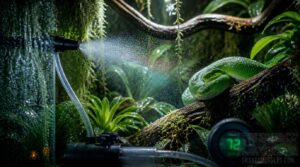
Ever wondered how a reptile misting system actually keeps your vivarium’s humidity consistent? It’s simpler than you’d think. A pump pushes water through tubing to one or more nozzles, which atomize it into fine droplets that settle on surfaces and raise ambient moisture. That’s the essence of how reptile misting systems work.
Pairing your misting system with a solid understanding of reptile humidity levels by species ensures you’re not just adding moisture — you’re hitting the right target.
The real magic happens in the controls. Run it on programmable intervals tied to a timer or humidity sensor, and the pump cycles on until your target RH is reached, then shuts off to prevent over-wetting. Pressure, nozzle geometry, and line routing determine droplet size and coverage, so taller enclosures need higher psi to reach upper zones.
Quality units are even expandable to 10 nozzles, letting you zone microclimates across multiple habitats. Add inline filters and fresh reservoir water, and you’ve got reliable, hands-off humidity.
Top 5 Reptile Misting Systems for Beginners
Now that you know how these systems work, let’s find the one that fits your setup and your budget.
I’ve pulled together five beginner-friendly options covering everything from budget picks to the hobby’s top choice. Each one earned its spot for reliability, ease of use, and real-world results in actual reptile rooms.
1. Exo Terra Monsoon Solo II Mister
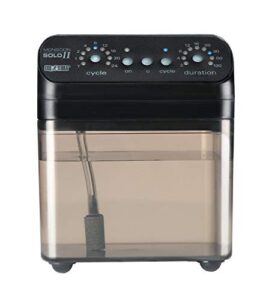
The Exo Terra Monsoon Solo II is a solid entry point for beginners who want automated misting without a steep learning curve. Its 36.25 PSI pump delivers consistent, fine mist, and it’s programmable with adjustable intervals and durations, so you can dial in humidity pulses for your species. The 1.5-liter reservoir controls extended misting between refills, and you can expand it to support two flexible spray nozzles.
Two things to know upfront: the power adapter isn’t included, so budget for that, and some users report inconsistent performance over time. Prime it properly and use distilled water to protect the nozzle.
| Best For | Beginner reptile and amphibian keepers, or tropical plant enthusiasts, who want an easy-to-program automated misting system without a steep learning curve. |
|---|---|
| Compact Size | 5.51 x 5.51 x 6.5 inches |
| Humidity Support | Maintains optimal humidity |
| Reptile Suitable | Reptiles and amphibians |
| Automated Operation | Programmable intervals |
| Lightweight Design | 1 kg |
| DIY Friendly | Expandable nozzles |
| Additional Features |
|
- Programmable intervals and durations let you fine-tune humidity for your species
- 36.25 PSI pump delivers consistent, fine mist
- Expandable to support two flexible spray nozzles
- Power adapter not included, adding to the upfront cost
- 1.5-liter reservoir may need frequent refills in high-use setups
- Some users report inconsistent performance or premature failure over time
2. MistKing Starter Misting System 5th Gen
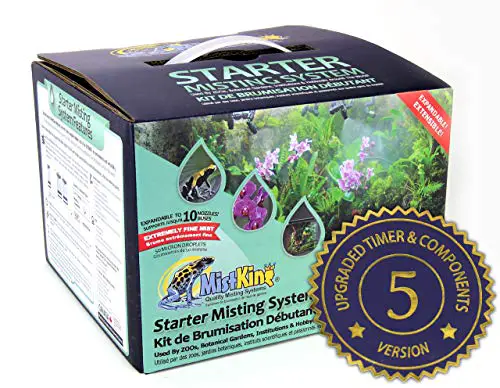
If you’re ready to level up from the Monsoon, the MistKing Starter Misting System 5th Gen is the upgrade most keepers make. It runs on a 24-volt pump and produces an extremely fine 50-micron mist, and it’s expandable up to 10 nozzles as your collection grows.
Understanding your species’ specific moisture requirements helps you configure the MistKing’s nozzle count and cycle timing correctly—start with reptile humidity needs and how to meet them before dialing in your schedule.
You get the pump, programmable timer, reservoir bulkhead with O-ring, and 15 feet of 1/4" tubing. It’s trusted by zoos and botanical gardens worldwide.
Fair warning: setup can frustrate first-timers, some units ship missing parts, and nozzles may drip after shutoff. Use distilled water and check your shipment on arrival.
| Best For | Keepers of arboreal geckos, chameleons, and amphibians who want a professional-grade, expandable misting system for automated humidity control and drinking water. |
|---|---|
| Compact Size | Includes 15 ft tubing |
| Humidity Support | Increases enclosure humidity |
| Reptile Suitable | Geckos and chameleons |
| Automated Operation | Programmable timer |
| Lightweight Design | Not specified |
| DIY Friendly | Scalable to 10 nozzles |
| Additional Features |
|
- Extremely fine 50-micron mist ideal for delicate species
- Expandable up to 10 nozzles as your collection grows
- Trusted by zoos, botanical gardens, and institutions worldwide
- Setup can be frustrating for first-time users
- Some units ship missing parts like tubing, T-pieces, or the manual
- Nozzles may drip residual water after shutoff
3. TempPro TP50 Digital Hygrometer Thermometer
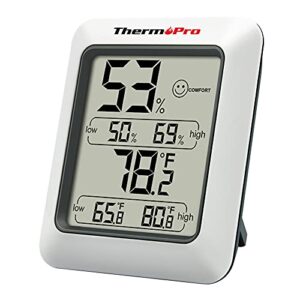
Here’s the thing about the MistKing: it’s only as good as the numbers you’re reading. That’s where the TempPro TP50 Digital Hygrometer earns its spot.
This little 2.62-inch unit tracks both humidity and temperature with ±2 to 3% RH accuracy, updating every 10 seconds. The DRY/COMFORT/WET indicator gives you instant feedback, and it stores high/low records so you can spot overnight drops. It runs on one included AAA battery.
Mount it at mid-height, cross-check against your misting zones, and you’ll always know your setup’s working.
| Best For | Reptile keepers and greenhouse hobbyists who need an affordable, quick-reading hygrometer to verify their misting system is hitting target humidity levels. |
|---|---|
| Compact Size | 2.62 inches length |
| Humidity Support | Monitors humidity levels |
| Reptile Suitable | Reptile environments |
| Automated Operation | 10-second refresh rate |
| Lightweight Design | Battery powered |
| DIY Friendly | Quick room readability |
| Additional Features |
|
- Accurate readings (±2 to 3% RH, ±1°F) with a fast 10-second refresh rate
- DRY/COMFORT/WET indicator plus high/low record storage for spotting overnight swings
- Compact, single-AAA design with a large, readable display
- Some units may fail after roughly a month of use
- Display can be smaller than product photos suggest
- No backlight, making it hard to read in low-light enclosures
4. Moistenland Reptile Humidifier Misting System
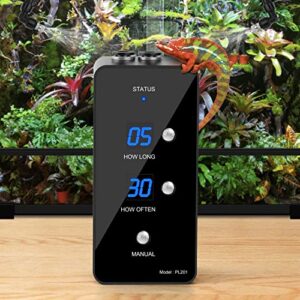
The Moistenland Reptile Humidifier Misting System takes a different approach: instead of a built-in reservoir, it draws water from an external bucket you supply yourself. That’s actually a win for you, since you can size the reservoir to your collection and skip constant refills.
Setup is refreshingly simple. The included 16ft hose and accessories get you running in about 10 minutes, and the 360° rotation nozzles let you direct mist exactly where your animals need it. The timer offers up to 5-minute spray durations with frequencies from 1 hour to 30 days.
For humidity-loving species like crested geckos and dart frogs, it’s a budget-friendly choice. Just watch those tubing connections for leaks, and mount nozzles 6–12 inches from decor.
| Best For | Budget-minded keepers of humidity-loving reptiles and amphibians—like crested geckos and dart frogs—who want a customizable, DIY misting setup without paying for a built-in reservoir. |
|---|---|
| Compact Size | 1.8D x 2.2W x 4.5H inches |
| Humidity Support | Simulates natural humidity |
| Reptile Suitable | Reptiles and amphibians |
| Automated Operation | Timer function |
| Lightweight Design | 520 g |
| DIY Friendly | 10-minute setup |
| Additional Features |
|
- Flexible external bucket reservoir lets you size water capacity to your collection and cut down on refills
- Quick, easy setup with included 16ft hose and accessories in about 10 minutes
- Adjustable 360° rotation nozzles and versatile timer (5-minute sprays, 1 hour to 30 days frequency) for full terrarium coverage
- Some units have reportedly failed within six months of use
- Leaks can develop at tubing connections and nozzle heads
- Mixed feedback on noise level and timer reliability
5. Reptile Smart Mister with Timer
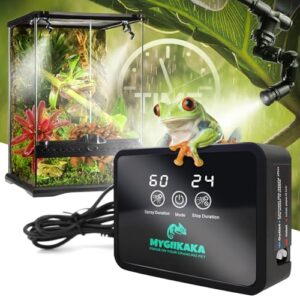
If you want smart features without a steep learning curve, this budget-friendly mister delivers. The Smart LED display with timer lets you dial in automatic spray cycles, while two 360° adjustable nozzles direct mist exactly where your reptile needs it. USB power and the included DIY installation kit make setup refreshingly simple.
A few ground rules, though: keep the water tank below nozzle height to prevent dripping, don’t exceed two nozzles or one meter of inlet pipe, and seal any housing gaps to keep feeder insects out.
| Best For | Budget-conscious reptile keepers and plant hobbyists who want a simple, timer-based misting system for terrariums, vivariums, or greenhouses without a complicated setup. |
|---|---|
| Compact Size | 8.66D x 8.27W x 2.56H inches |
| Humidity Support | Maintains humidity for shedding |
| Reptile Suitable | Terrariums and vivariums |
| Automated Operation | Automatic spraying timer |
| Lightweight Design | Resin construction |
| DIY Friendly | DIY installation kit |
| Additional Features |
|
- Smart LED timer automates spray cycles for hands-off humidity control
- Two 360° adjustable nozzles let you direct mist precisely where it’s needed
- USB powered with an included DIY kit, making installation quick and easy
- Requires careful setup (tank below nozzle height) to avoid continuous dripping
- Limited to two nozzles and a one-meter inlet pipe, restricting larger setups
- Housing design gaps can allow feeder insects to get inside
Choosing The Right Reptile Misting System
Now that you’ve seen the top picks, let’s make sure you pick the right one for your setup. The best mister for you depends on your animal’s humidity needs, your enclosure size, and how much maintenance you’re willing to take on. Here are the six factors I walk every new keeper through before they spend a dime.
Species Humidity Needs
Not every reptile needs the same moisture level, and getting this wrong is one of the most common beginner mistakes.
Leopard geckos thrive at 30–40% reptile enclosure humidity, while tropical species like crested geckos need 70–80%.
Your species-specific humidity targets should drive every decision you make about automated misting schedules before you buy anything.
Mister Versus Fogger
Misters deliver fine mist in quick, targeted bursts, spiking surface moisture fast. Foggers sustain ambient humidity longer with fewer cycles but cool the enclosure less.
If your species needs rapid humidity spikes on programmable intervals, a reptile misting system wins. For steady background humidity, a reptile humidifier-style fogger works better.
Comparing top-rated options side by side can help you match the right setup to your species, and this reptile misting systems guide for terrariums breaks down the key differences in runtime, precision, and noise levels.
Capacity And Coverage
Size matters here. Match system capacity to your setup:
- Single enclosure solution: basic 1–2 nozzle units handle small tanks perfectly.
- A large 8L reservoir grips multiple daily cycles without constant refilling.
- Expandable to 10 nozzles for true multienclosure misting across a reptile room.
- An expandable system grows comfortably alongside your collection.
- Higher-end units cover 40–60 m² with consistent humidity throughout.
Controls And Scheduling
The difference between a thriving enclosure and a moldy mess often comes down to scheduling.
The line between a thriving enclosure and a moldy mess is just a well-set schedule
Basic preset timers offer simple timer functionality with fixed cycles for forgiving species.
But if your reptile needs tighter humidity windows, you’ll want programmable misting intervals from 15 to 180 seconds.
Adjustable misting frequency lets you cluster cycles during daylight hours and dial back overnight.
Water And Maintenance
What you put into your system matters as much as how you schedule it.
Hard tap water causes mineral buildup that clogs nozzles fast. Use distilled or demineralized water whenever possible, and check whether your system includes a filter.
Soak nozzles weekly in diluted white vinegar to prevent scaling and keep mist output consistent.
Installation And Safety
Good water habits pair well with a safe, clean setup.
Most beginner systems are easy to install with basic hand tools, but always mount your reservoir 15–30 cm above the enclosure for proper flow and leak prevention. Use a drip loop on power cords, seal entry points with non-toxic silicone, and run a 24-hour test before adding your animal.
For the silicone sealing step, a reptile-safe aquarium sealant ensures entry points stay watertight without releasing harmful fumes near your animal.
Reptile Misting Setup, Scheduling, and Maintenance
Once you’ve chosen your system, getting the setup right matters just as much as the unit itself.
Position your nozzles toward the upper canopy so mist disperses evenly before settling. Most keepers do well with two to four daily cycles, timed during crepuscular windows — early morning and early evening — when your animal is naturally most active and temps aren’t spiking. That timing prevents condensation buildup on glass and keeps your misting schedule aligned with natural diel patterns.
For humidity control, pair your mister with a calibrated digital hygrometer and check readings daily until you know your enclosure’s behavior.
Maintenance is straightforward: flush the reservoir monthly, inspect fittings weekly, and replace tubing annually. Staying consistent here prevents algae, biofilm, and the headaches that follow.
Frequently Asked Questions (FAQs)
How often should I mist my reptile each day?
Getting humidity right is the heart of the matter. Start with 2–3 short sprays daily, then adjust your misting schedule after 1–2 weeks. Watch your reptile enclosure’s hygrometer: tropical species need 50–70% RH, drier species 30–50%.
Your reptile hydration depends on observing behavior, not guesswork. Beginnerfriendly automation controls humidity control consistently.
Can I use tap water in my misting system?
Yes, but pre-filter it. Tap water’s chlorine and minerals cause hard water buildup, clogging nozzles and shortening pump life. Use filtered water or distilled water, and flush lines regularly to prevent biofilm.
Do misting systems work in screen-top enclosures?
Do misting systems work in screen-top enclosures? Absolutely, they do—but you’ll need splash guards and drip shields to protect electronics while maintaining enclosure humidity effectively. Use distilled water, oscillating fans for even mist distribution, and sealed timers.
Will a mister raise humidity too much overnight?
Yes, it can if your reptile misting system runs overnight. Temperatures drop and ventilation slows, so enclosure humidity climbs. Use timed misting intervals with a humidity cap, and verify with humidity monitoring before bed.
How many nozzles do I need per enclosure?
Nozzle count depends on enclosure size. Small tanks (≤12 gallons) need just one; medium (12–36 gallons) need 1–2; large (≥36 gallons) need 2–4, spaced evenly for uniform humidity.
Conclusion
Here’s the part most beginners miss: the mister you choose matters less than how you use it.
A mid-priced system on a smart schedule beats a premium unit you set once and forget.
Start small, dial in your species’ numbers, and watch your animal respond.
Reptile misting systems for beginners work best when paired with patience.
Get that right, and you’ll spend less time troubleshooting and more time enjoying a genuinely thriving pet.