This site is supported by our readers. We may earn a commission, at no cost to you, if you purchase through links.
Pick up a garter snake for the first time, and you’ll probably discover snake musking defense mechanism the hard way—a pungent, oily smear that clings to your hands like a bad memory. That smell isn’t random. It’s a precisely engineered chemical weapon, loaded with volatile fatty acids, sulfur compounds, and nitrogen-based molecules that together rival the worst things nature has ever produced.
Snakes can deploy it in under a second, refill the glands within minutes, and customize the formula based on diet and microbiome. Understanding what triggers it—and what’s actually in it—makes you a far better keeper and a lot less fragrant.
Table Of Contents
Key Takeaways
- Snake musk isn’t random funk—it’s a precisely engineered chemical cocktail of fatty acids, sulfur compounds, and nitrogen molecules that clings, lingers, and trains predators to stay away for good.
- The whole thing fires under a second as a pure reflex, triggered by sudden grabs, cold hands, or even a looming shadow—your snake isn’t being dramatic; its nervous system is just doing its job.
- Every musk release actually lowers your snake’s tolerance for the next handling session, so repeated stress doesn’t just stink—it actively works against trust-building over time.
- You can dodge most musking entirely by approaching from the side, keeping sessions short, and building a calm, enriched enclosure—because a relaxed snake simply has less reason to pull the trigger.
What is Snake Musking?
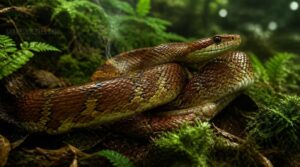
Every snake owner has a story about that one stinky surprise. There’s actual science behind why your scaly friend does this, and it’s not as gross as it smells. Here’s what’s really going on when musking happens.
Cloacal Musk Glands
Two little glands near the tail base — that’s the whole secret behind snake musk.
These paired cloacal glands connect to tail muscles, squeezing secretions through the cloacal duct on command.
When threatened, snakes can voluntarily trigger this response — a behavior covered in detail among snake stress symptoms and defensive behaviors.
Inside, secretory cells (varying epithelium thickness by species) cook up volatile organic compounds.
It’s a tidy defensive mechanism: small glands, big stink, built right into the snake’s own plumbing.
Research shows extensive interspecific variation in cloacal gland morphology across snake species.
Foul-smelling Defensive Fluid
So what actually comes out of those cloacal glands? Snake musk is a thick, oily defensive secretion packed with volatile organic compounds—the odor profile chemistry behind that gut-punch reek. This isn’t random funk; it’s chemical signaling mechanisms wired for scent-based deterrence.
These compounds and their behavioral triggers are broken down thoroughly in this guide to why snakes musk and what drives the response.
The lingering residue properties stick around, working as a seriously effective predator deterrent long after the snake slithered away.
Musk Versus Feces
Snake musk often comes bundled with feces or uric acid—a one-two combo aimed straight at a predator’s nose. This waste-mixing mechanics trick ramps up sensory aversion fast.
Snakes often aim for the head, maximizing respiratory exposure and olfactory disruption. Why? A snout full of stink and waste lingers longer, hitting harder than musk secretion alone—pure chemical alarm cues your nose won’t forget.
Reflexive Stress Response
That waste-musk combo doesn’t happen by accident — it’s your snake’s nervous system pulling the trigger automatically.
The moment it feels sudden restraint, the amygdala and brainstem circuits fire instantly, flooding the body with adrenaline. Heart rate spikes, muscles tense, and the autonomic nervous system signals the cloacal glands to release — no thinking required.
- Fight-or-flight kicks in within seconds
- Sensory processing narrows sharply to the threat
- Stress-induced secretion follows automatically
- Handling stress alone can be enough
How Snakes Release Musk
Musking isn’t random — there’s a real mechanical process behind that stink bomb. Your snake’s body follows a surprisingly predictable sequence every time it fires off a warning shot. Here’s exactly how it works, from the first muscle twitch to the last lingering smell.
Tail Muscle Activation

The moment a snake feels grabbed, its tail muscles fire fast — we’re talking 20–50 milliseconds after threat perception. Smaller intrinsic muscles stiffen the tail first, then larger extrinsic muscles kick in to drive that defensive thrash.
Warmer snakes react even quicker, since heat speeds contraction. This rapid sequence compresses the cloacal scent glands, priming musk for release.
Cloacal Discharge Process
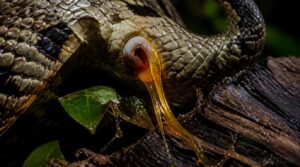
Once the tail muscles fire, the cloaca takes over fast. The surrounding tissues relax and open the vent, while muscular contractions compress the cloacal glands and push the fluid out — musk, oils, and waste mixed together.
That sticky residue clings to surfaces on contact. The whole reflexive discharge happens in under a second, leaving a smear you’ll definitely notice.
Sudden Handling Triggers
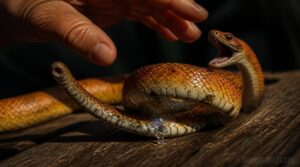
Here’s the thing — snakes don’t think before they musk. It’s pure reflex.
An unexpected grab from above mimics a predator strike, triggering an instant defensive secretion before your hand even settles. Looming shadows, sudden vibrations, and loud noises nearby produce the same startle. Even a quick temperature shock from cold hands can flip that switch immediately.
Stress and Husbandry Factors
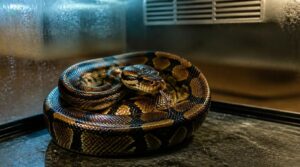
Husbandry problems are a slow-burn trigger — stress builds quietly before any muck ever flies.
Poor enclosure ventilation lets ammonia accumulate, irritating your snake’s respiratory tract and raising its baseline tension. Inconsistent light cycles disrupt natural rhythms. Temperature gradients that run too hot or cold spike stress hormones fast.
Even skipping substrate enrichment removes the hiding security snakes genuinely depend on to feel safe.
Repeated Musking Events

Once isn’t always enough for a stressed snake. Rapid glandular refilling means your snake can musk again within minutes — and it will if the stress sticks around.
Each release nudges cumulative arousal levels higher, lowering the trigger threshold for the next one. That’s sensory conditioning at work: your snake basically learns that handling equals danger, making every future session harder.
Every musk release trains your snake to fear handling more, making the next session harder than the last
Why Musking Defends Snakes

So why does a stink bomb actually save a snake’s life? Turns out, that smell is doing more work than you’d think, hitting predators in ways that go way beyond just "gross." Here’s what makes musk such a surprisingly smart defense.
Predator Smell Overload
This defensive mechanism works like a stink bomb to the nose. Musk secretion releases volatile organic compounds, an olfactory deterrent and predator deterrent that triggers olfactory avoidance behaviors and multimodal alarm responses.
Predators retreat fast, physiological stress indicators spike, and environmental scent dispersion spreads the warning.
Repeated hits build a learned predator association, snakes can count on for long-term survival.
Lingering Fatty Acids
The smell doesn’t just hit — it stays. That’s the real trick.
Volatile fatty acids (VFAs) like butanoic and propanoic acids bind to lipid carrier proteins in the musk, releasing slowly onto surfaces.
Temperature spikes? Volatility increases, pushing odor molecules airborne longer.
Skin microbes even oxidize these compounds into punchier odorants.
Fatty acid diffusion turns one musk event into hours of lingering warning.
Musk Mixed With Waste
Snake musk rarely travels alone. When those cloacal glands fire, the secretion mixes with feces and uric acid almost instantly — and that combo is nasty on a whole new level.
The volatile fatty acids from musk secretion bind to waste residue, amplifying scent dispersion and making the whole package stick harder to surfaces, fur, or feathers.
Learned Predator Avoidance
That nasty mix sticks—predators remember it. A juvenile’s stress-induced musk secretion acts as a lasting predator deterrent: animals link smell, sight, and sound through social cue transmission, teaching others to avoid garter snakes for weeks.
This multi-modal cue integration builds avoidance learning longevity, though safer habitat use trade-offs can mean thinner pickings.
Life stage learning sharpens this behavioral antipredator response.
Chemical Alarm Signals
Other snakes treat your musk secretion as a chemical alarm.
Conspecific danger cues spread through volatile compounds via rapid volatile signal dispersion, sharpening chemosensory receptor tuning to danger.
Picture the cue triggering:
- Quicker tongue-flicks
- Frozen postures
- Faster retreats
- Sharper vigilance
This builds predator avoidance learning, while environmental signal persistence keeps defensive secretions working for hours as a steady predator deterrent.
What Snake Musk Contains
So what’s actually in that stink? Snake musk isn’t just one bad smell—it’s a whole cocktail of compounds working together. Here’s what’s brewing in that nasty little mix.
Volatile Fatty Acids
Ever wonder why musk lingers so long? Volatile fatty acids—acetic, propanoic, butanoic—give musk its punch, evaporating fast yet clinging to skin and fabric. These carboxylic acids form through microbial fermentation, much like backyard composting.
| Acid | Sensory Note |
|---|---|
| Acetic | Sharp, vinegar-like |
| Propanoic | Sour, pungent |
| Butanoic | Rancid, cheesy |
| 3-Methylbutanoic | Sweaty, intense |
Their tiny molecular structure makes them volatile, easily picked up by sensitive noses—the same chemistry behind industrial biofuels, proving this chemical defense doubles as useful science.
Nitrogen-based Odor Compounds
Beyond the fatty acids, nitrogen-based compounds take the odor to another level. Trimethylamine—the same molecule behind rotten fish smell—hits your nose at just a few parts per billion. Combine that with indoles and skatoles from protein breakdown, and you’ve got something genuinely stomach-turning:
- A sharp, ammonia-like bite
- Fishy, urinous amine notes
- Fecal, animalic skatole undertones
- Lingering pungency that won’t quit
Sulfur-like Rotten Smells
Then there’s the sulfur punch. Snake musk contains volatile sulfur compounds that smell unmistakably like rotten eggs — think hydrogen sulfide, detectable at incredibly tiny concentrations. These compounds hit hard and fast.
| Sulfur Compound | Odor Effect |
|---|---|
| Hydrogen sulfide | Classic rotten-egg smell |
| Mercaptans | Sharp, lingering pungency |
| Sulfide byproducts | Acrid, burnt undertones |
Sticky Oils and Proteins
Musk isn’t just stinky — it’s engineered to stick around.
Beyond the volatile acids and sulfur compounds, snake musk contains sticky oils and proteins that bind the secretion to surfaces.
The oils spread fast across scales via viscous oil spread, while proteins form a protein network that slows evaporation and keeps the chemical deterrent clinging long after the snake is gone.
Species-specific Chemical Profiles
Think of each snake species as having its own chemical fingerprint — a musk blend so consistent that researchers can identify a species just from its scent profile. These species-specific bouquets are shaped by diet, habitat, microbiome, and age. A few key factors drive the differences:
- Geographic chemotypes shift compound ratios between regional populations
- Ontogenetic shifts mean juveniles and adults smell noticeably different
- Microbiome-derived volatiles add unique terpenoids and cyclic esters
Which Snakes Musk Most?
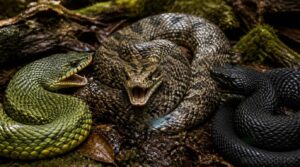
Not every snake is equally quick to deploy its stink bomb — some species are notorious repeat offenders, while others almost never bother. A lot depends on the snake’s biology, age, and natural habitat. Here’s a look at the usual suspects in terms of musking.
Garter snakes and water snakes tend to top the list of frequent musk-releasers, though their breath-holding abilities underwater show they’re just as impressively adapted in other ways.
Garter Snake Musking
If there’s one snake that’s practically synonymous with musking, it’s the garter snake. Common garter snakes (Thamnophis sirtalis) treat their cloacal gland secretion as a first instinct — grab one suddenly, and you’re getting hit.
Juveniles musk even more readily, since predation risk is highest early in life.
Regional populations also show slight variations in their defensive odor’s chemical blend.
Water Snake Musk
Garter snakes aren’t the only stinkers — water snakes lean into their aquatic habitat too, packing extra punch into every spray.
- Strong cloacal gland secretion when grabbed
- Defensive odor causing predator olfactory overload
- Species-specific signatures per population
- Compounds acting as environmental stress biomarkers
- Soap-and-water musk odor removal works fine
Pure defensive chemical signaling, swamp-style!
Hognose Snake Defenses
Hognose snakes bring theater to defense.
They flatten necks into a cobra-like hood, hiss sharply, then lunge—pure bluff.
If that flops, thanatosis kicks in: flipping, limp, playing dead.
Their upturned snout aids burrowing, offering substrate escape routes predators can’t follow.
Handling pressure triggers stress-induced secretion—musking behavior releasing defensive odor production, pungent snake musk sealing the deal.
Juveniles Versus Adults
Age changes everything with musking. Juvenile snakes musk more readily — their stress threshold is lower, and any sudden grab can trigger defensive odor production almost instantly. That’s survival math: smaller body, more predators, fewer options.
As snakes mature, handling tolerance improves noticeably. Adults coordinate musk with avoidance rather than firing it off reflexively.
- Juveniles hit peak stress faster
- Adults release larger musk volumes
- Maturing temperament means calmer responses
- Energy shifts from growth spurts to reproduction, subtly altering stress-induced secretion patterns
Boas and Ball Pythons
Compare that to boas and ball pythons, and you’re looking at a totally different temperament. Python musk happens, but rarely — these constrictors save defensive behaviors for true emergencies, not routine handling.
Size varies wildly: ball pythons stay compact, boas grow much larger. Both reward patient husbandry — proper humidity, steady feeding schedules, and gentle handling — with calm decades-long companionship instead of stress-induced musk.
Handling Snakes Without Musking
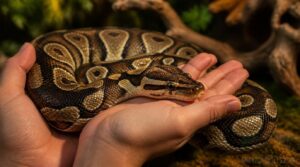
The good news is that musking isn’t inevitable — it’s mostly a response to things you can control. How you approach, handle, and care for your snake makes a huge difference in whether those scent glands ever fire. Here’s what actually works:
Approach From The Side
Picture sneaking up to a friend instead of jumping out at them—that’s the idea here. Lateral contact methods beat frontal pressure every time, since head-on approaches scream "predator." Gradual field entry with stable pivot positioning keeps things calm.
This style works because it:
- Lowers panic by minimizing visual glare
- Prevents stress-induced secretion
- Builds trust through gentler handling technique
Avoid Sudden Restraint
Think of it like tapping a friend on the shoulder instead of grabbing their arm — slow, deliberate contact signals safety. Quick grabs trigger the startle response that sets off stress‑induced secretion almost instantly.
Approach from the side, keep your movements predictable, and read your snake’s body language — tightening coils or defensive posturing means: pause, breathe, and back off.
Keep Sessions Short
Honestly, five minutes is plenty for a routine check. Snake husbandry works best with short, frequent sessions instead of one long handling marathon — start with a quick 2-minute observation window, then handle.
Watch for tail flicks or tensing coils: those agitation signs mean it’s time to stop. End on a calm note, and you’ll dodge stress-induced secretion almost every time.
Reduce Enclosure Stress
A calm enclosure makes a calmer snake — it’s that simple. Terrain complexity, stable thermal gradients, and hides cut baseline stress, so musking becomes less likely overall.
Trim auditory stressors (loud rooms, vibrating stands), keep lighting cycles consistent, and add enrichment like scattered hides. Lower chronic stress means fewer startled coils during handling — good husbandry isn’t just comfort, it’s real prevention.
Remove Musk Safely
So your snake musked — now what? Don’t panic, just act fast before that odor sets into everything it touches.
- Wear gloves and rinse skin with soap and water right away
- Wipe surfaces with enzymatic cleaners to break down the fatty acids
- Launder clothes separately to stop odor transfer
Quick cleanup, minimal skin contact, and good handling technique keep musk from lingering.
Frequently Asked Questions (FAQs)
How to get a snake to stop musking?
Build gentle handling routines, approach from the side, and keep sessions short. Habituation through consistent, positive reinforcement lowers stress triggers over time, no surprises, no squeezing, just patience and a predictable routine your snake learns to trust.
Is snake musk harmful or toxic to humans?
Smells like the apocalypse, but it won’t hurt you. Musk is non-toxic—just eye irritation, possible skin dermatitis, or mild respiratory discomfort. Rinse eyes, wash skin, ventilate the space, and you’re fine.
How long does musk odor linger on skin?
Expect hours, sometimes a full day. It clings to your stratum corneum, and oily skin (sebum) traps it longer.
Heat speeds evaporation; airflow helps too.
Quick hand washing with soap neutralizes odor fast—good sanitation habits matter for reptile keepers.
Do female snakes musk more than males?
Yes—gravid females musk harder and more often than males, especially in terrestrial populations.
Pregnancy raises escape costs, so maternal defense leans on stronger reproductive musk intensity, giving female snakes a sharper, sex-based scent strength edge over male snakes.
Can researchers identify snake species through musk chemistry?
Absolutely—chemical fingerprinting methods like volatile marker analysis reveal each species’ unique biochemical fingerprint. Musk profile consistency makes species-specific recognition reliable, turning gross-out goo into legit science.
Ethical field sampling could someday build identification tools rivaling visual ID for tricky snakes.
Why do gravid females release stronger musk?
Gravid females pack a stronger punch because pregnancy hormones ramp up gland activity, boosting fatty acid and sulfur compound production. More metabolic fuel, more potent musk — nature’s way of protecting mom and offspring simultaneously.
Conclusion
Next time a snake musk hits your hands, you’ll recognize it differently—not as an accident, but as a tiny chemical broadcast from an animal that’s been perfecting that message for millions of years. The snake musking defense mechanism isn’t just stink; it’s survival distilled into a single, weaponized second.
Respect that, work with it through smarter handling, and you stop being the threat that triggers it. That’s when real trust between keeper and snake begins.