This site is supported by our readers. We may earn a commission, at no cost to you, if you purchase through links.
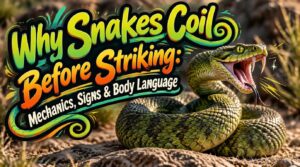
A snake’s strike takes 44 to 70 milliseconds. You blink in about 200. By the time your eyes register the lunge, the work is already done, and it was done before the snake moved at all.
That work happens in the coil. Snake coiling before striking isn’t a threat display or a nervous habit. It’s a loaded spring, built from axial muscle, stretched tendon, and ventral scales gripping the ground like cleats.
Read the coil correctly and you’ll know whether a snake is resting, defending, or ready to fire. Here’s how the mechanics work, and what each posture tells you.
Table Of Contents
- Key Takeaways
- Why Do Snakes Coil Before Striking?
- How to Tell a Strike Coil From a Resting Coil
- How a Snake’s Coil Powers Its Strike
- How Ball Pythons, Boas, and Other Snakes Coil
- What a Snake’s Pre-Strike Posture Can Tell You
- Frequently Asked Questions (FAQs)
- Do snakes coil before striking?
- How far can a rattlesnake strike when coiled?
- How do you know when a snake is about to strike?
- What does it mean when a snake coils up?
- Can snakes strike effectively without coiling first?
- Do aquatic snakes coil differently than land snakes?
- How does temperature affect a snakes strike speed?
- Are juvenile snakes capable of full defensive coiling?
- Can coiling behavior vary between male and female snakes?
- Can snakes strike without coiling first?
- Conclusion
Key Takeaways
- A snake’s coil works like a loaded spring, storing energy in its muscles and tendons so the strike, which lasts just 44 to 70 milliseconds, lands faster than you can blink.
- You can tell a strike coil from a resting one by checking three things: a rigid S-shaped front body, a raised head with a fixed stare, and rapid tongue flicking, hissing, or rattling.
- Treat one-third to one-half of a snake’s body length as your danger zone, and remember that snakes can still strike without coiling, just with less reach and accuracy.
- Coiling styles differ by species, so a ball python balls up to hide, a boa anchors to wrap prey, and a tree python grips with its tail, and knowing which you’re facing tells you what comes next.
Why Do Snakes Coil Before Striking?

Coils are a snake’s loaded weapon. Before a strike, the animal folds its body into tight S-shaped loops, and that posture does three jobs at once. First, it turns the axial muscles into a musculoskeletal spring. Elastic energy storage builds along the trunk, so the lunge, when it comes, isn’t just muscle. It’s kinetic energy release, fast and total.
A coiled snake also signals its mood through the tail, and the meaning behind snake tail rattling often reveals whether that loaded posture is a warning or a prelude to a strike.
Second, the coil anchors you can’t see. Ventral scales grip the ground, bracing the body against recoil so force travels forward instead of sideways. Those wide, flat keratin scales work much like boot treads for traction.
Third, the S-curve aims. It sets distance and angle before a single millisecond is spent.
That’s why defensive coiling signals a springloaded strike, not a bluff. Strikes last roughly 44 to 70 milliseconds. You won’t outreact one, so read the coil first.
A coiled snake is no bluff: its strike lands in under seventy milliseconds, so read the coil before it reads you
How to Tell a Strike Coil From a Resting Coil
You’ve seen the loaded spring. Now learn to separate it from a sleeping heap of loops, because the difference decides whether you stay safe.
Check three things:
- Body tension. A resting coil is loose and overlapping, muscles slack. A strike coil is rigid, with the front third pulled into an S.
- Head position. Resting snakes tuck the head under a loop or lay it on top. A striker holds it elevated, neck retracted, gaze fixed on you.
- Tongue and sound. Slow or absent flicks mean calm. Rapid flicking, hissing, or a rattle means defensive coiling.
Muscle preloading shows as sudden stiffness. Context matters too: near food, a springloaded strike is expected. Elsewhere, it’s a real warning aimed squarely at you.
If you’re deciding between the two species, this ball python vs. boa constrictor comparison shows how their temperaments differ and which one suits your handling experience.
How a Snake’s Coil Powers Its Strike

A coiled snake isn’t just waiting, it’s loaded like a drawn bow. Once you understand the stored energy system behind that posture, every strike stops looking like magic and starts looking like mechanics. Here are the three parts that make the lunge work, and you’ll want to master each one.
Muscle Tension and Stored Energy
Think of a crossbow, drawn and locked. That’s your snake mid-coil.
Muscle tension stretches tendons, not just fibers. This coiled spring mechanism drives elastic energy storage, and it’s your cue for strike readiness.
| Stage | Result |
|---|---|
| Coiling | Muscles tense |
| Holding | Tendons stretch |
| Release | Tendons recoil |
| Strike | Kinetic energy release |
Wait too long, though, and viscoelastic relaxation bleeds your snake’s power away.
Finding the sweet spot takes practice, so these ball python handling techniques can help you time sessions and build your snake’s confidence.
Body Anchoring and Traction
A stored spring is useless if it shoves you backward. Your snake knows this, so it relies on friction-based anchorage before it fires. Keepers handling a coiled snake on slick floors often use sturdy snake hook tongs to guide it onto grippier ground first.
Watch the rear coils. Ventral scutes lock into the surface through substrate grip: Since that coiled strike zone sits low to the ground, a pair of snake proof gaiters can shield your lower legs while hiking through snake country.
- Tail anchoring pins the base.
- Substrate bracing resists recoil.
- Rear coils stay static.
- A vertebral propulsion wave drives forward.
- Slick floors ruin everything.
Strike Speed and Distance
Every coil buys strike speed and reach. Treat half the snake’s length as your danger zone, since strike distance runs one-third to one-half.
| Snake length | Danger zone |
|---|---|
| 4 feet | 2 feet |
| 6 feet | 3 feet |
| Your blink | 200 ms |
| The strike | 70 ms |
Outblinking it is impossible. Read the strike readiness posture, watch strike initiation muscle groups, respect strike accuracy.
How Ball Pythons, Boas, and Other Snakes Coil

A ball python answers threat with protective balling: head tucked into the center, body wound tight. That’s a defensive coil, and it’s built for hiding, not hitting. Boas work differently. They anchor, then throw loops over prey belly-first, so their coils act as a springloaded strike platform.
Arboreal species add another twist: reach. Prehensile tails and long teeth let them launch more of their body from a branch.
Here’s how to read the three main styles:
- Ball python: compressed coils, high body tension, head hidden deep.
- Boa: anchored coils, heavy mass, loops ready to wrap prey.
- Tree python: tail gripping, neck cocked like a musculoskeletal spring.
Know the style, and you’ll know exactly what’s coming. Control starts with recognition.
What a Snake’s Pre-Strike Posture Can Tell You

Freeze. The snake in front of you has already made a decision, and your next move depends on reading it correctly. Even with calm instincts, keep a snake bite first aid kit in your pack, since immobilizing the limb and getting help fast matters most.
Look for the S-shaped strike posture first. The neck rises, the head locks onto you, and the tongue flicks fast. That’s muscle preloading in action, and it means the bite is a last resort the snake is ready to take.
A tight defensive coil tells a similar story, especially with hissing, tail rattling or gaping jaws. Beneath it, vertebral energy storage turns the body into a spring-loaded strike platform.
A loose coil in the sun? That’s rest. Don’t ever confuse the two. Mastery starts with watching the neck, the tongue, and the stare, then backing away slowly, calmly, and quietly. Keeping a snake identification field guide in your pack helps you tell a resting snake from a threatened one before stepping closer.
Frequently Asked Questions (FAQs)
Do snakes coil before striking?
Picture a pit viper on a trail at dusk, body pulled into a loose coil, head cocked back. Yes, most snakes coil before striking. That coiled position is your clearest sign of strike preparation.
How far can a rattlesnake strike when coiled?
A coiled rattlesnake usually reaches one-third to one-half its body length. Big diamondbacks can stretch to two-thirds. For a 4-foot snake, that’s about 2 feet of strike distance, so stay well outside it.
How do you know when a snake is about to strike?
Think a snake always warns you first? Wrong.
Watch the warning posture instead: a tight S-curve, a fixed stare, and rapid tongue flicking. That’s strike distance estimation, and visual axis alignment means you’re the target.
What does it mean when a snake coils up?
Ever wonder what that coil is saying? It’s body language signals at work: a defensive posture, a threat assessment, or strike preparation. Loose means rest. Tight, S-shaped means elastic energy release is coming. Back off.
Can snakes strike effectively without coiling first?
Yes, and you’ll see it more than you’d expect. A rattlesnake’s flexible neck vertebrae drive a direct lunge from a stretched position. You lose elastic energy release and reach, but gain a short strike latency when prey is already close.
Do aquatic snakes coil differently than land snakes?
Yes, you’ll see it. Water punishes tight coils, so aquatic snakes loosen them, trading energy storage for stealth. Spinal flexibility and muscular control keep peak speed equal, but strike latency grows and strike accuracy drops.
How does temperature affect a snakes strike speed?
Heat doesn’t make your snake the fastest striker; it makes the quickest decision. Strike latency drops as temperature climbs, while biomechanics and strike force generation stay stable. Temperaturedependent pliability and environmental influence on behavior matter.
Are juvenile snakes capable of full defensive coiling?
Yes, and from birth. Hatchlings tuck the head inside a tight coiled position and brace the loops with trunk tension. That defensive posture needs no practice, and juvenile snake coiling biomechanics keep strike latency short.
Can coiling behavior vary between male and female snakes?
Yes, and sexual dimorphism is why. Males carry heavier musculature, so their body tension favors fast, explosive strikes. Females often coil larger and tighter, conserving energy. Read the sex, and you’ll predict defensive behavior and strike latency.
Can snakes strike without coiling first?
Rattlesnakes strike up to two-thirds of their body length coiled, but only about half uncoiled. So yes, a snake strike works from a linear position, just with less reach and reduced strike accuracy variation control.
Conclusion
Picture a drawn bowstring, humming with tension, the arrow still resting against the grip. That’s the coil you’re now equipped to read.
Snake coiling before striking is stored energy made visible: tightened muscle, anchored scales, an S-shaped neck aimed at your position. Loose, layered loops mean rest. A tight, braced posture means the spring is loaded. Watch the neck, the tail, the distance. Learn the signals and you’ll never mistake a sleeper for a shooter.