This site is supported by our readers. We may earn a commission, at no cost to you, if you purchase through links.
snake that refuses to eat isn’t being stubborn—it’s telling you something. Every flick of the tongue, every slow S-coil before a strike, every cautious jaw-walk down a prey item run on biological precision that most keepers never fully decode.
feeding response in snakes isn’t a simple hunger switch; it’s a cascade of thermal detection, chemical sensing, and muscular coordination refined over millions of years.
Get the conditions right, and your snake feeds reliably. Miss one variable—prey temperature, enclosure humidity, handling frequency—and the whole sequence stalls.
Knowing exactly what drives each stage puts you in control of your animal’s health.
Table Of Contents
Key Takeaways
- Your snake’s feeding response is a hardwired sensory sequence—thermal detection, chemical sensing, and muscular coordination—that breaks down the moment any single environmental variable falls out of range.
- Prey temperature, size, and presentation method aren’t preferences; they’re biological triggers, and getting even one wrong is enough to shut down an otherwise healthy snake’s appetite entirely.
- Changes in feeding behavior—hesitation, refusal, or mid-meal withdrawal—are your earliest and most reliable indicators of stress, illness, or husbandry failure before other symptoms appear.
- Each species hunts on its own terms, so matching your feeding approach to your snake’s natural pattern—ambush, active foraging, or perch-strike—is what separates consistent feeders from chronic refusers.
What is Snake Feeding Response?

Your snake’s feeding response is a hardwired sequence — a chain of instincts that kicks in the moment prey is detected. Understanding each stage tells you a lot about your snake’s health and whether your husbandry is on point. Here’s what that sequence actually looks like, from first flick of the tongue to the long rest that follows.
Knowing whether your snake will accept live or dead prey can make the difference between triggering that feeding response and getting a flat-out refusal.
Prey Detection Cues
Before your snake strikes, it’s running a full sensory sweep. Tongue flicking accelerates as it pulls prey chemicals into the vomeronasal organ — identifying species, distance, and freshness in seconds.
Simultaneously, infrared pit organs detect heat differentials as small as 0.0015°C, pinpointing warm-bodied prey even in darkness. Ground vibrations and subtle air movements complete the picture, feeding response begins before you’ve even noticed the tongue.
Studies on fire beetle infrared receptors show comparable mechanisms that inspire bio‑engineered sensors.
Strike and Grip
Once prey recognition locks in, the feeding response accelerates. Prestrike behavior — the S-coil — aligns jaw muscles for reach. Mandible mechanics allow a wide gape; hook-like dentition grips prey firmly.
Strike accuracy depends on:
- Body posture matched to prey size
- Jaw dynamics generating fast closure
- Prey movement simulation triggering strike timing
- Dentition penetrating to prevent escape
- Prey immobilization secured at contact
Constriction or Holding
Once the strike lands, the body takes over.
Your snake throws coils around the prey, layering loops to cover every escape route. Muscles fire in sequential waves, tightening pressure specifically toward the prey’s chest — restricting breathing and blood flow simultaneously.
If the prey struggles, your snake recalibrates grip pressure instantly, closing any gaps until movement stops completely.
Jaw-Walking Swallow
Once the prey stops moving, your snake shifts from muscle to mechanics.
The jaw-walking swallow begins with one side of the lower jaw advancing forward independently, gripping and pulling the prey headfirst toward the throat.
Each side alternates in short, deliberate steps — a process called the pterygoid walk — while hyoid muscles coordinate each forward thrust with your snake’s swallowing reflex.
Post-Meal Rest
Once the jaw-walking swallow finishes, your snake enters a metabolic rest period that’s just as essential as the strike itself. Digestive blood flow shifts toward the gastrointestinal tract, slowing peripheral movement and triggering post-feeding lethargy that can last 48–72 hours. Don’t mistake stillness for illness — it’s the body doing its most intensive work.
After the swallow, stillness isn’t illness — it’s your snake doing its most intensive work
Here’s what normal post-meal rest looks like:
- Slow tongue flicking with minimal movement
- Curling tightly inside a secure hide
- Slightly elevated body temperature near the warm zone
- Reduced responsiveness to outside stimuli
- Gradual return to activity within 24–72 hours
Why Feeding Response Matters

Your snake’s feeding response tells you far more than whether it’s hungry. It’s one of the clearest windows into your animal’s overall health, stress levels, and environmental conditions. Here’s what to watch for.
Appetite as Health Check
Your snake’s feeding response is one of the clearest health indicators you have. Feeding window consistency matters — a snake that suddenly skips its usual evening feeding slot is signaling something worth investigating.
Track meal completion patterns closely; a snake that investigates prey but turns away, or quits midway through a meal, is showing a meaningful appetite shift.
Combine that with activity‑appetite correlation: if feeding refusal coincides with reduced daily movement, treat it as a red flag, not a coincidence.
Normal Versus Weak Response
Recognizing the difference between a normal and weak feeding response sharpens your appetite monitoring greatly.
A boa constrictor prey size chart can help you match meal portions to your snake’s jaw capacity, making it easier to spot when something’s off.
A healthy snake shows detection cue efficiency — rapid tongue flicking, immediate target lock, and a swift strike with precise strike accuracy indicators.
A weak response looks different:
- Delayed or hesitant strikes after repeated feeding cues
- Reduced prey immobilization speed and loose jaw grip
- Disrupted jaw-walking coordination during swallowing
Post-swallow stability — calm, settled posture — confirms a normal response. Behavioral cues like prolonged repositioning or feeding refusal signal something’s off.
Early Illness Warning Signs
Your snake’s feeding response is one of the earliest illness detectors you have. When appetite monitoring reveals sudden changes — a snake that fed eagerly last week now ignoring prey — that shift is meaningful clinical data, not coincidence.
| Warning Sign | What to Observe |
|---|---|
| Mouth Lesion Identification | Swollen lips, cheesy discharge, inflamed lining |
| Abnormal Breathing Sounds | Wheezing, clicking, open-mouth breathing at rest |
| Regurgitation Red Flags | Undigested prey returned shortly after swallowing |
| Lethargy Observation | Reduced movement, weak grip, excessive hiding |
Eye cloudiness indicators outside of normal shed cycles, combined with dull skin or sunken body fullness, signal systemic illness. Behavioral monitoring and health monitoring must work together — a disrupted feeding response is your prompt to investigate further before symptoms worsen.
Stress and Refusal Clues
A stressed snake rarely hides it — the clues show up in posture and behavior long before a full feeding refusal. Watch for tightly coiled, tense body posture rather than a relaxed, investigative stance. Key stress indicators include:
- Head turning away from offered prey
- Agitated tongue flicking without approach
- Withdrawing at the last moment before striking
- "Watch and ignore" behavior after initial investigation
Environmental threat triggers — noise, recent handling, unstable temperatures, or bright light — consistently suppress the feeding response. A sudden scent rejection of prey the snake previously accepted is equally telling. Behavioral monitoring across multiple sessions reveals whether refusal reflects stress response or something more serious.
Tracking Feeding Patterns
A simple feeding log transforms guesswork into data. Record the date, prey type, and portion size after every meal.
Over time, consistent intervals between feeds signal steady growth and stable health, while sudden refusals or irregular feeding patterns may indicate stress or early illness. Noting enclosure conditions alongside behavioral observations gives each entry meaningful context.
Set Up Feeding Conditions

Before your snake even sees a prey item, the enclosure itself is already working for or against you. Getting the environment right isn’t complicated, but a few specific conditions make all the difference between a confident strike and a flat refusal. Here’s what to dial in before feeding time.
Correct Thermal Gradient
Temperature regulation is one of the most direct levers you have over your snake’s feeding response. Set your warm zone to 29–35°C, with a cooler retreat around 22–26°C on the opposite side.
Snakes use this thermal gradient for niche selection — moving between zones to fine-tune digestion, hunting readiness, and rest without your intervention.
Proper Humidity Range
Humidity works hand-in-hand with temperature to keep your snake’s physiology on track. Species-specific humidity range matters here: ball pythons need 50–60%, boas prefer 60–70%, and green tree pythons require 70–90%.
Drop below 30%, and you’ll see dry, cracked scales and failed sheds.
Exceed 70% without proper airflow, and mold and respiratory infections follow.
Secure Hides
A hide isn’t just furniture — it’s a security system.
Escape-proof design with no pry-point seams prevents unplanned exits, while integrated humidity reservoirs stabilize the microclimate your snake needs to digest efficiently.
Choose materials with microbial-resistant surfaces for easy cleaning between feeding cycles.
Modular configurations let you reposition hides weekly, giving your snake varied retreat angles and reducing predictability-driven stress.
Low-Stress Enclosure
Your snake’s willingness to feed is directly tied to how safe its enclosure feels. Neutral wall colors, minimal visual clutter, and indirect lighting reduce perceived threat.
Maintain 2–5 air changes per hour through cross-ventilation, and choose non-abrasive substrates like aspen shavings.
Keep equipment quiet — unexpected sounds trigger startle responses that suppress appetite entirely.
Evening Feeding Timing
As dusk settles, your snake’s nervous system shifts into hunting mode. Most species operate on crepuscular or nocturnal cycles, making early evening the ideal window for your dusk feeding schedule.
Offer prey shortly after the enclosure cools from peak daytime temperatures. This thermal hunting alignment conditions the feeding response before nighttime rest begins.
Choose Prey Size and Type
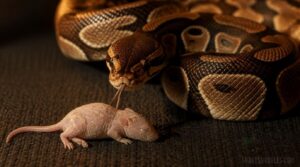
Getting prey size and type right isn’t just a preference — it’s one of the biggest factors in whether your snake eats confidently or ignores the meal entirely. Pick something too large and you’re risking a choking hazard; too small and your snake won’t even bother. Here’s what you need to know before your next feeding.
Feeding prey that’s the right size and type becomes even more important as your snake grows, and juvenile snake feeding guidelines walk you through exactly how to scale meals during those critical early stages.
Body-Width Prey Rule
Getting prey size right starts with one simple rule: match prey width to your snake’s midsection girth. Prey that exceeds your snake’s widest point forces the jaw beyond safe gape width limits, risking dislocation and stalling swallow progression. Aim for 60–80% of that midsection measurement to keep feeding cues strong and motivation consistent.
Once you’ve picked the right prey size, proper thawing matters just as much—these snake food storage tips cover safe refrigerator and cold water methods so nothing goes to waste.
For a corn snake reaching its full adult girth, checking a corn snake growth timeline by age can help you anticipate when to size up prey.
Width mismatches directly trigger regurgitation. When prey is too wide, the jaw-walking swallow slows, pauses, and often reverses. Three signs the width is correct:
- Swallowing moves continuously without visible strain
- Your snake settles into rest within 24 hours post-meal
- Feeding response stays confident across consecutive meals
Narrow prey isn’t just easier — it’s safer.
Weight-Based Prey Guidelines
Weight matters as much as width. Ideal mass ratios keep the feeding response confident and digestion efficient. For adults, prey weight should target 25–40% of body mass. Hatchling weight scales start lower — aim for 10–20% of body length in grams. If prey exceeds 50% of body mass, monitor for stress during the strike. Heavier prey requires an extra rest day.
| Life Stage | Prey Weight (% Body Mass) | Digestion Rest Period |
|---|---|---|
| Hatchling | 10–20% | 5–7 days |
| Juvenile | 15–25% | 7 days |
| Sub-adult | 20–35% | 7–10 days |
| Adult | 25–40% | 10–14 days |
| Heavy Prey Item | Up to 50% | Add 1 extra rest day |
Frozen-Thawed Rodents
Frozen-thawed rodents are the preferred method for captive feeding. They retain 95–98% of nutritional value and eliminate injury risk entirely.
Warm prey to 36–38°C using a warm water bath — never a microwave, which creates uneven hot spots.
Proper thawing preserves scent cues that trigger the feeding response.
Store portions individually, labeled with dates, to prevent freezer burn and maintain best scent retention.
Live Prey Risks
Live prey looks like a natural choice, but it comes with serious trade-offs. Cornered rodents bite back — defensive bites can puncture your snake’s mouth, damage jaw joints, and introduce pathogens that cause infections or systemic illness. Unattended prey can injure your snake repeatedly before the feeding response even completes.
Live prey also carries mites, parasites, and zoonotic bacteria — risks that extend to you.
Species Diet Differences
Not every snake eats the same thing — and getting prey type wrong disrupts the feeding response entirely. Ball pythons require rodents; garter snakes accept fish or amphibians; blind snakes eat only ants and termites. Species-specific feeding patterns reflect specialized gut systems and nutritional macronutrient ratios shaped by evolution.
- Ball pythons: rodents only
- Garter snakes: fish or amphibians
- Blind snakes: arthropods exclusively
Present Prey The Right Way
Even perfect prey won’t trigger a feeding response if you present it wrong. How you offer the meal — temperature, angle, distance, movement — can be the difference between a confident strike and a flat-out refusal. These five techniques give you direct control over that moment.
Warm Prey Safely

Before your snake even sees its prey, prey temperature already shapes the feeding response.
Warm frozen prey to 78–85°F using a warm water bath — not hot water — to avoid thermal shock. Fully thaw prey first so warmth distributes evenly, reducing strike hesitation from stiffness.
Inspect each piece for spoilage or discoloration, since contaminated prey can introduce dietary pathogens directly into your snake’s gut.
Use Feeding Tongs

Once prey is warmed, your hands should never enter the strike zone. Feeding tongs keep your fingers safely clear while giving you precise control over prey placement. Choose stainless steel or anodized aluminum — both resist corrosion and bite damage better than plastic alternatives.
Grip prey firmly at the head to prevent twisting. Sanitize tongs before and after each session to eliminate bacterial transfer and scent contamination between enclosures.
Match Strike Distance

Position prey at the right distance, and your snake’s strike accuracy improves immediately. Ambush specialists like ball pythons prefer a short presentation range — roughly one to one-and-a-half body widths. Active foragers tolerate slightly longer distances.
Watch for the S-coil and lowered head: those visual alignment cues tell you the strike zone is set.
Mimic Natural Movement

Once strike distance is dialed in, movement becomes the next trigger. Use tongs to introduce subtle lateral tail flicks — smooth, side-to-side motions that mirror how live prey naturally shifts.
Your snake’s sensory pits detect infrared heat changes instantly, while its eyes track micro-movements, engaging full prey-tracking precision and priming the jaw-opening response for a clean, confident strike.
Avoid Startling Your Snake

Even a well-warmed, correctly sized prey item can trigger a defensive response if your approach startles your snake before it feeds. Silent approach techniques matter here — move slowly from the side, keep your hands visible, and lower the prey without sudden drops or taps against the enclosure walls.
Watch for these visual warning signs before presenting prey:
- Flattened head or raised neck posture
- Rapid, repeated tongue flicking
- Tight defensive coiling or hissing
- Tail tension or erratic lateral movement
If any of these appear, pause. Give your snake a calm acclimation period — even five minutes resets its threat perception and allows the feeding response to engage naturally. Predictable interaction sessions over time reduce baseline startle sensitivity, making each prey presentation smoother than the last.
Match Species Feeding Patterns

Not every snake hunts the same way, and feeding one like it’s another is a fast road to frustration. Each species has hard-wired behaviors that shape how, when, and where it prefers to strike. Here’s what you need to know about the five most common types you’re likely to keep.
Ball Python Ambush Feeding
Ball pythons are nocturnal ambush hunters — they don’t chase prey; they wait for it. Your python relies on prey scent detection through tongue flicking, reading chemical signals before committing to a strike.
Position hides near the warm end of the thermal gradient to encourage natural ambush positioning. When you present prey within accurate strike range, expect a confident, coiling response.
Corn Snake Fast Strikes
Corn snakes are active foragers with a fast, decisive strike that sets them apart from ambush hunters like ball pythons. Using vomeronasal detection cues gathered through tongue flicking, your corn snake precisely locates prey before assuming an S-shaped neck position — coiling the body to launch a rapid, accurate lunge covering up to half its body length.
Post-strike, it constricts immediately to prevent escape.
Boa Feeding Behavior
Boas feed with a patience that feels almost calculated. Using pit organ sensing and constant tongue flicking, your boa builds a complete chemical and thermal map of its prey before committing.
Juvenile boas strike sharply, but adults often simply open their mouths with quiet confidence, initiating progressive constriction that tightens with each breath until prey stops moving.
Jaw hinges stretch wide to accommodate prey girth matching, and post-swallow digestion cycles can span several days.
Hognose Defensive Displays
Hognose snakes don’t always rush into a feeding response.
Before moving to feeding mode, they run through a layered defensive escalation sequence — first cobra mimicry (neck flattening, raised body, loud hissing), then tail vibration against substrate, then playing dead with jaw slack and odor release.
Recognizing this sequence helps you manage stress and time prey presentation after the snake visibly calms.
Green Tree Python Perching
Green tree pythons feed exclusively from a perched position — ground-level prey presentation almost always fails. In the wild, they coil around vertical branches 60–90 cm from heat sources, head angled downward, waiting to strike upward at passing prey.
Replicate this in your enclosure: mount sturdy horizontal perches within foliage, warm the ambient microclimate appropriately, and present prey below the snake’s head using tongs.
Fix Feeding Response Problems
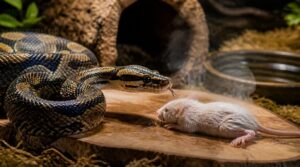
When your snake stops eating, the cause is almost always something specific and fixable. You just need to know where to look. These are the most common reasons feeding responses break down — and what to do about each one.
This guide on why snakes stop eating and how to fix it walks through each trigger so you can identify the problem and act quickly.
Check Temperature First
Before you try anything else, temperature should be your first suspect when feeding response fails.
Probe placement accuracy determines whether your readings are actually useful. A probe pressed against substrate or sitting too close to the heat mat overstates real air temperature — sometimes by several degrees.
Follow these three checks before every feeding attempt:
- Confirm thermostat cycling is active and controlling the heat source normally — a stuck-on heater can push warm-side temps dangerously high without any visible warning.
- Validate your temperature gradient by measuring both the warm side (75–85 °F) and cool side separately using a second thermometer to catch radiant heat drift distorting your primary reading.
- Monitor ambient temperature shifts, especially at night, since room temperature drops can alter heat output and suppress your snake’s thermal regulation enough to trigger feeding refusal.
Even a 5 °F fluctuation in environmental parameters is enough to shut down appetite entirely. Stabilize the enclosure, recheck your readings from consistent probe locations, and confirm the gradient holds steady before offering prey again.
Reduce Handling Stress
Once you’ve stabilized the thermal gradient, turn your attention to how often you’re handling your snake before meals. Handling within 48 hours of feeding raises oxidative stress considerably, which can trigger regurgitation.
Keep pre-feeding contact minimal, wash hands to eliminate cross-scent contamination, and stay out of the strike zone — a calm, unthreatened snake feeds far more confidently.
Watch Brumation Changes
Brumation explains a lot of "mystery" feeding refusals. When temperatures drop seasonally, metabolic rate shifts cause your snake to enter a low-energy state — appetite disappears, movement slows, and seasonal fasting can stretch three to five months.
Watch for these brumation signals:
- Prolonged stillness or hiding in cooler enclosure zones
- Reduced feeding response or total prey disinterest
- Brief waking episodes to drink, then returning to rest
- Slower digestion or jaw movement during prey presentation
- Sunken eyes or tacky mouth membranes indicating dehydration risk
Microclimate stability matters here — avoid temperature swings beyond 5°F. During post-brumation recovery, reintroduce smaller prey gradually as appetite returns.
Prevent Overfeeding
Once appetite rebounds after a quiet period, the temptation to overfeed is real. Calorie stacking — feeding too often or offering oversized prey — can drive fat deposits to 18–22% of body weight, shortening lifespan by up to 30%.
| Risk Factor | Fix |
|---|---|
| Prey too large | Downsize by one prey size |
| Feeding too often | Stick to your scheduled intervals |
| Gradual weight gain | Track baseline weight weekly |
Use body condition scoring alongside your feeding schedule to stay disciplined. Your snake’s feeding response tells you when to feed — not its behavior alone.
Call a Reptile Vet
Some feeding problems won’t resolve through husbandry adjustments alone — that’s when veterinary consultation becomes necessary. If your snake refuses food across multiple attempts, shows rapid weight loss, or repeatedly regurgitates, schedule a reptile vet visit rather than waiting.
Identifying emergency triggers matters here:
- Abdominal swelling or a firm, persistent lump
- Open-mouth breathing or audible clicking sounds
- Weakness following repeated regurgitation
- Unresponsiveness alongside feeding refusal
Before the appointment, focus on documenting husbandry changes — log every feeding attempt with date, prey type, and snake response. This feeding history gives the clinician immediate context. Diagnostic testing options may include bloodwork, radiographs, fecal parasite screening, or ultrasound depending on symptoms. While managing stressful waiting, hold temperatures steady and avoid repeated prey offerings, since unnecessary handling worsens refusal. Bring written records. A veterinary assessment turns guesswork into answers.
Frequently Asked Questions (FAQs)
Can snakes recognize their owners scent during feeding?
Yes, snakes can. They use their Jacobson’s organ to read chemical cues from handler scent profiles, building olfactory memory over weeks — familiar scents reduce stress and strengthen conditioned feeding responses reliably.
Do snakes drink water before or after eating?
Snakes almost always drink after eating, not before. Digestion raises their water needs, and postprandial hydration helps offset fluid lost during metabolic breakdown of prey.
How does shedding affect a snakes feeding motivation?
As the old saying goes, nature doesn’t rush — and neither does your snake. During the pre-shed period, reduced feeding motivation is normal, driven by sensory impairment, hormonal shifts, and energy redirected toward ecdysis.
Can music or vibrations disrupt a snakes feeding response?
Yes — low-frequency vibrations and loud bass can disrupt your snake’s sensory cues, delay strikes, and trigger stress responses. Keep the enclosure quiet during feeding windows to protect the natural feeding response.
Do snakes feed differently after relocating to a new enclosure?
Yes — relocation disrupts a snake’s routine. Expect initial feeding refusal for 3–7 days. Once secure hides, stable temperatures, and low stress are established, appetite usually rebounds within 1–2 weeks.
Conclusion
Picture your snake coiled and motionless inside a heated hide, tongue flickering steadily through the dark, every chemoreceptor primed and ready—that’s not hesitation, that’s precision biology performing exactly as designed.
The feeding response in snakes depends entirely on variables you control: temperature, prey presentation, and enclosure stress levels.
Master those conditions, and refusal becomes rare. Miss even one, and a healthy animal shuts down completely.
Understanding each stage puts real control in your hands.