This site is supported by our readers. We may earn a commission, at no cost to you, if you purchase through links.
A bearded dragon denied adequate UVB will stop processing calcium within days, leading to metabolic bone disease that no diet can fix. Light isn’t supplemental for reptiles. It’s physiological.
Managing reptile UVB lights for multi-tank collections compounds the challenge fast. One fixture type won’t serve a desert tortoise and a veiled chameleon equally. T5 HO tubes, LED bars, mounting distances, circuit loads, and species-specific Ferguson zones all demand separate decisions, and getting any one wrong affects the whole room.
This breakdown covers the top 10 options and the technical framework to deploy them correctly.
Table Of Contents
- Key Takeaways
- Top 10 Reptile UVB Lights for Multi-Tank Collections
- 1. Arcadia T5 UVB Reptile Light
- 2. ReptiZoo Dual Lamp Fixture
- 3. Lucky Herp UVB Reptile Lamp
- 4. ReptiZoo T5HO UVB Lighting Kit
- 5. Zoo Med T5 HO Terrarium Hood
- 6. Dual Reptile Light Fixture
- 7. REPTIDLDB UVB Light for Reptiles
- 8. T5 10 UVB Reptile Light
- 9. Zoo Med ReptiSun Mini UVB Lamp
- 10. Reptitrip 16 Inch LED UVB Light
- How to Choose UVB Lights for Multiple Reptile Tanks
- T5 HO Vs LED UVB Lights for Reptile Collections
- Safe UVB Installation for Stacked Tanks and Reptile Rooms
- Species-Specific UVB Levels, Monitoring, and Maintenance
- Frequently Asked Questions (FAQs)
- Is too much UVB bad for reptiles?
- What is the best UVB light source for reptiles?
- Are UVA and UVB light the same for reptiles?
- Should the UVB light be on all the time?
- Can a reptile have too much UVB?
- Can UVB lights affect reptile sleep patterns?
- Do UVB bulbs require special disposal methods?
- How does humidity impact UVB light penetration?
- Can reptiles get sunburned from UVB exposure?
- Do hatchlings need different UVB levels than adults?
- Conclusion
Key Takeaways
- UVB light isn’t optional for reptiles — without adequate exposure, calcium metabolism shuts down within days and causes irreversible skeletal damage that no diet can correct.
- Different species require vastly different UVB levels, so a multi-tank collection demands individual fixture decisions per enclosure rather than a one-size-fits-all approach.
- T5 HO tubes remain the most reliable choice for stacked multi-tank setups, delivering consistent output at practical mounting distances, while LED bars suit modular layouts where heat control and long-term replacement costs are priorities.
- UVB output degrades invisibly as bulbs age, so tracking baseline readings with a meter, cleaning reflectors regularly, and replacing tubes on a fixed schedule are non-negotiable for keeping your animals healthy.
Top 10 Reptile UVB Lights for Multi-Tank Collections
Managing multiple tanks means you need fixtures that pull their weight across different species and setups. The picks below cover the full range of UVB output levels, mounting options, and enclosure sizes you’re likely dealing with. Each one was selected for real-world performance in multi-tank collections.
For a deeper look at how these fixtures perform across mixed collections, terrarium lighting systems for multiple enclosures breaks down which combinations handle the widest range of species demands.
1. Arcadia T5 UVB Reptile Light
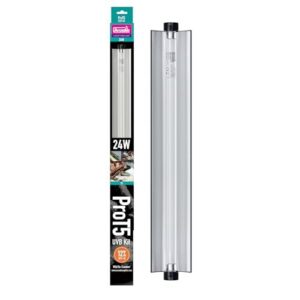
Running a multi-tank collection changes what you need from a UVB light, and the Arcadia T5 UVB Reptile Light is built for exactly that. It pushes 12% UVB and 30% UVA from a 24-watt, 22.5-inch T5 HO bulb, which is serious output aimed squarely at desert species like bearded dragons and tortoises.
The removable curved reflector focuses light into your basking zone instead of bleeding it sideways across the room. That matters when you’re stacking enclosures and can’t afford stray UVB hitting neighboring tanks.
The real draw is scale. You can link up to 10 units to a single power source, so wiring a reptile wall becomes one circuit instead of ten. Aluminum housing with a white finish fits cleanly inside wooden vivs or sits above mesh.
Mount it 12–18 inches from the basking spot, secure it with the included wing-nut hardware, and replace the lamp every 12 months. Expect moderate heat output and a higher price than budget brands, but you’re paying for consistency your animals will use.
| Best For | Keepers running multi-tank or desert-species setups—like bearded dragon or tortoise collections—who want high-output UVB they can scale across up to 10 linked units. |
|---|---|
| UVB Output | 12% |
| Light Source | T5 HO Fluorescent |
| Wattage | 24W |
| Target Species | Desert reptiles |
| Mounting Style | Vivarium or above mesh |
| Bulb Lifespan | 12 months |
| Additional Features |
|
- High 12% UVB and 30% UVA output ideal for desert species
- Linkable system connects up to 10 units to one power source
- Removable curved reflector focuses light on basking zones
- Output is too strong for non-desert species
- Requires specific mounting hardware like wing nuts
- Costs more than some alternative brands
2. ReptiZoo Dual Lamp Fixture
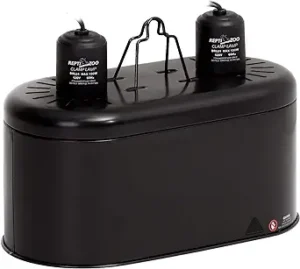
Where the Arcadia controls UVB alone, the ReptiZoo Dual Lamp Fixture runs heat and UVB from one housing. Two ceramic E26 sockets, each rated to 150W, sit under a polished reflector that pushes light straight down into your basking zone. Independent on/off switches let your basking lamp stay on while UVB cycles off, so you’re not rewiring anything or juggling timers.
It’s compact at 11.2 x 5.7 x 7.5 inches, weighs just 16 ounces, and carries ETL certification. Top vents and radiating holes bleed heat upward instead of cooking your tank, though ceramic sockets with high-wattage bulbs still run hot, so check your ambient temps. The hanging hook mounts it on any standard lampstand.
One caveat: don’t rest it directly on thin or non-metallic screens, and some owners report switch failures within two months. Works for bearded dragons, geckos, and iguanas alike.
| Best For | Reptile keepers who want to run a heat lamp and UVB bulb from a single compact, independently switched fixture mounted on a lampstand. |
|---|---|
| UVB Output | N/A |
| Light Source | Dual E26 Ceramic Sockets |
| Wattage | Up to 150W per socket |
| Target Species | Dragons, geckos, iguanas |
| Mounting Style | Hanging hook, lampstand |
| Bulb Lifespan | N/A |
| Additional Features |
|
- Two 150W ceramic sockets handle heat and UVB bulbs in one housing, with independent switches for separate control.
- Top vents and radiating holes direct heat upward, and the ETL certification adds safety assurance.
- Lightweight (16 oz) with a hanging hook that mounts easily on standard lampstands.
- Some owners report the switches failing within two months of use. If you’re worried about reliability, these reptile heat lamp options for small apartments are worth comparing before you buy.
- Not safe to rest directly on thin or non-metallic screens.
- At least one user experienced electrical buzzing and loose sockets after two months.
3. Lucky Herp UVB Reptile Lamp
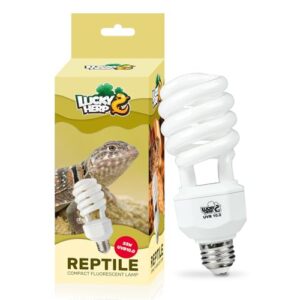
If you’d rather skip fixtures and reflectors entirely, the Lucky Herp UVB Reptile Lamp screws straight into any standard dome. It’s a compact CFL running a 10.0 UVB rating at 23W, pushing 10% UVB and 30% UVA to mimic desert sunlight. Bearded dragons, uromastyx, and tortoises are the target audience here.
The E26 base means zero adapter hunting, and you can mount it vertically or horizontally depending on your dome setup. Position it 8–12 inches from the basking spot.
Two things to watch. First, output fades quietly; the bulb stays bright long after UVB drops, so replace it every 6–12 months and test quarterly with a radiometer if you’re running multiple tanks. Second, it’s rated for 120V only, and some owners report early failures or flickering. The 90% CRI and low-degradation coating help, but budget replacements accordingly.
| Best For | Reptile keepers with desert-dwelling species like bearded dragons, uromastyx, and tortoises who want a simple bulb that screws straight into a standard dome without extra fixtures or reflectors. |
|---|---|
| UVB Output | 10% |
| Light Source | CFL E26 |
| Wattage | 23W |
| Target Species | Desert reptiles |
| Mounting Style | Standard dome (E26) |
| Bulb Lifespan | 6–12 months |
| Additional Features |
|
- Delivers 10% UVB and 30% UVA to replicate desert sunlight, supporting vitamin D3 synthesis and calcium absorption.
- Standard E26 base works with any regular dome fixture, and the 90% CRI keeps your reptile’s colors looking natural.
- Low-degradation technology helps UVB output stay stable over the bulb’s lifespan.
- Rated for 120V only, so it risks immediate damage if used in 110V regions.
- Some owners report units failing within days or months of purchase.
- UVB output fades invisibly while the bulb still looks bright, requiring replacement every 6–12 months and occasional flickering issues.
4. ReptiZoo T5HO UVB Lighting Kit
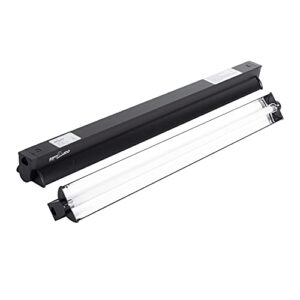
The ReptiZoo T5HO UVB Kit is the natural step up from a screw-in CFL. Instead of a bare bulb, you get a 24W T5 HO tube inside a low-profile housing with a polished curved reflector that focuses UVB downward where your animals actually need it. The integrated electronic ballast gives you rapid start and stable output with minimal flicker.
For top-mounted installations, positioning the tube 8–13 inches above your basking zone maximizes UVB delivery — see UVB lighting setups for large terrariums for guidance on scaling this kit to bigger enclosures.
Mount it under your mesh screen at 30–40 cm above the basking spot and you’ll hit solid intensity for desert species. It’s built for exactly that setup, and the removable power cable with on/off switch makes rack placement flexible.
Two caveats. Voltage is locked to 100–120V, so international keepers need a transformer. And some owners report early failures or bulbs dying within weeks, so test output with a meter and keep spares on hand.
| Best For | Desert-dwelling reptile keepers upgrading from a basic CFL bulb who want a low-profile T5HO fixture mounted under a mesh screen top. |
|---|---|
| UVB Output | N/A |
| Light Source | T5 HO Fluorescent |
| Wattage | 24W |
| Target Species | Desert reptiles |
| Mounting Style | Under mesh screen |
| Bulb Lifespan | N/A |
| Additional Features |
|
- Polished curved reflector focuses UVB downward for stronger, more targeted output
- Electronic ballast delivers rapid start and stable, low-flicker performance
- Removable power cable with on/off switch allows flexible placement
- Voltage locked to 100–120V, requiring a transformer for international use
- Some units reportedly fail within days or bulbs burn out after only weeks
- UVB intensity receives mixed feedback, so a meter is recommended to verify output
5. Zoo Med T5 HO Terrarium Hood
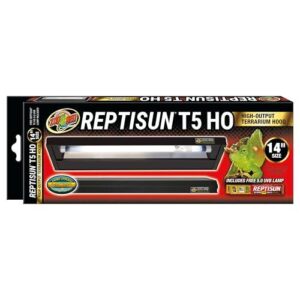
One fixture has quietly become the rack-builder’s default: the Zoo Med T5 HO Terrarium Hood. Model 26401 pairs an energy-efficient electronic ballast with a highly polished curved reflector, so UVB pushes downward cleanly without dead spots or light spilling onto your walls.
The included ReptiSun T5 HO 5.0 lamp delivers 5–6% UVB, ideal for tropical species in taller enclosures where penetration matters. At 16.3 x 5.9 x 1.1 inches, it’s genuinely low-profile. That matters when you’re stacking tanks and every inch of headroom counts.
Mount it 12–18 inches above the basking surface for reliable output. It rests on the enclosure top; no hanging hardware included.
Two cautions. Some units develop ballast connection issues, causing flickering or early failure, and durability complaints exist within three months. Replace the lamp every 12 months regardless of visible brightness.
| Best For | Reptile keepers with 18-inch wide, low-profile or stacked terrariums who need reliable UVB penetration for tropical species. |
|---|---|
| UVB Output | 5–6% |
| Light Source | T5 HO Fluorescent |
| Wattage | N/A |
| Target Species | Tropical reptiles |
| Mounting Style | Top of enclosure |
| Bulb Lifespan | 12 months |
| Additional Features |
|
- Includes a free ReptiSun T5 HO 5.0 UVB lamp delivering 5–6% UVB, ideal for tropical species in taller enclosures.
- Highly polished curved reflector distributes light cleanly downward without dead spots or wall spill.
- Energy-efficient electronic ballast with rapid start and a genuinely low-profile 16.3 x 5.9 x 1.1 inch design that saves headroom when stacking tanks.
- Some units develop ballast connection issues, causing flickering or early failure.
- No hanging hardware included, so it must simply rest on top of the enclosure.
- Durability concerns, with some users reporting units breaking within three months. Before buying, it’s worth weighing durability against your snake’s actual humidity needs—our fogger vs. misting system guide breaks down which setup suits your species best.
6. Dual Reptile Light Fixture
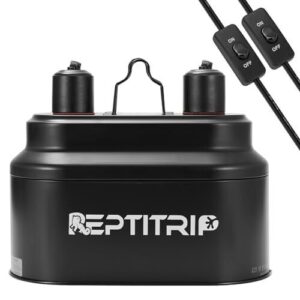
When you need heat and UVB in one footprint, this dual-socket fixture covers both. Each socket takes up to 160 watts and switches independently, so a ceramic heat emitter runs on one control while your UVB bulb runs on the other. The polished interior reflects light downward for tighter, more even coverage.
You won’t find a built-in timer here. Pair it with a smart plug or external thermostat instead. A heat warning label turns red above 113°F, and top ventilation holes help shed excess warmth. Mount it on mesh, verify bulb spacing, and you’ve got clean two-zone control.
| Best For | Reptile keepers who need independent heat and UVB control in a single fixture and already own a thermostat or smart plug. |
|---|---|
| UVB Output | N/A |
| Light Source | Dual E26 Sockets |
| Wattage | Up to 160W per socket |
| Target Species | General reptiles |
| Mounting Style | On mesh |
| Bulb Lifespan | N/A |
| Additional Features |
|
- Dual sockets with independent switches let you run heat and UVB bulbs separately
- Polished interior reflects light for tighter, more even coverage
- Heat warning label turns red above 113°F for added safety awareness
- No built-in timer, so you’ll need a smart plug or external controller
- Deep design may not fit shorter bulbs that need close proximity to the tank
- Some units have reported electrical shorts or rapid bulb burnout
7. REPTIDLDB UVB Light for Reptiles
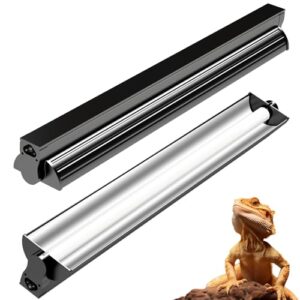
A bearded dragon in a 4-foot rack can get almost no usable UVB from a cheap coil bulb mounted two feet away. That’s the gap the REPTIDLDB UVB Light fills.
This fixture pairs a 10% UVB, 30% UVA T5 HO fluorescent tube with a built-in electronic ballast, so you skip the separate controller entirely. The alloy reflective layer pushes usable output down toward your basking zone, which matters when you’re working with 12 to 18 inches of clearance in stacked setups.
It comes in 12, 22, 34, and 46-inch lengths, from 8W to 54W, so you can match tube length to tank width instead of overhanging edges. The detachable cable and on/off switch make swaps quick, and the slim aluminum housing mounts inside a tank lid or under wire mesh.
Two cautions. Some buyers report units failing around the two-month mark, so test output with a meter early. And check heat in enclosed racks; a few users found it warmer than expected. Replace the tube every 6 to 12 months to hold output steady.
| Best For | Desert species like bearded dragons needing reliable UVB in compact racks |
| UVB Output | 10% |
| Wattage | 8W–54W |
| Light Source | T5 Fluorescent |
| Target Species | Desert Reptiles |
| Heat Output | Low |
| Additional Features | Alloy reflective coating, detachable cable switch, slim profile |
Best For: Desert reptile keepers like bearded dragon owners who need reliable UVB output in compact stacked racks or slim tank setups.
| UVB Output | 10% |
|---|---|
| Light Source | T5 HO Fluorescent |
| Wattage | 8W–54W |
| Target Species | Desert reptiles |
| Mounting Style | Inside lid or mesh |
| Bulb Lifespan | 6–12 months |
| Additional Features |
|
- Built-in electronic ballast with alloy reflective layer delivers strong usable UVB to the basking zone without needing a separate controller
- Multiple lengths (12–46 inches) and wattages (8W–54W) let you match the tube to your tank or rack dimensions
- Slim aluminum housing with detachable cable and on/off switch makes installation inside lids or under wire mesh simple
- Some customers report units failing after about two months of use
- Heat output is inconsistent, with some users finding it runs warm in enclosed setups
- Requires periodic bulb replacement every 6–12 months to maintain UVB levels
8. T5 10 UVB Reptile Light
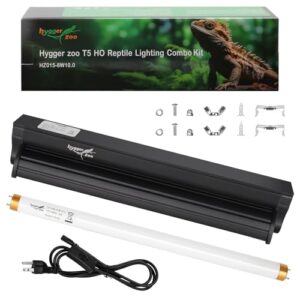
Small wattage doesn’t mean weak UVB. At 8W, this T5 tube hits 10% UVB output, which is exactly what desert species like bearded dragons, tortoises, and chameleons need for consistent D3 synthesis and calcium absorption.
The polished curved reflector concentrates output instead of letting it scatter, so you’re not wasting coverage across your rack. Mount it 12–18 inches above the basking zone to stay within safe exposure thresholds.
Aluminum housing keeps working temperatures low, which matters in stacked setups where heat accumulates fast. Plan to replace the bulb every 6–12 months. Some users have reported early bulb burnouts, so keep a spare on hand.
It also fits mesh covers and wooden vivariums without modification. At 13.23 x 3.9 x 3.27 inches, it’s compact enough for tight rack spacing.
| Best For | Reptile keepers housing desert species like bearded dragons, tortoises, chameleons, and lizards who need reliable high-output UVB lighting in compact or stacked vivarium setups. |
|---|---|
| UVB Output | 10% |
| Light Source | T5 Fluorescent |
| Wattage | 8W |
| Target Species | Desert reptiles |
| Mounting Style | Mesh or vivarium |
| Bulb Lifespan | 6–12 months |
| Additional Features |
|
- Delivers true 10.0 UVB output despite the low 8W draw, giving desert reptiles the D3 synthesis and calcium absorption they need
- Polished curved reflector focuses light efficiently, minimizing wasted coverage
- Aluminum housing dissipates heat well, making it a solid choice for stacked rack setups
- Some users report bulbs burning out within the first week, so keeping a spare on hand is a good idea
- Long-term durability is inconsistent based on mixed customer feedback
- The bulb can produce a slight rattle when unpowered, which may be off-putting even though it’s noted as normal
9. Zoo Med ReptiSun Mini UVB Lamp
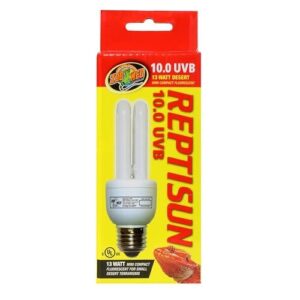
The ReptiSun Mini proves compact doesn’t mean compromised. At 13 watts, it pushes 10% UVB and 30% UVA through quartz glass, which cuts attenuation before UV reaches your animal. That matters more than raw wattage in tight enclosures.
Mount it vertically or horizontally depending on your hood setup. It fits Mini Deep Dome Lamps and standard terrarium hoods without crowding the space. Keep it 6 to 12 inches from the basking surface for consistent exposure. Any closer and you risk oversaturation. Any further and output drops fast.
It’s right for bearded dragons, box turtles, and gargoyle geckos. It’s not for large high-demand species without supplementation.
Replace it at 12 months. The bulb still glows past that point, but usable UVB output is already gone.
| Best For | Desert reptile owners with compact enclosures housing bearded dragons, box turtles, or gargoyle geckos who need reliable UVB coverage without sacrificing space. |
|---|---|
| UVB Output | 10% |
| Light Source | CFL (Quartz Glass) |
| Wattage | 13W |
| Target Species | Desert reptiles |
| Mounting Style | Dome or hood, any angle |
| Bulb Lifespan | 12 months |
| Additional Features |
|
- Delivers 10% UVB and 30% UVA through quartz glass, maximizing UV penetration even in tight setups
- Mounts vertically or horizontally, making it compatible with Mini Deep Dome Lamps and standard terrarium hoods
- At 13 watts, it provides effective UVB output without the bulk of larger bulbs
- UVB output degrades significantly after about six months, even though the bulb continues to glow
- Some users report early failures or inconsistent brightness within the first month
- May fall short of the UVB levels offered by competing brands, especially for higher-demand species
10. Reptitrip 16 Inch LED UVB Light
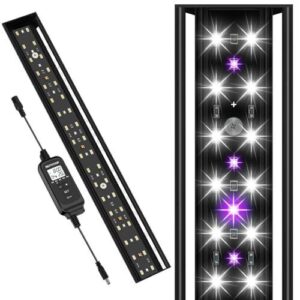
The long-game pick for multi-tank rooms runs cold, and that’s entirely the point.
At 14W with a 7,000-hour LED lifespan, the Reptitrip 16 Inch outlasts T5 HO bulbs by years, eliminating the replacement scramble that plagues most fluorescent setups. You’re getting UVI 2 at 16 inches for zone 2 species, or drop it down to 10 inches and you’re at UVI 8.5 for animals with higher basking requirements.
The built-in M1-M4 presets cover Ferguson zones 1 through 4, plus a manual mode for custom intensity. A programmable sunrise and sunset simulation syncs photoperiods across your full collection without any external timers.
Just account for supplemental heat separately. This fixture produces none at all, so plan your enclosures accordingly.
| Best For | Reptile keepers managing multiple tanks who want a long-lasting, low-maintenance UVB solution with built-in photoperiod control. |
|---|---|
| UVB Output | N/A |
| Light Source | LED |
| Wattage | 14W |
| Target Species | General reptiles |
| Mounting Style | Mesh, inside, or suspended |
| Bulb Lifespan | 7,000+ hours |
| Additional Features |
|
- 7,000-hour LED lifespan far outlasts traditional T5 HO bulbs, cutting down on frequent replacements
- M1–M4 Ferguson zone presets and programmable sunrise/sunset simulation make it easy to dial in the right UVB for any species
- Runs completely cool, so there’s no risk of accidental overheating from the light fixture itself
- Produces zero heat, meaning you’ll need to budget for and install separate heating sources for every enclosure
- UVB output can be inconsistent across units, and accurate testing requires professional equipment rather than the included UVB card
- Some reptiles reject the light outright, so it may not work for every animal in your collection
How to Choose UVB Lights for Multiple Reptile Tanks
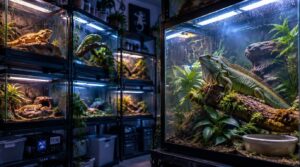
Choosing UVB for a multi-tank setup means more than picking a bright bulb. You need to match fixture technology, mounting physics, and species requirements before buying anything. These five factors will tell you exactly what to look for.
Match Species UVB Needs
Knowing your full species list upfront determines every UVB decision you’ll make. Species-specific care starts with understanding each animal’s natural light exposure; desert reptiles need 10–12 hours daily at 6–8% UVB irradiance, while nocturnal animals need minimal exposure to prevent eye stress.
Set species-appropriate UVI targets per tank. Getting UVB dosage wrong stalls calcium metabolism and causes lasting skeletal damage.
Compare Fixture Technologies
Once you’ve mapped your species’ UVB needs, fixture choice determines whether you can actually deliver them reliably.
T5 HO tubes dominate multi-tank setups: consistent output, wide coverage, proven UVB delivery. LED bars run cooler and offer dimming for tiered stacks, but verify actual UVB output before committing. Check daisy-chain load limits per circuit. Mismatched fixture compatibility wastes money and light.
Calculate Mounting Distances
Fixture choice narrows your options; UVB throw distance decides what animals receive. The inverse square law is blunt: double the distance, drop UVB intensity by 75%. T5HO units need 30-40 cm from basking surfaces. LEDs work at 15-30 cm.
Measure with a UVB meter at each spot. Enclosure height and rack changes create UVB dead zones you can’t spot visually.
Plan Electrical Loads
Once mounting locations are locked in, count your fixtures. Sum every watt, then divide by 120 to get amperes per circuit. Apply a 1.25× continuous-load factor before sizing breakers.
Daisy-chain load limits matter across multiple enclosures. Most power strips cap at 1,500 watts. Spreading fixtures across dedicated circuits prevents nuisance tripping. Build in at least 15% headroom for future tanks.
Monitor UVB Output
Three readings tell you more than one. After installing T5 HO tubes, record your baseline UVB output at each basking spot. Use Solarmeter grid scanning to map UVB intensity, not just the center point.
UVB monitoring means checking weekly for the first month, then monthly. Replace tubes when readings drop below 60–70% of baseline, even if they still look bright.
T5 HO Vs LED UVB Lights for Reptile Collections
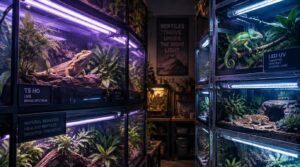
Choose between T5 HO UVB and LED bars based on your collection’s real demands, not marketing claims.
T5 HO delivers broader spectral output across longer tubes, covering multiple tanks with fewer fixtures. UVB intensity holds at 12-18 inches, reliable for large stacked setups. LED bars run cooler and last longer, but you’ll often need more units to match equivalent UVB output at practical distances.
| Factor | T5 HO UVB | LED UVB |
|---|---|---|
| UVB Spectrum | 290-320 nm broad | Narrow, tuned |
| Effective Distance | 12-18 inches | 6-18 inches |
| Lifespan | 12-18 months | 30,000+ hours |
| Heat Output | Higher | Lower |
For multitank collections with uniform species needs, T5 HO UVB is the stronger investment. LED bars work well for modular layouts where heat management and replacement costs matter.
Safe UVB Installation for Stacked Tanks and Reptile Rooms
Picture a six-tank stacked rack where two fixtures share a single circuit with the room lighting. Ballast interference from shared neutrals degrades output fast.
Stacked racks create UVB dead zones between tiers if you don’t stagger fixtures vertically. Use spacers and adjustable mounts so each lamp clears its basking zone by 8 to 12 inches. Don’t let one fixture’s light spread bleed into the enclosure below.
Electrical load safety matters at scale. Never exceed your daisy-chain load limits; dedicate a 120-240V circuit per bank and keep ballasts within 5 feet of each tank. Add GFCI protection in any room with stacked enclosures. A dedicated GFCI outlet plug for reptile rooms trips instantly on ground faults, giving you a critical safety layer where water misters and humid enclosures share circuits.
Fixture scalability depends on planning your conduit runs, ventilation clearances, and easy mounting access before your collection grows.
Species-Specific UVB Levels, Monitoring, and Maintenance
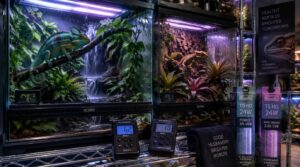
A veiled chameleon sharing rack space with a crested gecko needs entirely different UVB exposure. Your chameleon needs species-appropriate UVB at 5-8%, while your crested gecko requires far less. Getting this wrong stresses both animals and disrupts their long-term health.
Even rack neighbors need their own UVB prescription—one size fits none
Track UVB intensity measurement at each basking spot every three months. Output shouldn’t fall below 30 µW/cm². As bulb age increases, UVB degradation accelerates even when lamps still appear bright. T5 lamps usually show meaningful decline by nine months.
Build a solid maintenance checklist: record baseline readings at installation, recheck quarterly, clean reflectors every four to six weeks, and replace lamps on a fixed schedule. If output drops by more than 25% from your baseline, reposition or replace right away. A dedicated reptile husbandry care journal makes it easy to spot degradation trends across multiple enclosures before they become a real problem.
Frequently Asked Questions (FAQs)
Is too much UVB bad for reptiles?
Sunlight sustains life, but it also scorches. Too much UVB intensity burns skin, suppresses immunity, and stresses animals beyond recovery. Species-appropriate UVB exposure levels exist for a reason. UVB radiation isn’t a benefit you push to the limit.
What is the best UVB light source for reptiles?
T5 HO UVB is the strongest overall pick. It delivers higher reptile UVB lighting output at usable mounting distances, suits any multi-tank rack configuration, and makes UVB irradiance monitoring more reliable across your whole collection.
Are UVA and UVB light the same for reptiles?
They don’t occupy the same slice of the spectrum. UVA drives feeding and natural basking instincts. UVB triggers vitamin D3 synthesis, fueling calcium metabolism. Treating them as interchangeable is a mistake your reptiles pay for.
Should the UVB light be on all the time?
No. Continuous UVB disrupts your reptile’s circadian rhythm and degrades enclosure materials over time. Most species need 10–12 hours of UVB exposure daily. Use timer automation to align photoperiods properly with a natural day-night cycle.
Can a reptile have too much UVB?
Too much fire scorches. Yes, reptiles can overdose on UVB. Skin burns, corneal damage, and hypervitaminosis D are real consequences.
Always provide a UVB escape zone and measure UVB intensity at the basking spot regularly.
Can UVB lights affect reptile sleep patterns?
UVB exposure itself rarely disrupts reptile sleep patterns directly. The real problem is timing. Inconsistent photoperiod management causes circadian rhythm disruption, fragmenting nighttime rest. Keep your UVB lighting on a strict 10-12 hour daily cycle.
Do UVB bulbs require special disposal methods?
That spent UVB bulb sitting quietly on your bench isn’t ordinary trash. Most contain mercury vapor, making them legally hazardous waste. Drop them at a lamp recycling facility or a retailer take-back program, never curbside.
How does humidity impact UVB light penetration?
Humidity actively hurts UVB transmission. Water vapor absorbs and scatters photons before they even reach your animals, and relative humidity above 60-70% can reduce UVB intensity by up to 35% at your typical enclosure distances.
Can reptiles get sunburned from UVB exposure?
Yes, reptiles can get sunburned. Pale morphs and albinos face the greatest risk since melanin is their only UV shield. Without shaded retreats, excessive UVB intensity in the basking zone causes skin damage and photokeratitis.
Do hatchlings need different UVB levels than adults?
Think of a hatchling’s metabolism as running at full throttle. They actually need higher UVB intensity than adults, as faster growth demands more D3 synthesis. Without it, you’re risking metabolic bone disease. Monitor output monthly.
Conclusion
The complexity here is real. Ten fixture options, multiple species, Ferguson zones, and circuit loads aren’t trivial to manage. But you don’t need to design and deploy everything perfectly all at once.
Scaling reptile UVB lights for multi-tank collections works when you treat each tank as a controlled unit first, then build outward. Nail the UVB output per species, swap bulbs on a firm schedule, and measure output regularly. The biology takes care of the rest entirely.