This site is supported by our readers. We may earn a commission, at no cost to you, if you purchase through links.
Most corn snake keepers never think twice about UVB—until their snake’s spine curves wrong or a vet bill arrives with "metabolic bone disease" on it. For years, the reptile hobby treated corn snakes as a low-maintenance species that could thrive under basic incandescent bulbs, but research into diurnal and crepuscular behavior has quietly rewritten that assumption.
A corn snake basking near a sun-drenched rock face gets hit with enough UVB to synthesize 10,000 IU of vitamin D₃ in 15 minutes—your enclosure lighting needs to work harder than you think. Choosing the right reptile UVB lights for corn snake setups isn’t about following trends; it’s about replicating a biochemical process your snake’s body depends on.
The ten fixtures reviewed here span every budget and enclosure size, with the installation and maintenance details that actually determine whether the light does its job.
Table Of Contents
- Key Takeaways
- Why Corn Snakes Need UVB
- Choosing The Right UVB Light
- Top 10 UVB Lights for Corn Snakes
- 1. LckyY UVB Reptile Light
- 2. REPTIDLDB T5 UVB Light Fixture
- 3. QZQ T5 UVB Reptile Light Fixture
- 4. REPTI ZOO UVB Reptile Light
- 5. Hygger Zoo UVB Reptile Light
- 6. MRREPTILE UVB Reptile Light
- 7. Hygger Zoo Adjustable UVB Reptile Light
- 8. REPTI ZOO Tropical UVB Light
- 9. Hygger Dimmable LED UVB Reptile Lamp
- 10. EnchOrch LED UVB Reptile Light
- Safe UVB Installation Tips
- UVB Maintenance and Replacement
- Measuring Health and Adjusting UVB
- Frequently Asked Questions (FAQs)
- Can snakes get too much UVB?
- Which UVB light for corn snakes?
- Is 0 UVB good for corn snakes?
- Does my corn snake need an UV light?
- Is too much UVB bad for snakes?
- Can corn snakes share UVB lighting with other reptiles?
- How does seasonal photoperiod affect corn snake behavior?
- Can corn snakes get UVB through a window?
- Do hatchlings need different UVB than adults?
- How does UVB affect corn snake coloration?
- Conclusion
Key Takeaways
- Corn snakes genuinely need UVB light — without it, their bodies can’t produce vitamin D3, which leads to weakened bones, spinal deformities, and a shortened lifespan.
- UVI of 2.0–3.0 at the basking spot, mounted 12–18 inches above your snake, hits the sweet spot between effective exposure and overexposure risk.
- T5 HO tubes with 5–6% UVB output are the most reliable choice for corn snakes, delivering consistent UV without overwhelming a species that prefers gentle, optional light.
- UVB bulbs lose output long before they stop glowing, so replacing compact bulbs every 6–8 months and T5 HO tubes every 10–12 months is non‑negotiable for keeping your snake healthy.
Why Corn Snakes Need UVB
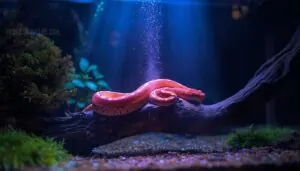
UVB isn’t just a nice extra for corn snakes — it plays a real role in keeping them healthy from the inside out. Understanding why they need it will help you make a smarter choice when picking the right light.
From calcium metabolism to immune function, UVB lighting for corn snakes supports biological processes you simply can’t replicate with heat alone.
Here’s what you should know before we get into the top options.
Vitamin D3 Synthesis and Calcium Absorption
When UVB hits your corn snake’s skin, it triggers the Skin Photochemistry Pathway — converting 7-dehydrocholesterol into vitamin D3, which then activates calcitriol to drive Calcitriol Intestinal Transport.
midday sun vitamin D3 can generate up to 10,000 IU in just 15 minutes.
- Calcium Transport Proteins like calbindin shuttle calcium into the bloodstream
- Parathyroid Hormone Regulation fine‑tunes how much active vitamin D gets produced
- Proper UVB intensity ensures this entire cascade actually runs
Preventing Metabolic Bone Disease
Without enough UVB lighting to drive vitamin D3 synthesis, calcium metabolism breaks down fast. That’s when metabolic bone disease (MBD) sets in — weakening bones, causing spinal deformities, and cutting lifespan short.
Calcium supplementation and a proper dietary calcium ratio help, but they can’t fully replace UVB intensity. Correct enclosure size and UVB placement are your real first line of defense.
Benefits of Low-level UVB for Corn Snakes
Low-level UVB does more than support vitamin D3 synthesis and calcium metabolism — it genuinely improves quality of life.
Corn snakes with proper UVB access show activity stimulation, better feeding appetite, and enhanced shedding cycles.
You’ll also notice stronger color vibrancy and an immune boost that dietary supplements alone can’t replicate.
Think of it as giving your snake a slice of real sunlight.
Low-level UVB gives your corn snake a genuine slice of real sunlight
Risks of Insufficient UVB Exposure
Skipping UVB isn’t just a small oversight — it can trigger a cascade that’s hard to reverse.
Calcium Deficiency develops when vitamin D3 drops, leading to Metabolic Bone Disease (MBD), Poor Shedding, Muscle Weakness, and Immune Suppression over time.
Risks of insufficient UVB lighting compound quietly, which is why Preventing metabolic bone disease with UVB through proper UVB dosage recommendations matters before problems appear.
Choosing The Right UVB Light
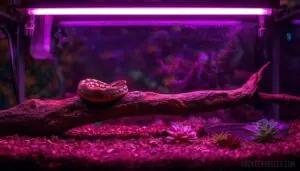
Not every UVB light works the same way, and picking the wrong one can make a real difference in your corn snake’s health. A few key factors — bulb type, output percentage, and fixture size — will guide you toward the right fit for your setup.
Here’s what to look for before you decide.
T5 HO Vs. T8 Fluorescent Bulbs
In terms of fluorescent UVB options, T5 HO tubes outperform T8 fluorescent lights for corn snakes in nearly every category. Their higher lumen efficiency and concentrated spectral output deliver stronger UVB output at greater distances.
T8s run cooler with lower heat generation, but require closer positioning.
Ballast compatibility and cost efficiency both favor T5 HO long-term, especially considering UVB bulb lifespan improvements.
LED UVB and Compact Fluorescent Options
Beyond fluorescent tubes, two modern alternatives stand out: LED lights and compact fluorescent CFL lights — each with real trade-offs worth knowing.
- Spectral Tuning: LEDs let you dial in precise UVB wavelengths (290–320 nm)
- Heat Management: LEDs produce minimal radiant heat, easing temperature control
- Cooling Mechanisms: Built-in drivers maintain stable UVB output
- UVB bulb lifespan: LEDs exceed 10,000 hours; CFLs need replacement every 6–12 months
- Form Factor Flexibility: Both fit standard fixtures, making them energy-efficient lighting options for reptile care
Ideal UVB Output for Corn Snake Setups
The sweet spot for corn snakes sits at a UVI Target Range of 2.0–3.0 measured directly at the basking surface.
UVB intensity measurement matters more than the bulb’s label — Distance Intensity Curve means UVB output drops sharply the farther away your snake basks. UVB output decay over time also shifts that range, so replacement timing is critical.
| Factor | Target | Impact |
|---|---|---|
| UVI at basking spot | 2.0–3.0 | Facilitates D3 synthesis |
| Ideal distance | 12–18 inches | Keeps UVI in safe range |
| Bulb replacement | Every 6–12 months | Prevents output decay |
Matching Fixture Size to Enclosure Size
Your fixture needs to fit the enclosure — not just sitting on top of it. Aim for proper Enclosure Volume Ratio by leaving at least 20% internal clearance for heat and wiring.
In narrow setups, Slim Fixture Design keeps airflow intact.
Tall enclosures call for Vertical Fixture Placement with a smaller Fixture Footprint Alignment.
Always confirm Standard Rail Compatibility before buying.
Comparing Metal Halide and Tube Fixtures
Metal halide lamps pack serious intensity — strong spectral output, combined UVB, UVA, and heat in one unit — but they come with trade‑offs. Heat generation is significant, installation complexity is higher, and lifespan replacement happens faster than most expect.
UVB fluorescent bulbs and T5 UVB tube fixtures win on energy efficiency, easier setup, and more even light spread for standard corn snake enclosures.
Top 10 UVB Lights for Corn Snakes
Finding the right UVB light doesn’t have to feel overwhelming, even with so many options on the market. Each pick below was chosen with corn snake care in mind — balancing output, fixture size, and ease of use.
Here are ten lights worth your attention.
1. LckyY UVB Reptile Light
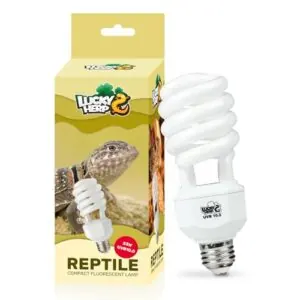
LuckyY UVB Reptile Light is a compact fluorescent option worth considering if you’re working with a smaller enclosure or a tighter budget. It delivers UVB in the 5–10% range, which sits right in the acceptable zone for corn snakes, alongside UVA to encourage natural feeding and exploration behaviors.
E26 screw base makes installation straightforward — no specialty fixtures required. Just remember to mount it without any glass or plastic in the way, and replace it every 6–12 months.
| Best For | Desert reptile owners — think bearded dragons, iguanas, and tortoises — who need solid UVB and UVA coverage without overcomplicating their setup. |
|---|---|
| UVB Output | 10% |
| UVA Output | 30% |
| Power Consumption | 23W |
| Heat Emission | Yes |
| Bulb/Unit Type | CFL Screw-in |
| Separate Heat Required | No |
| Additional Features |
|
- Puts out 10% UVB and 30% UVA, which mirrors natural desert sunlight pretty closely and supports vitamin D₃ production for healthy bones.
- High CRI of 90 means your reptile’s colors actually look true to life, making it easier to spot health issues.
- Standard E26 base fits most common fixtures — no special hardware needed.
- Some users report early burnout, sometimes as fast as two weeks, especially in dual-lamp setups that run hot.
- Takes a few minutes to warm up before hitting full brightness, so don’t expect instant results when you flip the switch.
- Only works on 120V US outlets — if your voltage is different, you’ll need a transformer or a different bulb altogether.
2. REPTIDLDB T5 UVB Light Fixture
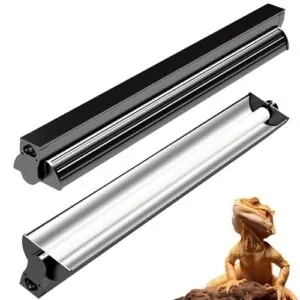
If you want something more structured than a compact CFL, the REPTIDLDB T5 UVB Light Fixture is worth a close look. At just 12 inches long and 8 W, it’s built for smaller enclosures without hogging headspace.
The built-in electronic ballast keeps output stable and flicker‑free, while the alloy reflective interior pushes UVB where your snake actually basks.
One thing to watch: the reflective coating can degrade over time, so inspect it regularly and replace the bulb every 6–12 months.
| Best For | Desert reptiles like bearded dragons and tortoises living in small to medium enclosures that need solid UVB support without a bulky setup. |
|---|---|
| UVB Output | 10% |
| UVA Output | 30% |
| Power Consumption | 8W |
| Heat Emission | Minimal |
| Bulb/Unit Type | T5 Linear Tube |
| Separate Heat Required | Yes |
| Additional Features |
|
- Delivers stable, flicker-free UVB thanks to the built-in electronic ballast — no annoying flickering stressing out your reptile.
- The alloy reflective interior does a good job directing UVB right where your pet basks, so none of that output goes to waste.
- Slim 12-inch design fits neatly without eating up headspace, and it runs cool so you won’t accidentally overheat the tank.
- The reflective coating can peel or crack over time, which chips away at UV output and could raise some safety concerns.
- At only 8 W, it’s not going to cut it for larger enclosures — you’d need one of the bigger models for that.
- UVB fades as the bulb ages, so you’ll need to stay on top of replacements every 6–12 months to keep things healthy for your reptile.
3. QZQ T5 UVB Reptile Light Fixture
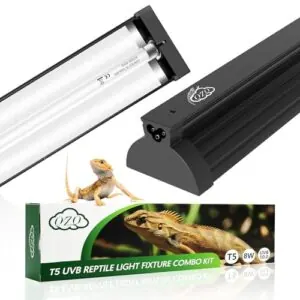
The QZQ T5 UVB Reptile Light Fixture takes a similar approach but adds a few practical upgrades worth noting. It delivers around 10% UVB and 30% UVA through a curved alloy reflector that distributes light more evenly across the basking zone.
The 8 W lamp sips power while still hitting the UVI range that corn snakes need.
Setup is straightforward, with mounting hardware compatible with mesh lids and wood frames.
Just replace the tube every 6–12 months to keep output reliable.
| Best For | Reptile owners keeping bearded dragons, geckos, tortoises, or similar lizards who want an energy-efficient UVB light that’s easy to mount on mesh or wood enclosures. |
|---|---|
| UVB Output | 10% |
| UVA Output | 30% |
| Power Consumption | 8W |
| Heat Emission | Minimal |
| Bulb/Unit Type | T5 Linear Tube |
| Separate Heat Required | Yes |
| Additional Features |
|
- Curved alloy reflector spreads UVB and UVA more evenly across the basking zone
- Low 8W power draw keeps running costs down without sacrificing UV output
- Comes with mounting hardware that works with both mesh lids and wooden tanks
- Some users report early lamp failure or flickering within the first 24 hours
- Packaging can be misleading — you likely get one lamp, not two
- UV output fades over time, so you’ll need to swap the tube every 6–12 months
4. REPTI ZOO UVB Reptile Light
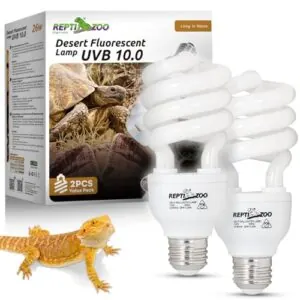
If you need a step up in build quality, the REPTI ZOO UVB Reptile Light is worth a close look. It uses a T5 HO tube with a detachable curved reflector that pushes UVB deeper into the enclosure — no dead zones, no guesswork.
The ETL certification means the electrical components have been independently tested, which matters when you’re running a light daily for years. It ships with a Desert 10.0 UVB lamp, so you’re ready to install right out of the box.
| Best For | Reptile owners who want a reliable, affordable UVB bulb pair for tropical and subtropical species like turtles, lizards, and frogs. |
|---|---|
| UVB Output | 5% |
| UVA Output | 30% |
| Power Consumption | 26W |
| Heat Emission | Yes |
| Bulb/Unit Type | CFL Screw-in |
| Separate Heat Required | Possibly |
| Additional Features |
|
- Dual-pack means you always have a spare on hand, so no scrambling when a bulb dies
- 10,000-hour lifespan keeps replacement costs low over time
- Standard E26 base fits most U.S. fixtures — no adapter needed
- Some users report bulbs burning out within a month, so quality can be hit or miss
- 5% UVB may not cut it for desert species like bearded dragons that need stronger output
- Shipping damage has been reported, so there’s a chance your spare arrives already broken
5. Hygger Zoo UVB Reptile Light
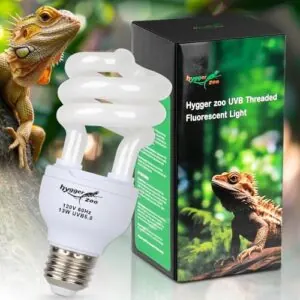
The Hygger Zoo UVB Reptile Light takes a different approach — LED technology instead of fluorescent, which means more consistent output over its rated lifespan with minimal color shift. The aluminum shell manages heat dissipation well, and the scratch-resistant lens stays cleaner longer than standard glass covers.
It’s compact enough for tight setups, mounts horizontally or overhead, and works alongside a separate heat source to maintain your thermal gradient.
For corn snake keepers running smaller enclosures, it’s a practical, low-maintenance option.
| Best For | Reptile and amphibian owners with shallow dome fixtures or smaller terrariums who need reliable UVA/UVB output for rainforest species like chameleons, iguanas, or tree frogs. |
|---|---|
| UVB Output | 5% |
| UVA Output | 30% |
| Power Consumption | 13W |
| Heat Emission | No |
| Bulb/Unit Type | CFL Screw-in |
| Separate Heat Required | Yes |
| Additional Features |
|
- Made from quartz glass, which delivers stable, consistent UVA/UVB transmission — more reliable than standard glass bulbs.
- Compact size fits shallow light domes where longer bulbs simply won’t work.
- Higher measured UVA/UVB output than comparable bulbs, so your animals are actually getting what they need for D₃ synthesis.
- No heat output at all — you’ll need a separate heat source, which adds cost and setup complexity.
- Lifespan can be hit or miss; some bulbs fail as early as 3–4 months, well short of the expected 8–12.
- Too bright for light-sensitive species, so you may need to tweak placement or limit exposure time.
6. MRREPTILE UVB Reptile Light
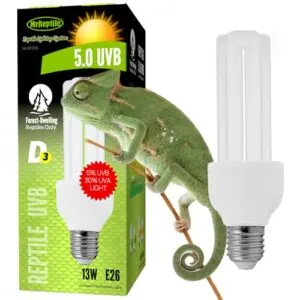
The MRREPTILE UVB Reptile Light is a budget-friendly compact fluorescent option at $11.99, making it easy to outfit multiple enclosures without breaking the bank. Running at 13W, it delivers roughly 2.0 UVI at 8 inches — right in the safe range for corn snakes.
Mount it 4–8 inches above the basking spot, keep glass or plastic out of the light path, and pair it with a dedicated heat source.
Replace it within 12 months, even if it still looks bright.
| Best For | Budget-conscious reptile owners who need a supplemental UVB source for smaller enclosures or secondary setups without spending much per bulb. |
|---|---|
| UVB Output | 5% |
| UVA Output | Unspecified |
| Power Consumption | 13W |
| Heat Emission | No |
| Bulb/Unit Type | CFL Screw-in |
| Separate Heat Required | Yes |
| Additional Features |
|
- At $11.99, it’s one of the cheapest ways to add UVB to a reptile enclosure — great if you’re running multiple tanks.
- Mounts vertically or horizontally, so it fits into awkward cage layouts without much hassle.
- Works for a wide range of species, from bearded dragons to geckos and turtles.
- The real UVB output (~3.7 UVI at 4 inches) falls short of the advertised 5.0 UVI, so you’re not getting what’s on the label.
- Effective range tops out around 8 inches, making it a poor fit for larger or taller enclosures.
- Some units rattle, fail early, or vary in output — consistency isn’t this bulb’s strong suit.
7. Hygger Zoo Adjustable UVB Reptile Light
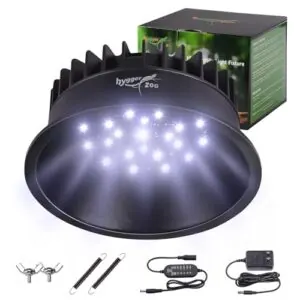
If you want flexibility without the hassle of swapping bulbs, the Hygger Zoo Adjustable UVB Reptile Light is worth a close look.
Its multiple preset intensity levels let you dial UVB up or down depending on your snake’s age, enclosure height, or basking zone layout.
The aluminum housing regulates heat well, and the integrated 24-hour timer removes the guesswork from your photoperiod.
One real downside: exact UVB output specs aren’t published, which makes precise dosing trickier for keepers who like to measure everything.
| Best For | Reptile keepers who want adjustable UVB lighting with a built-in timer and don’t want to babysit their setup every day. |
|---|---|
| UVB Output | Unspecified |
| UVA Output | Unspecified |
| Power Consumption | 5W |
| Heat Emission | Low |
| Bulb/Unit Type | LED Dome |
| Separate Heat Required | Possibly |
| Additional Features |
|
- Multiple intensity presets let you fine-tune UVB for different species, enclosure sizes, or life stages
- Built-in 24-hour timer automates day/night cycling so you don’t have to flip a switch manually
- Aluminum housing handles heat well, which helps the lamp last longer over time
- No published UVB output specs, making precise dosing a guessing game for detail-oriented keepers
- Timers and dimmers have been reported to fail within a year, and replacement parts are hard to find
- Heat output can run low for species that need serious basking temps
8. REPTI ZOO Tropical UVB Light
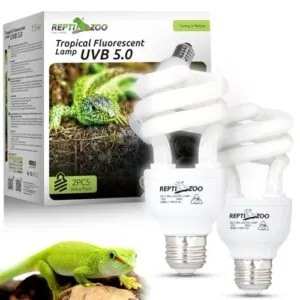
The REPTI ZOO Tropical UVB Light delivers 5% UVB and 30% UVA, giving your corn snake both the vitamin D₃ support it needs and the UVA stimulation that encourages natural feeding and activity.
Its standard E26 base drops into most existing fixtures without adapters.
That 10,000-hour rated lifespan sounds impressive, but some users report early burnout within two to three months — so keep a backup on hand.
Position it 12–18 inches above the basking spot for safe, consistent exposure.
| Best For | Hobbyists keeping tropical reptiles like geckos, chameleons, or iguanas who need a simple, affordable UVB bulb that fits any standard fixture. |
|---|---|
| UVB Output | 5% |
| UVA Output | 30% |
| Power Consumption | 15W |
| Heat Emission | No |
| Bulb/Unit Type | CFL Screw-in |
| Separate Heat Required | Yes |
| Additional Features |
|
- Comes as a dual-pack, so you’ve always got a spare ready to go
- Fits any standard E26 socket — no adapters, no fuss
- UVA UVB combo supports both natural behavior and vitamin D₃ production
- Some units burn out within 2–3 months, well short of the 10,000-hour claim
- 5% UVB may not cut it for species that need stronger UV exposure
- No positioning instructions on the packaging, which can trip up newer keepers
9. Hygger Dimmable LED UVB Reptile Lamp
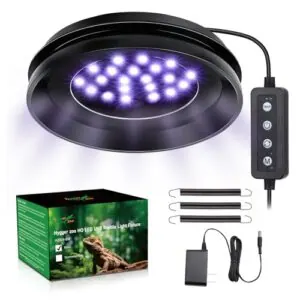
Few UVB lights give you this much control in one compact unit. The Hygger Dimmable LED UVB Reptile Lamp offers four selectable UVB intensity modes — 2.0, 5.0, 10.0, and 12.0 — so you can dial in exactly what your corn snake needs. The UVB 2.0 setting is ideal for corn snakes, and the built-in timer manages sunrise and sunset ramps automatically.
At just 6 watts, it won’t overheat a smaller enclosure.
You’ll still need a separate heat source, though.
| Best For | Reptile owners who want precise UV control for species with different light needs, from corn snakes to bearded dragons. |
|---|---|
| UVB Output | 2–12% (adjustable) |
| UVA Output | Yes |
| Power Consumption | 6W |
| Heat Emission | No |
| Bulb/Unit Type | LED Panel |
| Separate Heat Required | Yes |
| Additional Features |
|
- Four UVB intensity modes give you real flexibility to match your reptile’s natural habitat
- Built-in timer handles sunrise and sunset automatically — no extra gear needed
- Only 6 watts, so it won’t heat up small enclosures or spike your electric bill
- No heat output, so you’ll need a separate heat source on top of this
- UVB strength fades over time, meaning you’ll have to replace it periodically
- Wooden tank setups require drilling a hole for the magnetic mount, which adds a step to installation
10. EnchOrch LED UVB Reptile Light
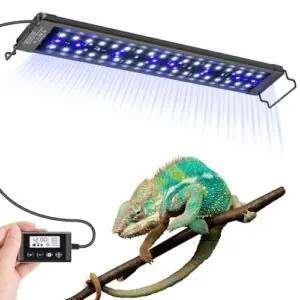
The EnchOrch LED UVB Reptile Light wraps full-spectrum UVA and UVB output into a slim, energy-efficient package that fits neatly over mid to large basking zones. At 20.3 inches long, it covers a 40-gallon enclosure without dark spots.
The aluminum alloy housing keeps heat dissipation in check, and the rated 8,000-hour lifespan means roughly two years of daily use.
You’ll still need a separate heat source, but for stable, low-maintenance UVB delivery, it’s a solid closer to this list.
| Best For | Reptile owners keeping tropical or desert species in 40-gallon tanks who want consistent UVA/UVB output without a complicated setup. |
|---|---|
| UVB Output | Unspecified |
| UVA Output | Yes |
| Power Consumption | Unspecified |
| Heat Emission | No |
| Bulb/Unit Type | LED Bar |
| Separate Heat Required | Yes |
| Additional Features |
|
- Covers a full 40-gallon tank evenly, so no awkward dark corners your reptile hides in all day
- Three preset modes (Rainforest, Desert, Reproduction) make it easy to dial in the right light cycle without guessing
- Energy-efficient LEDs with an 8,000-hour lifespan keep running costs low over time
- Puts out zero heat, so you’ll need a separate basking lamp for species that need warmth
- The programming interface is a bit clunky—expect some trial and error if you lose the manual
- UVB output can’t be checked with a basic test card; you’d need proper equipment to verify it’s working right
Safe UVB Installation Tips
Getting the light in place is just as important as choosing the right one. A few small mistakes during setup can cancel out all the benefits your UVB fixture is supposed to deliver.
Here’s what to get right before you flip the switch.
Mounting Height Above The Basking Spot
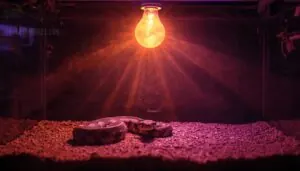
Mount your UVB lamp 12–18 inches above the basking spot — but that’s only half the equation. Mesh Attenuation Effect reduces UVB intensity before it reaches your snake, so UVB Gradient Calibration matters more than the label on the box.
Adjustable Perch Height, align installation height for Spot Temperature Alignment, and account for Bulb Arc Distribution to guarantee ideal distance covers the full basking surface.
Creating a Warm and Shaded Gradient
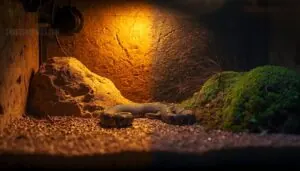
Once your fixture height is dialed in, think about how light and shadow work together across the enclosure. A proper Color Temperature Gradient runs from a bright Warm Zone Positioning at the basking spot down to a cooler, dimmer Shaded Zone Balance where your snake can decompress.
Here’s how to layer it right:
- Use 3500K bulbs at the basking spot, shifting toward 2700K in cooler areas for smooth Color Temperature Gradient flow.
- Apply Diffuse Light Layering with a matte reflector hood to eliminate harsh bright spots.
- Calibrate Light Intensity Calibration so shaded zones receive roughly 30–50% of basking brightness.
- Keep the temperature gradient consistent — 90°F at the basking spot, dropping to 75°F in the shade.
Using Reflective Hoods for Better Spread
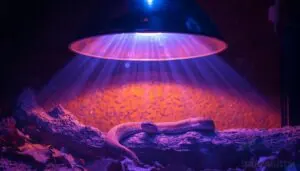
A good reflective hood does more than hold the bulb — it shapes how UVB light intensity and spectrum reach your snake.
White or silver reflective materials bounce more photons downward, creating uniform light across the basking zone.
Hood shape matters too: parabolic designs concentrate coverage while supporting heat dissipation.
Many UVB fixtures now offer modular upgrades, so you can swap reflectors without replacing the whole unit.
| Hood Type | Reflectivity | Best Use |
|---|---|---|
| Parabolic Silver | ~90% | Deep enclosures |
| Flat White | ~75% | Shallow tanks |
| Vented Aluminum | ~80% | Heat-sensitive setups |
Avoiding Glass or Plastic Barriers
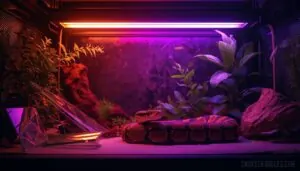
Even the best UVB lamp placement fails if glass or plastic sits between the bulb and your snake — both materials block the UVB light spectrum entirely. If you need a barrier, choose UV-resistant acrylic or polycarbonate barriers with proper edge protection solutions.
These impact-resistant alternatives won’t interfere with UVB lighting for corn snakes, and regular condensation management keeps UVB unobstructed by glass or plastic buildup.
Pairing UVB With Safe Overhead Heat
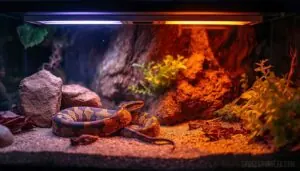
Now that barriers are handled, the next piece is heat. Your UVB lighting and overhead heat source — whether heat lamps or ceramic heat emitters — need Basking Spot Alignment so both overlap directly above the warm zone.
Thermostat Integration and Heat Gradient Synchronization keep temperatures from overshooting.
Without these safe installation practices, UVB Heat Overlap fails, and Safety Shutoff Protocols prevent dangerous spikes before they harm your snake.
UVB Maintenance and Replacement
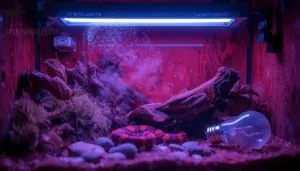
Getting a UVB light is only half the job — keeping it working correctly is what actually protects your corn snake long-term.
Bulbs degrade, fixtures collect dust, and schedules drift without the right habits in place. Here’s what you need to stay on top of it all.
UVB Bulb Lifespan and Replacement Timing
UVB bulb’s visible glow is misleading — UVB output decay happens long before the light burns out.
Compact bulbs need replacement every 6–8 months, while linear T5 HO bulbs last 10–12 months.
Cycle life variability means timers accelerate wear, so bulb age tracking matters more than brightness.
Write your installation date on the bulb, set a calendar reminder, and stick to an annual UVB bulb replacement schedule minimum.
UVB meter testing removes all guesswork.
Cleaning Fixtures and Reflectors
Dirty fixtures quietly rob your corn snake of the UVB it needs. Dust buildup on lenses and reflectors cuts UV transmission before the bulb even reaches its replacement window.
Keep fixtures clean with these simple steps:
- Start with microfiber wiping for dry dust removal before applying any liquid
- Mix mild soap with water for deeper cleaning — no abrasives
- Rinse thoroughly, then dry with a lint-free cloth
- Air drying prevents streaks on glass and polished aluminum reflectors
- Never submerge sockets or ballasts — electrical safety isn’t optional
Checking Wattage and Output Before Swapping
Swapping a UVB bulb without checking first is like driving blind. Before touching anything, confirm wattage verification by matching the replacement to your current UVB lamp’s printed specs.
Run a UVB output check and verify fixture compatibility — base type, ballast, and maximum wattage rating.
Electrical safety matters here, so recalibrate distance calibration afterward and remeasure UVB lamp placement to protect your snake.
Using Timers for Consistent Daily Lighting
A cheap plug timer is one of the most powerful tools in your setup. Program a 12-hour day and night cycle to lock in a consistent photoperiod without thinking about it daily.
Digital timers with Timer Drift Prevention keep your UVB lighting schedule accurate to the minute.
Add Programmable Sunrise transitions, Seasonal Schedule Adjustments, Backup Power Integration, and Remote Timer Control for a fully automated photoperiod rule your corn snake can count on.
Turning Off Lights Before Maintenance
Before touching anything, cut the power completely — this is non‑negotiable.
Safe installation practices include proper Power Isolation Steps: unplug the fixture, verify it’s off, and let Hot Parts Cooling happen naturally before handling glass or metal.
Electrical Shock Prevention means dry hands, no live contacts.
UV Exposure Shielding protects your eyes during bulb swaps.
Label the control point, then restart only after everything’s reassembled.
Measuring Health and Adjusting UVB
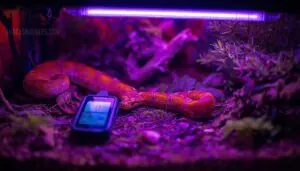
Getting the UVB right is only half the job — knowing how your snake responds tells you if it’s actually working.
A few key behaviors and environmental checkpoints will confirm you’re on track or flag when something needs to shift. Here’s what to watch and how to adjust.
Watching for Signs of Proper Exposure
Your corn snake’s behavior tells you more than any meter can. Watch for basking behavior patterns that stay relaxed and voluntary — a snake choosing its UVB spot without fleeing shows proper calcium absorption and bone metabolism are working.
Eye clarity indicators, shed quality observations, posture and movement, and activity level consistency all reflect snake health monitoring in action.
Consistent shedding and smooth movement confirm everything’s balanced.
Spotting Overexposure or Underexposure
Too much light shows up fast. Overexposure triggers Heat Avoidance Behavior — your snake retreats constantly and hides rather than basking.
Watch for Eye Discomfort Signs, like squinting or backing away from bright spots.
Insufficient lighting shows differently: Skin Color Dullness and Shedding Inconsistencies are quiet warnings.
Hydration Frequency Changes, and monitoring your corn snake’s response daily help you catch both extremes before adjusting UVB intensity.
Adjusting Fixture Distance and Intensity
Once you’ve spotted a problem, fixing it starts with Stepwise Distance Tuning — move the fixture up or down in 2-inch increments rather than making big leaps. Fine‑Tuned Intensity Control through a dimmable fixture lets you dial output in 5–10% steps.
Use UVB Photon Mapping with a handheld meter, and keep Exposure Log Tracking weekly to confirm your adjustments are holding.
Balancing UVB With Temperature and Humidity
Balancing temperature and humidity with UVB isn’t just a checklist item — it’s how everything works together. Temperature UVB Synergy matters because a corn snake won’t bask and won’t absorb UVB effectively if the basking spot runs too cool. Aim for 90 °F there, with a temperature gradient dropping to 75 °F on the cool side.
Keep humidity levels between 60–75 %, practicing Humidity Gradient Management by positioning water dishes away from the basking zone.
Good Ventilation Humidity Balance prevents condensation near your fixture — a real concern, since wet reflectors scatter UVB unevenly.
Condensation Prevention Strategies start with airflow: mesh panels beat solid lids here. Watch Substrate Moisture Regulation too, since damp substrate near the heat lamp raises local humidity fast.
Maintaining a Consistent Photoperiod
Your snake’s internal clock runs on light. A 12-hour day and night cycle is your baseline — set it with Timer Calibration using a programmable plug-in timer.
Seasonal Light Adjustments (8–13 hours) should shift gradually, not overnight. Dark Phase Integrity and Light Leak Prevention matter more than most keepers expect.
After outages, always confirm Power Outage Recovery by checking your timer’s schedule before resuming the photoperiod.
Frequently Asked Questions (FAQs)
Can snakes get too much UVB?
Too much of a good thing is still too much.
Yes, snakes can get too much UVB — mainly from poor UVB gradient design or incorrect mounting height, not the bulb itself.
Which UVB light for corn snakes?
For corn snakes, a T5 HO tube with 5–6% UVB output is your best starting point.
It delivers consistent UVB spectrum quality without overwhelming a crepuscular species that needs gentle, optional exposure.
Is 0 UVB good for corn snakes?
Yes — a 0 UVB bulb is a solid choice for corn snakes. It delivers gentle low-level UVB intensity that promotes vitamin D3 synthesis and bone health without risking overexposure.
Does my corn snake need an UV light?
Your corn snake can survive without UVB lighting, but it genuinely thrives with it.
UVB facilitates vitamin D3 synthesis, helping your snake absorb dietary calcium and reducing metabolic bone disease risk.
Is too much UVB bad for snakes?
Too much UVB is genuinely harmful. Excess exposure causes Eye Irritation Risk, Skin Damage, and Vitamin D Overload, disrupting calcium metabolism. Keep your UVB dosage controlled and photoperiod limits firm.
Can corn snakes share UVB lighting with other reptiles?
Sharing a UVB fixture is possible, but species UVB compatibility matters.
Corn snakes need less UV than many reptiles, so monitor individual exposure carefully and make sure each animal can self-regulate through shade access.
How does seasonal photoperiod affect corn snake behavior?
Seasonal photoperiod shapes nearly every aspect of your corn snake’s behavior — from feeding cycles and shedding patterns to reproductive cues and thermoregulation shifts.
Longer days spark activity; shorter ones trigger rest.
Can corn snakes get UVB through a window?
Window light is like sunlight through a screen door — it looks the same but something important is missing.
Standard glass blocks nearly all UVB, so your corn snake gets no meaningful UVB exposure from a window.
Do hatchlings need different UVB than adults?
Not exactly — the same UVB lighting works, but hatchlings need greater lamp distance to reduce UVB intensity.
Their skin thickness sensitivity and growth calcium needs make managing the hatchling UVB gradient essential for safe vitamin D3 synthesis.
How does UVB affect corn snake coloration?
UVB exposure facilitates melanin enhancement and morph color deepening by promoting vitamin D3 synthesis and healthier skin turnover.
Juveniles often show the most noticeable juvenile color shift, with richer, more saturated tones emerging after consistent UVB-induced shedding cycles.
Conclusion
Funny how a snake that spent millennia soaking up sunlight somehow became the poster child for no UVB needed. That myth has real consequences—curved spines, weakened bones, shortened lives.
The right reptile UVB lights for corn snake setups don’t just check a box; they replicate a biological process your snake’s body is still running. Get the fixture right, mount it correctly, replace it on schedule, and your corn snake gets exactly what the sun always provided.