This site is supported by our readers. We may earn a commission, at no cost to you, if you purchase through links.
A classroom reptile habitat can teach students more about biology than any textbook chapter—but only if the animal inside it thrives. Metabolic bone disease, the most preventable tragedy in captive reptile care, stems almost entirely from inadequate UVB exposure, and it happens quietly, over weeks, before most keepers notice anything wrong.
The right lighting isn’t a luxury detail; it’s the physiological foundation that drives calcium metabolism, immune function, and behavioral health in species that evolved under open sky or filtered forest canopy. Selecting reptile UVB lights for classroom habitats demands more precision than picking a bulb off a store shelf—species biology, Ferguson Zone classifications, lamp output, and fixture placement all intersect in ways that determine whether your classroom animal simply survives or genuinely flourishes.
Table Of Contents
- Key Takeaways
- Best UVB Lights for Classroom Habitats
- 1. REPTIDLDB T5 UVB Reptile Light Fixture
- 2. Jugbuy UVB Reptile Light Bulb
- 3. Repti Zoo UVB Reptile Bulbs
- 4. Repti Zoo Tropical Reptile UVB Bulbs
- 5. QZQ T5 UVB Reptile Light Fixture
- 6. Lucky Herp UVA UVB Reptile Light Bulb
- 7. Zoo Med ReptiSun Mini UVB Lamp
- 8. Hygger Dimmable Reptile UVB Light
- 9. Reptile Heat and UVB Basking Bulbs
- 10. Reptile UVA UVB Heat Lamp
- UVB Lighting Science for Reptiles
- Choosing The Right UVB Lamp Type
- Species-Specific UVB Requirements
- Setting Up and Maintaining UVB Lighting
- Frequently Asked Questions (FAQs)
- Conclusion
Key Takeaways
- UVB lighting isn’t optional equipment—it drives the calcium metabolism and immune function that determine whether your classroom reptile actually thrives or quietly deteriorates over weeks.
- Match your lamp choice to your species’ Ferguson Zone, since a bearded dragon’s high-UVI desert needs and a chameleon’s filtered canopy requirements are biologically incompatible with the same fixture.
- A bulb that still glows isn’t necessarily delivering UVB—replace fluorescent lamps every 6 to 12 months and use a SolarMeter 6.5 to verify real output, not just visible light.
- Lamp type matters more than price point: fluorescent tubes remain the gold standard for biological accuracy, while LEDs fall short on UVB spectrum and mercury vapor bulbs run too hot for most classroom enclosures.
Best UVB Lights for Classroom Habitats
A classroom terrarium needs UVB output that’s strong enough to support healthy reptiles, yet practical for daily handling by busy teachers and students. The right fixture balances safety, coverage, and ease of maintenance, since these lights run for hours every school day.
For deeper guidance on balancing UVB output with classroom safety, reptile habitat lighting options for terrariums breaks down which fixtures work best for long daily use.
Here are ten options worth considering, each suited to different habitat sizes and species needs.
1. REPTIDLDB T5 UVB Reptile Light Fixture
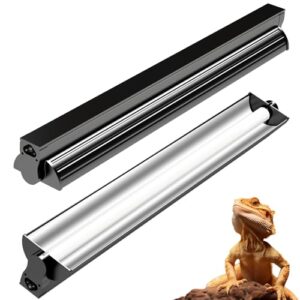
For classroom enclosures, the REPTIDLDB T5 UVB Fixture delivers a flicker-free 10.0 UVB bulb with reflective alloy backing, maximizing output across a 24-inch terrarium. Its 8W draw stays cool, ideal for desert species like bearded dragons, while the detachable cable simplifies safe mounting.
Just remember: swap bulbs every six months, and peel off that blue protective sleeve before powering on—skipping it blocks UVB entirely, leaving students’ reptiles vulnerable to weak bones despite a seemingly "working" light.
| Best For | This fixture is best for keepers of desert reptiles, like bearded dragons and tortoises, who need reliable UVB for healthy bones and digestion. |
|---|---|
| Wattage | 8W |
| UVB Output | 10% |
| UVA Output | 30% |
| Mount Type | Strip Internal/External |
| Target Species | Desert Reptiles |
| D3 Synthesis | Supported |
| Additional Features |
|
- Flicker-free T5 HO ballast paired with an alloy reflector for strong, consistent UVB output
- Low heat output keeps the enclosure from overheating
- Slim build with a detachable cable makes mounting easy inside or outside the tank
- Bulbs need replacing roughly every six months to keep UVB levels effective
- Blue protective sleeve must be removed first, or UVB output is blocked entirely
- Reflective coating may peel over time, reducing UVB efficiency
2. Jugbuy UVB Reptile Light Bulb
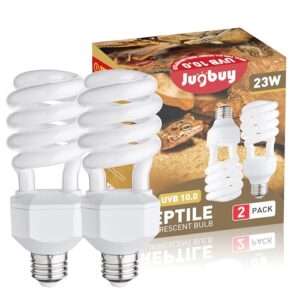
If you’d rather skip the bulb-sleeve guesswork, the Jugbuy UVB Bulb offers a simpler screw-in option for E26 fixtures already common in classrooms. It pairs 10% UVB with 30% UVA, using quartz glass for stable output and zero UVC.
At 23W, it suits desert species like bearded dragons, but keep it at least 12 inches away—and pair it with a separate heat source, since this bulb alone won’t create a full thermal gradient.
| Best For | This bulb is best for classrooms or hobbyists with desert reptiles like bearded dragons or tortoises who want an easy E26 screw-in upgrade. |
|---|---|
| Wattage | 23W |
| UVB Output | 10% |
| UVA Output | 30% |
| Mount Type | E26 Screw Base |
| Target Species | Desert Reptiles |
| D3 Synthesis | Supported |
| Additional Features |
|
- Delivers a solid 10% UVB and 30% UVA mix for healthy bone growth and natural behaviors
- Quartz glass keeps UVB output steady with zero harmful UVC
- Energy-efficient design cuts power use by up to 80%
- Needs at least 12 inches of clearance from animals, so placement takes some planning
- Doesn’t provide enough heat on its own, so you’ll need a separate heat source
- Some units may have reliability issues right out of the box
3. Repti Zoo UVB Reptile Bulbs
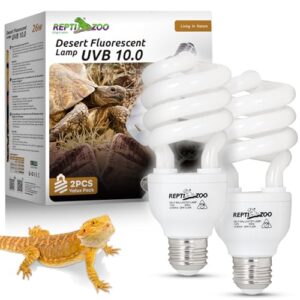
The Repti Zoo UVB Reptile Bulb takes a different approach than the Jugbuy’s straightforward screw-in simplicity — its dual-bulb configuration offers a built-in backup, so a single failure doesn’t leave your classroom reptile without critical UVB coverage mid-week.
Running at 26W with 5% UVB and 30% UVA, it fits standard E26/120V fixtures and delivers a 7500K spectrum closely resembling natural sunlight.
| Best For | Teachers and reptile owners who want peace of mind with a built-in backup bulb, especially if UVB gaps during the week aren’t an option. |
|---|---|
| Wattage | 26W |
| UVB Output | 5% |
| UVA Output | 30% |
| Mount Type | E26 Screw Base |
| Target Species | Multiple Reptiles |
| D3 Synthesis | Supported |
| Additional Features |
|
- Dual-bulb setup means one burnout won’t leave your reptile in the dark
- 5% UVB and 30% UVA at 7500K closely mimics natural sunlight
- Works with standard E26/120V fixtures, so no special hardware needed
- Longevity can be hit or miss — some bulbs don’t last as long as expected
- You’ll need a UV tester to confirm the actual UVB output
- Only compatible with E26/120V fixtures, so it won’t work in every setup
4. Repti Zoo Tropical Reptile UVB Bulbs
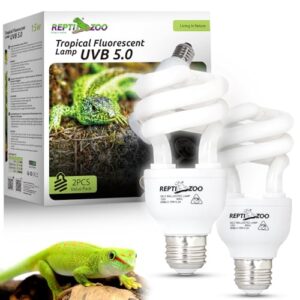
Designed specifically for tropical species, the Repti Zoo Tropical Reptile UVB Bulb runs at 15W with 5% UVB and 30% UVA — a spectrum calibrated to mimic the filtered, canopy-diffused light that chameleons and tropical geckos actually experience in the wild. Its 6200K color temperature and 722-lumen output keep the enclosure visually bright and behaviorally stimulating without the intensity risks that come with desert-grade lamps.
For setups needing both daytime UVB coverage and gentle overnight warmth, pairing this bulb with a reptile heat lamp suited for small apartment enclosures keeps tropical species comfortable around the clock.
Rated for up to 10,000 hours, it fits a standard E26 socket and replaces every 6–12 months.
| Best For | Owners of tropical reptiles like chameleons and geckos who want a naturalistic UVB setup that supports D3 synthesis and healthy behavior without overdoing the intensity. |
|---|---|
| Wattage | 15W |
| UVB Output | 5% |
| UVA Output | 30% |
| Mount Type | E26 Screw Base |
| Target Species | Tropical Reptiles |
| D3 Synthesis | Supported |
| Additional Features |
|
- Dual UVA/UVB output mimics real rainforest canopy light, which is exactly what tropical species need
- 10,000-hour lifespan means you’re not swapping bulbs every few months
- Fits a standard E26 socket, so no special fixtures required
- Not strong enough for desert or high-UVB basking species that need more intense output
- Some users have reported flickering or early burnout
- UVB levels may fall short as the bulb ages, even before it visibly dims
5. QZQ T5 UVB Reptile Light Fixture
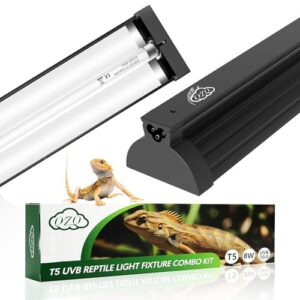
The QZQ T5 UVB Reptile Light Fixture brings T5 HO performance to compact classroom enclosures, pairing a 10.0 UVB rating with a curved alloy reflector that directs radiation precisely into the basking zone rather than scattering it. Its 8W consumption keeps energy demands minimal without sacrificing the UVB intensity desert species require for D3 synthesis.
Assembly instructions can frustrate first-time users, and occasional flickering at shutdown has been reported — so inspect your unit carefully on arrival.
| Best For | Reptile owners keeping desert or tropical species in compact setups who want reliable UVB output without running up the electric bill. |
|---|---|
| Wattage | 8W |
| UVB Output | 10% |
| UVA Output | 30% |
| Mount Type | Strip Linkable |
| Target Species | Desert & Tropical |
| D3 Synthesis | Supported |
| Additional Features |
|
- The 10.0 UVB rating with a curved alloy reflector means UVB actually lands where your reptile basks instead of getting lost in the enclosure.
- At just 8W, it’s easy on energy while still delivering the UVA and UVB output desert species need for D3 synthesis and healthy behavior.
- The linkable design is a nice bonus — you can chain multiple units together as your setup grows.
- Assembly instructions have tripped up quite a few first-time users, so expect some trial and error out of the box.
- Some owners have reported flickering when powering it off, which is a minor but noticeable annoyance.
- Product longevity has been inconsistent across units, so it’s worth keeping your receipt just in case.
6. Lucky Herp UVA UVB Reptile Light Bulb
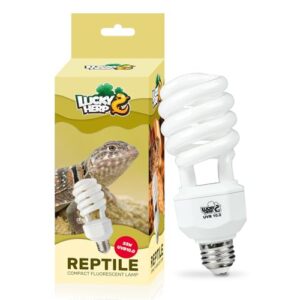
The Lucky Herp UVA UVB Reptile Light Bulb delivers a 10.0 UVB output rating, making it a practical choice for desert species like bearded dragons that depend on consistent D3 synthesis for calcium metabolism. Its standard E26 base fits most classroom fixtures without adapters, and at 23W it won’t strain a basic setup.
UVB output does degrade over time, so replace the bulb every 6 to 12 months to maintain effective exposure.
Even small oversights in your setup can compound quickly, so pairing a fresh bulb with a well-dialed environment—covered in this ball python terrarium setup guide—helps prevent the health issues that catch many keepers off guard.
Since species like Uromastyx need far more intense exposure than crepuscular reptiles, checking the UVB lighting requirements for desert species can help you choose the right bulb strength before deficiency has a chance to develop.
| Best For | Desert reptile owners—especially those keeping bearded dragons or tortoises—who want reliable UVA/UVB support for their pet’s health and natural behavior. |
|---|---|
| Wattage | 23W |
| UVB Output | 10% |
| UVA Output | 30% |
| Mount Type | E26 Screw Base |
| Target Species | Desert Reptiles |
| D3 Synthesis | Supported |
| Additional Features |
|
- Strong 10.0 UVB rating supports D3 synthesis and calcium absorption, which is exactly what desert species need
- Standard E26 base means it fits most common lamp fixtures without any extra adapters
- High color rendering index (90%) makes it easier to actually see your reptile’s true colors
- Only works on 120V systems, so it’s not compatible with international setups
- Needs to be replaced every 6 to 12 months, which adds to the long-term cost
- The bulb can run longer than expected, and it may not fit in tighter or smaller lamp housings
7. Zoo Med ReptiSun Mini UVB Lamp
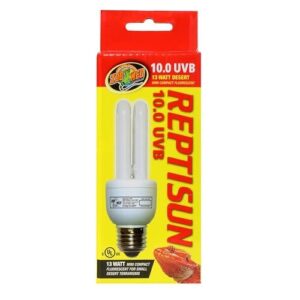
When space is tight and your enclosure is small, the Zoo Med ReptiSun Mini UVB Lamp proves that compact design doesn’t mean compromised performance. Its UVB-transmitting quartz glass maximizes UVB penetration despite the 13W form factor, while 10% UVB and 30% UVA output support both D3 synthesis and natural feeding behaviors.
The E26 socket fits standard fixtures, and its vertical or horizontal mounting flexibility suits most classroom hood designs. Replace it every 12 months to maintain effective UVB delivery.
| Best For | Owners of small reptile enclosures who need reliable UVB coverage for desert or basking species without sacrificing performance. |
|---|---|
| Wattage | 13W |
| UVB Output | 10% |
| UVA Output | 30% |
| Mount Type | E26 Screw Base |
| Target Species | Desert & Basking |
| D3 Synthesis | Supported |
| Additional Features |
|
- Quartz glass construction pushes UVB deeper into the enclosure, giving your reptile better exposure even in a compact setup
- Mounts vertically or horizontally, so it works with most standard hoods and fixtures right out of the box
- Strong 10% UVB and 30% UVA output covers both D3 synthesis and natural behavior support
- UVB output fades over time, so you’ll need to swap it out every 12 months whether it looks burned out or not
- Costs more upfront than combo bulbs that handle UVA, UVB, and heat all in one
- Needs a compatible E26 fixture — not every enclosure setup will work without some adjustment
8. Hygger Dimmable Reptile UVB Light
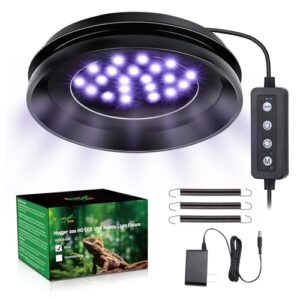
The Hygger Dimmable Reptile UVB Light gives you something most classroom fixtures don’t: precise control over UV intensity without swapping bulbs. Its four selectable UVB modes — 2.0, 5.0, 10.0, and 12.0 — let you dial in the right exposure for desert species like bearded dragons or tropical ones like day geckos. The programmable sunrise and sunset ramps, running 2, 8, or 12 hours, mirror natural photoperiods that support circadian health and appetite.
At just 6W, it delivers 90W-equivalent output with minimal heat buildup — a real advantage in classrooms where ambient temperature management matters.
| Best For | Reptile owners who want precise, programmable UV lighting for species like bearded dragons, day geckos, or turtles without the hassle of swapping bulbs. |
|---|---|
| Wattage | 6W |
| UVB Output | Adjustable |
| UVA Output | Yes |
| Mount Type | Multi-Mount |
| Target Species | Multiple Reptiles |
| D3 Synthesis | Supported |
| Additional Features |
|
- Four UVB intensity modes let you match lighting to your reptile’s natural habitat, whether that’s a dry desert or a humid tropical setup.
- The sunrise/sunset ramp feature mimics natural daylight cycles, which can do wonders for appetite, activity, and overall reptile health.
- At just 6W with a 90W-equivalent output, it’s energy efficient and won’t crank up the temperature in your enclosure.
- It’s not a heat lamp, so you’ll still need a separate heating source to keep your reptile’s environment at the right temperature.
- Some buyers have found the packaging missing advertised extras like magnets or non-slip mats, which is a bit disappointing out of the box.
- Installing it in a wooden enclosure means you’ll need to drill, which isn’t ideal if you prefer a tool-free setup.
9. Reptile Heat and UVB Basking Bulbs
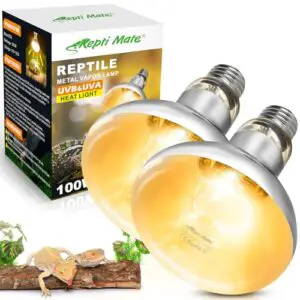
When one fixture needs to handle both heat and UVB simultaneously, mercury vapor basking bulbs earn their place in classroom habitats. This 100W self-ballasted design integrates UVA, UVB, visible daylight, and infrared heat in a single unit — no external ballast required, no separate heat dome needed. It promotes vitamin D3 synthesis and calcium absorption while encouraging natural basking behavior in bearded dragons, turtles, and lizards.
Replace every three to six months, and never restart immediately after switching off.
| Best For | Reptile owners who want one bulb that handles both heat and UVB — great for bearded dragons, turtles, lizards, and anyone setting up a tropical or desert habitat. |
|---|---|
| Wattage | 100W |
| UVB Output | Yes |
| UVA Output | Yes |
| Mount Type | Dome Lamp |
| Target Species | Multiple Reptiles |
| D3 Synthesis | Supported |
| Additional Features |
|
- All-in-one design covers UVA, UVB, heat, and visible light — no extra fixtures needed
- Supports D3 synthesis and calcium absorption, which is huge for long-term reptile health
- Works with standard dome lamps, so no special setup required
- Gets very hot during use, so you have to be careful handling it
- Needs time to warm up and cool down before restarting — not instant
- Lifespan is only 3 to 6 months, so replacement costs add up over time
10. Reptile UVA UVB Heat Lamp
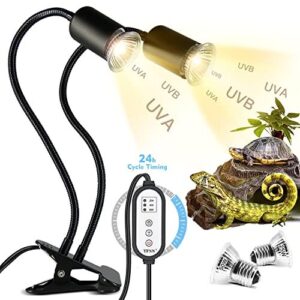
Think of this fixture as a two-in-one solution for classrooms that can’t juggle multiple devices. The Reptile UVA UVB Heat Lamp delivers both ultraviolet radiation and thermal output from a single unit, with 25W and 50W bulbs working together through independent ceramic sockets mounted on 360-degree rotating goosenecks.
An intelligent cycle timer automates photoperiods across 2, 4, or 6-hour intervals, while the secure clamp mount keeps everything stable above the enclosure.
| Best For | Reptile and amphibian owners who want a single, automated lighting setup that handles both UVA/UVB and heat without babysitting the schedule. |
|---|---|
| Wattage | 25W & 50W |
| UVB Output | Yes |
| UVA Output | Yes |
| Mount Type | Clamp Mount |
| Target Species | Multiple Reptiles |
| D3 Synthesis | Supported |
| Additional Features |
|
- Two bulbs (25W and 50W) in one fixture means you can create separate temperature zones without buying extra equipment.
- The built-in cycle timer automates your pet’s day/night routine — set it and forget it.
- 360-degree rotating goosenecks let you aim the light exactly where your animal needs it.
- The timer only runs on 2, 4, or 6-hour intervals, so you can’t fine-tune the schedule beyond those options.
- Heat output is serious — plastic surfaces nearby can warp or melt if you’re not careful with placement.
- Gooseneck length might not cut it for larger enclosures, leaving some spots under-lit.
UVB Lighting Science for Reptiles
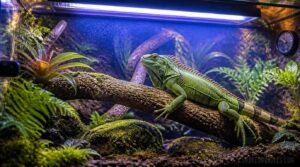
Before picking a bulb, it helps to understand what UVB actually does inside a reptile’s body—because the science shapes every setup decision you’ll make. From vitamin D3 synthesis to how reptiles literally see UV light, the biology matters more than most people realize. Here’s what’s going on beneath the surface.
UVB and Vitamin D3 Synthesis
UVB radiation spanning 290 to 315 nanometers penetrates the epidermal layers of your reptile’s skin, where 7-dehydrocholesterol undergoes photoconversion into previtamin D3—a thermally unstable precursor that isomerizes into vitamin D3 over subsequent hours. The liver then hydroxylates this compound, while the kidneys complete Vitamin D3 Conversion into active 1,25-dihydroxyvitamin D3, directly regulating Calcium Homeostasis and preventing metabolic bone disease.
Additionally, excessive UV radiation can convert vitamin D into inert photoproducts.
Impact on Reptile Visual Systems
While the previous section covered how UVB drives vitamin D3 synthesis, your reptile’s relationship with light goes even deeper — right into how it sees the world.
Most diurnal reptiles are tetrachromats, meaning they possess four cone types that extend perception well into ultraviolet wavelengths around 360 nm, enabling them to detect UV-reflective signals on mates, rivals, and prey that remain completely invisible to you.
Risks of UVB Overexposure
That same light strengthening your reptile’s vision carries real risks when delivered without precision. UVB overexposure can trigger photokeratitis, hypercalcemia from vitamin D toxicity, and even squamous cell carcinoma in low-melanin morphs. Key hazards include:
- Skin cancer risk from unfiltered prolonged exposure
- Photokeratitis effects causing corneal swelling and head-rubbing
- Immune suppression reducing infection resistance
- Reflective amplifiers like glass intensifying UVB intensity
- Hypercalcemia from metabolic bone disease mismanagement
Choosing The Right UVB Lamp Type
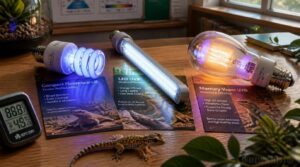
Not all UVB lamps are built the same, and that difference really matters when you’re setting up a classroom habitat. Fluorescent, LED, and mercury vapor bulbs each bring their own trade-offs in output, safety, and practical handling. Here’s how the main types stack up so you can pick what actually works for your setup.
Fluorescent Vs LED Vs Mercury Vapor
Choosing the wrong lamp type is one of the most consequential decisions you’ll make for a classroom reptile habitat. Each technology — UVB fluorescent lamps, LED, and mercury vapor — operates through a fundamentally different mechanism, and those differences determine whether your animal thrives or suffers deficiencies over time.
| Lamp Type | Key Trade-off |
|---|---|
| Fluorescent | Reliable UVB output; replace every 6–12 months |
| LED | Energy-efficient but limited UVB spectral output |
| Mercury Vapor | High UVB intensity and heat; requires significant clearance |
Mercury vapor UVB lamps deliver the most powerful combined UV and heat output — far exceeding fluorescent alternatives — but their heat generation levels and warm-up requirements make them impractical in most classroom enclosures. LED vs fluorescent ultimately comes down to spectrum: LEDs win on energy efficiency comparison and lifespan differences, routinely lasting 25,000–100,000 hours versus fluorescent’s 10,000–20,000, and they offer a excellent Color Rendering Index above 80. However, most LEDs can’t replicate the broad UVB spectrum reptiles require for Vitamin D3 synthesis, meaning fluorescent tubes remain the industry standard for UVB lighting where biological accuracy matters most. Fluorescent options also contain mercury content — a disposal consideration worth factoring into your classroom planning.
Safety Considerations for Classroom Use
Every classroom housing a reptile under UVB lighting carries real electrical and biological hazards that won’t manage themselves. Plug all fixtures into grounded, dedicated circuits — never overloaded strips. Tape cords against walls, away from foot traffic.
High UV irradiance causes photokeratitis in both animals and students, so position lamps to eliminate direct sightlines. Dispose of spent fluorescent bulbs as hazardous waste, and keep a Class A extinguisher within reach.
Species-Specific UVB Requirements
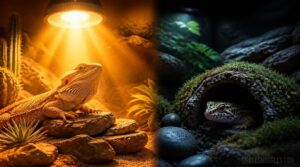
Not every reptile lives under a blazing desert sun, and that biological reality should shape every lighting decision you make for your classroom habitat. A bearded dragon’s UVB needs look nothing like a leopard gecko’s, and getting that wrong has real consequences for the animal’s health.
Here’s how different species stack up and what those differences mean for your setup.
Desert Vs Tropical Vs Nocturnal Species
Not all reptiles share the same relationship with the sun. Desert reptiles like bearded dragons bask aggressively and demand high UVI levels, while shade-dwelling tropical species such as chameleons need gentler, filtered UVB mimicking forest canopies. Nocturnal species rely on heat over UVB supplementation entirely.
Matching your classroom animal to the right UV Index isn’t optional — it’s foundational.
Ferguson Zones and Classroom Reptiles
Ferguson Zones classify reptiles by their wild basking behaviors and UV exposure needs, giving you a science-backed framework for every enclosure in your classroom. A bearded dragon belongs in Zone 3 or 4, demanding high UVI; a chameleon sits comfortably in Zone 2.
Rotating students through each habitat observation zone sharpens their understanding of how UV Index requirements differ species to species.
Matching Lamp Strength to Habitat
Matching lamp strength to habitat isn’t guesswork — it’s calibration. UVB output calibration starts with knowing your species’ Ferguson Zone, then selecting a bulb whose UVI rating recreates that zone’s natural intensity at your target basking distance.
A desert enclosure demands high UVB strength, while a tropical setup needs gentler, diffuse output that mimics filtered canopy light.
Setting Up and Maintaining UVB Lighting
Getting UVB lighting right comes down to a few practical decisions that make a real difference for your classroom reptile. From where you mount the bulb to how often you replace it, each step builds toward a setup that actually works. Here’s what you need to know to do it correctly.
Placement and Distance Guidelines
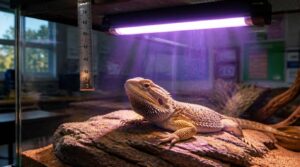
Think of your UVB lamp placement like calibrating a scientific instrument—precision matters more than guesswork.
Ideal lamp height for most terrestrial classroom reptiles falls between 12 and 18 inches above the basking surface, delivering effective UV intensity without risking photokeratitis or tissue damage. Desert species may need lamps as close as 12 inches to hit the higher UVI targets their physiology demands.
Creating Microhabitat Gradients
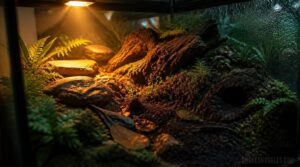
A well-designed microhabitat gradient isn’t decoration—it’s a functional necessity that lets your reptile self-regulate between UVB exposure, warmth, and shelter.
Position rocks and cork bark beneath the lamp to establish a direct basking zone, then layer substrate deeper toward the cooler end to create moisture retention. This thermal and humidity shift across the terrarium mirrors the natural microtopography reptiles depend on.
Photoperiod and Lamp Replacement
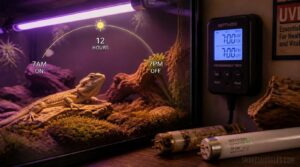
Once your microhabitat gradient is set, the next variable you can’t afford to overlook is time—specifically, how long your lights stay on and how often you replace them.
A consistent 10 to 14-hour photoperiod keeps your reptile’s circadian clock synchronized, supporting normal feeding, activity, and shedding cycles. Programmable timers make this simple and eliminate guesswork.
Replace UVB lamps every 6 to 12 months. Visible light doesn’t mean functional UVB output—the radiation your reptile needs for Vitamin D3 synthesis declines long before the bulb burns out.
Replace UVB lamps every 6 to 12 months — a bulb that still glows may no longer protect
Measuring UVB With SolarMeter 6.5
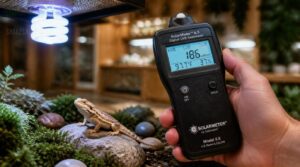
Knowing when to replace a bulb is only half the equation—knowing whether it’s still performing is the other. That’s exactly where the SolarMeter 6.5 earns its place in your maintenance routine, measuring UVB irradiance in µW/cm² with ±10% accuracy so you’re working with real data, not assumptions.
Frequently Asked Questions (FAQs)
Do UVB bulbs interfere with nearby electronic devices?
Yes, UVB bulbs can interfere with nearby electronics. Their electronic ballasts emit EMI in the 30–60 kHz range, potentially disrupting wireless devices. Using dedicated lighting circuits and ferrite chokes minimizes this risk effectively.
How do power outages impact reptile UVB schedules?
A power outage immediately halts UVB radiation output, interrupting vitamin D3 synthesis within hours. Juvenile reptiles face the greatest risk due to rapid bone development needs requiring consistent UVB exposure.
Are UVB lights safe around students with photosensitivity?
UVB lights can be safe in classrooms, but only with proper shielding, ventilation, and distance controls that keep UV Index levels near zero at student eye level for those with photosensitivity.
What certifications should classroom UVB fixtures carry?
Classroom UVB fixtures should carry UL or ETL certification from an NRTL, an IEC 62471 risk group rating, EMC compliance, and full safety documentation confirming the emitted spectrum matches manufacturer claims.
Conclusion
A reptile keeper once described UVB as "invisible sunlight your animal can’t ask for"—and that framing captures everything.
Selecting reptile UVB lights for classroom habitats isn’t a one-time checkbox; it’s an ongoing commitment to the physiology driving calcium metabolism, immune function, and behavioral expression behind the glass.
Get the Ferguson Zone right, replace bulbs on schedule, and measure output consistently. Your classroom animal won’t just survive—it’ll teach students what genuinely thriving in captivity looks like.