This site is supported by our readers. We may earn a commission, at no cost to you, if you purchase through links.
Set your dial thermometer at ground level and your digital probe on the wall, and you’ll swear you’re keeping two different snakes. That’s not user error, that’s physics: bimetallic strips lag behind heat swings while thermistors chase them in real time. Ten degrees of confusion isn’t rare, it’s routine.
Your snake doesn’t care about the marketing copy on the box. It cares whether the hot side actually hits temp, and whether you know it. Digital vs analog terrarium thermometer accuracy comes down to sensing method, drift over time, and where you stick the probe, not just the price tag.
Get the placement wrong and even a lab-grade sensor lies to you. Get it right, and you’ll finally trust the numbers you’re reading.
Table Of Contents
Key Takeaways
- Digital thermometers use thermistors that hold calibration within 0.2-0.5°C and respond within seconds, while analog bimetallic strips drift up to 1.0°C and need a minute or more to stabilize
- Where you place the probe matters as much as the thermometer type, so keep sensors at snake height, shielded from direct heat, and secured against slipping for accurate readings
- Every terrarium really needs two thermometers, one for the warm basking zone and one for the cool side, to get a true temperature gradient instead of a single misleading number
- No thermometer stays trustworthy forever, so weekly spot checks against a calibrated reference, plus replacing digital units every 12-24 months and analog ones around 12, catch drift before it harms your snake
Digital Vs Analog Thermometer Accuracy
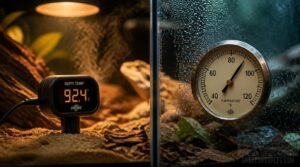
Not all thermometers are created equal, and the gap between analog and digital gets wider the longer your heat source runs. You’re trusting this reading to keep an animal alive, so it’s worth knowing where each type actually falls short. Here’s how they stack up, point by point.
If you want a clearer picture of which specs actually matter, this breakdown of digital terrarium thermometers for ball pythons walks through accuracy ratings and probe placement in plain terms.
How Each Thermometer Measures
Crack open a thermometer and you’ll find very different engineering underneath. Analog thermometers rely on bimetallic strips or liquid expansion; digital thermometers use thermistor resistance changes read by a microcontroller.
| Type | Sensing Method |
|---|---|
| Analog | Bimetallic strip/liquid |
| Digital | Thermistor resistance |
| Infrared | Radiation detection |
| Probe | Contact sensor |
| Thermocouple | Voltage differential |
Infrared units skip contact entirely, reading surface radiation instead. For high-precision needs, thermistors offer high sensitivity that makes them a popular choice in digital laboratory instruments.
Accuracy Under Steady Heat
Under constant heat, digital thermometers hold calibration stability within 0.2 to 0.5°C, while analog units drift up to 1.0°C.
| Type | Steady-Heat Accuracy |
|---|---|
| Digital | ±0.2-0.5°C |
| Analog | ±0.5-1.0°C |
| Shielded probe | ±0.2°C |
| Ground-level | Most stable |
| Wall-mounted | 0.2-0.4°C cooler |
Sensor drift analysis favors digital, but proper probe placement narrows that gap considerably.
Performance During Temperature Swings
A steady basking spot is one thing, but what happens when your heat lamp cycles off or a draft hits? Digital sensors update every 1-2 seconds, catching swings fast, though overshoot correction can wobble briefly. Analog dials lag due to thermal mass.
Both need a 60-120 second settling period before trusting the number.
Calibration Drift Over Time
Short-term lag is one problem; long-term drift is another. Bimetallic strips in analog thermometers lose elasticity after repeated thermal cycles, while digital sensors face sensor aging as voltage readings shift. Humidity accelerates both.
| Thermometer Type | Drift Behavior |
|---|---|
| Analog | 39-40°F off after 65 min |
| Digital | ±1°F, stable |
| Analog | Worsens with age |
| Digital | Longer calibration retention |
| Both | Need recalibration checks |
Digital Versus Analog Verdict
Numbers settle the Analog Vs Digital debate fast. Digital sensors use thermistors, deliver readings within seconds, and hold calibration. Analog units need minute-long stabilization and drift badly.
For reptile keepers, this reliability matters most when choosing a digital terrarium thermometer for boa constrictors, since consistent readings help maintain the stable temperatures these snakes need.
| Metric | Winner |
|---|---|
| Response time | Digital |
| Display resolution | Digital |
| Data logging | Digital |
| Long-term accuracy | Digital |
For this Terrarium Thermometer Showdown, digital wins on every practical measure that matters.
Accurate Placement in Snake Terrariums
A great thermometer still gives you bad data if it’s sitting in the wrong spot. Placement matters just as much as the device itself, especially in a terrarium where heat isn’t distributed evenly. Here’s what to get right when setting up your monitoring points.
Since your snake can’t regulate its own body heat, it relies entirely on the enclosure to do that job for it, which is why understanding why terrarium thermometer accuracy matters for snakes should guide where you place every probe.
Monitor Warm and Cool Zones

A single thermometer tells half a story. Zone temperature verification requires probes on both the warm side and cool side, since a healthy temperature gradient depends on that split.
Digital thermometers hold calibration better for this cross-validation work, while analog units drift under prolonged heat, undermining gradient stability monitoring and masking real thermal drift over time.
Measure at Snake Height

Ground-level readings mean little to an animal resting mid-branch. Snake height placement captures true ambient conditions around the mid-body region, not the cooler air pooling below.
Mount a vertical sleeve to hold your probe steady there, whether you’re running digital thermometers or analog thermometers. Check periodically, since enclosure rearranging shifts probe placement and quietly wrecks temperature accuracy.
Avoid Direct Heat Exposure

A probe baking a few inches from your basking bulb isn’t measuring the enclosure, it’s measuring the bulb. Keep sensors away from radiant sources and use reflective shielding to block infrared radiation, holding accuracy within 1-2 degrees.
Tuck probes behind opaque barriers with airflow intact, and check periodically for warped housings or discoloration signaling heat damage.
Secure Probes Against Movement
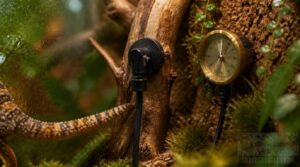
A probe dangling loose drifts toward the glass or gets shoved by a curious nose, skewing every reading after. Magnetic probe clips with a 90-degree bend resist that slippage even under climbing snakes, while silicone cord sleeves stop tugging without kinking.
For anything permanent, cable clamp anchoring and dual locking mounts hold angle and height, and quick release pins let you reposition without losing your fixed reference point.
Confirm Readings With Spot Checks
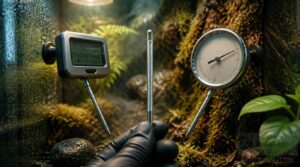
Trust, but verify. Even a well-placed probe deserves a second opinion.
- Weekly spot checks for active setups
- A calibrated reference thermometer
- Same time, same spot
- Logged date, reading, and difference
- Recalibrate past tolerance
Compare device against reference, log the gap, and flag drift early before it costs you a bad shed or worse.
Top 4 Terrarium Thermometers Compared
You’ve seen how digital and analog thermometers stack up, and where each one falls short in a snake terrarium. Now it’s time to put that knowledge to work on actual products you can buy. Here are four options worth considering, ranging from old-school analog to fully digital setups.
1. Zoo Med Analog High Range Reptile Thermometer
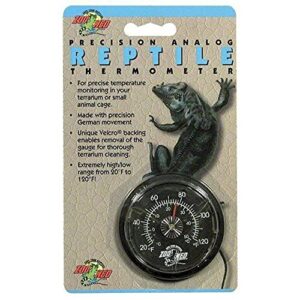
If you keep high-basking species like bearded dragons, the Zoo Med Analog High Range Reptile Thermometer reads 20 to 120°F using precision German movement. Velcro backing makes cleaning easy, and its compact 2 by 3 inch frame suits small tanks.
But temper expectations: no batteries mean no drift from power loss, yet owners report ±5 to 10°F swings, and the needle can wobble 30 seconds after bumps. Treat it as a secondary gauge, not your primary source.
- Precision German movement offers reliable analog operation across a wide 20°F to 120°F range
- Velcro backing makes it simple to remove for cleaning or repositioning
- Clear dial markings and simple installation make it easy to read at a glance
- Some units show accuracy variations of ±5 to 10°F, so it’s best used alongside a digital thermometer
- Needle can vibrate and take up to 30 seconds to stabilize after being bumped
- Built from basic plastic, with some customers noting lower overall build quality
2. Taam STA00237 Reptile Digital Thermometer
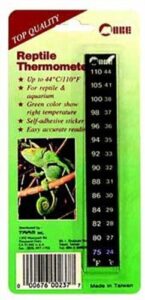
Where the Zoo Med analog gives you a ballpark, the Taam STA00237 gives you a number you can actually trust for daily checks. This handheld unit pairs with a separate probe, switches between Celsius and Fahrenheit, and updates readings at regular intervals with minimal lag.
Battery-powered operation means no outlet dependency, and low battery indicators prevent silent failures. Just watch adhesive backing on glass mounts, and recalibrate periodically against a reference thermometer to catch drift before it skews your basking data.
- Easy stick-on application to aquarium or terrarium glass
- Digital display makes temperature readings simple to check at a glance
- Useful for monitoring heating conditions across aquariums, terrariums, and ponds
- Some users report inaccurate readings when placed near UV or heat lamps
- Adhesive backing may not hold up well on all tank surfaces over time
- No listed information on calibration accuracy or long-term durability
3. Exo Terra Digital Combination Thermometer/Hygrometer
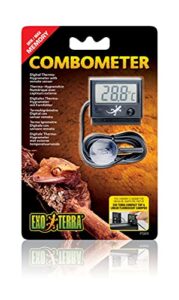
If the Taam covers your basics, the Exo Terra earns its keep by handling humidity too. Its remote combined sensor hangs on a flexible wire, letting you sample near the basking zone while the cable resists heat absorption from nearby bulbs.
Min/max memory tracks both metrics with one button press, and mounting slides into Exo Terra canopy slots cleanly. The catch: included suction cups often lose grip, and LCD visibility drops sharply off-angle.
- Dual sensor design monitors temperature and humidity simultaneously from a remote probe
- Max/min memory function makes it easy to spot daily fluctuations in conditions
- Flexible cable placement lets you position the sensor right where it matters, like near the basking zone
- Included suction cups have weak adhesion and don’t hold up well over time
- LCD display is hard to read unless viewed straight on
- Humidity readings can be inconsistent, with some users noting deviations of several percent
4. Fluker’s Digital Thermometer Hygrometer
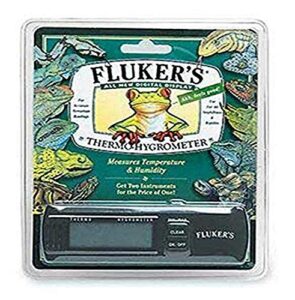
Rounding out the lineup, Fluker’s dual sensor packs temperature and humidity into a compact black unit built for gecko, snake, tortoise, and even hermit crab setups. Resolution runs fine, 0.1 degrees and 1% humidity, with min/max memory included.
Reality check: owners report humidity readings drifting 5-10% off and temps skewing roughly 3 degrees within weeks. It’s budget-friendly and functional out of the box, but long-term accuracy isn’t guaranteed.
- Combines temperature and humidity monitoring in one easy-to-read digital device
- Compact design fits well in a variety of pet habitats
- Comes with the battery included, so it’s ready to use right away
- Humidity readings can be off by 5-10%, and temperature by about 3 degrees
- Some units stop working or lose accuracy within just a month of use
- Customer feedback is mixed, with several reports of inconsistent long-term performance
Choosing Accuracy Without Overspending
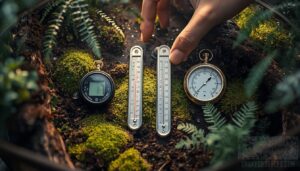
You don’t need the priciest thermocouple unit to get reliable readings, but you do need to know which features actually matter. Some specs are worth paying for, and others are just marketing. Here’s what to weigh before you buy.
Compare Price and Precision
A few extra dollars upfront often buys years of reliable readings. Digital thermometers cost 10-40% more, but their built-in calibration cuts drift to near zero, unlike analog units that wander 1-3°F yearly. That upfront gap shrinks fast once you factor in long-term savings on rechecks and replacements.
For budget setups, analog still works, but frequent monitoring favors precision, and precision favors digital.
Prioritize Humidity-resistant Sensors
Humidity is the silent killer of cheap sensors. Look for humidity-resistant sensors with protective membranes, vapor permeability design, and water-resistant enclosures rated IP65 or better.
Hydrophilic coatings curb condensation, and humidity compensation algorithms correct drift as conditions shift. Together, these features give digital thermometers real long-term drift resistance, something analog thermometers simply can’t match in a humid terrarium.
Check Min-max Temperature Tracking
Few features matter more than min-max temperature recording, since it catches what your eyes miss overnight.
- Verifies accuracy against actual highs and lows
- Reveals daily min-max trends at a glance
- Flags dangerous swings before they harm your reptile
- Lets you reset data after adjustments
- Confirms probe placement is catching real extremes
Interpreting these ranges beats guessing from a single reading, every time.
Consider Display and Battery Life
A dim, unreadable screen at 2 a.m. does you no good. Pick high-contrast displays with adjustable brightness and auto sleep modes, since dimming saves power without sacrificing readability under bright terrarium lighting.
Coin-cell units last 6-12 months; rechargeables need discipline. Low-battery icons prevent data loss.
Thermometer accuracy means nothing if the screen’s dead when you check.
An accurate thermometer is useless if its battery dies right when you need to check it
Add Infrared Surface Checks
No probe reaches every hot rock. That’s where infrared thermometers earn their keep, giving instant surface temperature readings on basking spots.
Set emissivity to 0.95, hold it 6-12 inches away, perpendicular. Surface vs air temp readings differ, so log both weekly to catch fluctuations before they become problems.
Frequently Asked Questions (FAQs)
How often should terrarium thermometers be replaced?
Even the most bulletproof-seeming sensor eventually betrays you: expect digital swaps every 12-24 months, analog sooner near 12, and any unit drifting past 2°F from a reference thermometer needs retiring immediately, regardless of age.
Are wireless thermometers more accurate than wired probes?
Not inherently. Signal interference and battery health can add slight lag, but calibrated wireless kits use the same sensors as wired probes. Wired setups edge out on consistency; wireless wins on placement flexibility and data logging for tracking drift.
How many thermometers does a single terrarium actually need?
Two, usually. One digital thermometer covers the warm basking zone, a second the cool side, giving you a real gradient reading instead of a guess, with occasional spot checks confirming both stay accurate over time.
Conclusion
A thermometer is a translator, and a bad one mangles every word your snake is trying to tell you.
Digital vs analog terrarium thermometer accuracy isn’t about brand loyalty, it’s about matching sensor to purpose and probe placement to biology. Analog dials earn their keep in steady basking spots, digital probes shine when swings happen fast. Trust the numbers only after you’ve checked them twice. Your snake was never confused. Only you were.