This site is supported by our readers. We may earn a commission, at no cost to you, if you purchase through links.
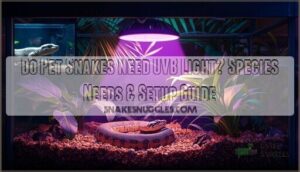
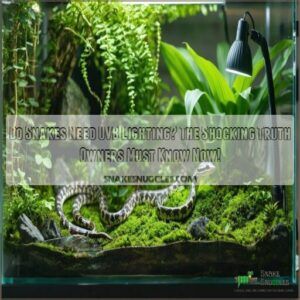
Generations of ball pythons and boa constrictors have been bred in captivity without a single UVB bulb overhead—and they’ve thrived. That fact surprises a lot of new snake owners who assume lighting requirements work the same across all reptiles.
The truth cuts through a lot of noise: snakes can survive without UV light, but survival and peak health aren’t the same thing.
Whether your snake actually needs UVB depends on its species, its diet, and what you’re aiming for as an owner.
The distinction matters more than most care guides admit.
Table Of Contents
- Key Takeaways
- Can Snakes Survive Without UV Light?
- Most Snakes Can Survive Without UV
- Why UVB Still Benefits Snakes
- Snakes That Benefit Most From UVB
- Safe UVB Setup for Enclosures
- When Lack of UVB Becomes Risky
- Frequently Asked Questions (FAQs)
- Can snakes survive without UVB?
- Do snakes need UVB lighting?
- Do snakes reflect UV light?
- How do snakes use UVB?
- What US state is home to no snakes?
- Can UV light affect a snakes color vibrancy?
- Do snakes use UV light for navigation or hunting?
- How does UV exposure influence snake breeding behavior?
- Can overexposure to UVB harm my pet snake?
- Conclusion
Key Takeaways
- Most snakes can survive without UVB because whole prey naturally delivers vitamin D3, calcium, and fat for absorption — but survival isn’t the same as thriving.
- UVB exposure triggers a chain reaction in the skin that produces active vitamin D3, which drives calcium absorption and supports bone density, immune function, and natural activity cycles.
- Species and lifestyle matter: shade-dwellers like ball pythons and corn snakes need minimal UVB, while diurnal baskers like garter snakes genuinely depend on it to stay healthy.
- If you skip UVB, your snake’s diet has to carry all the weight — and gaps in prey quality or variety can quietly lead to calcium deficiency and metabolic bone disease over time.
Can Snakes Survive Without UV Light?
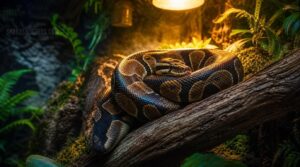
Whether your snake actually needs UV light depends on a few key factors — species, diet, and how you’ve set up its enclosure. Most snakes can survive without it, but survival and thriving aren’t always the same thing. Here’s what every owner should understand before making that call.
Understanding how UVA and UVB affect snakes differently can help you decide exactly what your setup actually needs.
Short Answer for Owners
Yes — most snakes can survive without UV light. UVB is not mandatory for every species, especially when feeder quality is high and dietary D3 comes from whole prey. That said, survival and thriving aren’t the same thing.
- Whole mice or rats deliver built-in vitamin D3
- Supplement choice fills gaps when prey falls short
- Health checks catch deficiencies before they become serious
UVB Versus UVA
Not all UV light works the same way.
UVB (290–320 nm) drives vitamin D₃ synthesis in snake skin, while UVA (320–400 nm) facilitates visual perception and natural behavior — but can’t replace UVB for calcium metabolism.
A bulb that only emits UVA won’t meet your snake’s UVB requirements, no matter how bright it looks.
Survival Versus Optimal Care
Knowing that UVB drives vitamin D₃ production is one thing — but does its absence actually threaten your snake’s life? The honest answer: survival is possible, but survival and thriving aren’t the same.
A snake can live without UVB if its diet fully covers calcium metabolism needs, yet chronic health risks can quietly build over time.
Captive Snake Basics
Before tackling UV decisions, get the fundamentals right. Your snake needs a temperature gradient with warm and cool zones, appropriate substrate for humidity control, at least two hides, and frozen‑thawed prey sized to its body width. These basics directly affect vitamin D3 metabolism and bone health — without them, no lighting setup compensates.
Implement a minimum two‑week quarantine to make sure new snakes are disease‑free before introduction.
Most Snakes Can Survive Without UV
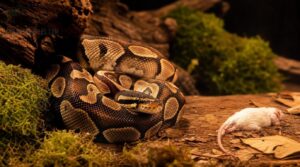
Here’s the thing — most snakes don’t actually need UVB to stay alive and healthy. Their bodies can pull vitamin D3 straight from whole prey, as long as diet and calcium intake are on point. A few key factors determine whether your snake is one of them.
Whole-prey Vitamin D3
Whole prey is nature’s vitamin D3 delivery system. When your snake eats a complete rodent, it gets vitamin D3 from prey tissues — especially the liver and organs — packaged alongside dietary fat that facilitates absorption.
Since vitamin D3 is fat-soluble, it travels through the gut with the meal’s natural fat content, entering the bloodstream efficiently.
Dietary Calcium Intake
Calcium is the backbone of your snake’s skeletal health, and whole prey delivers it naturally. A standard feeder rodent contains roughly a 1:1 calcium-to-phosphorus ratio, which promotes efficient calcium metabolism without supplementation.
- Rodent bones supply bioavailable calcium directly
- Organ tissues boost vitamin D3, aiding absorption
- Calcium powder dusting adds extra insurance
- Consistent prey nutrition prevents deficiency risks
- Whole prey reduces supplementation needs considerably
Species Differences Matter
Not all snakes are built the same way. Species-specific lighting needs vary widely depending on how a snake evolved.
A sun-loving gopher snake, for instance, thrives under UVB exposure that would stress a more secretive species—so it’s worth checking species-specific UVB lighting guidance for gopher snakes before you set anything up.
Corn snakes, classified as Ferguson Zone 1 shade-dwellers, need minimal UVB. Ball pythons are partial-sun baskers requiring only low-level exposure.
Diurnal species bask longer and synthesize more vitamin D₃ naturally, while nocturnal snakes rely more heavily on dietary sources.
When No UVB Works
Whole-prey diets are where UVB becomes unnecessary for many species. Boa constrictors, Burmese pythons, and rat snakes have all thrived across multi-generational captive breeding programs without a single UVB bulb — provided their diet covers the gap.
Here’s when skipping UVB actually works:
- Whole-prey diets supply natural dietary D3 and calcium together
- Nocturnal snakes rely more on food-sourced nutrients than skin synthesis
- Python skin adaptations support cholesterol conversion into active D3 internally
- Consistent feeding prevents the gaps that make metabolic D3 synthesis critical
That said, supplement efficacy limits mean no powder fully replaces a complete diet.
Why UVB Still Benefits Snakes
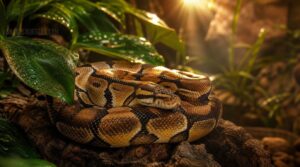
Surviving without UVB and actually thriving without it are two different things. Research shows that UVB exposure drives real, measurable improvements in snakes — from stronger bones to a more active immune system. Here’s what those benefits actually look like.
Surviving without UVB and thriving without it are two very different things
Vitamin D3 Production
When UVB hits your snake’s skin, it triggers a precise chain reaction. The radiation converts 7-dehydrocholesterol into pre-vitamin D3, which heat then stabilizes into vitamin D3.
The liver processes this into 25(OH)D, and the kidneys complete 1-alpha hydroxylation to produce calcitriol — the active hormone that binds VDR receptors and switches on genes controlling calcium and bone health.
Calcium Absorption
Active calcitriol flips on the genes that build calcium transport proteins in the gut lining — mainly in the duodenum. These proteins pull ionized calcium across the intestinal gradient through the transcellular pathway.
A second route, paracellular diffusion, moves calcium passively between cells throughout the intestine, bypassing vitaminD3 entirely but still contributing meaningfully to overall absorption.
Bone Health Support
When those calcium transport proteins do their job consistently, the skeleton stays dense and functional. But that only holds if active vitamin D₃ keeps flowing — and that’s exactly where UVB earns its place.
Metabolic bone disease is the clearest sign things have gone wrong. Soft jaw bones, spinal kinks, and tremors all point to the same root failure: not enough mineralized bone tissue.
Immune System Benefits
Bone health doesn’t exist in isolation. The same UVB exposure driving vitamin D₃ production also bolsters your snake’s defenses against infection.
Research shows UVB-exposed snakes develop higher white blood cell counts, which directly strengthens their ability to fight pathogens. Here’s what that means practically:
- Stronger innate immunity — faster first-line responses to threats
- Improved mucosal barrier defense — better protection at vulnerable entry points
- More active lymphoid organ function — supporting both antibody production and adaptive responses
A healthier immune system means fewer vet visits.
Natural Activity Cycles
UVB doesn’t just protect bones and immunity — it also helps regulate your snake’s internal clock.
Snakes exposed to consistent light-dark cycles show more natural dawn-dusk activity patterns, feeding more reliably and moving with purpose rather than random bursts.
That predictable rhythm is a sign of a thriving animal, not just a surviving one.
Snakes That Benefit Most From UVB
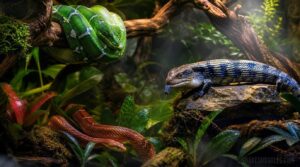
Not every snake needs UVB the same way, and that’s where species really start to matter. Some snakes genuinely thrive with regular UVB exposure, showing better health, stronger color, and more natural behavior when it’s part of their setup. Here are the types that benefit most.
Ball Pythons and Boas
Ball pythons and boas sit in Ferguson Zone 1–2, meaning they’re low-light dwellers by nature.
Still, adding low-level UVB can support vitamin D₃ production, strengthen their immune response, and regulate their nocturnal activity cycles more naturally — benefits that go beyond bare survival.
Corn Snakes
Corn snakes fall into Ferguson Zone 1, making them natural shade-dwellers that don’t require intense UVB.
UVB is optional for them — whole-prey diets supply enough vitamin D3 to prevent metabolic bone disease.
That said, low-level UVB can still improve appetite and activity cycles, giving your corn snake a more complete, naturalistic environment.
Sun-basking Species
Unlike shade-dwellers, diurnal sun-basking species genuinely depend on UVB to thrive. Racers and garter snakes fall into Ferguson Zone 3, needing 5–7% UVB output daily. They orient their bodies perpendicular to the light source to optimize vitamin D3 synthesis — skipping UVB here isn’t a minor gap, it’s a real health risk.
- Position UVB tubes 12–18 inches above the basking spot
- Run a 10–12 hour photoperiod daily
- Use T5 bulbs rated for Zone 3 species
- Guarantee open-mesh or UV-transparent enclosure tops
- Always provide a shaded hide for retreat
Basking orientation and thermal regulation work together — your snake needs both heat and UVB at the basking site simultaneously.
Nocturnal Snake Considerations
Nocturnal snakes — think ball pythons and boa constrictors — are genuinely UVB-free snakes by nature. Their rod-dominated retinas and heat-sensing pits let them hunt effectively in darkness, so UVB is optional for them.
What matters most is a consistent light-dark cycle of 10–12 hours, which keeps their circadian rhythms stable and feeding responses strong.
Albino Snake Sensitivity
Albino snakes are a special case. Because they lack skin pigmentation, they’re far more sensitive to UVB intensity — overexposure risks skin irritation and eye discomfort.
Use low-output UVB bulbs and always provide a fully shaded hide.
Prioritize dietary vitamin D3 to reduce UVB dependence, and monitor for stress behaviors like turning sharply away from light.
Safe UVB Setup for Enclosures
Getting UVB lighting right doesn’t require expensive equipment or complicated setups. A few straightforward choices make all the difference between a snake that thrives and one that just gets by. Here’s what your enclosure actually needs.
Low-output UVB Bulbs
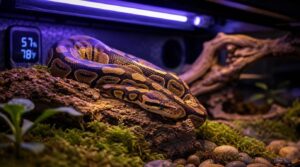
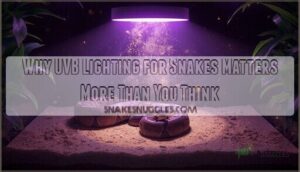
For most pet snakes, low-output UVB bulbs — usually labeled 2.0 or 5.0 — strike the right balance. T5 or T8 fluorescent tubes spread UVB evenly across the enclosure, while compact fluorescent lamps suit smaller setups.
Always confirm fixture compatibility before buying, since the wrong dome or reflector can reduce usable UVB considerably.
Proper Basking Distance
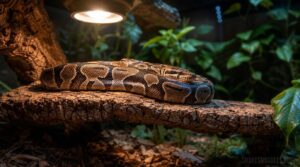
Position your UVB bulb 12–18 inches above the basking spot — not the enclosure floor. That gap matters more than most owners realize. A bulb hanging over a raised basking platform sits much closer to your snake than the raw floor distance suggests, which can spike UVB intensity beyond safe levels for your species’ Ferguson Zone.
Always verify with a thermometer probe placed directly at your snake’s actual resting height.
10–12 Hour Photoperiod
Once you’ve dialed in the bulb distance, timing is next. Aim for a 10–12 hour photoperiod — lights on, then full darkness for the remainder of the 24-hour cycle.
This light-dark cycle promotes circadian rhythm alignment and keeps your snake’s activity pattern regulation on track, mimicking the natural day-night cues it would follow in the wild.
Shaded Hides Required
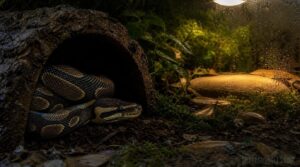
With your photoperiod locked in, don’t forget the other side of the equation — your snake needs somewhere to escape the light entirely.
At least one fully shaded hide is non-negotiable in any UVB setup. Snakes exposed to constant light without a dark retreat show elevated stress and disrupted resting behavior.
Here’s what a proper hide setup looks like:
- Place the shaded hide on the cool side, away from the basking zone.
- Size it snugly — the snake should fit fully inside without feeling exposed.
- Keep the interior clean and dry to prevent bacterial buildup.
- Use multiple hides across warm and cool zones so your snake can self-regulate.
- Block UVB completely inside the hide — opaque materials work best.
This gives your snake full control over its light exposure.
Replace Bulbs Regularly
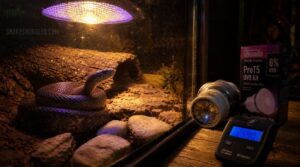
Your hides block the light — but here’s something easy to miss: UVB output fades silently. The bulb still glows, but it may deliver almost no usable UVB after 6–12 months.
Replace UVB bulbs on schedule, not at burnout. A UV meter confirms actual output at the basking spot, because placement, covers, and fixture design all affect delivery.
When Lack of UVB Becomes Risky
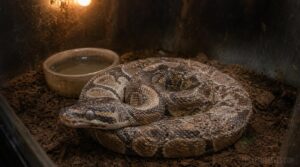
Skipping UVB doesn’t automatically put your snake at risk — but it does raise the stakes around everything else you’re doing. If your husbandry isn’t tight, the gaps start to show up in ways that are hard to reverse. Watch for these warning signs that a lack of UVB may be catching up with your snake.
Poor Diet Quality
Without UV light, your snake’s diet becomes the only safety net — and a poor one can quietly cause real harm. When meals lack whole-prey variety, the snake misses the minerals naturally distributed across different prey animals.
Feeding the same prey type repeatedly creates micronutrient gaps that accumulate over time, eventually raising the risk of MBD.
Calcium Deficiency Signs
When calcium absorption breaks down, your snake’s body starts sending clear distress signals. Watch for jaw softening first — a jaw that flexes abnormally when your snake strikes or feeds is a red flag.
You may also notice muscle tremors, subtle twitching that indicates disrupted nerve signaling caused directly by vitamin D3 deficiency and low blood calcium.
Metabolic Bone Disease
Metabolic bone disease is the endpoint of prolonged calcium absorption failure. When vitamin D3 stays low, your snake’s body can’t pull enough calcium from the gut, disrupting the delicate phosphate balance the skeleton depends on.
- Bone remodeling shifts toward resorption over formation
- Hormonal regulation breaks down as parathyroid hormone spikes
- Structural damage shows on imaging diagnostics as deformities
Weak Feeding Response
When metabolic bone disease takes hold, feeding behavior often suffers noticeably. Your snake may strike at prey but fail to grip it, or hold prey in its mouth and then simply let go.
That’s swallowing difficulty in action — the jaw and throat muscles lose coordination, making a normal feeding sequence feel impossible for the animal.
Vet Care Warning Signs
Some warning signs demand a vet visit, not a wait-and-see approach. If your snake shows labored breathing, open wounds that won’t close, or eye discharge, act quickly.
Unusual soaking habits or prolonged hiding can also signal trouble—understanding what causes irregular shedding cycles in snakes helps you catch these early warning signs before they escalate.
Skin irritation, dehydration signs, or visible bone deformities all point to a system under serious stress. These aren’t minor issues — they’re your snake telling you something has gone wrong.
Frequently Asked Questions (FAQs)
Can snakes survive without UVB?
Yes, most snakes can survive without UVB — whole-prey diets supply enough vitamin D3 to support bone health when fed consistently.
Even so, keepers who want extra insurance against metabolic bone disease can look at choosing a UVB lamp for your ball python and add low-level lighting to a whole-prey routine.
Do snakes need UVB lighting?
Most snakes don’t need UVB lighting to survive, but UVB promotes stronger bone health, better calcium metabolism, and more natural behavior — especially when diet alone doesn’t fully cover vitamin D
Do snakes reflect UV light?
Most snakes reflect UV light across parts of their body. This UV reflectance is invisible to human eyes but detectable by UV-sensitive predators and other animals.
How do snakes use UVB?
When a corn snake basks under a UVB lamp, its skin converts sunlight energy into vitamin D3 synthesis, which drives calcium absorption and keeps bones strong.
What US state is home to no snakes?
Alaska and Hawaii have no native land snakes. Alaska’s brutal cold and geographic isolation make survival impossible, while Hawaii’s remote Pacific location prevents any natural colonization by terrestrial snake species.
Can UV light affect a snakes color vibrancy?
UV light does more than support vitamin D synthesis — it also reveals a hidden layer of your snake’s appearance. UV reflectance shapes how other animals perceive your snake’s coloration, even when visible colors look unchanged.
Do snakes use UV light for navigation or hunting?
UV light does play a role in how some snakes perceive their world, but it’s more about detection than direction. UV vision helps certain species spot prey with UV-reflective markings.
How does UV exposure influence snake breeding behavior?
UV exposure influences breeding by triggering hormonal shifts that regulate gonad development, synchronizing courtship with seasonal cues through photoperiod breeding signals and improving egg viability via aligned maternal UV patterns.
Can overexposure to UVB harm my pet snake?
Yes, UVB overexposure can harm your snake. Risks include eye damage, skin burns, and stress — especially for albino morphs. Keep output low, maintain safe distance, and always provide a shaded hide.
Conclusion
The bar for "surviving" has always been low—but you’re here because you want more than that for your snake.
Whether snakes can survive without UV light is even worth asking; it depends entirely on your setup, your species, and your diet quality.
Whole-prey feeders may never need a UVB bulb. Others benefit clearly from one.
Know your snake, close the nutritional gaps, and let the evidence guide your enclosure choices—not assumptions.