This site is supported by our readers. We may earn a commission, at no cost to you, if you purchase through links.
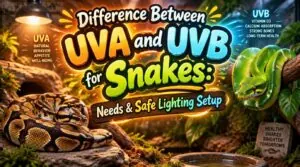
Your snake’s enclosure might glow with light and still leave its bones starving. A glass lid or plastic hood blocks UVB completely, yet it passes UVA, so the tank looks bright and tells you nothing.
That gap matters. The difference between UVA and UVB for snakes is the difference between a pet that sees, basks, and feeds on cue and one that develops soft bones, a bent spine, and fractures. UVA shapes vision and behavior. UVB drives vitamin D3 and calcium absorption.
You need both, in measured doses. Here’s how each wavelength works, what your species requires, and how to set it up safely.
Table Of Contents
- Key Takeaways
- UVA Vs. UVB for Snakes: Wavelengths and Key Differences
- What UVA Does for Snakes: Vision, Behavior, and Daylight Cues
- What UVB Does for Snakes: Vitamin D3, Calcium, and Bone Health
- How Much UVA and UVB Do Ball Pythons, Corn Snakes, and Boas Need?
- Choosing and Setting Up Safe UVA and UVB Lighting for Snakes
- Frequently Asked Questions (FAQs)
- Is UVA or UVB better for snakes?
- Do rattlesnakes glow under UV light?
- Which is more harmful, UVA or UVB?
- Do snakes really need UVB?
- What is the difference between UVA and UVB?
- How does UVA light affect reptiles?
- Do reptiles and amphibians need both UVB and UVA light?
- Why do Reptiles need a UV meter?
- Do reptiles need both UVA and UVB?
- What color light is best for snakes?
- Conclusion
Key Takeaways
- Glass lids and plastic hoods block UVB completely while letting UVA through, so a bright tank can still leave your snake with no UVB at all.
- UVB is the one your snake can’t skip, because it triggers the vitamin D3 your snake needs to absorb calcium and avoid soft bones, spinal kinks, and fractures.
- UVA isn’t optional either, since it shapes how your snake sees, basks, feeds, and keeps its day-night rhythm.
- You can’t judge UVB by eye, so measure the UV Index at basking height with a meter, match it to your species, and replace tubes every 6 to 12 months because output fades long before the light looks dim.
UVA Vs. UVB for Snakes: Wavelengths and Key Differences
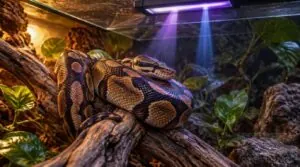
You can’t treat UVA and UVB as the same thing, because your snake’s body doesn’t. The difference starts with wavelength range. UVA runs 315 to 400 nm. UVB runs 280 to 315 nm, which makes it shorter, higher in energy, and absorbed near the skin’s surface. UVA reaches deeper into tissue.
Because UVB is what triggers vitamin D3 production, a guide to the difference between UVB and UVA lighting can help you choose the right bulb and keep your snake’s day-night cycle on track.
Here’s the catch. Glass and most plastics block UVB but pass UVA, so a lamp shining through a glass lid can look bright and still deliver no UVB at all.
A glass lid can make a lamp look bright while blocking every bit of UVB your snake needs
UVB matters most for vitamin D3 synthesis, which your snake relies on for calcium metabolism. Your species UV classification decides how much exposure you’ll aim for, and we’ll get to that later. Get it wrong and bone health suffers. UVB bulbs also lose strength with age, so replacing UVB bulbs regularly every 6 to 12 months matters even if they still emit visible light.
What UVA Does for Snakes: Vision, Behavior, and Daylight Cues
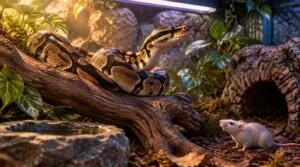
UVA doesn’t build bone, but it still shapes how your snake sees and acts. Snakes carry a fourth cone type tuned to UVA, so UVA vision shows them contrasts and colors you can’t see. Prey, rivals, and mates all look different under it.
That matters for behavioral enrichment. With proper UVA, snakes bask more, explore more, and respond better at feeding time. Without it, your snake may be working from a dull, flattened view of its world.
UVA also works as a circadian light cue. It tells your snake the time of day and season, which helps photoperiod regulation for feeding, breeding, and brumation. Even nocturnal species sense it.
If you’re setting up a new enclosure, this guide to how UV light affects snake health explains how to match lighting to your species’ natural rhythms.
Plan your UV enclosure design so UVA reaches every basking zone.
What UVB Does for Snakes: Vitamin D3, Calcium, and Bone Health
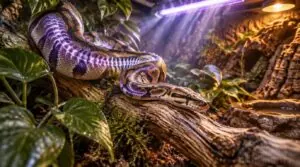
UVA shapes behavior. UVB builds bones.
When UVB (290-315 nm) hits your snake’s skin, it converts 7-dehydrocholesterol into previtamin D3, which becomes vitamin D3. The process regulates itself. Once your snake makes enough, extra previtamin D3 turns into inert byproducts, so overdose isn’t a worry.
That vitamin D3 drives calcium absorption in the gut. Without it, serum calcium drops, and your snake’s body pulls calcium from its own skeleton. The result is metabolic bone disease: soft, deformed bones, spinal kinks, and spontaneous fractures.
Frozen-thawed rodents can’t reliably fill the gap. Supplements risk hypervitaminosis D. UVB gives your snake exactly what it needs, which is why bone health depends on it, especially in growing juveniles. Always follow proper UV exposure guidelines.
How Much UVA and UVB Do Ball Pythons, Corn Snakes, and Boas Need?
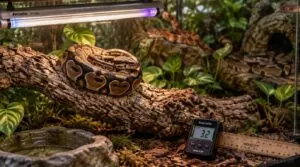
Now the practical question: how much? It depends on your species. Too little UVB invites bone disease.
Desert species like bearded dragons-style basking snakes need stronger UVB gradients, while nocturnal ones do better in deep shade, so check this snake habitat lighting requirements guide for species-specific settings.
Species-specific UVB needs vary. Ball pythons and boas want a basking UVI of 2.0-3.0. Corn snakes tolerate 1.5-3.0. Pick a 5.0 or 6% UVB percentage tube, and your numbers land in range.
Follow these UV exposure guidelines:
- Ball pythons: Zoo Med T5 HO ReptiSun 5.0, 10-14 inches from the basking surface.
- Corn snakes: same tube, 10-12 inches.
- Boas: 10-14 inches, or 4-6 inches with an Arcadia ShadeDweller MAX.
Keep that UV safety distance consistent. Mesh blocks output, so measure instead of guessing. UVB dose monitoring with a Solarmeter 6.5 confirms your UVI. Recheck readings monthly, since tubes fade long before they burn out.
Choosing and Setting Up Safe UVA and UVB Lighting for Snakes
You now know what UVA and UVB do, so the next step is getting the lighting right. Safe setups come down to three choices: bulb type, lamp placement, and your daily routine. Here’s how to handle each one with confidence.
Bulb Types and UV Transmission
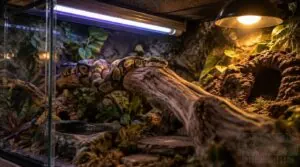
Not every bulb that glows delivers UVB. Pick wrong, and your snake gets light without the benefit.
T5 HO Fluorescent tubes are your best bet. Choose 5% to 14% to match your species. Mercury vapor lamps add heat and UVA too.
Glass blocks UVB, so never shine a lamp through it. Mesh cuts 25-50%, so use a reflector or bump up the percentage.
Lamp Distance, UVI, and Shade Gradients
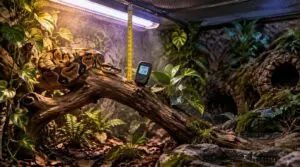
Distance controls your UVB dose. Measure basking distance with a UV Index meter, never by eye. Then build your UV gradient:
- Place the lamp above the basking spot
- Check UVI at snake height
- Remember UVA doesn’t replace UVB
- Allow for screen mesh loss
- Provide hides for shade utilization
Doubling distance cuts UVI to one-quarter, so measure again after every adjustment.
Daily Lighting Schedules and Bulb Replacement
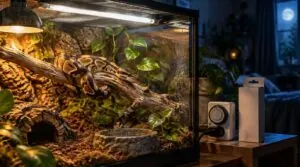
Your snake needs 10 to 12 hours of light every day. No more, no less. Daily Lighting Schedules work best on a timer, so nights stay truly dark. A digital outlet timer for reptile lighting lets you program exact on and off times, so your snake’s day and night cycle never drifts.
UVB output fades long before the bulb looks dim. Plan Bulb Replacement now: T8 tubes at 6 months, T5 HO at 12 months. Keep your Basking Distance consistent for UVA and UVB.
Frequently Asked Questions (FAQs)
Is UVA or UVB better for snakes?
Corn snakes under UVB showed 242% higher vitamin D3 levels after 28 days. That’s your answer. UVB is the one your snake can’t skip. UVA shapes basking behavior and vision, but UVB drives calcium absorption.
Do rattlesnakes glow under UV light?
Ironically, the "glowing" rattlesnake you’ve seen is your eyes fooled. Under UV radiation it reflects, not fluoresces. UVA and UVB won’t change that. Pits sense heat. UV vision enhancement and the UV spectrum don’t matter.
Which is more harmful, UVA or UVB?
UVA makes up about 95% of terrestrial UV, yet UVB is more harmful.
It damages DNA directly, so UV excess risks like burns come mostly from UVB.
Track UV Index; UV deficiency symptoms hurt too.
Do snakes really need UVB?
One ball python I treated had rubbery jaw bones. Do snakes really need UVB? Yes.
UVB drives vitamin D3 synthesis, which protects your snake’s bones. UVA shapes behavior. Skip both, and your reptile husbandry suffers.
What is the difference between UVA and UVB?
UVA spans 315 to 400 nm. UVB runs 280 to 315 nm. That shorter wavelength packs more energy per photon, so UVB hits harder. It drives vitamin D3 synthesis, while UVA shapes vision and behavior. Position your basking distance to create a proper UV gradient.
How does UVA light affect reptiles?
Your corn snake tracks a cricket across the tank. That’s UVA at work.
It sharpens vision, sets your circadian rhythm, and sparks mating displays. It’s behavioral enrichment, but vitamin D3 and calcium absorption need UVB.
Do reptiles and amphibians need both UVB and UVA light?
Picture sunlight pouring across a rock at noon. Your animal gets two signals from it, not one.
Yes, most reptiles and amphibians need both. UVB drives vitamin D synthesis and calcium absorption. UVA shapes behavior and daily rhythm. Species-specific needs set the dose.
Why do Reptiles need a UV meter?
Your bulb looks bright, so it’s fine? Not necessarily. UVB fades invisibly.
A UV meter confirms your snake’s UV gradient, helps with UVB dose monitoring, and protects UV exposure safety. Without UVB monitoring, you’re just guessing.
Do reptiles need both UVA and UVB?
Yes, you need both. UVB drives vitamin D3 synthesis, which lets your snake absorb calcium and avoid metabolic bone disease. UVA shapes behavior, appetite, and stress levels. Good reptile lighting delivers both, matched to species-specific needs.
What color light is best for snakes?
Think of light like a meal: your snake needs the full plate. Choose a full-spectrum bulb with warm white balance and UVA, which sharpens visual perception.
Add UVB for vitamin D3, mind your basking distance.
Conclusion
A bright tank isn’t a healthy tank. Light you can see doesn’t guarantee light your snake can use.
Remember the difference between UVA and UVB for snakes: UVA lets your animal see and behave naturally, while UVB builds the vitamin D3 that keeps bones strong. Provide both, match the dose to your species, and always offer shade. Measure the UVI, replace bulbs on schedule, and watch your snake’s posture.
Strong bones are the quiet proof.