This site is supported by our readers. We may earn a commission, at no cost to you, if you purchase through links.
Ordinary window glass blocks nearly all UVB but lets UVA pass straight through. That single fact trips up more snake keepers than any other lighting mistake, and it explains why some pet snakes develop soft, rubbery jaws and bent spines despite basking daily near a sunny window.
The difference between UVB and UVA lighting comes down to wavelength and what each one does inside your snake’s body. UVB drives vitamin D3 synthesis and calcium metabolism; UVA shapes activity patterns and visual perception. Get the ratio wrong, and you’re not just missing a technicality—you’re risking your snake’s bone health.
Here’s what separates these two wavelengths, and how to use both correctly in your enclosure setup.
Table Of Contents
- Key Takeaways
- UVA Vs UVB Lighting Basics
- Key Differences at a Glance
- What UVA Lighting Does
- What UVB Lighting Does
- Do Snakes Need UVA?
- Do Snakes Need UVB?
- UVA and UVB Safety
- Choosing Snake UV Lighting
- Setting a Healthy Light Cycle
- Common UVA and UVB Mistakes
- Frequently Asked Questions (FAQs)
- Do regular light bulbs give off UVB?
- Is UVA light the same as UVB?
- Do I turn off my UVB light at night?
- Do UVB lamps give you vitamin D?
- What’s better, UVA or UVB?
- What is the difference between UVA and UVB lighting?
- How to tell if it’s UVA or UVB?
- Can UVA or UVB lighting treat human diseases?
- How do UVA and UVB affect aquatic animals?
- Do indoor plants need UVA or UVB light?
- Conclusion
Key Takeaways
- Ordinary glass blocks nearly all UVB while letting UVA pass through, so basking near a sunny window gives your snake no real vitamin D3 benefit.
- UVB (280–315nm) triggers vitamin D3 synthesis and calcium metabolism, making it essential for preventing metabolic bone disease and issues like soft jaws or kinked spines.
- UVA (315–400nm) shapes circadian rhythms, feeding behavior, and visual perception rather than bone health, so it serves a behavioral and enrichment role.
- Species-specific UVB needs vary widely, meaning you should match bulb percentage and placement to your snake’s natural habitat, such as low-output bulbs for nocturnal boas versus higher exposure for diurnal corn snakes.
UVA Vs UVB Lighting Basics
Before you set up any UV lighting for your snake, it helps to know what you’re actually working with. UVA and UVB might sound like two versions of the same thing, but they behave differently and serve different purposes in your enclosure. Here’s a quick breakdown of the basics you need to know.
If you’re still weighing whether your pet even needs it, this guide on why snakes need UVB lighting breaks down the science in plain terms.
Ultraviolet Light Explained
Every snake basking under a heat lamp is soaking up more than warmth. Ultraviolet light sits on the electromagnetic spectrum between visible light and X-rays, measured in nanometers (nm).
| Band | Wavelength | Source |
|---|---|---|
| UVA | 315–400 nm | Sun, specialty bulbs |
| UVB | 280–315 nm | Sun, mercury vapor |
| UVC | 100–280 nm | Sun (filtered by ozone) |
The atmosphere blocks most UVC before it reaches your snake’s enclosure.
UVA Wavelength Range
That 315–400 nm slice covers the longest ultraviolet wavelengths hitting your snake’s enclosure, sitting closest to visible light.
Photon energy runs lower here than in UVB, but atmospheric filtering barely touches it—roughly 95% of ground-level UV is UVA.
The UVA wavelength range extends from about 320 to 400 nm, making it the longest UV band.
| Feature | UVA Detail | Practical Note |
|---|---|---|
| Range | 315–400 nm | Longest UV band |
| Penetration | Reaches dermis | Passes through glass |
| Atmospheric loss | Minimal | Present all day |
UVB Wavelength Range
Shift down the spectrum a bit and you hit UVB, the 280–315 nm band responsible for the biology snakes actually depend on. Atmospheric absorption blocks most of it, so what reaches your enclosure matters.
| Feature | UVB Detail |
|---|---|
| Range | 280–315 nm |
| Source | Sun, UVB bulbs |
| Ground % | ~5% of UV |
Energy Level Differences
Photon energy proportionality explains why these two bands behave so differently on your snake’s skin. Shorter wavelengths pack more punch per photon, so UVB carries more energy than UVA, triggering deeper electron excitation states.
| Property | UVA | UVB |
|---|---|---|
| Wavelength | 315-400 nm | 280-315 nm |
| Photon Energy | Lower | Higher |
| Biological Punch | Mild | Vitamin D3 driver |
That energy gap isn’t trivia — it’s why UVB, not UVA, builds your snake’s bones.
Key Differences at a Glance
UVA and UVB aren’t interchangeable, and knowing how they differ helps you set up your snake’s enclosure correctly. A few key traits separate these two types of light, from how deep they penetrate to how they affect your snake’s body. Here’s a quick side-by-side look at what makes each one unique.
Wavelength Comparison
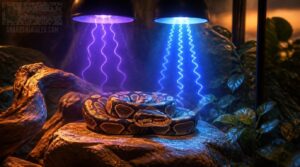
UVA runs 315-400 nanometers; UVB runs 280-315 nanometers, sitting lower on the wavelength spectrum. That gap matters: shorter wavelengths carry higher photon energy.
So UVB packs more energy per photon than UVA, driving stronger chemical reactions in living tissue. Understanding this UV wavelength physics helps you grasp why these two ultraviolet light rays serve such different roles in your snake’s enclosure.
Penetration Differences
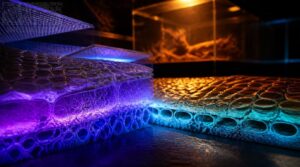
Where UVA and UVB actually reach in your snake’s tissue makes all the difference in care outcomes.
UVA penetrates deeper, passing through outer layers into dermal tissue. UVB stays shallow, absorbed mostly at the surface.
Material filtration effects matter too:
- Glass blocks UVB but passes UVA
- Plastic screens filter UVB greatly
- Acrylic reduces UVB more than UVA
This surface vs dermal impact drives everything about UV wavelength range choices for enclosure setups.
Biological Effects
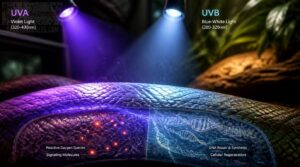
Biological effects differ at the cellular level too. UVA triggers oxidative stress response through reactive oxygen species, raising cellular mutation risks indirectly. UVB causes direct DNA lesions, activating DNA repair pathways within minutes.
Both wavelengths affect mitochondrial health impact and spark inflammatory signaling triggers in exposed tissue—key reasons reptile lighting applications require careful, species-specific dosing rather than guesswork.
Glass Blocking Differences
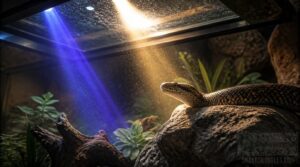
Ever wonder why your snake still basks by a sunny window but shows no shedding benefits? Ordinary glass blocks nearly all UVB while letting UVA pass through freely.
This matters for UV lamps too: enclosure glass or plastic tops filter UV radiation unevenly, cutting UVB transmission levels far more than UVA. That’s why UV exposure through glass barriers won’t support real physiological benefits.
To get real UVB uptake, position basking sites so reptiles bask close to unfiltered mesh openings, following the UVB dosing and seasonal scaling guidance for breeding setups.
Reptile Care Relevance
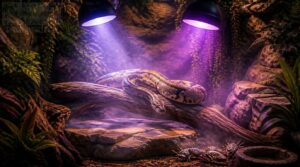
Here’s the short answer for your enclosure setup: UVB drives metabolic disease prevention, while UVA shapes visual stimulus and natural behavior. Skipping UVB risks calcium disorders; skipping UVA limits enrichment and naturalistic habitat simulation.
Matching UV radiation to species dietary needs and activity patterns isn’t optional extra credit. It’s the difference between a snake merely surviving and one that’s genuinely thriving under proper UV exposure.
What UVA Lighting Does
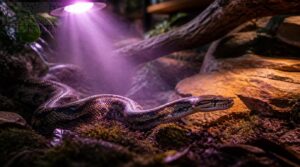
UVA doesn’t just light up the enclosure, it changes how your snake behaves in it. This wavelength touches everything from movement to mealtime to how well your snake actually sees its world. Here’s what UVA does once it reaches your snake’s environment.
Supports Natural Activity
Snakes don’t just bask — they explore, and UVA drives that daytime rhythm. It helps circadian rhythm regulation, encouraging natural movement between sunlit and shaded zones.
Watch for these cues:
- Increased daytime exploration patterns
- Voluntary movement across naturalistic zones
- Reduced stress through familiar routines
Balanced UV exposure, mixing UVA with ultraviolet light gradients, keeps behavior consistent, active, and closer to wild patterns you’d expect in the field.
Encourages Feeding Behavior
That daytime activity boost feeds into something practical: appetite. Adequate UVA exposure correlates with consistent feeding times and shorter meal latency in some snakes.
Better prey detection under UV radiation means foraging activity picks up naturally. Pair steady UVA with comfortable enclosure temps, and you’ll likely see calmer, more predictable feeding responses instead of a snake that refuses meals out of stress.
Helps Visual Perception
Good foraging starts with good eyesight. UVA exposure sharpens saliency cue processing, helping snakes pick out prey against cluttered backgrounds.
This shows up in five ways:
- Better edge detection for outlining prey shapes
- Sharper color contrast recognition
- Improved motion tracking of moving targets
- Enhanced spatial depth perception for strike accuracy
- Faster response to UV radiation within the visible light spectrum
Influences Daily Rhythms
Sharp eyesight only helps if your snake’s internal clock is running on time. UVA acts as a circadian light cue, telling the brain when day starts and ends.
This alignment promotes hormonal rhythm alignment, temperature sleep cycles, and metabolic timing patterns. Without steady UV exposure, cognitive alertness cycles drift, leaving your snake sluggish or feeding at odd hours.
What UVB Lighting Does
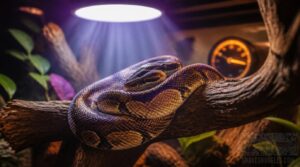
UVB works differently than UVA, and its job matters more than you might think. This wavelength drives real physiological processes inside your snake’s body, not just behavior. Here’s what UVB actually does once it hits your snake’s skin.
Enables Vitamin D3 Production
Vitamin D3 synthesis starts in the skin, not a bottle. UVB rays trigger 7-dehydrocholesterol conversion into previtamin D3, which then undergoes thermal isomerization into usable vitamin D3.
Effective UVB wavelengths fall between 290-310nm. Without proper UV exposure at this range, your snake’s skin barrier blocks the reaction entirely, leaving photoproduct balance processes disrupted and calcium processing stalled before it begins.
Supports Calcium Metabolism
Once vitamin D3 forms, your snake’s liver and kidneys convert it into calcitriol, the active hormone driving calcium homeostasis.
Calcitriol boosts intestinal absorption of dietary calcium and helps renal reabsorption, working alongside parathyroid hormone and bone remodeling to keep serum calcium stable:
- Intestinal calcium uptake
- Kidney reabsorption
- Bone calcium release
Without adequate UVB exposure, this entire cascade stalls.
Helps Bone Health
Once calcium reaches the bloodstream, your snake’s skeleton puts it to work. Osteoblast signaling drives new bone matrix formation, while calcium and phosphate handle mineralization support pathways that harden that matrix.
This creates steady bone remodeling balance between formation and resorption. Without UVB-driven vitamin D synthesis, that balance tips toward weaker, poorly mineralized bone over time.
Prevents Deficiency Risks
Skip UVB, and the whole system unravels quietly. Without it, vitamin D synthesis stalls, calcium absorption drops, and your snake risks metabolic bone disease alongside weaker immune system support.
Skip UVB and the whole system unravels quietly, stalling vitamin D, draining calcium, and weakening bones and immunity alike
Watch for these micronutrient deficiency signs:
- Soft or rubbery jawbone
- Muscle tremors
- Lethargy despite normal feeding
- Poor appetite
- Kinked spine
Dietary variety and proper UVB exposure work together, keeping metabolic pathways healthy long-term.
Do Snakes Need UVA?
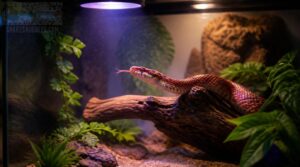
UVA doesn’t carry the same medical urgency as UVB, but that doesn’t mean it’s optional. Your snake’s daily behavior, from basking to hunting, is shaped by cues UVA provides. Here’s what that looks like in practice.
Species Activity Patterns
Snakes don’t share one activity clock.
Ball pythons hunt mostly at night, corn snakes lean crepuscular around dawn and dusk, while garter snakes stay largely diurnal.
Nocturnal feeding cycles and crepuscular hunting spikes shape natural UVA exposure needs, since low-level UVA still filters through twilight hours.
Temperature-driven movement and seasonal activity shifts further influence when your snake naturally seeks light or shade.
Daytime Behavior Cues
Watch your snake closely during daylight, and its body language tells you plenty about UVA’s role.
Open-mouthed gaping under basking light usually signals thermoregulation, not aggression. Slow circling near enclosure walls reflects habitat surveying, while glass-pacing often means your snake wants more space. Frequent tongue-flicking during movement shows active surveillance for prey or threats, and quicker eye movement often accompanies foraging bouts.
Enrichment Benefits
A snake exploring dappled UVA light isn’t just basking, it’s engaging its brain.
Visual exploration sharpens as your snake tracks light shifts across branches and glass, while varied textures invite motor stimulation through climbing and investigating.
Puzzle-style feeding under natural light patterns encourages foraging behavior, and scent trails paired with light gradients add sensory variety that keeps captive life mentally rich, not routine.
Naturalistic Enclosure Lighting
Good enrichment starts with good design. Mimicking canopy light means layering branches and foliage so UVA falls in dappled patches rather than flat, uniform glow.
Creating light gradients lets your snake choose bright basking spots or shaded retreats. Add photoperiod timers for consistent cycles, and simulating dusk transitions with gradual dimming helps signal natural rest periods each evening.
Do Snakes Need UVB?
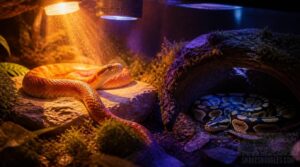
UVB isn’t a one-size-fits-all answer for every snake in your care. Some species evolved basking in open sun, while others spent their lives in burrows or leaf litter, so their UVB needs look pretty different.
Here’s what to keep in mind for a few common pet snakes, plus when it’s worth asking your vet.
Species-specific Needs
No two snakes share the same UVB blueprint. Habitat niche replication matters here: a fossorial burrower and a sun-basking arboreal species process UV radiation differently, tied to their natural exposure levels.
Metabolic rate variation and dietary nutrient requirements also shape calcium needs, which UVB exposure helps. Getting these species-specific needs right means fewer deficiency risks and healthier snakes overall.
Ball Python Considerations
Ball pythons come from grassland and scrub habitats, active mostly at dawn, dusk, and overnight, so natural UVB exposure stays low. Many keepers succeed with minimal or no UVB, relying instead on diet.
Even so, a low-output UVB bulb helps vitamin D3 synthesis and calcium metabolism without overwhelming this shade-adapted species. Individual health needs still guide the final setup.
Corn Snake Considerations
Corn snakes differ from ball pythons in one key way: they’re more diurnal, often basking during the day in the wild. That’s why low-level UVB exposure encourages natural behavior here.
Practical setup tips:
- Use a 2-5% UVB bulb
- Position it away from hides
- Pair it with a 75-90°F gradient
Watch for stress signs like hissing if placement feels off.
Boa Constrictor Considerations
Since boas are largely nocturnal and secretive, their UVB needs stay minimal compared to baskers like corn snakes. A low-output 2-5% bulb still helps natural vitamin D3 synthesis without stressing them.
Given their size, prioritize an 8x4x4 ft enclosure with 60-70% humidity and gentle handling routines. Feed every 1-2 weeks and watch for UV exposure safety guidelines around shaded retreats.
Veterinary Guidance
When in doubt, ask your reptile vet. Species-specific care plans should guide UVB choices, since a vet can assess clinical monitoring indicators, coordinate preventive medicine, and explain UV radiation hazards clearly.
Informed consent protocols mean you’ll understand costs and options upfront. If pain management oversight is ever needed, your vet ensures humane, appropriate care every step of the way.
UVA and UVB Safety
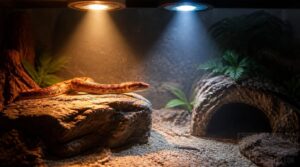
UVA and UVB bring real benefits, but they carry risks too if you’re not careful. Too much exposure, poor lamp placement, or no escape from the light can harm your snake instead of helping it. Here’s what you need to know to keep your setup safe.
Avoid Overexposure
Too much UV, too fast, and a snake’s eyes pay the price.
- Keep basking distance per manufacturer specs
- Monitor UV intensity monthly with a meter
- Watch for corneal irritation signs early
- Reduce glare with proper bulb positioning
- Support cataract prevention through shaded retreats
UV exposure safety guidelines matter for both UVA and UVB fixtures, since unchecked UV radiation hazards build gradually, not all at once.
Protect Snake’s Eyes
A snake’s eyes have no lids, so the spectacle is its only shield against UV radiation.
| Eye Protection Feature | Why It Matters |
|---|---|
| Spectacle | Blocks debris, retains moisture |
| Shedding | Clears old, cloudy layers |
Watch for dull spectacles or shedding complications signaling UV-related eye damage. Keep bulbs within exposure limits to preserve visual clarity and spectacle health long-term.
Provide Shaded Areas
Every enclosure needs an escape hatch from UV, not just a source of it.
Position a hide or dense foliage opposite the bulb to create a real UV gradient, mimicking natural microclimates where your snake retreats when exposed enough. This isn’t optional decor. Shaded zones let your snake self-regulate exposure, staying within safe UV limits and avoiding overexposure while resting comfortably in a cooler thermal refuge.
Monitor Basking Behavior
Your snake’s basking habits tell a story worth reading. Watch how long it stretches under the bulb each morning, then note any drop-off in duration or enthusiasm.
Simple basking duration logs, paired with sensor data near the hotspot, help you catch UV or heat issues before lethargy or shedding problems appear. Consistent tracking builds a clear health baseline.
Follow Lamp Distances
Once basking logs look steady, distance from the bulb deserves equal attention. Adjusting for height keeps UVA and UVB within safe ranges, since even small shifts change UV exposure limits fast.
Check manufacturer charts and measure lux levels near the hotspot. Verifying uniform coverage and managing glare risks protect eyes while meeting UV safety standards for both wavelengths.
Choosing Snake UV Lighting
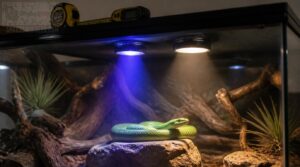
Picking the right UV setup involves more than grabbing any bulb off the shelf. Fixture size, output strength, and placement all shape how much UV your snake actually receives. Here’s what to check before you buy.
Fixture Size Matters
Since enclosures vary widely, your UV fixture needs to match the space, not the other way around. Match fixture length to enclosure width, keep bulb height proportional to basking distance, and check bulb compatibility before buying:
- Small tanks: compact fixtures
- Long enclosures: linear UVB tubes
- Tall vivariums: adjustable-height mounts
Wrong sizing creates weak spots or overexposure zones.
Correct UVB Percentage
Getting the fixture right is only half the job—the bulb’s UVB percentage matters just as much. There’s no single correct number for every snake; it depends on species, basking distance, and enclosure setup.
Most common snakes do well starting around 5-12%. Closer basking spots call for lower percentages, while greater distances can handle 10-12%. A UV meter helps confirm actual dosing at the basking site.
Screen-top Filtering
Screen-top filtering deserves a check once your UVB percentage is dialed in, since mesh lids absorb some output before it ever reaches your snake. Standard aluminum screening can cut UV transmission by 30-50%, so measure with a UV meter at basking level, not just the bulb’s rated dose.
Clean mesh regularly. Dust and mineral buildup reduce transmission further, quietly undermining even correctly chosen bulbs.
Enclosure Height
A few inches can make or break your setup. Vertical space determines whether your UVB lamp mounts at proper basking distance without cooking your snake or scattering weakly.
- Tall enclosures aid thermal airflow and reduce heat pooling
- Extra clearance provides maintenance access for bulb checks
- Height affects equipment clearance around fixtures and mounting hardware
Stability matters too, especially with taller setups needing secure anchoring for installation stability.
Brand and Bulb Quality
Not all UV lamps are created equal, and your snake’s health depends on that difference. Manufacturer reliability and standardized quality control mean consistent UVA and UVB output batch after batch.
Look for safety certification marks like UL or CE, plus documented luminous efficacy ratings. Cheap bulbs often show component wear, flicker, or uneven output—risking under- or over-exposure for your reptile.
Setting a Healthy Light Cycle
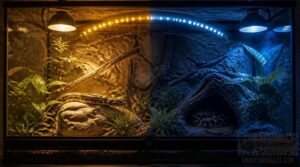
Good UV lighting means nothing without a proper schedule behind it. Your snake’s body relies on consistent light and dark periods to regulate its natural rhythms. Here’s what you need to get that cycle right.
Day-night Schedule
Your snake’s internal clock runs on light, not the calendar on your wall. A healthy day-night schedule mimics dawn, midday sun, and dusk, supporting circadian rhythm support through natural light transitions.
Pairing that steady light cycle with a calm, low-traffic spot makes a real difference—see this guide on choosing the best location for your snake’s enclosure for tips on finding the right room.
- Consistent 12-14 hour light periods
- Automated timer benefits for precision
- Seasonal cycle shifts for realism
- Gradual dawn-dusk simulation
Monitor UV exposure daily, adjusting UVA and UVB timing as seasons change.
Turn Lights Off Nightly
Darkness isn’t just "lights off" — it’s a biological signal. Full nightly darkness boosts melatonin production, reinforcing circadian rhythm cues your snake depends on for rest.
Stray bulb heat also disrupts microclimate stability overnight. Use a timer for consistent dark adaptation benefits and steady nocturnal rest patterns.
Keep monitoring UV exposure and daytime UV radiation levels to avoid UV health risks from imbalanced cycles.
Seasonal Lighting Adjustments
Your snake’s enclosure doesn’t feel spring or fall, so photoperiod transitions are on you to manage.
- Add 1–2 hours in spring, gradually
- Trim 1–2 hours come autumn
- Bump UVB and intensity modulation together
- Log every seasonal lighting change
Pair light with temperature synchrony, watch behavioral cues, and keep UV exposure monitoring steady through each shift.
Timer Use
Would you trust your own memory to flip lights on and off every day at the exact right minute? Neither should you.
A digital timer takes care of scheduling light cycles automatically, managing basking intervals without guesswork. Digital timer reliability beats manual switching every time.
Run multiple timers for UVA and UVB separately—multi-timer tasking keeps UV exposure monitoring accurate. Add visual alert methods like indicator lights for quick checks during daily care routines.
Common UVA and UVB Mistakes
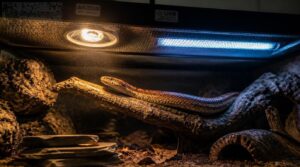
Even experienced keepers slip up about UV lighting. Small oversights can quietly undo months of good husbandry. Here are the mistakes to watch for.
Using Old Bulbs
Because UV lamp lifespan is shorter than most keepers expect, output can crash weeks before a bulb visibly dims. Check wattage compatibility before reusing old fixtures.
- UVB output fades long before the bulb burns out
- Watch for filament failure signs like flickering
- Mismatched wattage causes overheating hazards
- Follow bulb recycling safety guidelines when discarding old UVA/UVB bulbs
LED upgrades improve reliability and reduce incandescent heat hazards.
Wrong Lamp Placement
Old bulbs aren’t the only way to sabotage your setup — where you put a perfectly good lamp matters just as much.
Wrong lamp placement creates uneven exposure zones, with some spots over lit and others left in the dark. Poor angular direction casts basking spot shadows, while lamps mounted too close risk thermal stress and substrate overheating. Position fixtures directly over basking sites, angled correctly, and monitor UV output regularly.
No UV Gradient
Even a well-placed lamp can still fail if UV radiation isn’t spread evenly across the enclosure. Uniform irradiance matters more than raw intensity.
- Confirm basking zone consistency with a UV meter
- Watch for wavelength drift between UVA light and UVB light
- Recheck irradiance measurement monthly
- Make sure spectral stability across the whole habitat
- Practice regular UV monitoring for safety
Confusing Heat and UV
Confusing warmth with UV radiation safety trips up many keepers. A basking bulb feels hot, so it’s easy to assume UVA light and UVB light are present too — they aren’t linked. Temperature vs irradiance are separate metrics entirely.
| Metric | Measures |
|---|---|
| Thermometer | Heat only |
| UV Index | UV radiation |
| Heat lamp | Infrared |
| UVB bulb | Ultraviolet |
| UV meter | True UVB output |
Skipping Replacement Schedules
Because UVB output degrades long before a bulb goes dark, skipping replacement leaves you guessing at real UV dose. Most bulbs need swapping every 6-12 months regardless of appearance.
Tracking your replacement schedule alongside a proper snake heat lamp daily duration guide ensures your setup delivers consistent, reliable UVB without the guesswork.
Treat this like any maintenance calendar item, not a "wait and see" task. A UV sensor or UV monitoring device confirms actual output. Skipping schedules raises failure risk and undermines UV radiation safety your snake depends on daily.
Frequently Asked Questions (FAQs)
Do regular light bulbs give off UVB?
No — most household bulbs emit negligible UVB. Incandescent glass and fluorescent phosphor coatings absorb it, LEDs produce none unless specialized, so your snake won’t get real UVB rays from a bedroom lamp.
Is UVA light the same as UVB?
No, they’re distinct spectral bands. UVA (315–400nm) carries lower photon energy and penetrates deeper into tissue, while UVB (280–315nm) is more energetic, surface-absorbed, and drives vitamin D3 synthesis in your snake’s skin.
Do I turn off my UVB light at night?
Yes — turn UVB off at night to prevent circadian rhythm disruption and support natural reptile sleep patterns.
Use UVB timer settings for naturalistic photoperiods, and rely on separate nighttime heat management, since UVB rays aren’t needed for warmth once basking hours end.
Do UVB lamps give you vitamin D?
Funny enough, that same glow keeping your snake’s bones strong also fuels cholesterol conversion into vitamin D in your own skin—wavelength efficiency near 295-300nm matters most, while UVB-only tanning beds skip the thermal isomerization step your body actually needs.
What’s better, UVA or UVB?
Neither wins alone. Synergistic lighting benefits matter most: UVB drives vitamin D3 and calcium metabolism, while UVA aids natural behavior and nutrient absorption partnership. Match species-specific requirements and balance intensity for genuine snake health.
What is the difference between UVA and UVB lighting?
UVA (315–400nm) carries lower photon energy and penetrates deep into tissue, while UVB (280–315nm) carries higher energy, absorbing mainly in outer skin layers. UVB drives vitamin D3 synthesis; UVA helps activity cues and visual perception in reptiles.
How to tell if it’s UVA or UVB?
Your eyes can’t detect the very light that could save your snake’s health. Trust bulb labeling and spectral output data instead: check packaging for wavelength specs, or use a UV meter for accurate intensity measurement.
Can UVA or UVB lighting treat human diseases?
Yes — under controlled medical dosing, clinical phototherapy treats psoriasis, eczema, and fibrosing skin disorders.
This differs entirely from reptile UV husbandry, though; UV medical therapy targets specific skin diseases through measured UV radiation health effects, not general illness.
How do UVA and UVB affect aquatic animals?
In water, UVA rays penetrate far deeper than UVB, while UVB causes skin lesions, immune suppression, and larval mortality.
Fish combat oxidative stress with antioxidants and avoid bright zones behaviorally, reducing cumulative UV radiation health effects on growth and survival.
Do indoor plants need UVA or UVB light?
Sun’s out, leaves out: your greenery thrives on both UVA rays and UVB rays. UVA drives stomatal opening and signaling cues; UVB boosts flavonoid pigment production and secondary metabolites, though species specific tolerance means dosing carefully matters.
Conclusion
UVA guides behavior. UVB builds bones. Together, they define the difference between UVB and UVA lighting that keeps your snake thriving instead of merely surviving.
A 5.0 or 10.0 UVB bulb, replaced on schedule and paired with proper gradients, does more for skeletal health than any supplement alone. Your snake can’t tell you its bones ache. Get the wavelengths right, and you’ll never have to wonder.