This site is supported by our readers. We may earn a commission, at no cost to you, if you purchase through links.
Your snake already knows your terrarium is fake. It tests every seam, tastes every surface, and reads temperature the way you read a clock. A glass box with a heat rock and paper towels keeps a snake alive, but it won’t make your snake behave like itself.
A natural snake terrarium starts with function: a thermal gradient from 90°F to 60°F, a substrate deep enough to burrow, and hides at both ends. Then comes the look. Plants, cork bark, and sturdy branches follow the same rules as the heat.
Build it in the right order, and your snake will do the rest.
Table Of Contents
- Key Takeaways
- Plan a Natural Snake Terrarium Around Your Species’ Needs
- Build Species-Appropriate Substrate Layers
- Add Snake-Safe Plants, Secure Hides, and Stable Climbing Branches
- Set Up Species-Specific Heat, Lighting, and Humidity
- Maintain Your Natural Snake Terrarium Without Disrupting Security
- Frequently Asked Questions (FAQs)
- Can you make a snake enclosure bioactive?
- How often should I feed my terrarium snake?
- Can snakes recognize their owners over time?
- What signs indicate my snake is about to shed?
- How do I introduce a second snake safely?
- When should I take my snake to a vet?
- How do I make a terrarium background look natural?
- Can I use rocks and driftwood from outside?
- How should I introduce a new snake to its terrarium?
- What natural decorations are unsafe for snakes?
- Conclusion
Key Takeaways
- Build your terrarium around your snake’s species first, sizing it to at least your adult snake’s length and giving it a secure, escape-proof enclosure with hides at both ends.
- Create a real temperature and humidity gradient, with a thermostat on every heat source, and match depth and moisture of your substrate to your species’ burrowing and humidity needs.
- Stick to snake-safe plants, cork bark hides, and sturdy mounted branches, and quarantine or sterilize anything natural, including plants, wood, and rocks, before it goes in.
- Keep maintenance light by spot cleaning and leaving the layout and familiar scents alone, because a snake that feels secure behaves naturally and doesn’t test the seams.
Plan a Natural Snake Terrarium Around Your Species’ Needs
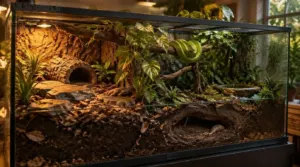
A natural terrarium starts with your snake, not your shopping list. Before you buy a single branch or bag of soil, you need to know how your species lives, moves, and hides.
Once you know whether your snake is a ground-dweller or a climber, this buyer’s guide to terrariums for snakes makes it easier to compare sizes, materials, and prices.
Below, you’ll find two planning points that shape every build decision: enclosure size, security, and ventilation, followed by terrestrial, arboreal, and burrowing layouts.
Enclosure Size, Security, and Ventilation
Length decides everything. Your enclosure size must at least match your adult snake’s length, with width at half that and height at half for terrestrial species. A 5-foot snake needs 5 by 2.5 by 2.5 feet.
Choose a secure enclosure with front-opening doors and locking mechanisms. Snakes test every seam, so escape prevention starts there. Add mesh panels for enclosure ventilation, keeping airflow off the basking spot.
Put the warm and cool ends at opposite sides of the long axis with a tight-fitting hide at each end, so your snake can choose a usable thermal gradient without giving up security.
Terrestrial, Arboreal, and Burrowing Layouts
Now match the layout to how your snake actually moves.
If you’re unsure how much room your snake needs to stretch and turn, this guide to appropriate snake habitat size breaks down enclosure dimensions by species and body length.
- Terrestrial: make the most of floor space, add low climbing branches.
- Arboreal: build height, with perches at multiple levels.
- Burrowing: deepen the substrate choice until your snake vanishes.
- Every type: place hiding spots at both ends.
Watch your snake for a full week. Behavioral observation guides your habitat mimicry better than any guess.
Build Species-Appropriate Substrate Layers
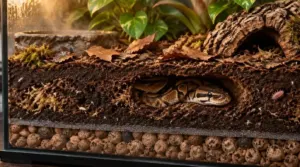
Your substrate is the foundation of everything else in the terrarium. Get it right, and your snake can burrow, hydrate, and shed the way it would in the wild. Here’s what to decide, in order: substrate choice and burrowing depth, when drainage layers are needed, and whether a bioactive setup suits you.
Substrate Choice and Burrowing Depth
Picture a Kenyan sand boa sliding into aspen shavings until only its eyes and nostrils show. That’s the goal. Your substrate choice decides whether it happens.
Because they stay calm and rarely bite, sand boas are a favorite for first-time owners, and this guide to snakes that handle well shows how they compare.
Match burrowing depth to your snake: 4-5 inches for sand boas, 3-4 for corn snakes. Pick substrate types by climate. Aspen suits dry species. Coconut fiber or cypress mulch holds moisture for tropical ones. Skip cedar, pine, and sand.
When Drainage Layers Are Needed
Once you’ve picked your substrate, ask whether it’ll stay wet. Your species’ humidity needs decide that.
Tropical snakes like ball pythons need a 2-3 inch drainage layer beneath the substrate. Daily misting otherwise waterlogs the root zone. Corn snakes need only 1-2 inches. Desert species skip it entirely, since dry substrate depth drains fast on its own.
Optional Bioactive Setup and Cleanup Crew
A bioactive cleanup crew turns waste into soil. Isopods and springtails drive the waste decomposition cycle, so your enclosure stays odor-free. Set it up right:
- Layer leaf litter and hardwood fragments.
- Keep a moisture gradient across the substrate.
- Add the crew a month before your snake.
Microfauna waste processing needs little oversight, but bioactive substrate maintenance still matters. Check weekly.
Add Snake-Safe Plants, Secure Hides, and Stable Climbing Branches
Choose non-toxic plants first. Boston fern, snake plant, and rattlesnake plant all tolerate humidity and give your naturalistic terrarium real visual cover. Skip pine, cedar, and eucalyptus. Their volatile oils irritate a snake’s airways.
Run a plantsafe plant quarantine before anything goes in. Rinse the roots, repot in pesticide-free mix, and hold each plant apart for 4-6 weeks.
Place cork bark hides on both the warm and cool ends, plus one humid hide packed with moist sphagnum. Bake natural pieces at 250°F for 2-3 hours. Keep openings snug.
Mount hardwood branches, 2-4 inches thick, with stainless screws. Layer these climbing structures at varied heights. Then check secure vivarium latches, because climbers test every gap. Inspect all decor monthly for loosening.
Set Up Species-Specific Heat, Lighting, and Humidity
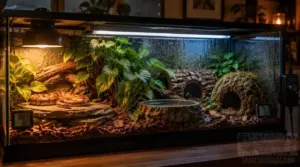
Isn’t a heat lamp and a water bowl enough?" Not if you want a snake that thrives. Natural behavior depends on choices your snake can make, and that starts with setup.
Build a temperature gradient with a warm side, a cool side, and a hide in each. A corn snake needs a 90°F basking surface and nights no colder than 60°F. Wire every heat source to a thermostat. Skip heat rocks entirely.
Match humidity levels to your species. Western hognose do well at 30-50%, corn snakes at 60-75%. Track both with a digital thermostat and hygrometer probe, one on each side. Add a moist sphagnum hide for shedding.
Provide UVB lighting too. Cover half to two-thirds of the enclosure, and replace the bulb every 6-12 months.
Maintain Your Natural Snake Terrarium Without Disrupting Security
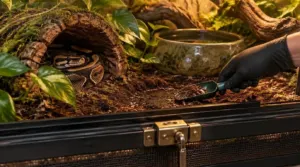
Think of your terrarium as a quiet house your snake has memorized. Every cleaning visit rearranges the furniture, so keep it light. Spot clean waste right away with a scoop, removing only soiled substrate within an 8-10 inch radius.
Treat your snake’s terrarium like a quiet home it has memorized, and keep every cleaning visit light so nothing feels rearranged
- Check daily for waste, uneaten food, and shed skin.
- Leave hides partly unwashed to keep familiar scents.
- Test lid latch reliability every time you close up.
- Confirm wire locks and doubledoor locking mechanisms hold firm.
- Keep water bowl and decor exactly where they were.
Cleaning is when escapes happen, so treat enclosure escape prevention as part of the job. A snake that feels secure won’t test the seams, and escapeproof security keeps it that way. Do deep cleans only when needed.
Frequently Asked Questions (FAQs)
Can you make a snake enclosure bioactive?
Yes, you can. A bioactive setup pairs live plants with isopods and springtails that break down waste and mold. Use a moisture-appropriate substrate depth, but keep spot-cleaning, because your cleanup crew won’t remove everything.
How often should I feed my terrarium snake?
Think of feeding as a clock that slows with age. Hatchlings eat every 5–7 days, juveniles stretch wider, and most adults settle into 7–14 days. Big boas and pythons can wait 3 weeks.
Since prey size should match your snake’s body width rather than its age alone, this baby ball python feeding schedule guide helps you adjust each meal as your hatchling grows.
Can snakes recognize their owners over time?
Your snake won’t recognize your face, but it learns your scent. Steady feeding and gentle handling teach it that you mean safety. Through behavioral observation, you’ll notice calmer posture and relaxed tongue flicking. That’s conditioning, not affection.
What signs indicate my snake is about to shed?
Watch your snake’s eyes first. Cloudy, bluish eyes mean the shedding cycle has started. Skin dulls, appetite drops, and hiding increases sharply. Keep humidity levels steady in your naturalistic terrarium, and rely on behavioral observation.
How do I introduce a second snake safely?
Two snakes need company, right?" Not really. Most species do best alone, so check species compatibility first. Quarantine the newcomer 90 days in a separate room, then confirm health with two fecal screenings before moving it.
When should I take my snake to a vet?
Snakes hide illness brilliantly, so don’t wait for a dramatic collapse. Watch for snake health signs: open-mouth breathing, limpness, mouth swelling, incomplete sheds, or months without eating. Call a reptile-savvy vet promptly if any appear.
How do I make a terrarium background look natural?
Picture a cliff face cut into your enclosure’s back wall. Layer cork bark or textured stone over the background, vary the depth, and let ledges break the line. Seal any foam so it’s inert.
Can I use rocks and driftwood from outside?
Picture a ball python owner hauling home a creek stone with a jagged edge. Two weeks later, her snake has a scraped belly. Yes, you can use outdoor rocks and driftwood, but only after you boil, bake, and inspect them.
How should I introduce a new snake to its terrarium?
Think of the first hour as a handshake, not a hug. Set the transport container inside your finished, secure enclosure and open it. Dim the lights. Let your snake explore its hiding spots and naturalistic interior unhurried. Wait a week before feeding.
What natural decorations are unsafe for snakes?
Nature, the original designer, makes a terrible decorator for a safe enclosure.
Skip pine, cedar, cones. Wild plants need reptile safe plant quarantine. Reptile habitat safety and reptile substrate safety shape habitat complexity for snakes.
Conclusion
Picture a corn snake at dusk, sliding from a warm slab of cork into cool, loose soil, tongue flicking, body finally unhurried. That’s the payoff. Learning how to make a snake terrarium feel natural comes down to a few honest choices: a real gradient, deep substrate, secure hides, and branches that hold.
Get those right, and plants and bark are finishing touches. Keep maintenance quiet. Your snake will confirm it by acting like a snake.