This site is supported by our readers. We may earn a commission, at no cost to you, if you purchase through links.

Most keepers obsess over substrate depth and drainage layers, then drop in whatever ceramic dish came with the tank. That bowl becomes the weak link—a bacterial reservoir that kills cleanup crews, destabilizes humidity, and stresses the snake it’s supposed to hydrate.
Bioactive setups run on microbial balance. A porous, ill-sized, or poorly placed water dish disrupts that balance faster than almost any other husbandry mistake. The wrong material leaches into the substrate. The wrong size puts a juvenile at drowning risk. The wrong placement turns your carefully cultivated bioactive soil into a swamp.
Getting reptile water dishes for bioactive terrariums right means understanding sizing by species, materials that won’t kill isopods, and placement that works with your enclosure’s humidity—not against it.
Table Of Contents
Key Takeaways
- Bowl size, material, and placement aren’t minor details — get any one wrong and you’re actively working against bioactive setup’s microbial balance.
- Match dish diameter to your snake’s body width with at least 3 inches of clearance, and keep water depth below chest height to eliminate drowning risk.
- Non-porous materials like sealed resin or glazed ceramic are the only safe choices in a bioactive enclosure — porous surfaces harbor bacteria that kill isopods and destabilize water quality fast.
- Daily water changes with a conditioner like ReptiSafe, combined with weekly scrubbing and elevated dish placement, are what actually keep your cleanup crew alive and your ecosystem intact.
Choose Species-Safe Bowl Size
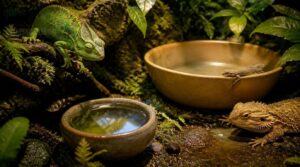
Bowl size isn’t one-size-fits-all — get it wrong and you’re either drowning your animal or leaving it with a puddle it can barely drink from. A few key measurements will tell you exactly what your species needs before you buy anything. Here’s what to look at first.
Material matters just as much as size — the wrong choice can leach chemicals or harbor bacteria, so reviewing safe water bowl materials for desert reptiles before buying can save you a costly mistake.
Snake Length Bowl Sizing
Dish diameter matters more than most snake keepers realize. For juveniles 12–18 inches long, aim for a 6–8 inch bowl. Snakes reaching 2–4 feet need 8–10 inches. Large constrictors like boas? Go 12–16 inches minimum.
- Juveniles outgrow bowls fast — size up every few months
- A cramped bowl stresses snakes during soaking
- Boas need room to coil partially underwater
- Correct diameter promotes natural hydration behavior
- Dish size scales directly with snake length
Body-width Clearance Rule
Length matters, but width seals the deal. Measure your snake at its thickest point, then scale bowl diameter so it clears that width by at least 3 inches. This clearance rule prevents enclosure entrapment and keeps entry comfortable for any small lizard sharing the setup too.
Tight margins kill water bowl stability and block easy climbout design — wide margins prevent drowning altogether.
Drinking Versus Soaking Depth
Diameter governs entry. Depth governs purpose, and those are two different jobs.
For sipping safety, keep drinking edges at 1–2 inches — deep enough for a sip, shallow enough to dodge snout immersion and substrate contamination.
Soaking is another animal entirely. Reptile water bowls built for immersion benefits run 3–5 inches, supporting thermal regulation and shed cycles in any bioactive terrarium without drowning risk.
Juvenile and Adult Needs
Growth stage sizing matters as much as depth. Juveniles outgrow dishes fast, so plan for life stage transitions every few months rather than waiting for a tight squeeze.
Maturity level adjustments favor adults needing stable, wider reptile water bowls sized to body length.
Track developmental water requirements closely — juvenile reptile safety and steady reptile hydration depend on it in any bioactive terrarium, alongside consistent water quality.
Chest-height Safety Limit
Once water rises above your snake’s chest, drowning risk climbs fast — that’s the line you can’t cross. Keep water at half body height, never higher.
For hatchlings, a shallow water bowl with low-profile sides keeps things safe and prevents tipping. This promotes juvenile reptile safety, easier ergonomic care access, balanced humidity distribution, and fewer injury prevention audits down the road.
Pick Bioactive-Safe Materials
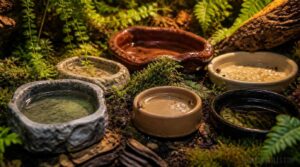
Bowl size matters, but material matters just as much. Bioactive setups bring moisture, bacteria, and curious digging critters into the mix, so your dish needs to hold up. Here’s what actually works.
Sealed Resin Bowls
Sealed resin bowls are a smart pick for bioactive setups. A resin-printed bowl like the Bio Dude Rock Water Bowl mimics natural décor while staying non-porous — meaning algae can’t grip the surface. Once fully cured, food-grade resin won’t off-gas near your animals. UV-stabilized formulas resist fading under enclosure lighting.
Key qualities to look for:
- Sealant integrity — inspect regularly for crazing or microcracks
- Smooth lip edges to prevent reptile injuries
- Anti-slip base for stability on bioactive soil
- High-gloss or satin aesthetic finish options for naturalistic blending
Glazed Ceramic Dishes
Ceramic dishes earn their place in bioactive setups through sheer practicality. Glazed, non-porous surfaces resist bacterial biofilm — a genuine concern when cleanup crews are active below. The glaze seals the ceramic body completely, keeping water quality stable.
The initial bisque firing creates porosity ensures the glaze adheres uniformly.
Inspect regularly for crazing or chips; damaged glaze harbors bacteria fast. Stick to certified non-toxic glaze formulations only.
Stainless Steel Inserts
Stainless steel isn’t common in water dish builds — but as a mounting or structural insert, it earns its place. Grade 304 or 316 alloys resist corrosion even in high-humidity bioactive setups.
Heat set installation locks inserts flush into plastic housings without loosening over time. Passivation treatment adds another barrier against rust, keeping water quality clean near any fastened components.
Naturalistic Rock Finishes
Rock-finish dishes pull double duty: they look like habitat, and they’re actually functional. Mineral veins and weathered edges give a natural rock bowl appearance that blends seamlessly into bioactive terrarium equipment.
Subtle texture grip keeps the rockstyle water dish stable on shifting substrate. UV-colorfast formulations resist fading under enclosure lighting.
Sealant wears over time — inspect periodically and refresh as needed.
Crack and Chip Checks
Every dish eventually shows its age. Run your finger along the rim — any sharpness or roughness means a chip has compromised the edge.
Use a bright light at an oblique angle to catch hairline cracks or crazing before they spread. A crack wider than 2 mm, or a chip over 5 mm, is a replacement trigger.
Nonporous, intact surfaces are the only reliable barrier against biofilm.
Place Dishes for Healthy Humidity
Where you place a water dish matters more than most keepers expect. The right position controls evaporation, protects your substrate, and keeps humidity steady without you constantly misting. Here’s what to know before setting your dish down.
Distance From Heat Lamps
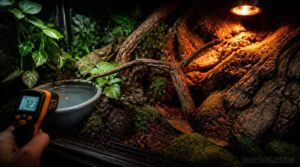
Keep the water dish at least 12–18 inches from your heat lamp. Infrared heat drops sharply with distance — a few extra inches make a real difference in bowl temperature.
Aim to land the dish at the edge of the thermal gradient, not inside it. Verify surface temps with an infrared thermometer; water above 30–32°C is too warm.
Raised Bowls Above Substrate
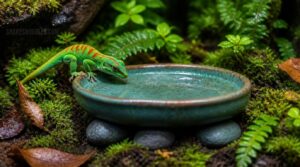
Elevation is a simple fix with real payoff.
Raising your bowl 1.5–3.5 cm above the substrate limits direct contact between water and bioactive soil — cutting down on substrate contamination and reducing biofilm buildup underneath the dish. It also keeps beneficial microfauna from washing out each time your animal enters the bowl.
Evaporation Without Saturation

A shallow bowl near — but not directly under — a heat source does more than hold water. It creates evaporation-driven humidity through a process called vapor pressure deficit: warm air above the surface pulls moisture upward continuously, without saturating the enclosure. Wide, low-profile dishes increase surface area ratios, releasing vapor steadily rather than in one wet burst.
A shallow dish near warmth doesn’t just hold water — it steadily breathes humidity into your enclosure
- Place the bowl 25–30 cm from your heat lamp — close enough for gentle surface warming, far enough to prevent overheating.
- Choose wide, shallow dishes to increase the evaporation surface without adding excessive water volume.
- Use a low-profile bowl to keep microclimate humidity gradients consistent across the enclosure floor.
- Avoid sealed corners — airflow evaporation dynamics require some circulation around the dish to remove vapor and sustain steady moisture release.
- Photonic evaporation drivers — your lighting itself — contribute to surface water loss, so factor lamp placement into your humidity calculations.
Good water retention in terrariums isn’t about pouring more in. It’s about releasing moisture at a pace your setup can absorb.
Stable Low-traffic Placement
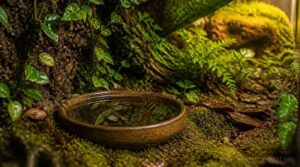
Where you set the bowl matters as much as what’s in it.
Positioning it near one side of the enclosure creates the moisture gradient your snake needs — a technique covered in detail in this guide to terrarium water bowl placement for humidity control.
A little planning goes a long way — this guide to choosing the right water bowl for your snake walks through stability, material, and placement so you can get it right from the start.
A well-placed water bowl can also double as a humidity booster, and this guide to reptile water bowls for humidity control breaks down which shapes and placements work best.
Avoid heavy-digging zones — active substrate areas tip dishes fast. Anchor your bowl in a low-traffic corner, away from basking paths.
Wide bases and low-profile geometry resist nudges on soft bioactive soil. Corner-fitted bowls waste minimal floor space and stay put through the most restless soaking sessions.
Tropical Humidity Support
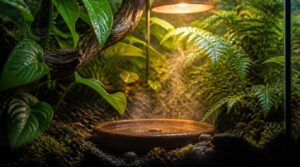
Tropical setups demand more than a bowl — they demand water surface area. A wider dish releases more ambient moisture, helping your bioactive habitat hold humidity between misting cycles.
- Larger dishes reduce misting frequency
- Surface area evaporation stabilizes microclimate moisture levels
- Water near a heat source creates localized humidity zones
- Deeper water retains warmth, boosting overnight humidity
Top 8 Bioactive Water Accessories
Not every water dish earns a spot in a bioactive setup — most don’t hold up to cleanup crews, moisture, or a determined boid. These eight options cover the full range, from corner-fitted climbing bowls to arboreal magnetic ledges. Here’s what made the cut.
1. Exo Terra Large Water Dish
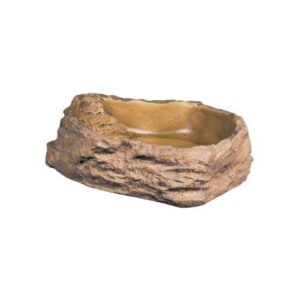
The Exo Terra Large Water Dish is one of the most reliable picks for mid-to-large reptiles. It measures 8.7 × 6.7 × 2 in and weighs 2.2 lb — heavy enough to stay put when a ball python decides to bulldoze through the enclosure.
The food-grade resin interior resists bacterial buildup and cleans fast. Built-in exit steps prevent small animals from drowning.
One trade‑off: prolonged UV exposure can yellow the plastic over time.
| Best For | Mid-to-large reptiles like ball pythons and bearded dragons that need a stable, easy-to-clean water dish that blends naturally into their enclosure. |
|---|---|
| Material | Food-grade plastic resin |
| Dimensions | 8.7 × 6.7 × 2 in |
| Weight | 2.2 lb |
| Primary Use | Reptile water and soaking dish |
| Color / Finish | Natural rock grey |
| Maintenance | Hand wash, smooth interior |
| Additional Features |
|
- Food-grade, non-porous resin interior resists bacteria and wipes clean quickly
- Heavy, low-profile design stays put even in active enclosures
- Built-in exit ramp keeps small reptiles, amphibians, and insects from drowning
- Shallow depth may not suit larger species that need deeper water
- Prolonged UV exposure can yellow or scratch the plastic over time
- Heavy weight makes repositioning tricky once it’s placed in the enclosure
2. Zilla Natural Rock Lair
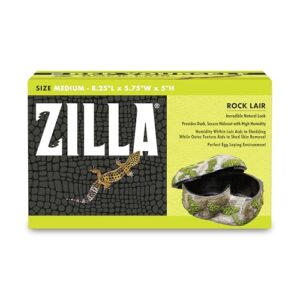
Unlike a standard water bowl, the Zilla Natural Rock Lair does double duty — it’s a humid hide and humidity tool in one. The moss-textured exterior and dark interior keep shedding snakes calm and comfortable. At 11 × 8 × 6 in, it fits most 20-gallon-and-up setups without crowding the floor.
One heads-up: wash it before use. Several owners report a noticeable plastic smell straight out of the box.
| Best For | Reptile owners keeping snakes or geckos who want a hide that doubles as a humidity and shedding chamber. |
|---|---|
| Material | Rigid plastic |
| Dimensions | 7.28 × 10.63 × 6.89 in |
| Weight | Not specified |
| Primary Use | Humid hide and egg-laying chamber |
| Color / Finish | Grey textured moss |
| Maintenance | Hand wash before first use |
| Additional Features |
|
- Retains moisture well, making it ideal for shedding support and egg-laying
- Heavy, stable base means climbing reptiles won’t tip it over
- Naturalistic rock texture blends into the terrarium and helps reduce animal stress
- Pricier than basic plastic hides on the market
- Takes up a good chunk of terrarium floor space at medium size
- Can arrive with a strong plastic smell and may be vulnerable to chipping during shipping
3. Fluker Corner Rock Bowl
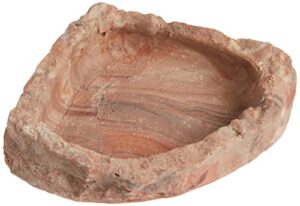
Space is always at a premium in a bioactive build. The Fluker Corner Rock Bowl solves that with a squared back edge that sits flush in any terrarium corner, keeping the center floor open for movement.
At 5.4 × 6 in with a weighted base, it resists tipping even when a curious reptile climbs the rim. The resin surface cleans easily — though rinse it thoroughly before first use, as some report a residual odor straight out of the box.
| Best For | Hermit crab and small reptile owners who want a space-efficient feeding and watering station that fits neatly into a terrarium corner. |
|---|---|
| Material | Resin |
| Dimensions | 5.4 × 1.5 × 6 in |
| Weight | 1.05 lb |
| Primary Use | Food and water bowl |
| Color / Finish | Natural rock appearance |
| Maintenance | Hand wash, smooth resin |
| Additional Features |
|
- Corner-fit design keeps the tank floor open and maximizes usable space
- Weighted base prevents tipping, even with active or curious reptiles
- Easy to clean thanks to the smooth resin surface
- Some users report a sticky residue that requires several washes before the bowl is ready to use
- Porous texture can trap moisture and encourage mold if not dried thoroughly
- May emit a noticeable odor when used as a water dish, which can be unpleasant in enclosed tanks
4. Zoo Med Reptile Food Dish
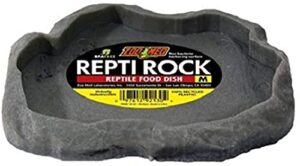
Zoo Med’s Reptile Food Dish does one thing well: it stays clean. The non-porous plastic surface resists bacterial buildup and withstands a quick scrub without degrading. At roughly 7.5 × 6 in, it fits mid-size setups for bearded dragons, leopard geckos, and tortoises without crowding the floor.
One honest caveat — it’s not built to hold water. The shallow 1-inch profile and rubber base make it a solid feeding platform, not a soaking dish. Use it for food; source your water bowl elsewhere.
| Best For | Reptile owners with bearded dragons, leopard geckos, or tortoises who want a low-maintenance feeding dish that’s quick to clean and fits neatly in mid-size terrariums. |
|---|---|
| Material | Rubber |
| Dimensions | 7.5 × 6 × 1 in |
| Weight | 9.6 oz each |
| Primary Use | Feeding and basking platform |
| Color / Finish | Natural rock appearance |
| Maintenance | Scrubbable, non-porous surface |
| Additional Features |
|
- Non-porous rubber surface resists bacteria and cleans up fast with minimal effort
- Realistic rock look blends naturally into terrarium setups
- Comes as a two-pack, so you always have a spare on hand
- Too shallow to hold water reliably — strictly a food dish
- Thin profile can tip over if heavier prey or large food items are placed on it
- The 1-inch depth may not work well for foods that need more volume
5. Zoo Med Reptile Corner Water Dish
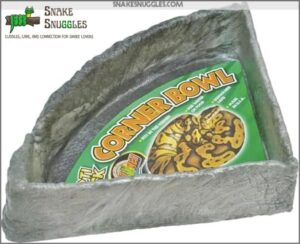
Corner space is prime real estate in a terrarium — and this dish claims it smartly. The triangular corner footprint fits flush against two walls, freeing up your enclosure’s center for hides, climbing structures, or enrichment items.
At 13.8 × 13.2 × 3.2 in with roughly a gallon of capacity, it accommodates soaking for snakes, bearded dragons, and turtles without dominating the layout. The smooth recycled plastic resists staining and cleans up fast — top-rack dishwasher safe. Smaller species may struggle with the high sides, though.
| Best For | Reptile owners with medium to large enclosures who keep snakes, bearded dragons, turtles, or chameleons and want a spacious soaking dish that doesn’t eat up valuable floor space. |
|---|---|
| Material | Durable plastic |
| Dimensions | 13.8 × 13.2 × 3.2 in |
| Weight | 3.8 lb |
| Primary Use | Large soaking and dig box |
| Color / Finish | Assorted colors |
| Maintenance | Dishwasher safe |
| Additional Features |
|
- Corner-fit design keeps the center of your enclosure open for hides, decor, and enrichment
- Generous ~1-gallon capacity is great for soaking larger reptiles comfortably
- Smooth plastic surface resists staining and is dishwasher safe for easy cleanup
- High sides can make it tough for smaller or less mobile reptiles to climb in and out
- The large footprint may overpower smaller tanks or feel visually overwhelming for shy species
- Colors can look different in person than in product photos, so check before buying
6. Pangea Silicone Magnetic Feeding Ledge

Arboreal species need a different solution entirely. The Pangea Silicone Magnetic Feeding Ledge mounts directly to glass using two silicone-encased magnets — no suction cups, no floor space sacrificed. It holds standard 0.5–1.5 oz cups snugly, handling food or water for crested geckos, day geckos, and tree frogs with ease.
Cleanup is straightforward: detach, rinse, or run it through the dishwasher. The 50 g load capacity keeps it practical for small portions. Just handle those magnets carefully near glass.
| Best For | Owners of arboreal reptiles like crested geckos, day geckos, and tree frogs who want a reliable, easy-to-clean feeding solution that mounts to glass without suction cups. |
|---|---|
| Material | Food-grade silicone |
| Dimensions | 4.12 × 2.62 × 1.18 in |
| Weight | 5.44 oz |
| Primary Use | Magnetic arboreal feeding cup |
| Color / Finish | Translucent silicone |
| Maintenance | Dishwasher safe |
| Additional Features |
|
- Two silicone-encased magnets create a secure hold on glass — no suction cup failures or dishes dropping overnight.
- Fully dishwasher safe and easy to detach, making cleaning quick and hassle-free.
- Silicone construction is waterproof, heat-resistant, and won’t scratch or rust your enclosure glass.
- Costs more upfront than basic suction-cup feeding dishes.
- The silicone grip can make it tricky to pop out small plastic or paper cups cleanly.
- Strong magnets need careful handling — accidental contact with the glass can cause chips or cracks.
7. Tree Collectors Arboreal Obsession

Not everything in a top-8 list fits the same mold. The Tree Collectors by Amy Stewart isn’t a water dish — it’s a 336-page illustrated book profiling fifty tree enthusiasts, complete with watercolor portraits and arboreal glossaries.
At $19.27, it’s a thoughtful gift for the keeper who sees their bioactive setup as a living collection, not just a habitat. It won’t condition water, but it might quietly reshape how you think about the living world inside your terrarium.
| Best For | Nature lovers, horticulture enthusiasts, and gift-givers looking for something meaningful and beautifully illustrated for the tree-obsessed person in their life. |
|---|---|
| Material | Paper and ink |
| Dimensions | 6.62 × 1.3 × 8.58 in |
| Weight | 2.31 lb |
| Primary Use | Tree-enthusiast illustrated book |
| Color / Finish | Full-color watercolor illustrations |
| Maintenance | No cleaning required |
| Additional Features |
|
- Fifty hand-drawn watercolor portraits make it a visually stunning read, not just informative
- Covers cultural and historical tree-collecting traditions, giving readers rich context beyond just the plants themselves
- At $19.27, it’s an affordable and thoughtful gift for educators, nature clubs, or anyone passionate about the living world
- Not a practical guide — readers hoping for planting tips or tree care instructions will come away empty-handed
- The anecdotal storytelling style won’t satisfy anyone looking for technical horticultural depth
- Return shipping costs (~$6.99 reported) could sting if the book turns out to be a mismatch for the recipient
8. Natural Slate Reptile Basking Platform
From a curio book to cold stone — that’s the range of a genuinely useful list.
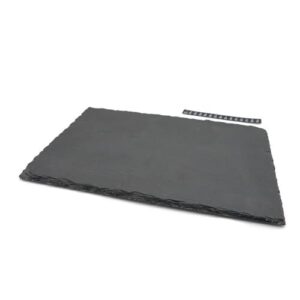
The Natural Slate Basking Platform (40 cm × 25 cm) earns its spot here not as a water dish, but as the surface that keeps your setup honest. Slate heats fast, retains warmth after the lamp cuts out, and passively wicks moisture from nearby dishes to stabilize humidity. Four EVA pads prevent shifting. Hand-polished edges protect claws. Clean it with a damp cloth. Done.
| Best For | Turtle, tortoise, and bearded dragon owners looking for a low-maintenance basking surface that naturally supports nail wear, heat retention, and humidity balance. |
|---|---|
| Material | Natural slate stone |
| Dimensions | 15.7 × 9.8 in |
| Weight | 3.39 lb |
| Primary Use | Basking and nail-wear platform |
| Color / Finish | Natural grey slate |
| Maintenance | Rinse and wipe clean |
| Additional Features |
|
- Retains heat well after the lamp turns off, giving reptiles a warm spot to linger
- Passively wicks moisture to help stabilize enclosure humidity for healthy shedding
- Hand-polished edges and slip-resistant EVA pads make it safe and stable right out of the box
- At 40 × 25 cm, it may be too small for larger or adult reptiles
- Can arrive with minor chips or edge damage from shipping
- The included temperature strip adhesive sometimes leaves tape residue on the stone
Keep Water Clean Daily
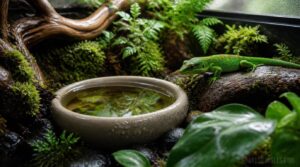
Clean water isn’t optional — it’s the foundation of a healthy bioactive setup. A few consistent habits keep your dish from becoming a bacterial breeding ground between deep cleans. Here’s what your daily routine should cover.
Daily Lukewarm Water Changes
Daily water changes aren’t optional — they’re the baseline. Change water once a day, ideally at the same time, to keep parameters stable and humidity consistent.
Aim for lukewarm water between 28–32°C — close enough to tank temperature that your reptile won’t register the difference. A quick thermometer check keeps thermal shock off the table entirely.
Tap Water Conditioning
Tap water isn’t automatically safe. Chlorine, chloramines, and ammonia all survive the journey from treatment plant to tap — and none of them belong in your reptile’s bowl.
ReptiSafe Water Conditioner addresses all four threats at once:
- Neutralizes chlorine and chloramines instantly
- Detoxifies ammonia and nitrites on contact
- Adds electrolytes and essential ions for hydration support
- Stabilizes pH to reduce tissue irritation
Carbon filters help too, but require regular cartridge replacement to stay effective.
Reptile-safe Disinfecting Methods
Clean the bowl before you disinfect it. Organic debris — feces, shed skin, feeder remains — blocks disinfectants from reaching the surface. Scrub with hot water and dish soap first, including the rim and underside.
Then choose your chemical. Chlorhexidine gluconate (diluted from 2% concentrate) works for routine cleaning — low odor, surface-safe, 10-minute contact time. F10SC at 1:500 manages everyday contamination; bump to 1:250 after illness. Bleach at 1:32 (roughly half a cup per gallon) suits ceramic, glass, or stainless steel — never porous or chipped resin. Mix bleach fresh each session; never combine it with ammonia or vinegar.
Rinse thoroughly until no scent remains. Air-dry completely before returning the bowl. Reptiles mouth the rim — residue matters.
Biofilm Prevention Tips
Biofilm doesn’t announce itself — it builds quietly. That slick, invisible film coats nonporous interior surfaces within 24 hours of standing water. Change water daily and empty before refilling to disrupt early colonies.
Scrub biofilm buildup weekly with a soft brush. Rotate sanitizers to prevent microbial resistance. Keep substrate dry around the bowl. Inspect crevices and cracks — bacteria anchor there fast.
Cleanup Crew Considerations
Your cleanup crew — isopods and springtails — are sensitive to water quality. Reptile-safe disinfectants break down microfauna colonies if residue lingers near the bowl. Rinse thoroughly after every cleaning.
Elevated bowls prevent substrate saturation, protecting the nutrient cycle below. Stable moisture around the dish keeps microbial balance intact without drowning beneficial organisms that hold your bioactive ecosystem together.
Frequently Asked Questions (FAQs)
What kind of water do you give your bioactive terrarium?
Most keepers use treated tap water — and that’s the right call. Add a conditioner like ReptiSafe to handle chlorine and ammonia removal, plus electrolyte supplementation. Temperature stability matters too; aim for 78–86 °F.
Can water dishes affect enclosure CO2 levels?
Yes — evaporation raises humidity, which can slow CO2 venting in sealed enclosures. Poor airflow lets CO2 pocket near the water surface. Good ventilation keeps gas exchange stable.
How do water dishes interact with live plants?
Water feeds plants. Plants feed air. Transpiration lifts humidity, roots pull moisture from nearby substrate, and foliar uptake lets leaves absorb trace minerals — keeping the bioactive ecosystem quietly balanced without extra intervention.
Do isopods colonize inside reptile water dishes?
Isopods tend to cluster near moisture, not inside water dishes. Smooth, non-porous bowls discourage colonization. Daily water changes disrupt biofilm buildup, keeping dishes clean and your cleanup crew thriving where they belong.
Which dish shapes work best for arboreal species?
Corner bowls and ledge-mounted dishes suit arboreal species best.
Narrow rims, sloped basins, and low‑profile shapes allow natural side‑angle drinking. Shallow depth and wide rim edges keep water stable mid‑climb.
How often should water dishes be fully replaced?
Replace water fully every 1–2 weeks under normal conditions. Cloudy water, odor, or biofilm means same-day replacement. High-humidity setups need refreshes every 3–5 days.
Conclusion
A keeper upgrading a juvenile ball python‘s enclosure swapped a ceramic dish for sealed resin—isopod deaths stopped within a week. That single change illustrates everything: reptile water dishes for bioactive terrariums aren’t accessories, they’re system components.
Wrong material, wrong size, wrong placement—any one of those breaks the microbial balance you’ve worked to build. Get the dish right, and the rest of your bioactive setup finally gets to do its job.