This site is supported by our readers. We may earn a commission, at no cost to you, if you purchase through links.
A rescue reptile’s margin for error is thin. Unlike pet-store animals with known histories, rescues often arrive stressed, immunocompromised, and less equipped to handle temperature swings that a healthy animal might shrug off.
A two-degree drop on the cool side during a quarantine night isn’t just discomfort—it can tip a fragile animal toward a respiratory infection it won’t recover from. That’s why reptile thermometers for rescue caregivers aren’t an accessory; they’re a frontline tool.
The six options below cover everything from basic dual-probe setups to data-logging units that track overnight fluctuations while you sleep.
Table Of Contents
Key Takeaways
- Rescue reptiles arrive already stressed and immunocompromised, so even a two-degree temperature drop can trigger a respiratory infection they won’t bounce back from.
- You need at least two thermometers per enclosure—one on the warm side, one on the cool side—to track the full heat gradient your animal actually lives in.
- Digital thermometers with min/max memory are worth the extra cost because they catch overnight temperature swings you’d never notice while you’re asleep.
- Checking min/max readings every morning and running a monthly ice-water calibration test are the two habits that separate reliable monitoring from false confidence.
Top 6 Reptile Thermometers for Rescues
Not every thermometer on the market is built with rescue caregivers in mind, but these six are worth your attention. Each one brings something different to the table — whether it’s fast response time, reliable humidity tracking, or easy mounting in a quarantine setup.
If you want a deeper breakdown by category, this guide to snake thermometers for quarantine setups covers accuracy, sanitation, and placement in practical detail.
Here’s a closer look at the options that hold up when your animals need consistent, accurate care.
1. Fluker Digital Thermometer Hygrometer
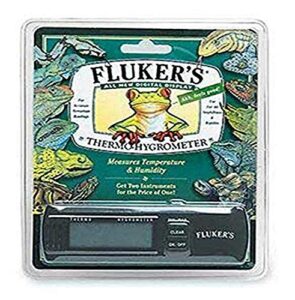
The Fluker Digital Thermometer Hygrometer mounts cleanly on the outside of your enclosure using a slim magic sticker backing, so it won’t disturb a stressed rescue animal. It reads temperature from 0–50°C and humidity from 10–99% RH, with accuracy within 1°C and ±5% RH.
The included CR2032 battery means you’re ready immediately. Its MAX/MIN memory function helps you catch overnight temperature drops without staying up to monitor — a real advantage during intake and quarantine.
| Best For | Reptile and amphibian owners who need a simple, affordable way to keep tabs on temperature and humidity in their pet’s enclosure. |
|---|---|
| Display Type | Digital LCD |
| Mounting Method | Adhesive Backing |
| Power Source | Alkaline Battery |
| Temp Scale | °F and °C |
| Housing Material | Plastic |
| Humidity Sensor | %RH Reading |
| Additional Features |
|
- Shows both temperature and humidity on one clear LCD screen, so you’re not juggling two separate gauges
- Comes with a battery included and mounts right to the tank wall — setup takes about a minute
- Budget-friendly enough to grab multiple units and monitor different zones in the same enclosure
- Humidity readings can drift 5–10%, so don’t rely on it alone for species with tight humidity requirements
- The adhesive is seriously strong — repositioning or removing it from certain tank setups can be a hassle
- Some users report the humidity sensor or the whole unit failing earlier than expected, so it’s worth keeping a backup on hand
2. Zoo Med Dual Thermometer Hygrometer
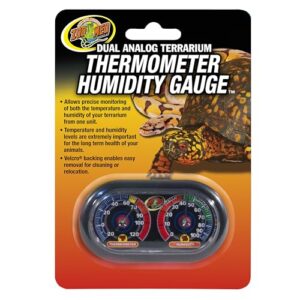
If the Fluker’s digital precision is your go-to, the Zoo Med Dual Thermometer Hygrometer offers a battery‑free backup worth keeping on hand. Its dual analog dials show temperature (50–122°F) and humidity (0–100% RH) at a glance, and the Velcro backing makes repositioning between enclosures quick and clean.
Just know that readings are in ~10°F increments, so it’s best for spot‑checking rather than precise gradient tracking.
| Best For | Hobbyists and small-scale breeders who want a no-fuss, battery-free way to spot-check temperature and humidity across multiple enclosures. |
|---|---|
| Display Type | Analog Dial |
| Mounting Method | Velcro |
| Power Source | Battery-Free |
| Temp Scale | °F |
| Housing Material | Plastic |
| Humidity Sensor | %RH Reading |
| Additional Features |
|
- No batteries needed — just mount it and read it
- Velcro backing makes it easy to move between tanks in seconds
- Shows both temperature and humidity at a glance on one compact unit
- Temperature readings jump in ~10°F increments, so it’s not great for dialing in precise gradients
- Accuracy can drift over time, especially in high-humidity setups
- Plastic housing may crack or let moisture in with long-term use
3. Repti Zoo Digital Terrarium Thermometer Hygrometer
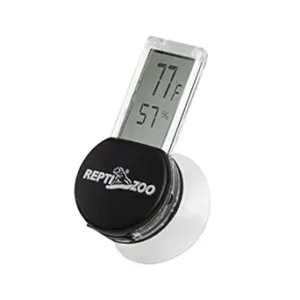
When you need real-time numbers on a screen, the REPTI ZOO Digital Terrarium Thermometer Hygrometer earns its place in a rescue setup.
It reads both temperature and humidity simultaneously on a clear LED display, and the 3-sided suction-cup mount lets you position it on the front, left, or right glass panel — handy when your enclosures aren’t all the same shape.
Battery life runs over a year, so it won’t leave you guessing mid-quarantine.
| Best For | Reptile keepers who want a simple, no-fuss way to track both temperature and humidity at a glance without spending a lot. |
|---|---|
| Display Type | Digital LCD |
| Mounting Method | Suction Cup |
| Power Source | 2× AA Battery |
| Temp Scale | °F and °C |
| Housing Material | Glass & ABS |
| Humidity Sensor | %RH Reading |
| Additional Features |
|
- Shows temperature and humidity on one screen at the same time — no switching between readings
- Suction cup mount makes it easy to move between enclosures or reposition as needed
- Battery lasts over a year, so it’s pretty much set-it-and-forget-it
- The suction cup can lose its grip on smooth or curved glass, especially over time
- LCD can be tough to read under bright lighting conditions
- Not waterproof, so splashing can knock it out until it dries out completely
4. Zoo Med Digital Thermometer Humidity Gauge
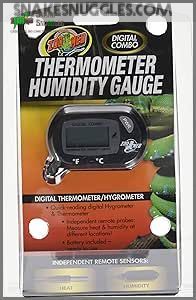
If the REPTI ZOO felt a little high-tech for your needs, the Zoo Med Digital Thermometer Humidity Gauge keeps things straightforward. It gives you live temperature and humidity readings on a clear digital display, with a waterproof external probe that accommodates wet enclosures without fuss.
If you’re keeping a ball python, pairing this gauge with a solid understanding of ideal ball python temperature and humidity ranges helps you actually act on those readings.
The probe cord stretches about 39 inches, so you can monitor deep inside the habitat while keeping the display safely outside. One LR44 battery powers it, and setup takes minutes.
| Best For | Anyone who wants simple, reliable temp and humidity readings for reptile tanks, terrariums, or small animal setups without overcomplicating things. |
|---|---|
| Display Type | Digital LCD |
| Mounting Method | Suction Cups |
| Power Source | LR44 Battery |
| Temp Scale | °F and °C |
| Housing Material | Plastic |
| Humidity Sensor | Waterproof Probe |
| Additional Features |
|
- Clear digital display makes it easy to check conditions at a glance
- Waterproof probe handles wet enclosures without any issues
- Quick to set up and runs on a single LR44 battery
- Suction cups can be hit or miss when it comes to sticking to glass
- The humidity reading shoots up to 99% if the probe gets directly wet
- Swapping the battery out is more of a hassle than it should be
5. TempPro Indoor Hygrometer Thermometer
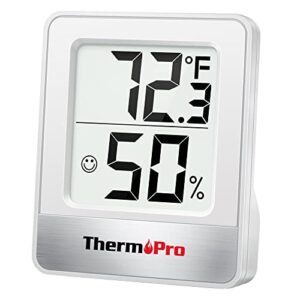
The TempPro Indoor Hygrometer Thermometer is a compact unit that quietly earns its place in a rescue setup. It reads temperature from −58 °F to 158 °F and humidity from 10% to 99% RH, updating every 10 seconds. Accuracy sits at ±1 °F and ±2% RH — solid for most species.
If you’re monitoring several enclosures at once, this comparison of humidity gauges for multiple enclosures shows how the top ten stack up and where to mount them.
Its 3-way mounting options — tabletop, magnetic, or hanging — make placement flexible. Large LCD digits help you check readings fast, even through glass.
| Best For | Anyone monitoring humidity-sensitive spaces like nurseries, grow tents, or greenhouses — especially seniors or users who need large, easy-to-read digits at a glance. |
|---|---|
| Display Type | Digital LCD |
| Mounting Method | 3-Way Mount |
| Power Source | Included Battery |
| Temp Scale | °F and °C |
| Housing Material | Plastic |
| Humidity Sensor | IPX5 Rated |
| Additional Features |
|
- Reads every 10 seconds with solid ±1 °F / ±2% RH accuracy, so you’re not guessing at conditions
- Three mounting options (tabletop, magnetic, hanging) make it easy to place anywhere in your setup
- IPX5 water resistance means it holds up in humid environments without babying it
- No external probe, so it only captures conditions right where it’s sitting — not ideal for larger or multi-zone spaces
- Battery life isn’t specified, so you won’t know when to stock up until it dies on you
- Some units take up to a month for the comfort-face icons to kick in, which feels like a long wait for a basic feature
6. Inkbird Digital Temperature Hygrometer
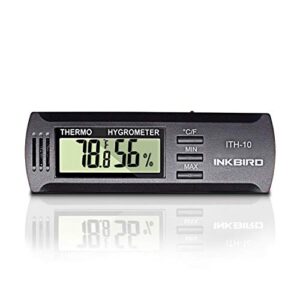
Inkbird’s digital hygrometer is a smart pick if you want more than just a number on a screen.
It logs up to 30,000 data records, so you can spot trends in a rescue animal’s environment over days or weeks.
Temperature accuracy hits ±0.3 °C, and humidity stays within ±3% RH — both tight enough for species-specific recovery.
Bluetooth connectivity lets you check readings remotely without opening the enclosure and stressing your animal.
| Best For | Anyone who needs a simple, no-fuss way to monitor temperature and humidity inside instrument cases, humidors, or small storage spaces. |
|---|---|
| Display Type | Digital LCD |
| Mounting Method | Velcro Straps |
| Power Source | CR2032 Battery |
| Temp Scale | °F and °C |
| Housing Material | ABS Plastic |
| Humidity Sensor | %RH Reading |
| Additional Features |
|
- Tracks both max and min readings, so you always know the range — not just the current moment
- Compact enough to tuck into a guitar case or cigar box without taking up real estate
- Switches between Celsius and Fahrenheit, which is handy if you share data with others
- You can’t recalibrate it yourself, so if it drifts, you’re stuck verifying it against another device
- Some units have shown humidity variance closer to ±5% RH, which matters if precision is critical
- Runs on a CR2032 battery with no rechargeable option, so you’ll want to keep a spare around
Why Rescue Caregivers Need Monitoring
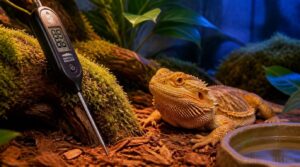
Rescue reptiles don’t come with a history, and that uncertainty makes monitoring more critical, not less. Getting the environment right from day one can mean the difference between a quick recovery and a slow decline. Here’s why keeping a close eye on temperature and humidity matters so much in rescue care.
Stress-sensitive Rescue Reptiles
Rescued reptiles are wired for survival — and that means they treat almost everything as a threat. Cortisol spikes can hit within minutes of handling, suppressing appetite and slowing healing.
A stable environment with consistent temperatures and humidity isn’t a luxury; it’s what keeps stress from turning into respiratory infection.
Quiet, minimal disturbance helps their bodies reset faster. covering glass sides during the first 24 hours reduces visual stress.
Quarantine Enclosure Safety
Every new arrival carries unknown pathogens, which is why quarantine isn’t just isolation — it’s active protection.
Sealed enclosure walls and directional airflow with HEPA filtration prevent cross-contamination between animals.
Monitoring temperature and humidity sensors keeps microclimates stable, while strict disinfection schedules reduce bioburden after every interaction.
Preventing Respiratory Problems
Respiratory problems are one of the biggest threats to a reptile that’s already weakened by stress. Airway moisture balance matters more than most caregivers realize — too dry, airways get irritated; too humid, microbes thrive.
Ammonia from waste builds up fast in closed spaces, so clean substrate and prompt spot‑cleaning aren’t optional.
Dusty bedding and poor ventilation drafts compound the risk quickly.
Tracking Heat Gradients
Heat moves in layers — and a rescue reptile can’t tell you when something’s off.
Thermal gradient management means tracking the full range from the warm basking spot to the cool ambient zone, not just one reading.
- Conduction warms substrate from below
- Convection shifts heat through enclosure air
- Radiant lamps create sharp near-field spikes
- Poor spatial resolution hides dangerous hotspots
- Slow sampling rate dynamics miss sudden heater swings
Microclimate mapping and gradient stability monitoring protect recovery before problems start.
Supporting Species-specific Recovery
Tracking the gradient is just one piece of the puzzle.
Every rescued reptile also needs species-specific thermal requirements met — a desert tortoise recovering from dehydration needs a very different microclimate than a green tree frog. Microclimate matching means your thermometer isn’t optional; it’s the only way to know you’re hitting the right range.
For rescue reptiles, a thermometer isn’t optional — it’s the only way to know you’re hitting the right range
Choosing Accurate Reptile Climate Tools
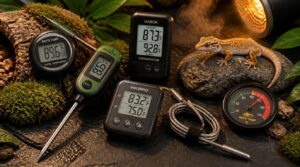
Not every thermometer on the market earns a spot in a rescue setup. You need tools that give you real numbers, not rough guesses, especially when an animal’s health is already on shaky ground. Here’s what actually separates a reliable gauge from one that’ll let you down.
If you’re also weighing options for tracking enclosure conditions, this comparison of digital and analog humidity gauges for reptiles breaks down which style holds up best when accuracy really matters.
If humidity is part of your rescue setup too, this guide to humidity gauges for breeders can help you pick a unit that won’t fail you in a damp, dusty rack.
Temperature Accuracy Ratings
When a label promises ±1°F, that’s its absolute accuracy, how close the reading sits to the true enclosure temperature.
Sensor type matters: thermistors shine in cooler zones but drift near heat, while RTDs hold steadier across wider ranges.
Cheap probes show calibration drift fast, so monthly repeatability testing catches sensors losing precision before your reptile pays the price.
Humidity Accuracy Limits
Humidity readings aren’t as forgiving as temperature ones.
Most sensors claim ±5% RH, but extreme RH errors near 20% or 80% grow worse, and sensor drift caused by dust or oils chips away at humidity accuracy.
Temperature compensation matters too, since pressure influences factors and sensor contamination risks push humidity fluctuations beyond labeled limits, making real humidity control harder than the box suggests.
Digital Versus Analog Gauges
Once you’ve wrestled with humidity drift, the next question is just as practical: should you trust a digital thermometer or an analog gauge?
Digital thermometers win on precision — they display readings to one decimal place, log min/max data, and hold consistent accuracy without guesswork. Analog gauges need no power, but their needle dials drift over time and resist clear readings in foggy enclosures.
- Digital units catch overnight temperature drops automatically
- Analog dials work during power outages without missing a beat
- Data logging reveals patterns you’d never spot manually
- Analog needles can stick or drift after months of humidity exposure
- Digital backlit screens stay readable through condensation
For rescue caregivers managing multiple animals, digital wins most days.
Probe Versus Surface Readings
Probes and surface sensors don’t measure the same thing. A digital probe thermometer reads ambient temperature inside the enclosure directly. Surface infrared temperature measurement scans glass exteriors but risks emissivity measurement errors on reflective surfaces.
| Factor | Temperature Probe | Surface Reading |
|---|---|---|
| Thermal lag | Minimal | Significant |
| Microclimate mapping | Accurate | Limited |
| Sensor contact quality | Essential | Not applicable |
Internal vs external heat gaps can reach 10°F. Keep probes secured for reliable thermal accuracy.
Min/max Memory Features
Min/max memory tracks the highest and lowest temperatures recorded during a session, giving you a clear picture of what happened when you weren’t watching. This matters most overnight.
- Catch dangerous extreme excursion tracking
- Review alarm event timestamps after a breach
- Adjust logging interval optimization for your species
Power-loss memory retention keeps records intact even after battery swaps.
Placement Tips for Rescue Enclosures
Where you place your thermometer matters just as much as which one you buy. Rescue enclosures come in all shapes — desert tanks, tall arboreal setups, aquatic habitats — and each one needs probes positioned in the right spots to give you accurate readings. Here’s what to know for each type.
Warm-side Probe Placement
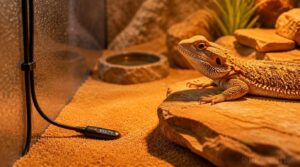
Place your temperature sensor on the warm side directly at substrate level, with the probe placement tip flush against the surface your reptile actually touches. This captures true basking spot temperature rather than ambient air.
Keep the probe away from water bowls to avoid moisture interference, and secure cables along the enclosure wall to prevent shifting.
Cool-side Probe Placement
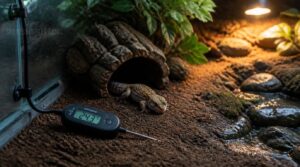
The cool end is your baseline — it tells you what temperature your reptile retreats to when it needs to cool down. Get this reading wrong, and you’re flying blind.
- Place the probe at substrate level, away from the heat source
- Keep it clear of water splash zones
- Shield it from direct light interference
- Secure cables to prevent probe drift
Good substrate contact accuracy ensures your cool-end ambient zone reflects true temperature gradients.
Arboreal Enclosure Monitoring

Tree-dwelling reptiles live in vertical worlds — and your digital thermometer and hygrometer setup needs to reflect that. Vertical gradient mapping requires at least three probes: one roughly 15–20 cm below the basking branch, one at mid-canopy near foliage for microclimate monitoring, and one close to the floor. This gives you a real picture of what your reptile actually experiences.
Arboreal probe mounting means using non-toxic adhesives on vertical surfaces and angling probes away from leaves to keep air sampling accurate. Shield each temperature and humidity sensor from dripping water, and route cables out of reach to prevent chewing.
Watch for vertical moisture detection too — humidity often pools at different heights in tall enclosures, so placing your hygrometer near bromeliads or moisture-retaining foliage reveals the microclimate humidity pockets your animal depends on during recovery.
Aquatic Setup Considerations
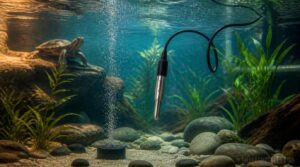
Aquatic enclosures play by different rules.
You need a waterproof temperature probe fully submerged at mid-depth — not clipped to the glass surface — to get an honest water temperature reading. Pair that with filtration turnover of 4x per hour and an aeration stone for oxygenation, and your submersible probe will capture the stable conditions your rescue animal actually needs.
Avoiding Glass-only Readings
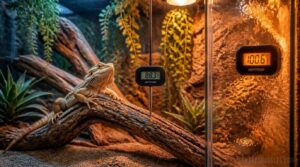
Glass walls absorb and radiate heat, so a thermometer stuck to the side can read 3–5 °F warmer than the actual air your reptile breathes. That’s glass heat bias, and it can quietly mislead you.
Position your external probe at your reptile’s body level, away from the glass, to capture what the environment truly feels like.
Maintenance, Calibration, and Reliability
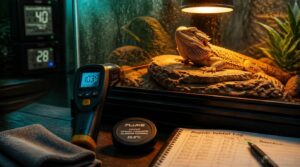
Getting a thermometer is only half the job — keeping it accurate is the other half. A few simple habits can make a big difference in how much you can trust your readings over time. Here’s what rescue caregivers should know about maintaining their equipment.
Monthly Calibration Checks
Once a month, run a quick ice-water calibration test — fill a cup with ice water and check that your probe reads 32 °F (0 °C). Any drift beyond ±1 °F means the sensor needs recalibration or replacement.
Log the date, instrument ID, and result each time. That written record catches sensor drift early, before it puts a recovering reptile at risk.
Battery Replacement Schedules
Just like your calibration log keeps readings honest, a battery replacement schedule keeps the power behind those readings reliable. Most alkaline cells in reptile thermometers last 12–24 months, while CR2032 cells usually run 12–18 months under continuous 10-second updates. Extreme heat accelerates battery drain, so enclosures running above 100 °F deserve closer attention.
| Battery Type | Replacement Interval |
|---|---|
| Alkaline (AA/AAA) | 12–24 months |
| CR2032 lithium | 12–18 months |
| Lithium-ion packs | 2–5 years |
| NiMH cells | 3–5 years |
| Sealed lead acid | 3–5 years |
A voltage drop indicator — like a flickering display or sluggish response — signals replacement before total failure. Don’t wait for that moment during a critical quarantine check. Build a preventive maintenance calendar with annual battery swaps for stored units and every 6–12 months for high-use devices. Log the battery replacement date alongside your calibration records. That way, nothing quietly loses power mid-rescue.
Condensation-resistant Displays
Dead batteries aren’t the only silent threat in a humid rescue setup — fogged displays can be just as dangerous. When warm enclosure air meets a cooler display surface, condensation forms fast.
Look for thermometers with IP-rated enclosures and hermetically sealed faces, which block moisture ingress entirely. Anti-fog coatings and optically bonded screens maintain clear visibility even at 90% humidity.
Secure Mounting Methods
A loose probe shifts overnight — and a shifted probe lies. Choose by enclosure:
- Suction cups grip glass for quick installation
- Magnetic back mounting provides strong attachment strength on metal frames
- Adhesive mounting offers reliable bonding longevity on clean surfaces
- Velcro backing allows easy repositioning without residue
- Strap redundancy ensures structural mounting stability with a secondary anchor
Use corrosion-resistant hardware near moisture.
When to Replace Sensors
Even a reliable sensor doesn’t last forever. Most digital thermometers remain accurate for 5 to 7 years, but humidity damage, heat exposure, and condensation can shorten that window.
Replace yours when readings drift more than 2°F from a reference thermometer, when calibration fails twice in 30 days, or when low battery alerts appear alongside inaccurate readings.
Frequently Asked Questions (FAQs)
Can smart thermometers send alerts during temperature drops?
Yes, they can — and ironically, most people only find that out after something goes wrong. Smart Wi-Fi thermometers send real-time push alerts the moment temperatures drop below your preset threshold.
How many thermometers does one enclosure need?
Most enclosures need at least two thermometers — one on the warm side, one on the cool side. A third midpoint reading helps verify gradient smoothness and catch unexpected hot spots early.
Do infrared thermometers work for quarantined reptiles?
Infrared thermometers offer a gentle, hands-off option, but they only read surface temperature — not internal body temperature. Barrier reading risks and spot size limitations mean quarantine visibility challenges can make readings unreliable.
Which power source lasts longest for continuous monitoring?
Primary lithium cells win for continuous monitoring, lasting several years on low current draw. Battery-powered sensors with duty cycling and sleep modes stretch longevity further, while solar harvesting can sustain low-draw monitors indefinitely in bright conditions.
What temperature delta confirms a healthy heat gradient?
A healthy heat gradient needs at least a 10 °F delta between your warm and cool zones. Anything smaller collapses into a narrow temperature band where your reptile can’t meaningfully thermoregulate.
Conclusion
Like an apothecary carefully weighing remedies on a brass balance scale, precision matters most when an animal’s life is at stake. The right reptile thermometers for rescue caregivers don’t just display numbers—they give fragile, stressed animals a real fighting chance during their most vulnerable hours.
Watch the gradients, trust your data, and check min/max readings every single morning. That one small habit, done repeatedly and consistently, is what separates a recovery from a loss.