This site is supported by our readers. We may earn a commission, at no cost to you, if you purchase through links.
Most desert reptiles never drink from standing water in the wild—they absorb moisture through skin contact, lick condensation, or extract water from prey. This biological reality makes your bowl choice far more consequential than it appears.
A bowl that’s too deep drowns a hatchling gecko before you notice anything wrong. One made from unstable plastic near a basking lamp leaches additives directly into the water your animal drinks. These risks highlight how reptile water bowls for desert species sit at the intersection of safety, hygiene, and enclosure design.
Getting the details right ensures everything else becomes easier to manage.
Table Of Contents
- Key Takeaways
- Best Desert Reptile Water Bowls
- Choosing Safe Bowl Materials
- Size and Depth Guidelines
- Placement in Desert Terrariums
- Cleaning and Maintenance Tips
- Frequently Asked Questions (FAQs)
- What is the best water bowl for corn snakes?
- Do bearded dragons really need a water bowl?
- Will wild rabbits drink out of a water bowl?
- Do desert reptiles actually need water bowls?
- Can I use tap water or distilled?
- How often should I refill the bowl?
- What if my reptile never drinks visibly?
- Should I add supplements to the water?
- Can tap water harm desert reptiles over time?
- How often should water bowls be replaced entirely?
- Conclusion
Key Takeaways
- Desert reptiles absorb moisture through skin contact, so a bowl made from unstable or porous materials near a heat source can leach contaminants directly into the water your animal drinks.
- Bowl depth is a life-or-death detail—keep it under one inch for hatchlings, and always choose designs with built-in escape steps or sloped walls so smaller species can climb out on their own.
- Always place your water bowl on the cool side of the enclosure; positioning it near the basking lamp accelerates evaporation, spikes humidity, and speeds up bacterial growth.
- Daily water changes and weekly deep scrubs with reptile-safe cleaners aren’t optional extras—biofilm and pathogens can establish within 24 hours at typical enclosure temperatures.
Best Desert Reptile Water Bowls
Finding the right water bowl for a desert reptile isn’t as simple as grabbing whatever’s on the shelf. The wrong choice can mean spills, bacterial buildup, or worse—a drowning risk for smaller species.
Getting it right from the start is easier with a solid reptile water bowl guide for beginners that walks you through size, depth, and material considerations.
Here are eight bowls worth considering, each chosen with arid-environment needs in mind.
1. Exo Terra Reptile Water Dish
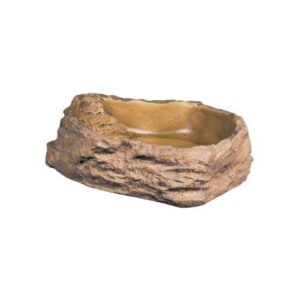
The Exo Terra Water Dish earns its spot at the top for good reason. At 8.7 × 6.7 × 2 inches and nearly 2.4 pounds, it stays put even when your bearded dragon decides to bulldoze through the enclosure.
The food-grade resin interior resists bacterial buildup, so daily wipe-downs actually work. Resists bacterial buildup.
Built-in safety steps give smaller reptiles a reliable escape route, eliminating drowning risk.
Pairing these escape-ready designs with a reptile water bowl built for bioactive setups keeps both your cleanup crew and your reptiles safe from overflow events.
Natural rock texture blends seamlessly into desert setups.
And at $13.85, it’s genuinely hard to beat.
| Best For | Reptile and amphibian owners who want a sturdy, easy-to-clean water dish that looks natural in the tank and keeps smaller critters safe. |
|---|---|
| Material | Food-grade resin |
| Dimensions | 8.7×6.7×2 in |
| Weight | 2.39 lb |
| Easy to Clean | Yes, smooth interior |
| Tipping Resistance | Heavy low-center design |
| Price | $13.85 |
| Additional Features |
|
- Food-grade resin interior resists bacterial growth and wipes down easily
- Heavy, low-profile build stays put even with active or large animals
- Built-in safety steps help small reptiles, frogs, and insects escape without drowning
- Listed dimensions may not match actual size, so double-check before buying for tight enclosures
- At nearly 2.4 pounds, it can be a pain to move or reposition
- The 2-inch depth might be too much for very small or shallow-water species
2. Zilla Medium Rock Lair Hide
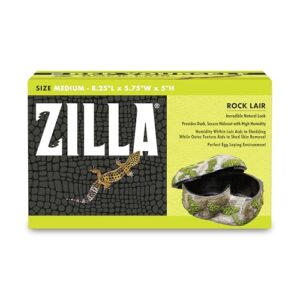
Not every desert reptile needs just a water bowl — sometimes they need a refuge too. The Zilla Medium Rock Lair Hide ($29.49) pulls double duty as a humid hide and stress-reducing shelter.
Its mossy exterior texture helps reptiles rub off shed skin naturally, while the dark interior mimics a burrow environment your animal instinctively trusts. Measuring roughly 8.3 × 5.8 × 5 inches, it fits most small-to-mid-sized species comfortably.
Line it with damp sphagnum moss and it becomes a reliable shedding station.
| Best For | Reptile owners with small-to-mid-sized snakes, geckos, or egg-laying lizards who want an easy-to-clean hide that doubles as a humid shedding spot. |
|---|---|
| Material | Rigid plastic |
| Dimensions | 8.3×5.8×5.0 in |
| Weight | Not specified |
| Easy to Clean | Yes, removable top |
| Tipping Resistance | Stable solid build |
| Price | $29.49 |
| Additional Features |
|
- The textured exterior actually helps your reptile rub off shed skin on its own — no extra effort needed.
- Snap-fit lid stays put even with curious, active animals, and the removable top makes cleaning a breeze.
- Works great as a lay box — just add damp sphagnum moss and you’ve got a solid humid microclimate.
- At $29.49, it’s pricier than basic cork or foam hides, which might sting a bit for budget-conscious keepers.
- A few buyers noted a plastic smell out of the box — nothing a little ventilation won’t fix, but worth knowing.
- Too small for larger adult snakes, so you may need to size up sooner than expected.
3. Natural Sandstone Decorative Stone

For a genuinely wild, natural aesthetic, sandstone decorative stone offers authenticity that molded resin cannot replicate. Its layered bedding patterns and iron-oxide color range—warm yellows, creams, and deep reds—blend seamlessly into arid environments.
Sandstone’s porous nature makes sealing non-negotiable, as unsealed surfaces absorb water and harbor bacteria rapidly.
To maintain both appearance and sanitation, reseal every one to three years and use only mild stone-safe cleaners. This ensures a safe surface for reptiles to drink from.
| Best For | Reptile keepers who want a natural, authentic look in arid or desert-themed enclosures. |
|---|---|
| Material | Unknown |
| Dimensions | Unknown |
| Weight | Unknown |
| Easy to Clean | Unknown |
| Tipping Resistance | Unknown |
| Price | $0.00 |
| Additional Features |
|
- Stunning layered patterns and warm iron-oxide tones that look genuinely wild
- Blends naturally into desert setups in a way synthetic materials just can’t match
- Durable stone that holds up well over time when properly sealed
- Porous surface requires regular sealing every one to three years — skip it and bacteria moves in fast
- More maintenance than resin alternatives, since you need stone-safe cleaners to keep it reptile-safe
- No pricing or sizing specs available, so you’ll need to dig for details before buying
4. Flukers Corner Rock Bowl for Hermit Crabs
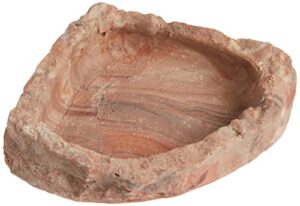
If sandstone’s natural look appeals to you, Fluker’s Corner Rock Bowl delivers similar aesthetics without the sealing headaches. Its realistic rock-formation design sits flush in enclosure corners, freeing up central floor space—a smart win in compact terrariums.
At roughly 1.5 inches wide and made from durable resin, it’s shallow enough to keep small species safe from drowning while staying stable thanks to its solid 1.05-pound base.
Rinse it thoroughly before first use to clear any residue.
For more on placement and keeping things clean from the start, snake water bowl setup tips cover exactly what you need.
| Best For | Hermit crab and small reptile owners who want a space-saving, natural-looking dish that won’t tip over or crowd their setup. |
|---|---|
| Material | Resin |
| Dimensions | 5.4×1.5×6 in |
| Weight | 1.05 lb |
| Easy to Clean | Yes, smooth resin |
| Tipping Resistance | Heavy solid base |
| Price | $8.99 |
| Additional Features |
|
- Corner design tucks neatly against the wall, leaving more room for climbing structures and substrate
- Heavy resin base keeps it from tipping, so food and water stay where you put them
- Shallow depth reduces drowning risk for hermit crabs while still holding a useful amount of water
- May arrive with a sticky residue that needs a few good washes before it’s ready to use
- Textured surface can trap moisture and encourage mold if not dried thoroughly after cleaning
- Some users notice a strong smell from the resin, which can linger especially when used as a water dish
5. Zoo Med Repti Rock Food Dish
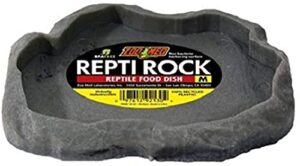
The Zoo Med Repti Rock Food Dish does double duty in desert setups—accommodating both food and water without complaint.
Made from non-toxic resin, its smooth, non-porous surface resists biofilm and wipes clean in seconds.
The low-profile rock design blends naturally into arid décor, while its shallow edges allow leopard geckos, bearded dragons, and tortoises to access it effortlessly.
Available in multiple sizes, it scales well across species.
Inspect it regularly for chips from rougher reptiles.
| Best For | Reptile owners with medium-sized species like leopard geckos, bearded dragons, or tortoises who want a low-maintenance, easy-access feeding dish. |
|---|---|
| Material | Rubber |
| Dimensions | 7.5x6x1 in |
| Weight | 9.6 oz |
| Easy to Clean | Yes, non-porous |
| Tipping Resistance | Low-profile stable |
| Price | Not specified |
| Additional Features |
|
- Unbreakable rubber construction holds up to daily use without cracking or chipping
- Smooth, non-porous surface is a breeze to clean — no food getting stuck in grooves
- Low-profile design lets smaller reptiles walk right up and eat without any struggle
- Not truly waterproof, so it’ll leak if you try using it as a water dish long-term
- Shallow depth means liquids or loose food can spill if the dish gets nudged
- Feels a bit flimsy for larger, more active reptiles that like to push things around
6. Zoo Med XL Rock Corner Water Dish
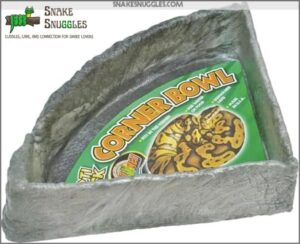
The Zoo Med XL Rock Corner Water Dish maximizes prime real estate in a terrarium with its triangular footprint, efficiently utilizing corner space without compromising floor area for reptiles.
Its smooth, non-porous interior resists biofilm build-up and ensures effortless cleaning—simply wipe it down or place it in the dishwasher.
Measuring 13.8 × 13.2 cm with a shallow 3.2 cm depth, the dish is ideal for larger desert species like bearded dragons and ball pythons, providing easy access.
Smaller, less agile reptiles may struggle with the walls, so consider this when selecting for such species.
| Best For | Owners of large reptiles like ball pythons, bearded dragons, and land turtles who need a spacious, easy-to-clean water dish that fits neatly in a tank corner. |
|---|---|
| Material | Plastic |
| Dimensions | 13.8×13.2×3.2 cm |
| Weight | 3.8 lb |
| Easy to Clean | Yes, dishwasher-safe |
| Tipping Resistance | Weighted thick plastic |
| Price | Not specified |
| Additional Features |
|
- Holds about a gallon of water, giving bigger reptiles plenty of room to soak or drink
- Dishwasher-safe and easy to wipe down, so keeping it clean takes almost no effort
- Corner design saves floor space and can double as a dig box or feeding dish
- Deep sides can be tough for smaller or less agile reptiles to climb in and out of
- Takes up a significant chunk of tank floor space in medium-sized enclosures
- Actual color may not match what you see in product photos online
7. Galapagos Heavyweight Ceramic Egg Dish
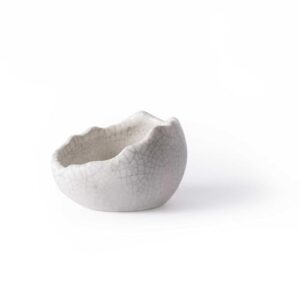
The Galapagos Heavyweight Ceramic Egg Dish punches above its weight for such a compact piece. Measuring just 5.5 × 5.5 inches with a 2.75-inch depth, it’s sized right for hatchlings and juveniles that don’t need a full soaking bowl.
Its dense ceramic base stays put on sandy substrates—no tipping mid-drink. The non-porous glaze blocks bacterial absorption and wipes clean easily.
At $11.99, it’s a practical, aesthetically natural fit for desert setups housing species like leopard geckos or juvenile bearded dragons.
| Best For | Hatchlings and juvenile reptiles like leopard geckos or young bearded dragons that need a stable, right-sized dish for food or water. |
|---|---|
| Material | Ceramic |
| Dimensions | 5.5×5.5×2.75 in |
| Weight | 4.16 oz |
| Easy to Clean | Yes, non-porous |
| Tipping Resistance | Heavyweight ceramic |
| Price | $11.99 |
| Additional Features |
|
- Heavy ceramic base stays put—no sliding or tipping on sand or loose substrate
- Non-porous surface resists bacteria and wipes clean in seconds
- Blends naturally into desert and tropical setups without looking out of place
- Ceramic chips or cracks if you’re not careful—handle with some respect
- Too small for larger reptiles or bigger prey items
- The weight can make it a hassle to reposition inside a compact enclosure
8. MagNaturals Earth Magnetic Rock Ledge
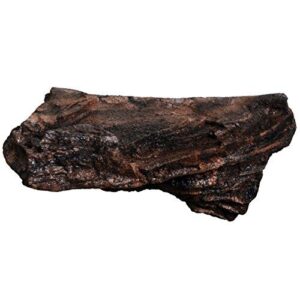
The MagNaturals Earth Magnetic Rock Ledge isn’t a water bowl—but it solves dead vertical space in desert enclosures. At 9.3 × 4.6 inches, it mounts tool-free on terrarium glass, providing climbing species like bearded dragons and Chinese water dragons with a secure perch near their water source.
Constructed with a non-toxic polyurethane foam core, it wipes clean easily, though its porous texture demands regular rinsing.
Rated for pets up to 2 lb, it’s a smart layout addition at $50.
| Best For | Reptile and amphibian owners who want to add vertical climbing space to glass terrariums without drilling or adhesives. |
|---|---|
| Material | Polyurethane foam resin |
| Dimensions | 9.3×4.6×3.4 in |
| Weight | 16 oz |
| Easy to Clean | Yes, rinse with soap |
| Tipping Resistance | Magnetic wall-mount |
| Price | $50.00 |
| Additional Features |
|
- Snaps onto glass in seconds with strong neodymium magnets—no tools, glue, or velcro needed
- Non-toxic foam core is safe for a wide range of species and easy to wipe down
- Works with multiple units so you can build out a custom layout over time
- Magnetic hold weakens near the 2 lb limit, so bigger or more active climbers may knock it loose
- Porous foam traps debris and needs consistent cleaning to stay hygienic
- Doesn’t grip well on acrylic or thin bamboo panels—really only reliable on glass
Choosing Safe Bowl Materials
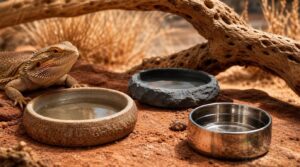
The bowl you pick does more than hold water — it either protects your animal or puts it at risk. Material matters more than most keepers realize, and the wrong choice can mean bacterial buildup, tipped dishes, or a reptile that can’t climb out.
The wrong bowl doesn’t just hold water poorly — it puts your reptile at risk
Here are the key material types worth knowing before you buy.
Non-Porous Surfaces
A nonporous surface is your first real defense against bacterial contamination in desert enclosures. Unlike porous materials that trap moisture in microscopic gaps, nonporous materials leave bacteria nowhere to anchor.
Nonporous glaze benefits extend beyond aesthetics—they directly enhance antibacterial performance and ensure long-term durability through repeated cleaning cycles.
For desert reptile husbandry, this material choice isn’t optional; it’s foundational. Its smooth texture promotes rapid liquid runoff to maintain dry surfaces.
Food-Grade Resin
Food-grade resin earns its place in desert reptile husbandry because it’s engineered for this demand. BPA-free formulations and chemical inertness ensure no harmful substances leach into clean water, even after repeated disinfection cycles.
Durability testing confirms scratch resistance holds up under daily scrubbing, leaving nonporous materials intact. This ensures consistent bacterial contamination prevention.
Regulatory compliance certifications confirm the bowl meets food-contact safety standards before entering your enclosure.
Heavy Ceramic Options
Heavy ceramic takes durability a step further than resin. High-quality ceramic bowls offer genuine claw-impact durability, with thick walls that resist cracking under daily reptile traffic.
A lead-free glaze creates a smooth, glazed finish that prevents bacterial contamination.
The thermal mass keeps water temperatures stable, while a slip-resistant base and integrated drainage directly support the hydration needs of desert species.
Heavy, weighted bowls simply stay put.
Sealed Stone Safety
Stone bowls offer a rocklike construction that mimics natural aesthetics while delivering robust performance. However, unsealed stone absorbs moisture, creating an environment where bacteria harboring occurs rapidly. To ensure a nonporous surface, apply food-safe, non-toxic sealants with solid epoxy compatibility.
Regular maintenance is critical: conduct routine crack inspections every few months, as mineral buildup accelerates wear and compromises longevity.
For desert-style terrariums, a bacterial prevention coating tailored to meet the hydration needs of desert species maintains a clean habitat and safeguards animal health.
Avoiding Unstable Plastic
Sealed stone withstands heat and looks great—but plastic is where things get risky. Unstable plastics trigger additive leaching near heat lamps, and UV aging quietly weakens the bowl before cracks appear.
To mitigate these risks:
- Run a plastic crack inspection monthly
- Replace bowls every 6–12 months
- Keep plastic away from basking zones to prevent heat-induced degradation
- Switch to ceramic for better water dish stability and nonporous surface pathogen control in terrariums
Size and Depth Guidelines
Getting the size and depth right isn’t just about aesthetics — it’s the difference between a safe setup and a drowning risk. Every desert species has different needs depending on age, body size, and soaking behavior, so there’s no single bowl that works for everyone.
Here’s what to look for across the most important sizing factors.
Hatchling Safety
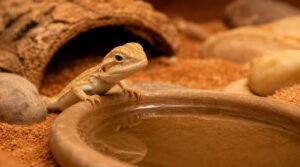
Hatchlings are far more vulnerable than adults — a dish that seems harmless can become a drowning hazard overnight. Your escape-proof enclosure needs a shallow water dish, ideally under one inch deep, paired with a smooth substrate and secure hide spots to minimize stress.
Always prioritize choking prevention by keeping the bowl free of debris, and change water daily to prevent pathogen buildup before it starts.
Adult Soaking Needs
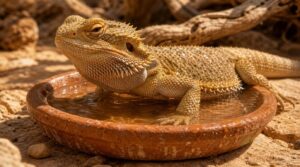
Adult desert reptiles require a 4 to 6 inches wide and 1 to 2 inches deep water bowl to soak fully. A 5 to 15 minutes soak duration provides essential hydration by replenishing moisture through skin and mucous membranes. Watch for behavioral cues like crouching near the bowl’s rim, indicating readiness to soak.
Use room-temperature water to minimize thermal stress, and ensure daily changes for strict pathogen control and reduced dehydration risk.
Climb-Out Access
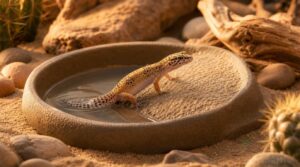
Every bowl you choose needs a clear exit strategy for your reptile. A sloped interior and textured grip surface let your animal push out without scrambling. Keep the low edge lip and vertical clearance minimal—shallow versus deep water dishes make a real difference here.
Rim texture prevents slipping, while water bowl stability prevents tipping. Together, these features ensure your desert-style terrarium is genuinely safe.
Drowning Risk Prevention
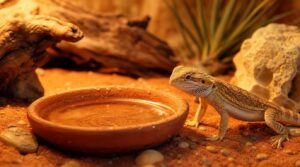
Drowning risk isn’t just a human-pool concern—it’s a real threat inside your enclosure. Shallow vs deep water dishes determine whether your reptile stays safe or struggles.
Follow these water depth limits:
- Keep depth under 1 inch for hatchlings
- Use a low-set rim with non-slip surfaces
- Apply barrier installation logic: stable and accessible bowl placement only
Supervision protocols and emergency drills reinforce every safety hazard of deep bowls.
Species-Specific Fit
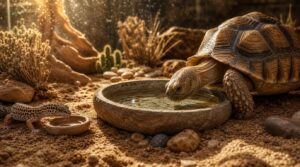
No two desert species drink in the same way. A small gecko requires a bowl just 4–6 cm wide and barely 2 cm in depth, while a medium tortoise drinks comfortably from a bowl that’s 14–18 cm across. Rim curvature, drinking posture, and contrast color all influence edge visibility inside a terrarium.
Adhering to specific water bowl size guidelines eliminates safety hazards linked to deep bowls and maintains stable low humidity.
Placement in Desert Terrariums
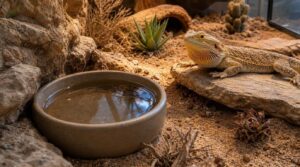
Where you place your water bowl matters more than most keepers realize.
The wrong spot can quietly spike humidity levels, stress your animal, or drain the bowl before the day’s done.
Here’s what to keep in mind before you set it down.
Its shallow 0.7-inch depth makes it perfect for beginners — browse terrarium water bowls designed for safe, easy reptile hydration to find the right fit before your first setup.
Cool-Side Positioning
Placing your water bowl on the cool side isn’t optional — it’s foundational to Cool Zone Stability and terrarium humidity control. Heat shielding strategies start here, because cool-side placement directly underpins Bowl Temperature Regulation and water contamination prevention.
- Keeps evaporation low, supporting low humidity thresholds
- Preserves Water Visibility Optimization by slowing algae growth
- Reduces bacterial growth linked to heat exposure
- Accommodates Seasonal Temperature Shifts without destabilizing hydration
Basking Lamp Distance
Lamp Height Adjustment directly affects Enclosure Heat Transfer, so position your basking bulb 6–12 inches above the focal spot. Verify the basking surface temperature using an infrared thermometer to ensure accuracy.
Beam Pattern Effects can scatter radiant heat toward the cool side, accelerating evaporation from the water bowl. This compromises water contamination prevention and bacterial growth prevention, both critical to reptile health and wellbeing.
Humidity Control
Radiant heat doesn’t stop at the basking spot—it creeps across the enclosure, nudging ambient humidity upward. For desert species, this matters. Your target range sits between 20 and 40 percent, making sensor calibration non-negotiable; unchecked drift triggers mold growth prevention failures fast.
Monitor mist system timing and avoid humidity peaks. Practice microclimate management through smart substrate moisture control to keep bacterial growth prevention on track.
Evaporation Reduction
Evaporation pulls more water from your bowl than expected—especially when heat lamp placement puts warmth too close to the dish. Smaller bowls with low-profile walls and a tighter surface area help retain water in terrarium setups.
Reflective surfaces, insulating films, floating covers, wind breaks, and chemical monolayers all share a common goal: slow vapor transfer at the source. These methods reduce water loss by disrupting evaporation dynamics at their origin.
Space-Saving Corners
Corner space is often wasted in desert terrariums—and that’s a missed opportunity. Triangular Bowl Designs, like the Flukers Corner Bowl, slot cleanly into wall angles, supporting space-saving enclosure design without sacrificing clean water access.
Corner Shelf Integration and Modular Corner Units extend this logic vertically, maximizing vertical utility. These solutions optimize underused areas while maintaining accessibility.
Multi-Functional Corner Benches with Hidden Storage Fixtures keep supplies close, enhancing practicality. Corner placement benefits reptiles by freeing central floor space for movement, prioritizing both functionality and habitat efficiency.
Cleaning and Maintenance Tips
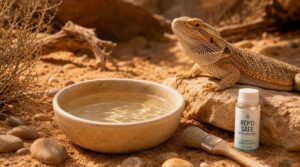
A clean water bowl isn’t optional—it’s one of the most direct ways you protect your reptile from bacterial infections. Desert species are especially sensitive, so your cleaning routine needs to be consistent and deliberate.
Here’s what you should be doing to keep things safe and sanitary.
Daily Water Changes
Fresh water isn’t optional — it’s your first line of pathogen control in terrariums. Skipping daily cleaning lets bacterial colonies establish within 24 hours at enclosure temperatures. Stick to routine scheduling and your reptile water dish stays genuinely safe.
- Match added water within 2°F for temperature matching — cold water causes thermal shock
- Practice contaminant dilution by replacing 10–20% daily
- Monitor hydration behavior — consistently clean water encourages normal drinking
- Change water immediately when soiled, regardless of schedule
Weekly Deep Scrubs
Daily rinses handle surface debris, but weekly deep scrubs tackle what you can’t see — biofilm, mineral buildup, and bacterial accumulation hiding in corners and under rims.
| Scrub Step | Detail |
|---|---|
| Circular Brush Method | Gentle nylon brush in circular motions |
| Scrub Pressure | 200–300 grams, consistent and controlled |
| Mineral Buildup Removal | Reptile-safe detergent, two-pass technique |
| Post-Scrub Drying | Completely dry before refilling |
| Scrub Schedule | Same day weekly for pathogen control in terrariums |
Lock this into your cleaning schedule for reptile habitats — consistency is everything.
Biofilm Prevention
Biofilm doesn’t announce itself — it builds quietly on bowl surfaces until bacterial accumulation becomes a real health threat to your animal.
- Use antiadhesive coatings or non-porous bowls to disrupt initial bacterial footholds
- Apply enzymatic cleaners weekly to break down the polysaccharide matrix biofilm hides behind
- Consider UV light treatment near feeding areas to lower microbial load
These steps make your hygiene routine for reptile tanks genuinely effective for pathogen control in terrariums.
Reptile-Safe Cleaners
Choosing the right cleaner matters as much as the bowl itself. Chlorine dioxide sprays break down to salt and water, leaving no harmful residue behind.
Hydrogen peroxide rinses decompose into oxygen and water after application. Enzyme cleaners, powered by enzymes, dissolve biofilm at the molecular level.
For routine maintenance, vinegar dilution ratios around 1:1 work well. Always verify non-toxic disinfectant labels specify food-safe, environmentally safe materials.
Soiled Bowl Response
When contamination hits, speed is everything. Contamination Detection starts with a quick visual clarity check — cloudy water, floating debris, or a slimy film signals immediate replacement is non-negotiable.
- Remove and discard soiled water without delay
- Disinfect the bowl to prevent cross-contamination between enclosure occupants
- Dry completely before refilling, eliminating biofilm management issues at the source
Frequently Asked Questions (FAQs)
What is the best water bowl for corn snakes?
The Exo Terra Reptile Water Dish is your best bet. Its low-set rim, bowl stability, and shallow depth eliminate safety hazards of deep bowls.
It supports reliable reptile hydration in any desert-style terrarium.
Do bearded dragons really need a water bowl?
A shallow reptile water dish promotes hydration behavior, complements diet moisture, and reduces stress for bearded dragons.
While misting alternatives help, direct bowl access remains a reliable health indicator for your bearded dragon’s daily routine.
Will wild rabbits drink out of a water bowl?
Wild rabbits rarely drink from bowls naturally—they lap from streams, puddles, and dew-covered plants. If offered a shallow dish, most will eventually drink, especially when seasonal water needs rise.
Do desert reptiles actually need water bowls?
Desert reptiles obtain hydration from dietary moisture and metabolic water, so they don’t depend solely on water dishes—but a shallow bowl still facilitates basking behavior, shedding, and occasional drinking.
Can I use tap water or distilled?
Both work, but each comes with trade-offs. Tap water is convenient and cost-effective; just age it overnight or use a dechlorinator for chlorine removal.
Distilled water eliminates mineral impact entirely but costs more in the long term.
How often should I refill the bowl?
Refill daily — twice-daily checks during peak heat keep your desert-style terrarium from running dry.
Replace water after feeding-time top-ups whenever debris contaminates the dish.
Adjust your refill rotation strategy seasonally as temperatures shift.
What if my reptile never drinks visibly?
Many desert reptiles absorb hidden hydration cues through prey moisture benefits rather than visible drinking.
Monitor weight trends, skin texture, and urine consistency to assess hydration. Firm white urates do not always confirm adequate hydration.
Should I add supplements to the water?
Skip it. Supplement dosing through water is unreliable—concentration spikes as water evaporates, making reptile mineral balance impossible to control. Overdose risks outweigh benefits.
Nutrient bioavailability is far better through properly supplemented food.
Can tap water harm desert reptiles over time?
Yes, tap water can harm desert reptiles over time. Chlorine accumulation and heavy metal exposure pose gradual risks.
Water hardness also contributes to long-term health issues—use a reptile-safe conditioner to neutralize chemical residues before every refill.
How often should water bowls be replaced entirely?
Even the cleanest bowl has a retirement date. Replacement intervals vary by material.
High-quality ceramic lasts two to four weeks, while plastic shows biofilm signs within days, demanding faster swaps for reptile health maintenance.
Conclusion
Think of your enclosure as a closed system—every component either aids or undermines the whole.
A keeper once lost a juvenile leopard gecko to a plastic bowl that warped near the basking side, contaminating water the animal absorbed through skin contact.
Choosing the right reptile water bowls for desert species isn’t a minor detail; it’s foundational infrastructure.
Nail the material, depth, and placement, and everything downstream—hydration, hygiene, animal health—falls into place naturally.
- https://www.nomoy-pet.com/news/the-ultimate-guide-to-reptile-bowls-choosing-the-best-for-your-scaly-friends/
- https://a-z-animals.com/reviews/best-water-dishes-for-your-lizard/
- https://gotfeeders.com/blogs/faq/the-importance-of-proper-hydration-for-desert-reptiles?srsltid=AfmBOooFwnKAx-vRaiPJ9cUlRXEi_5i7qLssxbHLkbDCJRMPTPxO-xNy