This site is supported by our readers. We may earn a commission, at no cost to you, if you purchase through links.

A snake without a proper hide isn’t just uncomfortable—it’s chronically stressed, and chronic stress kills. Most keepers focus on temperature, substrate, and feeding schedules, but the hide often gets treated as an afterthought: a half-buried flowerpot or a plastic container with a hole cut in the side. That improvised approach works until it doesn’t, and the signs of failure—refusal to eat, constant glass-surfing, incomplete sheds—show up weeks before most owners connect them to the hide.
Creating a secure hiding place for pet snakes involves more than dropping a cave into the enclosure. It requires matching materials, dimensions, humidity, and placement to your specific animal’s biology.
Table Of Contents
- Key Takeaways
- Choose Safe Hide Materials
- Measure Your Snake Correctly
- Pick The Best Hide Shape
- Place Warm and Cool Hides
- Build a Humid Hide
- Add Ventilation Without Escape Risks
- Make Budget DIY Snake Hides
- Top 8 Snake Hideouts
- Clean and Inspect Hides
- Frequently Asked Questions (FAQs)
- Can multiple snakes share one hiding place?
- How often should hides be replaced completely?
- Do snakes prefer dark or light-colored hides?
- Should hides be removed during feeding time?
- Whats the best hide for shedding snakes?
- How often should I replace my snakes hide?
- Can snakes share a hide in the same enclosure?
- Do hides need to be anchored down securely?
- Can lighting placement affect hide effectiveness?
- Conclusion
Key Takeaways
- A hide that fits snugly—not loosely—is essential, because a space that’s too large leaves your snake feeling exposed while one that’s too small becomes a stress trap.
- Material choice matters: non-porous options like ABS, polypropylene, PVC, and glazed ceramic resist mold and bacteria, while wood quietly harbors both.
- Placement isn’t optional—you need at least two hides, one on the warm side (83–88°F) and one on the cool side (72–80°F), so your snake can self-regulate temperature around the clock.
- A humid hide packed with damp sphagnum moss is your most reliable tool for clean sheds, since it holds moisture evenly and maintains the microclimate your snake needs during the shedding cycle.
Choose Safe Hide Materials
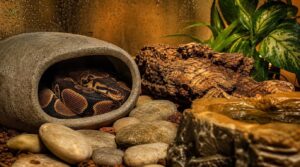
The material your snake’s hide is made from matters more than most people realize. Some options hold up beautifully over time, while others quietly become a breeding ground for bacteria and mold.
Choosing the right one is especially important for younger owners, and this guide to snake hides for kids with pet snakes breaks down which materials are safest and easiest to keep clean.
Here’s what’s actually worth using.
ABS and Polypropylene
Two plastics stand out for DIY snake hide material selection for reptile hides: ABS and polypropylene. Both offer solid impact resistance, meaning they won’t crack under pressure, and their chemical resistance keeps cleaning solutions from degrading the surface. Either plastic container works well — both are non-porous and genuinely reptile-safe materials.
ABS tolerates heat up to around 105°C, while polypropylene withstands higher temperatures. Polypropylene’s lower density makes the hide lighter than an equivalent ABS version. lower density of polypropylene
PVC Hide Options
PVC takes hide-building a step further. A PVC snake hide DIY project delivers flawless interiors that resist moisture at any humidity level — no warping, no mold. Here’s what makes PVC worth choosing:
- Expandable Dimensions – Interlocking modules let you expand the hide as your snake grows.
- Snap‑in Vent Inserts – Remove them instantly for cleaning.
- Color Finishes – Textured surfaces mimic rock while staying fully sanitizable.
Safe Ceramic Hides
Ceramic brings something neither ABS nor PVC can match: thermal mass. A glazed, non‑porous surface absorbs warmth slowly and releases it over hours, providing your snake steady temperature buffering through the night.
That weight stability also means the hide won’t shift when a larger species pushes against it.
Inspect glazed surfaces regularly for chips — cracks break even heat distribution and create spots where bacteria hide.
Sealed DIY Materials
Building your own hide opens up real creative freedom — and with the right materials, you can make something just as safe as any store-bought option.
Aquarium-safe, non-toxic sealants applied to plastic bowls, plastic lids, or insulated foam create smooth, cleanable surfaces. Spray foam shaped into cave-like forms works well when finished with UV-resistant coatings and sealed edges.
Sealant compatibility matters here — Minwax fast-drying polyurethane clear satin bonds reliably to foam shells and holds up through regular disinfection cycles.
Edge gasket design and durability testing prevent moisture from seeping into seams.
Unsafe Porous Wood
Wood might look natural in a snake enclosure, but it’s one of the least reptile-safe materials you can use.
Moisture absorption causes swelling, warping, and structural decay over time.
Microbial growth takes hold fast inside open pores — and no amount of scrubbing fully clears it.
Wood dust allergens irritate both you and your snake, while chemical leaching from untreated species adds another hidden risk.
Measure Your Snake Correctly
Getting the hide size right is probably the most overlooked part of snake keeping. Too big and your snake feels exposed; too small and it becomes a stress trap.
A hide too large leaves your snake exposed; a hide too small becomes a stress trap
Here’s what to look at when sizing a hide for your specific snake.
Snug Body Contact
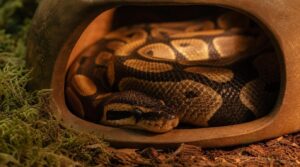
Think of a hide as a second skin — it should hold your snake, not just shelter it. The right contact surface texture and curved interior design work together for proper pressure distribution across the body. For safe hiding spots for pet reptiles, prioritize these features in hide boxes:
- Support the midsection without compressing it
- Use subtle texture for material grip balance
- Guarantee smooth plastic prevents scale snagging
- Maintain consistent midsection support throughout the interior
Coiled Resting Size
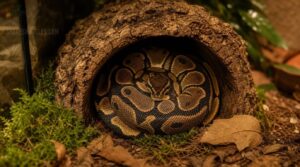
When your snake settles in, its coiled resting size determines the ideal hide fit. Use the Coil Diameter Guidelines below to match species with appropriate hide boxes:
| Species | Resting Footprint | Coil Diameter |
|---|---|---|
| Ball Python | Compact | 2.5–3.5 in |
| Corn Snake | Moderate | 3–5 in |
| King Snake | Medium | 3–4 in |
Temperature Coil Effect and Humidity Coil Variation can slightly alter these measurements, so regularly revisit Growth Size Adjustments to ensure ongoing suitability.
Hatchling Hide Sizing
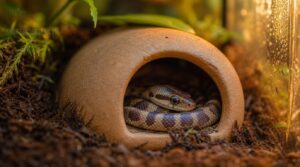
Hatchlings need more precision than you’d expect. Their growth curve is steep, so starting with the right fit matters immediately.
Follow this Diameter Ratio Guide for sizing safe hiding spots for pet reptiles:
- Match floor area to one loose coil, leaving under 1 inch of Tailroom Allowance per side
- Set interior height to 1.2–1.5 times the hatchling’s body thickness using the Hatchling Length Factor
- Keep Incremental Size Shifts small — avoid jumping more than one size up
- Apply species-specific requirements when sourcing hide boxes or made-to-order reptile hide dimensions
- Test DIY snake hide ideas against these same snug-fit standards
Adult Snake Upgrades
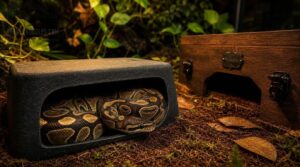
Adult snakes outgrow their starter hides faster than most keepers anticipate. When your snake’s body spills past the entrance or bunches awkwardly inside, it’s time to upgrade.
Proper tailored reptile hide dimensions support variable thermal gradients, escape prevention, and secure locks that keep your snake settled.
| Growth Stage | Recommended Hide Size |
|---|---|
| Juvenile (under 2 ft) | 8″ × 5″ × 3″ |
| Sub-adult (2–3 ft) | 11″ × 7″ × 4″ |
| Adult (3–4 ft) | 13″ × 9″ × 3.25″ |
| Large adult (4–5 ft) | 16″ × 11″ × 5″ |
| DIY hide for huge snake | Custom-built to coiled body width |
A safe hiding spot for pet reptiles should always fit snugly — not loosely.
Species-specific Fit
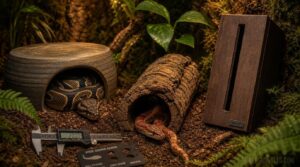
Not every snake fits the same mold. A ball python’s coil diameter clearance differs from a slender corn snake’s, and arboreal species need vertical hide boxes that mimic tree crevices.
Match your head width entrance to 1.2–1.5 times your snake’s head size. Sex-specific dimensions matter too — females need deeper retreats.
Following a growth upgrade schedule every 6–12 months keeps tailored reptile hide dimensions accurate.
Pick The Best Hide Shape

Shape matters more than most keepers realize for how secure and comfortable your snake feels. A hide that looks great to you might feel completely wrong to your snake.
Here are the key shapes to focus on when making your choice.
Low Horizontal Caves
Low horizontal caves serve as the benchmark for naturalistic hide construction, offering a design that mirrors how snakes move through wild burrows. This linear passage layout helps keep pets calm and secure, replicating their natural behavior.
Substrate accumulation along the floor provides natural camouflage, while the microclimate remains consistently stable throughout the enclosure. These features create an environment that aligns with a snake’s instinctive needs.
Whether exploring DIY snake hide ideas or purchasing ready-made options, this shape ensures easy maintenance access without compromising escape prevention. Its practical design balances functionality with naturalistic appeal.
Tight Entrance Holes
The entrance hole’s diameter sizing is critical for snake comfort. A snug opening—around 0.75 to 1.25 inches for corn snakes—creates a visual barrier that fosters security, while edge rounding (2–4mm radius) and surface polishing prevent scale abrasion. A tight fit also acts as a thermal seal, retaining warmth to support digestion.
- Snug holes reduce stress by mimicking natural burrow pressure
- Smooth, polished edges protect delicate scales during entry and exit
- Uniform circular cuts prevent snagging or uneven wear
- Tight openings preserve internal heat, supporting digestion after feeding
- Easy maintenance access keeps hide boxes hygienic without structural compromise
Whether you’re exploring DIY snake hide ideas, handmade snake hide ideas, or refining your reptile enclosure design, prioritizing these details ensures a functional and stress-free habitat.
Flat Stable Bottoms
Beyond a snug entrance, the base of your hide box matters just as much. A flat, stable bottom promotes uniform heat transfer, ensuring your snake rests evenly without pressure points. Non-slip coating prevents sliding on smooth enclosure floors.
Prioritize base material durability and consider detachable base designs for easier cleaning. These features enhance both functionality and maintenance.
Adding insulation around the base helps maintain consistent warmth—a detail that elevates any DIY snake hide.
Vertical Hide Uses
While flat bases suit ground-dwellers, climbing species like rough green snakes or vine snakes genuinely need vertical height utilization. A tall DIY snake hide made from PVC pipe or natural wooden plastic hides lets them stretch upward, supporting enrichment benefits and space-saving in tighter setups.
Position vertical hiding places near climbing structures to enable vertical heat transfer — warmth rises, so your snake thermoregulates naturally as it ascends.
No Sharp Edges
Sharp edges are a quiet hazard — even a small burr along a hide entrance can tear delicate scale tissue during shedding. Whether you’re finishing a DIY snake hide with PVC pipe, spray foam, or insulated foam, Filleted Edge Standards apply: all interior corners should curve, never cut at 90 degrees.
Keep these Edge Safety Testing checks in your routine:
- Run a gloved finger along every interior surface to catch hidden burrs — Burr Removal Methods include light sanding or a quick pass with an X-Acto knife
- Inspect Rounded Entrance Design by checking that the entry lip curves gently, sitting recessed roughly 2 mm so your snake’s snout doesn’t catch
- Seal any DIY snake hide built from a cardboard box or plastic bowl using reptile-safe materials like Minwax Fast-Drying Polyurethane Clear Satin to prevent edge chipping
- Prioritize Edge Wear Inspection every cleaning cycle, especially on plastic versus wood reptile shelters, since wood splinters faster and compromises reptile enclosure safety quickly
Place Warm and Cool Hides
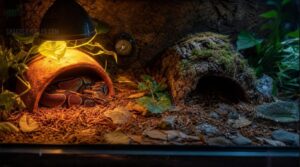
Placement makes or breaks how well your snake actually uses its hides. You’ll need at least two — one on the warm side and one on the cool side — positioned with purpose.
Here’s how to set each one up correctly.
Warm-side Hide Setup
Position your warm-side light directly over the heat source—this maximizes heat transfer efficiency and keeps the interior within 2–4°F of the basking spot. Use a thermostat calibration routine to avoid dangerous hot spots.
Material conductivity matters too; ABS or PVC won’t trap excessive heat. Monitor your temperature gradient regularly, targeting 83–88°F inside for most common pet snakes.
Cool-side Hide Setup
Your cool-side hide should be placed at the far end of the enclosure, well away from the heat source. Use temperature probes to verify interior temps stay between 72–80°F, avoiding reliance on ambient readings.
Gradient mapping across the substrate level confirms your temperature gradient remains stable.
If readings rise, adjust the thermostat to fine-tune heat output—don’t move the hide.
Matching Hide Styles
Using Color Coordination—matching hide styles on both warm and cool sides—does more than satisfy aesthetic preferences; it reinforces a snake’s sense of security. When hides share Theme Consistency, Texture Harmony, and Size Symmetry, snakes cannot distinguish a "safe side" from a "risky side," reducing stress.
- Match materials: Use the same Pattern Matching finish and weight for both hides.
- Mirror dimensions: Size Symmetry eliminates behavioral bias toward one hide over the other.
- Coordinate décor: Integrate naturalistic décor and a DIY natural snake hide designs to enhance visual barriers.
This method also unifies decorative reptile hide ideas into a cohesive, naturalistic setup, prioritizing both function and aesthetics.
Basking Area Access
Your warm-side hide functions as a gateway to the basking area—not a barrier. Position it so the entrance aligns precisely with your Heat Lamp Position, creating a clear Gradient Progression Path from sheltered warmth to open heat. This design ensures a smooth, stress-free temperature gradient for your snake.
| Basking Area Factor | Recommended Setup |
|---|---|
| Heat Source Selection | Low-wattage bulb, 88–92°F surface |
| Clearance Space | 4–6 inches between hide and lamp |
| Basking Platform Size | Wide enough for full body contact |
| Secure Perch Stability | Flat, non-slip surface near hides |
Post-meal Thermoregulation
After feeding, your snake isn’t just resting—it’s actively managing Digestive Heat Retention. Maintain a stable Post-Meal Temperature Gradient: warm-side hides around 28–32°C, cool-side around 22–26°C.
Warm hide saturation allows your snake to linger without overheating, while cooldown hide availability prevents discomfort.
Track thermal flip frequency with a digital thermometer. Frequent hide switches often signal that your temperature regulation in terrariums needs adjustment.
Build a Humid Hide
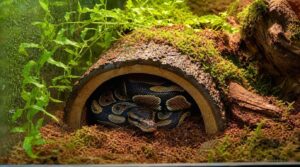
A humid hide is one of the most important things you can set up for a snake that needs help shedding or staying hydrated. Getting it right comes down to a few simple details — the right materials, proper floor contact, and knowing your snake’s specific humidity needs.
Here’s what to focus on when building one: correct grammar and spelling, preserve meaning, style, and formatting.
Damp Sphagnum Moss
Damp sphagnum moss is the ideal solution for humidity control inside a DIY snake hide. It holds up to 20 times its own weight in water, providing exceptional moisture retention.
Its capillary action distributes moisture evenly throughout the hide, while its natural expansion fills curved interiors snugly. This creates the microclimate stability essential for your snake’s well-being.
The moss’s slight acidity discourages bacterial growth, ensuring humidity management remains both effective and safe.
Moist Paper Towels
Paper towels make a reliable backup when sphagnum moss isn’t on hand. Their absorbency comes from wood-pulp fibers that wick and spread moisture evenly—effective humidity management without the mess. For DIY snake hides, follow these four steps:
- Use plain, unscented towels only
- Dampen thoroughly, then wring out excess water
- Replace every 24–48 hours for mold prevention
- Check for sliminess before each replacement as a basic safety precaution
Flush Floor Contact
Once your moist paper towels are in place, the hide itself must sit perfectly flat against the enclosure floor. A level floor integration isn’t just cosmetic—it creates a direct thermal conduction path from the substrate to your snake’s belly. Gaps allow warmth to escape and invite debris underneath.
| Flush Contact Factor | Why It Matters |
|---|---|
| Gasketed base design | Seals moisture in, keeps substrate out |
| Debris exclusion seal | Prevents mite harborage beneath the hide |
| Flat, non-porous bottom | Enables full body contact for larger snakes |
| Substrate selection | Firm bedding holds the hide level without shifting |
| Inspection schedule | Weekly checks catch warping before gaps form |
For any DIY snake hide or commercial reptile hide, press the base firmly down and check all four corners. Ventilation for reptile hides should never compromise that seal.
Digital Hygrometer Probe
Once your hide sits flush, you need real data—not guesswork to confirm effective humidity control. Place a digital hygrometer probe inside the hide, ensuring tidy cable management by routing the flexible cord along the enclosure wall.
These probes measure relative humidity with ±3% RH accuracy, and models featuring wireless monitoring and data logging enable trend tracking without disturbing the setup.
Species Humidity Targets
Every species has its own comfort zone regarding relative humidity. Ball pythons require 60–70%, while corn snakes thrive at 40–60%. Desert species, however, have a maximum tolerance of 50%—exceeding this threshold risks mold becoming a real problem.
During a shedding humidity spike, temporarily increase humidity by 5–15 points to facilitate the process.
Maintaining consistent humidity year-round requires seasonal adjustments and implementing a misting system.
Add Ventilation Without Escape Risks
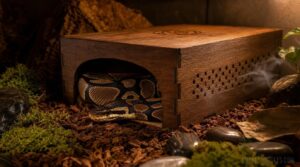
Good ventilation keeps your snake comfortable, but the wrong setup can turn a hide into an escape hatch.
A few simple rules make it easy to get airflow right without giving your snake a way out. Here’s what to keep in mind when adding ventilation to any hide.
Quarter-inch Mesh Openings
Mesh screen openings no larger than ¼ inch (6.35mm) ensure your enclosure remains escape resistant while maintaining airflow efficiency. This gap size effectively blocks escape attempts without compromising ventilation.
For lasting enclosure security, select stainless steel for its corrosion resistance or UV-stabilized plastic for outdoor use. Additionally, edge crimping prevents scale snags, addressing a critical safety detail for your snake’s well-being.
Distributed Airflow Holes
Staggered Hole Pattern Optimization across multiple sides prevents dead zones and facilitates consistent airflow rate calculations. Aim for roughly one vent per 100 cubic inches of the hide’s volume.
Anti-Escape Grommets seal edges cleanly, while Moisture Barrier Design and Pressure Drop Management work together to balance reptile ventilation needs.
This approach ensures optimal airflow dynamics without chilling your snake or compromising environmental stability.
Covered Ventilation Points
A hooded vent design enhances airflow dynamics while shielding openings from spills and debris, ensuring uninterrupted reptile ventilation. By integrating low-profile grates (6–12 mm across) that sit flush, the system eliminates snag points and maintains a sleek profile.
Weatherproof sealing gaskets and UV-resistant coatings fortify the structure, preventing material degradation over time. These features collectively safeguard against environmental wear, ensuring long-term functionality.
A polycarbonate monitoring lens allows visual confirmation of active airflow, guaranteeing consistent ventilation for the snake’s respiratory needs. This transparent component provides both durability and real-time performance verification.
Debris-free Vents
Magnetic vent covers snap on and off for cleaning while keeping debris out through fine mesh openings. ABS vent housings resist moisture and wipe down quickly.
Integrated dust seals and baffle airflow filters trap particles before they reach your space. Stick to a weekly vent cleaning routine, and your ventilation system stays clear and functional.
Secure Hide Placement
Position your snake hides with intention — corner placement creates a natural visual barrier function, reducing stress by limiting sightlines. Keep DIY snake hide builds away from direct light and close to your temperature gradient alignment for effective thermoregulation.
Elevated hide placement works for some species, but proximity to water matters just as much.
Strategic reptile hide positioning ties your entire setup together.
Make Budget DIY Snake Hides
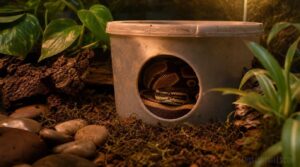
You don’t need to spend much to give your snake a safe, comfortable place to hide.
A few everyday materials can be turned into functional hides that work just as well as store-bought options.
Here are five budget-friendly builds worth trying.
Yogurt Container Hide
A standard yogurt container is one of the most practical DIY snake hide options you’ll find. Made from BPA-free plastic polypropylene, it’s easy to clean and genuinely portable.
Cut a small entrance hole, add a drainage modification near the base, and layer damp sphagnum moss inside for microclimate stability.
The opaque walls handle light blocking naturally—keeping your snake calm and secure.
Cardboard Box Shelter
If the yogurt container feels too small for your snake, a DIY cardboard snake hide scales up easily. Use food-grade corrugated cardboard for an eco-friendly material that won’t off-gas chemicals.
Apply a non-toxic moisture barrier sealant along interior seams, then reinforce corners using lightweight plastic brackets as reinforcement techniques.
This portable design makes it a practical, budget-friendly option for habitat enrichment for snakes.
PVC Pipe Hide
PVC pipe surpasses cardboard when you need something truly waterproof. Cut sections to custom lengths—4 to 6 inches for hatchlings, up to 14 inches for adults—then deburr every edge to prevent scale snags.
Color-coded diameters help track sizing across multiple snakes. Fit Seal-Pro endcaps to control humidity and ensure a secure environment.
Incorporate an integrated thermometer near modular connectors for temperature monitoring and system adaptability in this DIY snake hide.
Foam Cave Shell
Closed-cell foam offers a significant upgrade over rigid pipe, combining lightweight durability, shapeability, and moisture resistance. This makes the Foam Cave Shell an ideal DIY solution for snake hides.
Its design excels in reptile enclosures with key features:
- Humidity Resilience — resists warping even at 80% enclosure humidity
- Non-Slip Base — stays put on glass or PVC flooring
- Paintable Surface — accepts acrylic paint sealed with reptile-safe sealant
- Custom Entrance Width — trim openings to fit hatchlings (4–5 inches) or adults (9–12 inches)
- Multi-Level Design — staggered entrances support thermal zoning across warm and cool sides
Crucially, this hide contains no harmful VOCs, ensuring a safer environment for reptiles compared to many commercial alternatives.
Sealed Spray-foam Rock
Sealed spray-foam rock elevates your DIY snake hide by shaping closed-cell insulated foam into a cave form. Apply a surface coating that doubles as a moisture barrier, blocking humidity swings from degrading the core. Custom carving allows precise sizing of the entrance to fit your snake’s needs.
Basic durability testing—such as a firm squeeze and a wipe-down—confirms this reptile-safe material withstands long-term use.
Top 8 Snake Hideouts
If you’d rather skip the DIY route and grab something ready to go, there are plenty of solid options worth knowing about. These picks cover different styles, sizes, and budgets, so there’s something here for most setups. Here are eight snake hideouts that consistently get the job done.
1. Reptology Shale Scape Cave Hideout
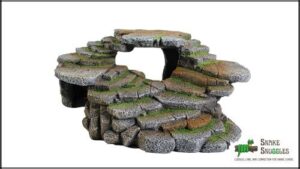
The Reptology Shale Scape Cave Hideout gives your snake something flat plastic boxes can’t — layered depth, four entrance holes, and a built-in basking platform, all in one 11 × 8.25 × 4-inch resin piece.
The non-porous material resists mold and cleans up easily with mild soap.
One thing to check before setup: run your fingers along the edges. Some surfaces arrive slightly rough, so a quick sanding keeps your snake’s scales and shed skin safe.
| Best For | Small reptiles, amphibians, and aquatic critters like axolotls, shrimp, and crayfish who need a hide, a climb, or a basking spot in one piece. |
|---|---|
| Material | Resin |
| Dimensions | 11 × 8.25 × 4 in |
| Entry Points | 4 holes |
| Easy to Clean | Yes, mild soap |
| Edge Safety Check | Sand before use |
| Best Snake Size | Small only |
| Additional Features |
|
- Four entry points and a stepped platform give animals real options — hiding, climbing, or just chilling on top
- Non-porous resin means no mold buildup and easy cleaning in both freshwater and saltwater tanks
- Works in aquariums and terrariums, so it pulls double duty if you ever switch up your setup
- Edges can come out of the box a little sharp, so you’ll want to sand them down before your animal goes near it
- No anchor means it can wobble in larger tanks unless you set it into the substrate
- Medium and larger reptiles will outgrow it fast — it’s sized for smaller animals
2. Exo Terra Snake Cave Hideout
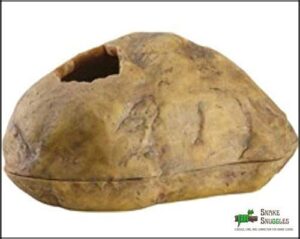
The Exo Terra Snake Cave stands out for one practical reason: it doubles as both a standard hide and a humid retreat. At 9.8 × 7.4 × 4.7 inches, it fits comfortably in 20–40 gallon enclosures and suits ball pythons, king snakes, and corn snakes up to about 3–4 feet in length.
The included dry moss packet lets you dial in 50–70% humidity inside the hide simply by dampening it, creating an ideal microclimate for shedding and hydration.
A removable top ensures stress-free health checks and cleaning, eliminating the need for disruptive excavations.
| Best For | Owners of small to mid-sized snakes like ball pythons, corn snakes, or king snakes who want a hide that pulls double duty as a humid shedding retreat. |
|---|---|
| Material | Resin |
| Dimensions | 9.8 × 7.4 × 4.7 in |
| Entry Points | 1 entrance |
| Easy to Clean | Yes, mild soap |
| Edge Safety Check | Check base lip |
| Best Snake Size | Up to 3–4 ft |
| Additional Features |
|
- The removable lid makes health checks and cleanouts quick and easy — no need to stress your snake out digging for it
- Built-in moss support lets you bump up humidity right inside the hide, which is a game-changer during shedding season
- Heavy, stable construction means it stays put even when your snake is pushing around inside it
- The entrance is on the snug side, so larger or thicker snakes over 4 feet may struggle to get in and out comfortably
- The shallow lip at the base is something to watch — a small snake could get pinched if you set the lid down without checking first
- The included moss can have a noticeable odor out of the box, and some owners skip it entirely and swap in their own
3. Zilla Vertical Rock Cave Decor
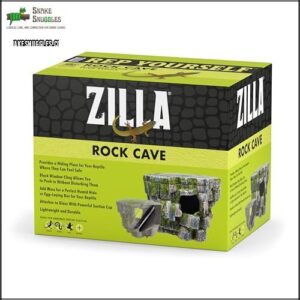
Most hides sit on the floor, but the Zilla Vertical Rock Cave Decor takes a different approach—it mounts directly to the glass wall using suction cups, putting the hide where arboreal species actually want to be.
At 7.87 × 5.51 × 6.30 inches, it works well in 20-gallon or larger terrariums.
The hand-painted foam mimics natural rock, and the built-in viewing window lets you check on your animal without disturbing it.
Just sand down any rough spots before introducing your pet.
| Best For | Gecko, frog, and small arboreal reptile owners who want a hide that matches how their animals actually live—up off the ground. |
|---|---|
| Material | Painted Foam |
| Dimensions | 7.87 × 5.51 × 6.30 in |
| Entry Points | 1 entrance + window |
| Easy to Clean | Yes, repositionable |
| Edge Safety Check | Sand rough spots |
| Best Snake Size | Small arboreal |
| Additional Features |
|
- Mounts to the glass wall, giving climbing species a natural elevated hide and basking spot
- Built-in viewing window lets you peek in without stressing your animal
- Easy to reposition and clean, so habitat upkeep stays simple
- Suction cups can lose grip over time, which is a real concern for anything mounted above the floor
- At nearly 8 inches long, it can eat up a lot of space in a smaller enclosure
- Foam surface may have rough patches out of the box and has shown durability issues after a few months
4. Exo Terra Reptile Cave Hide
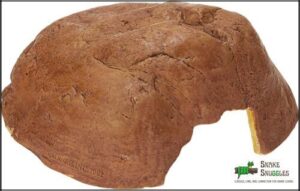
The Exo Terra Reptile Cave Hide (Model PT2854) provides a roomy, no-fuss hideout for your snake. Measuring 10.23 × 11.02 × 4.33 inches and weighing just over 2 pounds, its substantial build ensures stability even when your reptile moves around.
Constructed from high-density resin, this hide effectively controls humidity and cleans easily with mild soap. For added moisture, tuck damp moss inside to create a humid hide tailored to your pet’s needs.
Before initial use, inspect the entrance edges—light sanding removes minor roughness from the mold, ensuring a smooth, safe surface.
| Best For | Reptile owners with medium to large species—like adult ball pythons, bearded dragons, or big geckos—who want a spacious, durable hide that fits naturally into their setup. |
|---|---|
| Material | High-Density Resin |
| Dimensions | 10.23 × 11.02 × 4.33 in |
| Entry Points | 1 entrance |
| Easy to Clean | Yes, mild soap |
| Edge Safety Check | Sand before use |
| Best Snake Size | Medium to large |
| Additional Features |
|
- Roomy enough for larger reptiles, and you can tuck damp moss inside to double it as a humid hide
- Easy to clean thanks to a simple design without a lot of hard-to-reach crevices
- Sturdy resin construction holds up well under strong lighting and regular handling
- Edges can come out of the mold a bit sharp, so you may need to sand them down before use
- The size is overkill for smaller tanks—it’ll eat up a lot of floor space in a 10-gallon or under
- Not the best fit for enclosures with constant misting, since repeated moisture exposure can cause the resin to degrade over time
5. Zilla Reptile Bark Bend Terrarium Decor
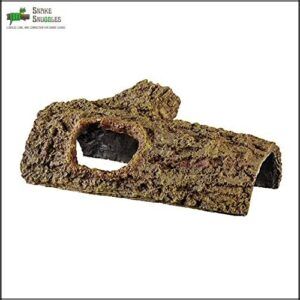
The Zilla Bark Bend offers a practical choice for keepers seeking a natural-looking hide without real wood’s risks. Its non-porous, rot-resistant plastic mimics bark texture closely, measuring 11.1 × 4.8 × 5.5 inches—ideal for corn snakes and small ball pythons.
The open-ended design allows unobtrusive observation, perfect for monitoring shedding cycles without disturbing your snake.
Clean it easily with mild soap and water, ensuring long-lasting hygiene for years of use.
| Best For | Reptile keepers who want a natural-looking hide that’s easy to clean and lets them keep an eye on their animals without pulling the whole setup apart. |
|---|---|
| Material | Non-Porous Plastic |
| Dimensions | 11.1 × 4.8 × 5.5 in |
| Entry Points | Open-ended |
| Easy to Clean | Yes, mild soap |
| Edge Safety Check | Sand or seal edges |
| Best Snake Size | Small ball pythons |
| Additional Features |
|
- Looks like real bark but won’t rot, splinter, or harbor bacteria the way natural wood can
- Open-ended design lets you watch shedding and burrowing behavior without disturbing your pet
- Heavy enough to stay put in water or on substrate, so it won’t shift around
- Some units arrive cracked or with rough edges that need sanding or sealing before they’re safe to use
- The actual dimensions can vary from what’s listed, so fit isn’t always guaranteed
- At nearly a pound, it can be a bit awkward to reposition inside a smaller tank
6. BobbyPet Hobbit House Aquarium Decoration
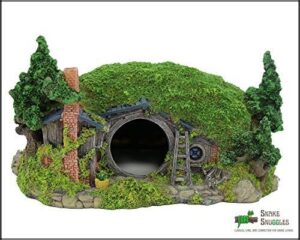
The BobbyPet Hobbit House offers a unique option for themed vivariums. Measuring 26.5 × 18 × 15 cm, it provides a spacious retreat for smaller corn snakes and similar-sized reptiles. Constructed from non-toxic resin, it ensures safety by preventing harmful compound leaching. Its sealed, water-resistant surface allows for effortless cleaning.
Inspect the interior openings carefully, as the largest entrance measures 2.2 inches. While suitable for juveniles, this may be too snug for adult snakes.
| Best For | Hobbyists setting up themed freshwater or saltwater tanks, small reptile enclosures, or anyone who just wants a fun little hideout for bettas, shrimp, or juvenile snakes. |
|---|---|
| Material | Non-Toxic Resin |
| Dimensions | 26.5 × 18 × 15 cm |
| Entry Points | 4 holes |
| Easy to Clean | Yes, sealed surface |
| Edge Safety Check | Sand interior edges |
| Best Snake Size | Juvenile only |
| Additional Features |
|
- Four entrance holes in different sizes give a variety of critters a way in, and the weighted base keeps it from tipping over in the tank.
- Made from non-toxic resin that’s safe for both freshwater and saltwater setups, so you’re not stressing about chemicals leaching into the water.
- Doubles as shelf décor if you’re not using it in a tank — it’s genuinely a cute piece on its own.
- The interior can have sharp edges right out of the box, so you’ll want to do a quick inspection (and maybe some light sanding) before adding it to your tank.
- A few buyers have noticed a strong chemical smell initially — plan on soaking it in hot water for a day or two before use.
- The largest opening is only 2.2 inches, which works fine for juveniles but won’t fit most adult snakes or larger fish.
7. Exo Terra Skull Terrarium Decor
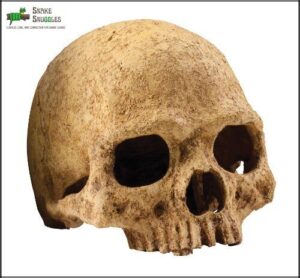
If you’re after something with a bit more personality than a plain cave, the Exo Terra Skull Terrarium Decor is worth considering.
Measuring 6.3 × 6.3 × 5.7 inches and weighing 0.88 lb, it stays stable on flat substrate without shifting.
Multiple entry points — eye sockets, cheek openings, and a rear crack — let smaller snakes choose their own access angle. Check the interior edges before placing it, though; resin lips around the openings sometimes need light sanding.
| Best For | Small reptiles and amphibians like ball pythons, leopard geckos, and crested geckos whose owners want a hide that actually looks cool in the tank. |
|---|---|
| Material | Resin |
| Dimensions | 6.3 × 6.3 × 5.7 in |
| Entry Points | Multiple openings |
| Easy to Clean | Yes, mild soap |
| Edge Safety Check | Sand interior edges |
| Best Snake Size | Small only |
| Additional Features |
|
- Multiple entry points (eye sockets, cheek openings, rear crack) give shy animals options and double as a climbing structure for frogs and spiders
- Works in desert, rainforest, and aquatic setups, so it’s versatile enough to move between tanks
- Stable weight keeps it from shifting around when animals push against it
- Interior edges can be sharp right out of the box — you may need to sand them down before it’s safe to use
- Too small for adult or larger reptiles, so it has a pretty narrow size range
- It’s decorative, not a full hide — smaller animals still need a separate primary shelter for proper coverage
8. Reptile Hide Box for Geckos and Snakes
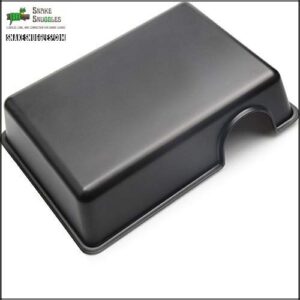
If personality isn’t your priority and function is, the Zipefy Reptile Hide Box keeps things straightforward. At 9.5 × 6.7 × 2.2 inches, it fits comfortably in 28–41 qt tubs and works well for small adult ball pythons or geckos.
The resin surface wipes clean in seconds, and the textured interior actually helps with shedding.
At $9.88 a unit, stocking both warm and cool sides won’t hurt your wallet. Just note it runs snugly for larger individuals over four feet.
| Best For | Small reptile owners — geckos, spiders, and juvenile to small adult ball pythons — who want a no-fuss, affordable hide that’s easy to clean and works well in a rack setup. |
|---|---|
| Material | Resin |
| Dimensions | 9.5 × 6.7 × 2.2 in |
| Entry Points | 1 entrance |
| Easy to Clean | Yes, rinse only |
| Edge Safety Check | Not flagged |
| Best Snake Size | Small to medium |
| Additional Features |
|
- Smooth resin wipes clean fast, so maintenance takes almost no time
- Textured interior actually helps reptiles shed, which is a nice bonus
- At $9.88, buying multiple hides for warm and cool sides is totally doable
- Tight fit for ball pythons over four feet — larger snakes will feel cramped
- Resin feels lighter than wood or glass, so it’s not ideal under heavy décor
- Dimension listings can be inconsistent, which makes sizing a bit of a guessing game
Clean and Inspect Hides
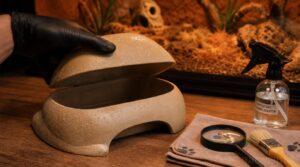
Keeping your snake’s hide clean directly affects their health and stress levels. A quick routine check can catch problems before they become serious.
Watch for issues like mold, mites, or cracks during inspections. These concerns require prompt attention to prevent complications.
Here’s what to look for and how to stay on top of it.
Mild Soap Cleaning
Regular cleaning keeps your DIY snake hide safe and stress-free for your snake. Stick to a weekly schedule using warm water (25–35°C) and an unscented formula like castile soap — no dyes, no antibacterial agents.
Always wear gloves, rinse thoroughly until zero lather remains, then air-dry completely before returning your snake.
- Remove your snake first, every time
- Mix mild soap into warm water for light suds
- Wipe all hide surfaces with a soft cloth
- Rinse twice to eliminate soap film
- Dry fully before reassembly
Vinegar Disinfection Soak
Once a week, soap cleaning manages surface grime, but deeper disinfecting and sanitizing calls for a vinegar soak.
Mix a 1:9 white-vinegar-to-water solution — that’s your ideal solution concentration — and fully submerge the DIY reptile hide for 30 minutes.
Material compatibility matters here: ABS and polypropylene tolerate this well. Always wear gloves as a safety precaution.
Rinse thoroughly with clean water before drying completely.
Mold and Mite Checks
Routine enclosure inspection keeps problems from sneaking back, even after disinfecting and sanitizing. During your regular cleaning schedule, check for fuzzy white or dark patches — mold spotting early saves you a bigger mess later.
Run a ventilation audit on all openings and conduct a sealant inspection around joints to maintain structural integrity.
Mite trail detection requires closely scanning seams and corners, as mites thrive where humidity control slips.
Cracks and Warping
Crack detection becomes critical once a hide starts showing material fatigue — small splits widen fast under daily handling pressure.
Heat-induced warping, common with ABS hides placed too close to heat mats, compresses interior space and can trap your snake.
For any DIY reptile hide tutorial build, follow basic repair guidelines: replace hides when cracks exceed 2mm or walls bow noticeably.
Stress Behavior Signs
Your snake’s body doesn’t lie — stress shows up fast when something’s wrong with its environment, including its hide. Watch for these reptile behaviors and stress signals:
- Rapid breathing or coiled tightening into a defensive ball
- Excessive tongue flicking without any feeding interest
- Lethargic shedding cycles or incomplete shed patches
- Feeding refusal lasting two or more consecutive meals
Fixing your snake hide — or building a better DIY snake hide — often resolves these issues quickly.
Frequently Asked Questions (FAQs)
Can multiple snakes share one hiding place?
No, most snakes shouldn’t share hides. Territorial behavior, stress indicators, and disease transmission risks make it unsafe.
Even size compatibility and species-specific requirements do not justify it—using separate reptile hides is always the better call.
How often should hides be replaced completely?
Material lifespan varies: ABS and polypropylene hides last around five years, PVC up to seven. Watch for wear indicators like cracks or warping — those signal replacement time regardless of age.
Do snakes prefer dark or light-colored hides?
Most snakes prefer darker hides. Light sensitivity drives this: dark interiors mimic natural burrows, support camouflage benefits, and reduce stress.
Thermal influence, species variation, and age preferences all shape the final choice.
Should hides be removed during feeding time?
Think of the hide as a hunter’s blind — removing it disrupts ambush behavior cues mid-strike. For feeding stress reduction, leave it in place.
Most snakes exhibit improved prey containment safety and comfort signals in snakes with hides intact.
Whats the best hide for shedding snakes?
A humid hide packed with damp sphagnum moss is your best option.
It promotes moisture retention, maintains shedding temperature, and gives your snake molting access for a clean, complete shed every cycle.
How often should I replace my snakes hide?
Replace snake hides based on material lifespan: ABS and polypropylene last around two years, while porous wood degrades within six months in humid enclosures.
Visual wear like cracks signals immediate replacement regardless of schedule.
Can snakes share a hide in the same enclosure?
Most snakes do not share well. Territorial aggression, stress indicators, and health concerns make cohabitation risky.
Species compatibility and size matching rarely align safely, so separate hides and enclosures are always the better choice.
Do hides need to be anchored down securely?
A loose hide is like a door with no frame.
Anchor your DIY snake hide using substrate-compatible fasteners to ensure stable placement, support load testing, and maintain an escape-resistant enclosure.
Can lighting placement affect hide effectiveness?
Lighting placement affects hide effectiveness.
Diffuse entrance lighting and glare reduction keep your snake calm, while LED lights and visual barriers support shadow camouflage without overheating the space inside your snake hides.
Conclusion
Think of your snake’s hide the way you’d think of a good night’s sleep—without it, nothing else in the enclosure really works. Creating a secure hiding place for pet snakes ties every other care decision together: temperature regulation, shedding success, feeding response, and long-term health.
Get the fit right, maintain the humidity, keep it clean, and your snake’s behavior will tell you everything you need to know.