This site is supported by our readers. We may earn a commission, at no cost to you, if you purchase through links.

A snake without a hide isn’t just uncomfortable—it’s physiologically stressed. Elevated cortisol from constant exposure keeps snakes in a low-grade defensive state that suppresses appetite, disrupts shedding cycles, and shortens lifespan over time. The hide isn’t an accessory; it’s the anchor of the whole enclosure.
Most keepers understand this in theory, but the gap shows up in practice: one plastic box shoved in a corner, sitting on the wrong temperature zone, two sizes too big. The snake paces. Sheds come out patchy. Feeding strikes get inconsistent. Choosing the right types of snake enclosure hides—material, size, placement, and quantity—closes that gap faster than almost any other husbandry adjustment you can make.
Table Of Contents
- Key Takeaways
- Why Snake Enclosure Hides Matter
- Common Types of Snake Hides
- How to Choose Hide Size
- Best Hide Placement Strategies
- Top 10 Snake Hide Products
- 1. Leottera Medium Snake Lizard Gecko Hide
- 2. Pangea Large Reptile Hide Box
- 3. Gondola Small Plastic Reptile Hide Box
- 4. FCALIVV Reptile Hide Box
- 5. Exo Terra Medium Gecko Cave Hideout
- 6. Jihaqua Black Reptile Hide Box
- 7. Lucky Critter Reptile Viewing Cave
- 8. Reptizoo Resin Tree Trunk Hideout
- 9. Zilla Rock Lair Small Humid Reptile Hide
- 10. Reptizoo Magnetic Tree Trunk Hide
- Frequently Asked Questions (FAQs)
- What is the best material for a snake enclosure?
- What makes a good snake hide?
- What is the best flooring for snakes?
- How many hides should a snake have?
- How often should snake hides be replaced?
- Can snakes share hides in multi-snake enclosures?
- Do seasonal hide changes benefit snakes?
- Are homemade hides as effective as commercial?
- What bedding works best inside hides?
- Can hides be made at home using safe materials?
- Conclusion
Key Takeaways
- A hide isn’t optional comfort — without one, your snake experiences elevated cortisol levels that suppress appetite, disrupt shedding, and shorten its lifespan.
- Fit matters more than looks: the interior should be 80–90% filled when your snake coils, with wall contact on at least three sides to provide a sense of security.
- You need a minimum of two hides placed at opposite ends of the temperature gradient, plus a third damp hide packed with sphagnum moss during shedding season.
- Material choice has trade-offs — plastic is easy to clean and durable, resin retains heat better, cork offers a naturalistic look, and ceramic adds thermal mass but is prone to chipping if dropped.
Why Snake Enclosure Hides Matter
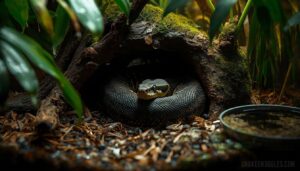
A hide isn’t just decoration — it’s one of the most important things in your snake’s enclosure. Without a proper one, even a well-fed, healthy snake can start refusing meals and showing signs of chronic stress.
A good starting point is browsing options like these snake hides designed for kids with pet snakes, which balance the right sizing and ease of cleaning.
Here’s what you need to know about why hides matter before you pick the right one.
Stress Reduction and Security
Without visual privacy, your snake never fully relaxes — and chronic stress suppresses immune function over time. Opaque hides block overhead movement, which tanks stress biomarkers quickly.
Enclosure trust builds when your snake can press against solid walls on all sides. That security alone reduces defensive behavior and dramatically improves habituation speed, making routine handling safer for both of you.
Providing a tight fitting hides improve security can further reduce stress.
Thermoregulation Across Warm and Cool Zones
Security isn’t the only reason hides matter — placement across the temperature gradient is just as important.
Your snake’s vasomotor control depends on zone switching: moving between the warm and cool sides to manage metabolic heat.
Without covered shelter in both zones, heat exchange breaks down. One hide on each end of the thermal gradient ensures thermoregulation functions optimally.
Better Shedding With Humidity Support
Humidity matters just as much as temperature when shedding season rolls around. A humid hide lined with sphagnum moss—your best option for moisture retention ratio—creates a localized damp pocket without soaking the whole enclosure.
During the cloudy pre-shed phase, snakes instinctively self-select these spots. Humidity hide benefits are real: cleaner sheds, fewer stuck eye caps, and reduced need for intervention.
Feeding Confidence and Normal Behavior
A secure feeding hide does more than shelter your snake — it directly facilitates consistent feeding cues and normal feeding posture. Snakes strike more reliably from covered spots, and a calm enclosure setup prevents stress-induced anorexia before it starts.
Predictable routine patterns matter too: same time, same method, less hesitation.
Understanding the role of hides in snake behavior helps you prevent stress-related feeding issues before they develop.
Why Most Snakes Need Multiple Hides
Most snakes genuinely need more than one hide — not as a luxury, but as a baseline for reptile stress reduction and enhanced immune function. Here’s why multiple hides matter:
- Thermal regulation – Dual placement covers both the 88–92°F warm zone and 76–80°F cool zone without forcing exposure.
- Stress hormone suppression – Constant cover access keeps baseline cortisol low.
- Escape route redundancy – Multiple retreats mimic natural burrow systems.
- Using humidity hides for shedding – A third, damp hide facilitates clean 4–8-week shed cycles.
- Energy conservation – Snakes burn less energy when cover is always within reach.
Common Types of Snake Hides
Not all hides are created equal, and material makes a bigger difference than most keepers expect. Each type has real trade-offs in durability, humidity retention, and how well it fits your snake’s natural behavior.
Here’s a breakdown of the seven main options you’ll find on the market.
Plastic Hide Boxes
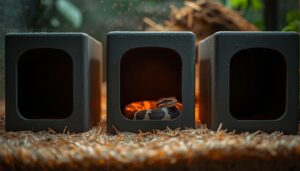
If you want something that just works, the plastic hide box is hard to beat. Most are made from recycled polypropylene—lightweight with a real Weight Advantage over ceramic—and their smooth, rounded edges won’t scratch your snake. Cleaning Efficiency is a genuine plus here: wipe it down, done.
| Size | Dimensions | Opening |
|---|---|---|
| Small | 14 × 9 × 6 cm | 3.5 × 4.5 cm |
| Medium | 24.5 × 17.5 × 6 cm | 5 × 4.5 cm |
| Large | 33 × 24 × 8 cm | 6 × 6 cm |
Material Longevity is solid—rigid polypropylene holds its shape through repeated disinfecting cycles without cracking. Cost Comparison? These usually run cheaper than resin by a wide margin.
No top seal, no suction cup drama. Just a reliable, dark-interior utility hide that gets the job done.
Resin Rock Hides

Resin rock hides punch above their weight in several ways. The nontoxic resin with thermal inertia absorbs warmth and releases it slowly, while the non-porous surface resists bacterial buildup and cleans easily. Heavy stability keeps them grounded when your snake pushes around.
Natural rock textures and natural aesthetics blend beautifully into bioactive setups.
Top picks include LEOTERRA Snake Hide, Pangea Reptile Hide Box, and Zilla Vertical Rock Cave for long-term durability.
Ceramic and Clay Hides
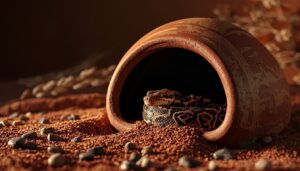
Ceramic and clay hides bring serious thermal mass to the table — fired clay holds heat longer than thin plastic, helping stabilize warm-side temperatures naturally.
Stoneware bodies fired above 1200°C offer solid weight stability and resist tipping when your snake pushes against them.
Glaze sealing matters here: unglazed earthenware absorbs moisture and harbors bacteria, while a proper glaze makes cleaning straightforward.
Impact durability is a trade-off — drop one, and it may chip.
Best for species suitability where a snug, heavy retreat beats a lightweight box.
Cork Bark and Log Hides
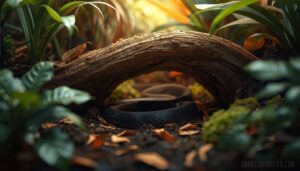
Cork bark is about as close to a naturalistic hide as you’ll get without digging up a forest. It’s lightweight—weight considerations matter in stacked or bioactive builds—resists mold naturally, and blends into planted enclosures without effort.
Eco-friendly materials like this tick multiple boxes at once.
- Custom cutting lets you trim pieces to fit tight corners
- Natural surface texture gives snakes real grip
- Natural aesthetics make it ideal for display enclosures
Composite Natural-look Hides
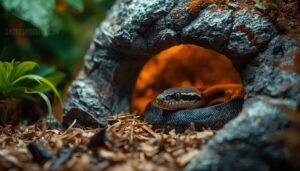
Composite hides split the difference between plastic utility and cork’s natural look. A resin shell over a foam or fiberglass core provides resin’s durability with a realistic texture that mimics weathered stone.
The thermal mass inside moderates temperature swings more effectively than thin plastic, enhancing environmental stability.
Models like the LEOTERRA Snake Hide, Exo Terra Gecko Cave, and Pangea Reptile Hide Box exemplify this naturalistic design while maintaining stable weight and easy cleaning.
Humidity Hides for Shedding

A snug, enclosed space packed with sphagnum moss creates a concentrated moisture pocket essential for your snake, especially during the pre-shed stage. Watch for dull, cloudy eyes and a blue-grey body tone—these pre-shed behavior indicators signal that a damp hide should be prepared.
Moisture Retention Materials worth keeping on hand:
- Sphagnum moss — holds moisture longest and releases it slowly
- Vermiculite or perlite — retains humidity without becoming waterlogged
- Damp paper towel — quick, easy swap during active shedding
- Removable lids support easy-clean hide designs and fast material swaps
- A small hygrometer nearby acts as your go-to humidity monitoring tool
Mold prevention strategies are critical: keep the fill moist, not soaking, and air it out between shed cycles. Proper humidity retention inside the hide helps loosen retained skin on toes and eye caps—without turning the entire enclosure into a swamp.
Arboreal and Elevated Hides

While your ground-dwelling snake appreciates a snug floor hide, arboreal species live a completely different life. Green tree pythons, tree boas, and carpet pythons spend over 90 percent of their time elevated.
Sky Hide Rails mount plastic boxes to enclosure roofs, supporting up to five pounds. Cork Bark Hollows, Magnetic Tree Mounts, and 3D Printed Shelves give climbing opportunities for snakes that rarely touch the ground.
How to Choose Hide Size
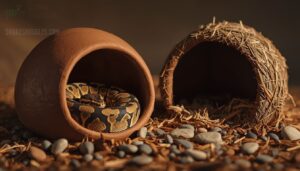
Getting the size right is honestly where most beginners trip up. A hide that’s too big gives your snake no sense of security, and one that’s too small stresses it out just as fast.
Here’s what to look at before you buy.
Snug Fit Vs Oversized Hides
Think of it like a sleeping bag — you want it fitted, not roomy. When a hide is oversized, your snake stays alert instead of settling, and that low-grade tension shows up as stress indicators like erratic movement or feeding latency.
An oversized snake hide trades security for stress, turning a shelter into a source of anxiety
Snug-fitting hides encourage hide retention and calmer behavior. Choosing the right snake hide means sizing down before sizing up.
Interior Width and Coil Space
Width is where most keepers miscalculate. Take your snake’s mid-body girth, divide by 3.14, then add 0.5 cm — that’s your coil diameter ratio baseline.
Understanding size requirements for snake hides means the interior should fill 80–90% with coiled body. Choosing the right snake hide uses this girth width ratio so space utilization efficiency stays tight, keeping your snake genuinely settled.
Entrance Opening Size
The entrance opening size matters more than most keepers realize. Clear Opening Width should measure 1.5–2× your snake’s body diameter — wide enough for smooth entry, tight enough to feel sheltered. Threshold Height affects ease of passage too; a sharp edge discourages use.
Species Body Size and Hide Form Factor both shape how Approach Path Fit works in practice.
Understanding size requirements for snake hides starts here.
Length Requirements for Full-body Coverage
Length is where most keepers quietly get it wrong. The full-body length rule is simple: your hide’s interior should match or exceed your snake’s snout-to-tail length, ideally by about 25%. That’s the length proportion rule in practice.
A good fit means:
- Full-body coverage with tail clearance at the rear
- Multi-sided contact so the snake feels enclosed
- No sharp coiling forced by a cramped interior
- Size guidelines for hides that scale as the snake grows
Watch for the size-up trigger — when any part stays exposed, it’s time to upgrade.
Sizing Hides for Hatchlings, Juveniles, and Adults
Each life stage demands a distinct approach to sizing snake hides, as growth curve measurements and body girth ratios evolve rapidly—particularly in juveniles. These shifts often outpace keepers’ expectations, making proactive adjustments critical.
| Life Stage | Age-specific Clearances | Snake Size Benchmarks |
|---|---|---|
| Hatchling | Snug, body-contact fit | Smallest commercial size |
| Juvenile | Slight turn-around room | Mid-size; recheck often |
| Adult | Full coil, walls touching | Largest species-appropriate hide |
Juveniles, such as corn snakes, outgrow hides faster than their length suggests, with girth increases leading the way. Conversely, adult ball pythons prioritize width over length to accommodate their bulk. To address these needs, rely on Shift Timing Guidelines and size specifications tailored to body shape.
Ultimately, successful hide selection hinges on prioritizing body girth ratios and adhering to stage-specific benchmarks. Regular checks and timely upgrades ensure enclosures remain functional and stress-free as snakes mature.
When to Upgrade Hides as Snakes Grow
Your snake will tell you it’s time to upgrade — you just have to know what to watch for. Growth spurts, especially in juveniles, can outpace your awareness fast.
- Fit Indicators: Body parts spilling out of the enclosure mean it’s too small.
- Behavioral Cues: Restless pacing or nose-rubbing signal discomfort.
- Shedding Cycle: Frequent sheds every four to six weeks require regular monitoring of their size.
Best Hide Placement Strategies

Getting the size right is only half the job — where you put each hide matters just as much.
A misplaced hide can throw off your snake’s thermoregulation, cause stress, and even interfere with shedding, no matter how well it’s built.
Here’s how to position every hide in your enclosure so your snake actually uses it.
Warm-side Hide Placement
Your warm-side hide should sit directly over or very near your heat source—that’s the whole point of thermal gradient positioning. For ball pythons, the hide’s interior temperature should reach 88–92°F; corn snakes prefer 82–88°F.
Ensure the substrate is level underneath the hide to prevent tipping. While heat source proximity is critical, hide stability assurance ensures your snake will actually use it.
Cool-side Hide Placement
Far-End Placement isn’t optional—it’s the foundation of any solid hide placement strategy. In a 4-foot enclosure, position it within the last 12 inches. Substrate Anchoring ensures stability after your snake moves around.
Run a Temperature Spot-Check inside the enclosure; Cool-Side Stability and Gradient Accessibility only work when the floor reads 72–80°F.
Mid-enclosure Humidity Hide Setup
A humid hide works best somewhere in the middle, not hard against either wall. This midpoint gives your snake access without forcing it to one temperature extreme. Sphagnum moss is my go-to substrate—it holds moisture well and releases it gradually. Maintaining a temperature gradient balance and simplifying moisture monitoring becomes easier when the damp hide isn’t competing with heat sources.
- Substrate Selection: sphagnum moss, coconut fiber, or damp paper towels all work
- Replace bedding every 2–3 weeks for Mold Prevention
- Keep the substrate damp, never soaked—no standing water
- Use a hygrometer to track humidity retention inside
- Apply Hide Relocation Tips first if your snake ignores it—move before changing anything else
Safe Distance From Heat Lamps
Heat source positioning is where many keepers quietly make mistakes. Lamp clearance guidelines exist for good reason — plastic hides can warp or melt below 6 inches, while resin rock hides handle 10-inch proximity safely.
A wattage distance chart helps: 75-watt halogens need 10–12 inches minimum. Pair that with thermostat use and daily infrared checks for solid thermal burn prevention.
Ground Hides Vs Elevated Hides
Once lamp clearance is sorted, the next decision is whether your hide sits on the floor or up the wall.
Species preference drives this more than anything else:
- Terrestrial snakes (corn snakes, ball pythons) want ground-level, snug-fitting hides mimicking burrows
- Arboreal species need wall-mounted hide options above substrate
- Stability concerns matter — a wobbly elevated hide kills predator perception of safety
- Microclimate variation and space utilization improve when you mix both levels
Creating Cover Without Trapping Excess Moisture
Cover is only half the job — moisture management is the other half. Ventilation design and drainage features matter more than most keepers realize. A damp hide with no airflow turns into a mold pocket fast.
Choose low material permeability options like smooth plastic, and add substrate barriers underneath.
Practice drying rotation — swap hides weekly so each fully dries before returning.
Top 10 Snake Hide Products
Finding a hide that actually fits your snake — and holds up over time — takes more than scrolling through Amazon reviews. I’ve used and tested options across plastic, resin, and composite materials, at different price points and size ranges.
Here are ten worth your time.
1. Leottera Medium Snake Lizard Gecko Hide
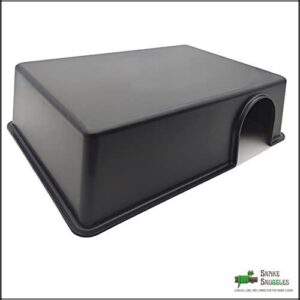
The LEOTERRA Medium hide punches above its $12.99 price tag in a few ways that actually matter. Its top-seal design locks in moisture, making it a solid humidity hide for species like corn snakes or ball pythons during shed cycles.
The 2.75 × 2.36-inch entrance accommodates most snakes under 150g without a struggle. Smooth, non-porous plastic ensures cleaning takes minutes, not effort.
Larger snakes can tip it, so anchoring may be necessary.
| Best For | Small reptile owners keeping corn snakes, ball pythons, geckos, or lizards under 150g who want a low-maintenance, humidity-friendly hide. |
|---|---|
| Material | Injection-molded plastic |
| Color | Black |
| Ease of Cleaning | Smooth, non-porous surface |
| Species Compatibility | Snakes, lizards, small mammals |
| Humidity Support | Top-seal moisture retention |
| Unit Count | 1 |
| Additional Features |
|
- Top-seal design holds moisture well, making it great for shed cycles and species that need a humid microhabitat
- Smooth, non-porous plastic is a breeze to clean — just rinse and you’re done
- Works for more than just reptiles; small mammals like hamsters and ferrets can use it too
- Larger snakes can tip or lift it, so you may need to weigh it down or anchor it somehow
- Feels less natural than cork or wood hides, which might not blend as well in a naturalistic setup
- Only comes in medium, so if your animal is on the bigger side, you’ll need to look at a different size entirely
2. Pangea Large Reptile Hide Box
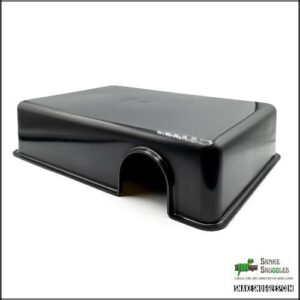
The Pangea Large Reptile Hide Box is a no-frills workhorse that earns its place in serious collections. At 13.25 × 9 × 3.25 inches, it fits comfortably in 28- to 41-quart tubs, providing a genuinely snug retreat for small adult ball pythons, boas, and kingsnakes.
Constructed from 1/8-inch ABS plastic, the hide box withstands repeated disinfection without warping, ensuring long-term durability.
The offset entrance is thoughtfully designed to reduce front exposure, actively lowering stress for reptiles rather than merely appearing clever.
One caveat: snakes under 500g may feel lost inside it, as the spacious interior could overwhelm smaller individuals.
| Best For | Reptile keepers housing adult ball pythons, boas, corn snakes, or kingsnakes in mid-sized tubs who want a durable, easy-to-clean hide that just works. |
|---|---|
| Material | Rigid plastic |
| Color | Black |
| Ease of Cleaning | Smooth, wipe-clean surface |
| Species Compatibility | Ball pythons, boas, corn snakes |
| Humidity Support | Not specified |
| Unit Count | 1 |
| Additional Features |
|
- Roomy enough for most adult snakes up to 5 feet, so they can fully tuck in and feel secure
- Super easy to clean — smooth plastic surfaces wipe down fast and hold up to repeated disinfecting
- Fits a wide range of enclosure sizes (28- to 41-qt tubs) and works on either the hot or cool side
- Too big for smaller snakes under 500g — they may feel exposed rather than secure
- It’s purely functional, so if you want something that looks natural in a display tank, this isn’t it
- Only one hide comes in the box, so you’ll need to buy more if you’re outfitting multiple enclosures
3. Gondola Small Plastic Reptile Hide Box
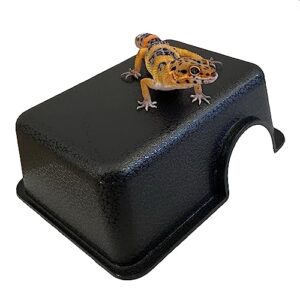
The Gondola Small Plastic Reptile Hide Box punches well above its price point for hatchlings and small juveniles. At 6.1 × 4.33 × 2.16 inches, it fits snugly in 3-quart tubs — exactly where most new keepers start.
Its wide 2⅜-inch entrance accommodates thicker-bodied hatchlings without a struggle, while the matte black plastic stays clean with a quick wipe-down. Weighing just 1.76 oz, repositioning it during tank reconfigurations takes seconds.
It won’t suit anything approaching adult size, but for small corn snakes or juvenile geckos, it’s genuinely practical.
| Best For | New reptile keepers housing hatchlings, small corn snakes, or juvenile geckos in 3-quart tubs or compact enclosures. |
|---|---|
| Material | Matte plastic |
| Color | Black |
| Ease of Cleaning | Moisture-resistant surface |
| Species Compatibility | Geckos, corn snakes, juvenile boas |
| Humidity Support | Not specified |
| Unit Count | 1 |
| Additional Features |
|
- Wide 2⅜-inch entrance makes it easy for thicker-bodied hatchlings to get in and out without squeezing
- Moisture-resistant matte plastic wipes clean in seconds — great for humid setups
- At just 1.76 oz, it’s light enough to reposition whenever you’re rearranging the tank
- The textured outer surface catches debris, so deep cleaning takes a bit more effort
- Only comes in black, so it won’t blend into every terrarium theme
- Too small for anything beyond juveniles or small adults — you’ll outgrow it faster than you’d like
4. FCALIVV Reptile Hide Box
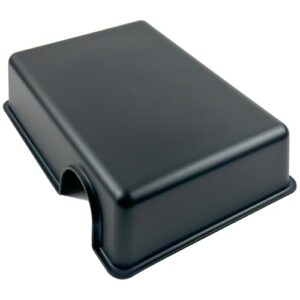
The FCALIVV hits a practical middle ground — big enough for adult leopard geckos and juvenile ball pythons, yet compact enough not to dominate a 10-gallon setup. At 9.45 × 6.89 × 2.17 inches and just 5.29 oz, it’s easy to reposition without rearranging your entire layout.
The smooth black plastic interior wipes clean in under a minute, a critical feature when managing humid hides.
One entrance limits exit options, but for most ground-dwelling species, that single opening provides the snug security they seek.
| Best For | Hobbyists keeping small reptiles like leopard geckos, juvenile ball pythons, or tarantulas in a 10-gallon or similarly sized enclosure. |
|---|---|
| Material | Rigid polymer plastic |
| Color | Black |
| Ease of Cleaning | Smooth interior surface |
| Species Compatibility | Ball pythons, geckos, tarantulas |
| Humidity Support | Not specified |
| Unit Count | 1 |
| Additional Features |
|
- Smooth plastic interior wipes clean fast — great for humid hide setups where mold and bacteria build up quickly.
- Lightweight and easy to reposition, so you can tweak your tank layout without a full teardown.
- Neutral black finish stays out of the way visually and fits most standard terrarium setups.
- The "large" label is a stretch — adult or larger snakes will likely outgrow it fast.
- Only one entrance, which can be a dealbreaker for species that feel safer with multiple exit points.
- Plain plastic look won’t win any points for naturalistic décor — it’s purely functional.
5. Exo Terra Medium Gecko Cave Hideout
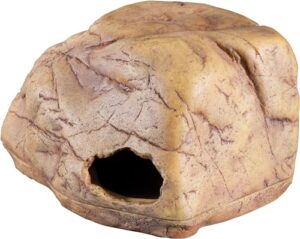
The Exo Terra Gecko Cave Medium earns its spot here for one reason: the removable lid. At 5 × 6 × 3.7 inches and 1.65 lb, it’s sturdy enough that active geckos will not tip it, and the resin construction holds humidity better than basic plastic.
Fill it with dampened sphagnum moss, and it doubles as a proper shedding hide. The material’s ability to retain moisture makes it functional for humidity-dependent processes.
However, it’s not ideal for most snakes—the entry hole is small. For leopard geckos and similar species, though, it works well at $14.99.
| Best For | Leopard gecko owners who want an easy-to-clean humid hide that doubles as a shedding spot. |
|---|---|
| Material | Resin |
| Color | Natural/Brown |
| Ease of Cleaning | Detachable lid for access |
| Species Compatibility | Leopard geckos, similar species |
| Humidity Support | Detachable lid for moss |
| Unit Count | 1 |
| Additional Features |
|
- Removable lid makes cleaning and moss swaps quick and painless
- Heavy enough to stay put even under an active, larger gecko
- Retains moisture well, so it works great as a dedicated shedding hide
- The entry hole is too small for most snakes and could be a tight fit for bigger adult geckos
- Won’t work well as a warm hide since heat doesn’t penetrate the resin base easily
- Moss dries out over time, so you’ll need to mist or refresh it regularly
6. Jihaqua Black Reptile Hide Box
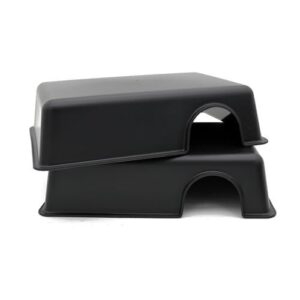
The Jihaqua Black Reptile Hide Box keeps things simple—and that’s exactly its strength. Built from 1/8-inch heavy-duty polypropylene, it resists cracking under pressure from restless corn snakes or curious juvenile ball pythons weighing under 500 grams.
The black plastic blocks light effectively, a critical feature for reducing stress in reptiles. Its offset entrance ensures your snake remains fully concealed from view, enhancing privacy and security.
Cleaning requires just 30 seconds: wipe, rinse, and you’re done. However, note the interior runs snug, so snakes over 500 grams will require a larger alternative.
| Best For | Small reptile owners keeping juvenile or small adult snakes—like corn snakes or ball pythons under 300g—who want a clean, low-maintenance hide that pulls double duty as a basking platform. |
|---|---|
| Material | High-impact plastic |
| Color | Black |
| Ease of Cleaning | Easy-wipe surface |
| Species Compatibility | Corn snakes, ball pythons |
| Humidity Support | Flat top for moisture source |
| Unit Count | 2 |
| Additional Features |
|
- Super easy to clean—just wipe it down and you’re done in seconds
- Flat top lets you add a heat tile or moisture source, so it works as more than just a hide
- Two-piece set with a removable lid makes it easy to check on your snake without the stress
- Too small for larger snakes or adults over 300g, so you may outgrow it fast
- Actual dimensions don’t always match what’s advertised, which can cause fit issues in tighter enclosures
- A bit pricey for what’s essentially a small plastic box—value feels thin if you’re buying singles
7. Lucky Critter Reptile Viewing Cave
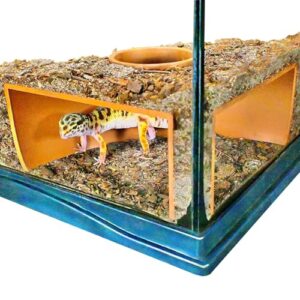
If privacy matters most, the Jihaqua wins. But if you want to actually watch your corn snake or hognose without lifting the lid, the Lucky Critter Reptile Viewing Cave earns its place.
The transparent panel lets you observe your animal while it stays tucked in—no stress, no disruption. At roughly 6 × 6 × 3 inches, it fits juveniles and small adults well.
It doubles as a humid hide when you pack sphagnum moss inside, supporting cleaner sheds without a separate setup.
| Best For | Owners of small or juvenile reptiles who want to observe their pet without causing stress or disturbing its hiding spot. |
|---|---|
| Material | Durable plastic |
| Color | Brown |
| Ease of Cleaning | Smooth plastic interior |
| Species Compatibility | Geckos, snakes, anoles |
| Humidity Support | Specialized humid hide design |
| Unit Count | 1 |
| Additional Features |
|
- The transparent panel lets you check on your reptile without lifting the lid or spooking them.
- Fits snugly into tank corners and mimics a natural underground burrow, which reptiles genuinely seem to love.
- Works as a humid hide when packed with sphagnum moss, supporting healthy sheds without needing extra equipment.
- The interior is small, so larger or adult reptiles will likely outgrow it fast.
- Spraying moisture inside is tricky given the underground placement, making humidity harder to maintain.
- Photos can make it look bigger than it is, so double-check the dimensions before you buy.
8. Reptizoo Resin Tree Trunk Hideout
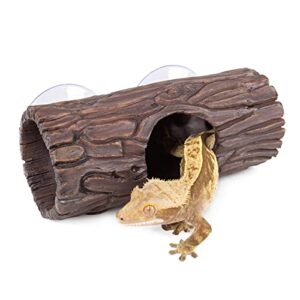
The Reptizoo Resin Tree Trunk Hideout serves well for observation and décor, offering dual functionality as shelter. Ideal for juveniles and smaller species like leopard geckos, it combines practicality with aesthetic appeal.
Measuring 7.8 × 4.9 × 2.1 inches and weighing just over 8 ounces, it’s designed for compact habitats. Two suction cups enable secure mounting on glass or acrylic surfaces at customizable heights, ensuring stability and versatility.
Constructed from non-toxic resin, the hideout is easy to clean and maintains its color without fading. This durable, low-maintenance design prioritizes both safety and longevity in reptile enclosures.
| Best For | Small reptiles and juveniles like leopard geckos or anoles that need a secure, wall-mounted hideout in a glass or acrylic enclosure. |
|---|---|
| Material | Resin |
| Color | Brown |
| Ease of Cleaning | Resin, does not discolor |
| Species Compatibility | Geckos, anoles, hermit crabs |
| Humidity Support | Not specified |
| Unit Count | 1 |
| Additional Features |
|
- Mounts easily to glass or acrylic walls with dual suction cups, so you can adjust the height anytime.
- Made from non-toxic resin that’s simple to clean and won’t fade or discolor over time.
- The hollow interior gives small reptiles a cozy spot to hide, rest, and feel less stressed.
- Not a great fit for larger or adult reptiles — at just under 8 inches, it’s on the small side.
- Suction cups can lose their grip on textured or dirty surfaces, so placement matters.
- Some users find the look a bit plain, so it may not blend well with more detailed enclosure setups.
9. Zilla Rock Lair Small Humid Reptile Hide
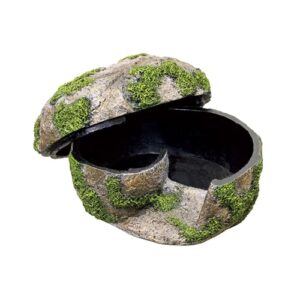
The Zilla Rock Lair Small prioritizes function over decoration, unlike the Reptizoo. At 5.5 × 5 × 4 inches, it’s purpose-built as a humid hide—ideal for filling with damp moss or wet paper towels to support clean sheds.
Its cast resin construction ensures durability and stability, preventing tipping. The rough exterior texture also serves a practical purpose, providing snakes with a surface to rub against during shedding, a detail that significantly enhances its utility.
| Best For | Small reptile owners—especially those keeping geckos, small snakes, or egg-laying lizards—who need a reliable humid hide to support healthy shedding and natural behavior. |
|---|---|
| Material | Cast resin |
| Color | Grey |
| Ease of Cleaning | Durable, easy-to-clean resin |
| Species Compatibility | Snakes, geckos, small lizards |
| Humidity Support | Sealed lid with drain holes |
| Unit Count | 1 |
| Additional Features |
|
- Built-in humidity retention makes it easy to create a damp microenvironment with just moss or wet paper towels
- Rough exterior texture gives snakes a useful surface to rub against during shedding
- Heavy, stable base keeps it from tipping even when active reptiles climb on top
- Shipping damage is a real issue—chips and cracks show up more often than they should
- The interior runs small, so juveniles that grow quickly may outgrow it fast
- Fresh out of the box, the resin smell can be strong and needs airing out before use
10. Reptizoo Magnetic Tree Trunk Hide
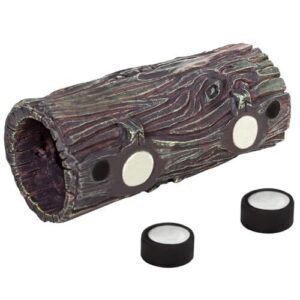
Where the Zilla leans into function, this one leans into form — and still holds its own. The Reptizoo Magnetic Tree Trunk Hide mounts directly to your glass wall using neodymium magnets, supporting up to 1.8 lb without suction cups or drilling.
At 3.54 × 6.22 × 2.99 inches, it fits small species like leopard geckos comfortably. The hollow resin trunk doubles as a climbing perch, combining utility with natural aesthetics.
Repositioning takes seconds — simply slide the magnets carefully. However, thin glass doesn’t forgive rough handling, so ensure gentle adjustments to avoid damage.
| Best For | Small reptile and amphibian owners who want a natural-looking hide that’s easy to reposition without leaving marks on the glass. |
|---|---|
| Material | Resin |
| Color | Brown |
| Ease of Cleaning | Smooth resin surface |
| Species Compatibility | Reptiles, amphibians, crustaceans |
| Humidity Support | Not specified |
| Unit Count | 1 |
| Additional Features |
|
- Mounts securely with strong neodymium magnets — no suction cups, no adhesives, no hassle
- Doubles as a climbing perch, giving small species like leopard geckos both shelter and activity
- Non-toxic, UV-stable resin keeps it looking good long-term without color fading
- The 1.8 lb weight limit rules it out for bigger or heavier species
- Sliding the magnets carelessly can crack thin glass, so it needs a gentle touch
- Only one hide per pack, which may not cut it for larger enclosures
Frequently Asked Questions (FAQs)
What is the best material for a snake enclosure?
Think of PVC as the Swiss Army knife of enclosure materials — it holds heat, locks in humidity, and cleans up fast.
For most snake keepers, it’s the most reliable all-around choice.
What makes a good snake hide?
A good snake hide fits snugly, remains stable, uses non-toxic materials, and maintains smooth interior surfaces.
Your snake should contact at least three walls when coiled inside — that contact is what makes it feel safe.
What is the best flooring for snakes?
Hides get most of the attention, but flooring quietly does the heavy lifting.
Aspen suits dry species, coconut husk works for tropical snakes, and paper towels keep quarantine setups clean and easy to monitor daily.
How many hides should a snake have?
At minimum, your snake needs two hides — one on the warm side, one on the cool side. Ball pythons benefit from a third humid hide during shedding.
Since hides and setup are just one piece of the puzzle, it’s worth reading up on which pet snake breeds best match your lifestyle before committing to decades of care.
How often should snake hides be replaced?
Like a worn-out shoe, a hide that’s cracked, warped, or persistently smelly needs to go. Replace plastic hides when damage appears.
Natural materials like cork usually last 6–18 months depending on humidity.
Can snakes share hides in multi-snake enclosures?
Technically yes, but it’s rarely a good idea.
One snake almost always claims the best hide, leaving the other exposed or stuck in a poor temperature zone — silent stress with real consequences.
Do seasonal hide changes benefit snakes?
For most snakes, seasonal hide swaps aren’t necessary. The one adjustment that actually matters is adding a humid hide when shedding season approaches or the air gets drier.
Are homemade hides as effective as commercial?
Homemade hides can work just as well as commercial ones — if they fit snugly, use non-porous materials, and have a smooth finish.
Build quality matters far more than the price tag.
What bedding works best inside hides?
The best bedding inside hides depends on your snake’s needs. Aspen works for dry-lovers, coconut fiber holds humidity for tropicals, and damp sphagnum moss hits 90% for shedding support.
Can hides be made at home using safe materials?
Yes, you can build safe DIY hides using styrofoam, grout, and polyurethane sealant. Let materials cure fully — at least two weeks — before placing them in the enclosure.
Conclusion
Think of your enclosure as a blueprint for trust—every hide you place is a signal your snake reads before it ever relaxes. Getting the types of snake enclosure hides right, from material and size to placement and quantity, isn’t just about ideal. It’s about consistency.
A snake that feels secure eats well, sheds clean, and lives longer. You’ve got the knowledge now. Match it with the right hides, and your setup will show it.