This site is supported by our readers. We may earn a commission, at no cost to you, if you purchase through links.

Most desert snakes die not from dehydration, but from the well-intentioned keeper who drowns their enclosure in moisture, trying to prevent it. A rosy boa from the Sonoran Desert evolved for ambient humidity hovering around 20%—yet it still needs a damp microclimate to shed cleanly and stay healthy.
That tension between desert species and "moisture requirements" trips up even experienced reptile keepers. Nailing desert snake humidity care means understanding that dry doesn’t mean bone-dry, and that precision—not guesswork—separates a thriving snake from one cycling through retained sheds and respiratory infections.
Table Of Contents
- Key Takeaways
- Ideal Humidity for Desert Snakes
- Measure Humidity The Right Way
- Build a Safe Humidity Gradient
- Raise Humidity Without Overdampening
- Fix Humidity Problems Fast
- Frequently Asked Questions (FAQs)
- How humid is too humid for a snake?
- Can a snake plant handle high humidity?
- Is 30 degrees too hot for a corn snake?
- Can desert snakes share enclosures with humidity differences?
- How does diet affect a desert snakes hydration needs?
- Do hatchlings require different humidity than adult snakes?
- How does geographic origin influence individual humidity tolerance?
- Can soaking replace enclosure humidity for desert snakes?
- Conclusion
Key Takeaways
- Desert snakes don’t need bone-dry enclosures—species like rosy boas thrive at 15–40% ambient humidity, with a localized damp zone added only during shedding cycles.
- Calibrated hygrometers, one at each end of the enclosure, give you an actual humidity map rather than a single misleading number.
- A humid hide packed with damp (not dripping) sphagnum moss targets moisture precisely where your snake needs it without saturating the whole enclosure.
- Earliest warning signs—retained eye caps, patchy sheds, and excessive soaking behavior—indicate that humidity has drifted too low—check your gauges and substrate before the next shed begins.
Ideal Humidity for Desert Snakes
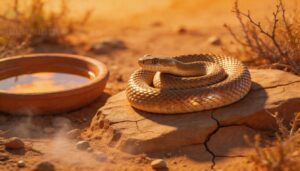
Desert snakes aren’t high-maintenance regarding humidity — but that doesn’t mean anything goes. Each species has a specific range that keeps it healthy, and getting it right starts with knowing your snake.
A good starting point is checking a species-specific humidity guide for desert snakes before you ever set up your enclosure.
Here’s what the numbers should look like for the three most common desert species.
Target Range for Rosy Boas
Rosy boas aren’t a one-size-fits-all species regarding humidity requirements. Desert subspecies thrive in a microclimate zone target of 15–40%, while coastal subspecies tolerate 60–80% given their Baja California origins.
Keep ambient levels under 60% for most localities, then apply a shedding humidity boost using substrate selection like sphagnum moss.
Seasonal humidity variation indoors demands consistent monitoring.
Maintaining the proper temperature gradient requirement is also critical for overall health.
Target Range for Hognose Snakes
Hognose snakes split cleanly by species. The Western Hognose Range sits at 30–50% humidity—dry, well-ventilated, and close to their sandy prairie origins. Eastern Hognose Range runs slightly higher at 50–60%, reflecting moister woodland habitats.
Substrate moisture influence matters here:
- Keep the top layer visibly dry
- Retain light moisture below the surface
- Apply a shedding boost timing when shed cycles begin
- Maintain temperature-humidity balance throughout
Target Range for Desert Kingsnakes
Desert kingsnakes operate comfortably within a 40–60% seasonal humidity range, with ambient levels for subspecies like Lampropeltis splendida sitting between 50–75% depending on geographic humidity variation.
Younger snakes benefit from age-based levels slightly higher in that range.
The temperature-humidity link matters here—your warm basking end stays near 40%, while the cool side naturally climbs.
That balance is desert kingsnake husbandry done right.
When to Raise Humidity During Shedding
Kingsnake humidity stays controlled year-round—but shedding changes the rules.
Watch for Early Shed Signs: dull, faded scales, and a pinkish belly are your Behavioral Cues to act.
Once the Mid Shed Phase hits and eyes cloud over, raise your humidity gradient to 60% locally.
Post Shed Recovery means dropping back down immediately. Temp Humidity Sync keeps the misting techniques targeted, not total‑enclosure.
Why Desert Species Still Need Moisture Balance
Even arid-adapted snakes lose water through respiratory water loss and skin evaporation—their bodies minimize loss; they don’t eliminate it. Species-specific humidity requirements exist because kidney concentration and skin flexibility both depend on periodic moisture access.
Even desert snakes need moisture—their bodies minimize water loss, but never eliminate it
In the wild, microclimate burrows supply that balance.
Your enclosure’s humidity gradient, substrate selection, and ventilation replicate those sheltered refuges, directly supporting metabolic efficiency and preventing the health impacts of improper humidity.
Measure Humidity The Right Way
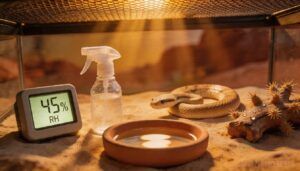
Knowing your snake’s target humidity range is only half the battle—you also need reliable tools to confirm what’s actually happening inside the enclosure. A guess isn’t good enough when the difference between 40% and 60% can mean a clean shed or a trip to the vet.
Here’s what you need to measure humidity accurately and consistently.
Best Hygrometers for Reptile Enclosures
Not all digital hygrometers are built equal — and in desert snake keeping, the wrong tool quietly undermines everything.
Look for models with waterproof sensors, fast response updates, and a backlit display you can actually read in dim conditions.
Wireless connectivity via Bluetooth, like the Govee H5100, allows remote humidity monitoring through app alerts.
Prioritize units with humidity calibration support and humidity data logging to track shed-cycle trends reliably.
Battery life of 10–12 months keeps maintenance minimal.
Where to Place Hygrometers for Accurate Readings
Where you mount your digital hygrometer matters as much as which model you buy. Mid‑height placement keeps the humidity sensor reading actual air conditions rather than pooled substrate moisture or heat‑distorted zones near basking bulbs — heat source avoidance is non‑negotiable.
Maintain water bowl distance to prevent inflated readings, and dodge vents for stable airflow and drafts.
Substrate clearance and thoughtful positioning give your humidity monitoring tools and placement best practices real microclimate‑zone accuracy.
Using Two Gauges to Track Enclosure Zones
One gauge tells you the humidity. Two gauges tell you the story.
Place a digital hygrometer at each end, and your Dual Readings Analysis immediately reveals the humidity gradients shaping your snake’s daily choices. Gauge Data Sync and Spatial Moisture Mapping show exactly how microclimate zones differ — critical for species-specific humidity requirements.
Watch for:
- Zone Humidity Trends drifting apart after misting
- Cross-Zone Alerts signaling ventilation strategies for glass terrariums that over-dry the warm side
- Uneven substrate moisture skewing one reading independently
How to Calibrate a Digital Hygrometer
A hygrometer that reads 5% off isn’t giving you data — it’s giving you false confidence.
The Salt Reference Test fixes that. Pack table salt with a few drops of water into a small cup, place it beside your digital hygrometer inside a Sealed Bag Setup, and wait. Wait Time Guidelines suggest 6–12 hours minimum — don’t peek early.
| Calibration Step | Key Detail |
|---|---|
| Salt mixture texture | Damp paste, not a puddle |
| Sealed environment | Airtight bag or container |
| Target reading | 75% relative humidity |
| Wait time | 6–12 hours (24 for precision) |
| Button Offset Adjustment | Press calibration button or note the difference |
If your reading drifts, apply a Button Offset Adjustment immediately. Follow a Recalibration Schedule every six months — more often if temperatures swing dramatically.
Logging Daily Humidity Changes
A single reading tells you almost nothing — patterns tell you everything.
Log morning and evening humidity in each enclosure zone daily, noting minimums and maximums, so Trend Analysis and Zone Comparison reveal whether moisture is holding or drifting.
Data Visualization across weeks exposes Seasonal Patterns tied to indoor heating.
Set Alert Thresholds, so repeated low readings trigger action before your snake’s next shed suffers.
Build a Safe Humidity Gradient
A good humidity gradient gives your desert snake the freedom to self‑regulate — moving between drier and damper zones as its body needs. Setting one up is less complicated than it sounds, and a few targeted adjustments go a long way.
Here’s exactly how to build each zone correctly.
Creating Dry and Humid Enclosure Zones
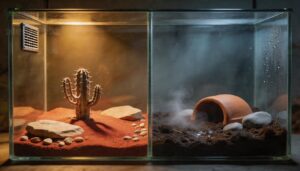
Zone Partitioning turns a flat, uniform enclosure into a functional landscape your snake can actually navigate by choice.
Effective Microclimate Separation depends on three core decisions:
- Position the Dry Basking Area on the warm end, keeping ventilation holes high to direct Airflow Direction away from humid zones.
- Use Moisture Barriers—like glass panels or sealed dividers—to contain humidity boxes without saturating the whole enclosure.
- Concentrate damp substrate on the cool end, creating humidity gradients in terrariums that mirror desert microhabitats naturally.
Substrate Depth for Moisture Control
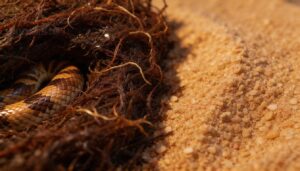
Substrate depth shapes humidity stability more than most keepers expect. In the humid hide zone, 3–4 inches of coconut coir or cypress mulch creates layered moisture zones that release water slowly — a critical factor for desert kingsnake sheds.
Shallower 1–2 inch layers on the dry side improve drainage and aeration. Particle size influence matters too: finer substrates retain moisture longer, so depth‑adjustment scheduling keeps retention depth balance consistent.
Water Bowl Placement and Evaporation

Once substrate depth is locked in, water bowl placement becomes your next lever for humidity control.
For a desert kingsnake enclosure, cool side benefits are real — slower evaporation rate, more stable readings, and fewer bacterial blooms. wider, shallower dishes increase surface area and push moisture up faster.
Key placement principles:
- Position on the cool side to limit unintended humidity spikes
- Choose a wide, shallow bowl to manage evaporation rate deliberately
- Keep bowls away from vents — airflow positioning affects how quickly water disappears
- Factor heat proximity effects into cleaning frequency, since warm placement accelerates slime buildup
Humid Hides for Localized Moisture
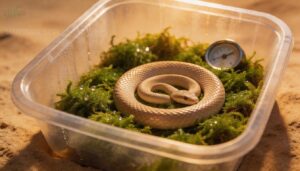
A water bowl raises ambient humidity passively, but a humid hide targets moisture exactly where your snake needs it.
Pack a plastic tub — sized just larger than your snake’s body — with long-fiber sphagnum moss for Moss Moisture Management that holds 70–85% within that microclimate zone.
Hide Size Optimization matters: too large, and the moisture dissipates.
Monitor with a small internal hygrometer for accurate Microclimate Monitoring, and follow monthly Cleaning Protocols using diluted F10SC to prevent bacterial buildup.
Balancing Ventilation With Humidity Retention
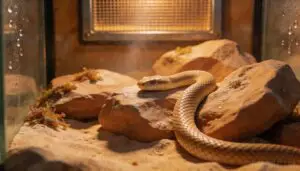
Ventilation Airflow Balance is the variable most keepers overlook — pushing too much air through and your carefully built humidity gradients collapse within hours.
- Use Pressure Controlled Exchange: seal duct gaps with mastic or foil tape (Duct Sealing Strategies) to prevent uncontrolled moisture loss
- Install Smart Vent Sensors that throttle airflow when humidity drops below target
- Consider Heat Recovery Ventilators for steady fresh-air exchange without stripping moisture
- Match screen coverage to your microclimate zones and substrate choices for moisture control
Raise Humidity Without Overdampening
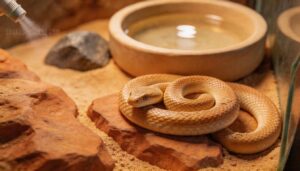
Getting humidity right for desert snakes isn’t about soaking the enclosure—it’s about knowing exactly when, where, and how much moisture to add. line between helpful and harmful is narrower than most keepers expect.
Here’s what actually works without tipping the enclosure into damp territory.
When and How Often to Mist
Misting desert snakes isn’t about routine—it’s about reading the enclosure. Morning Mist Timing works best because surfaces dry before nightfall, cutting mold risk. Only trigger evening misting when humidity monitoring and data logging practices show readings still below the range.
| Scenario | Mist Schedule |
|---|---|
| Normal conditions | 2–3x weekly |
| Pre‑Shed Boost | Daily spot-mist |
| Already in range | Skip; let ventilation work |
| Post-shed recovery | Resume normal frequency |
Mist Volume Control—light, wall-aimed spray, never a soak.
Best Substrates for Desert Snake Humidity Care
The right substrate does most of your humidity work before you even pick up a spray bottle.
A Coconut Fiber Mix retains moisture without sogging out, while Cypress Mulch Benefits include a slow, steady release that keeps levels stable for weeks.
Orchid Bark Longevity means months of structural integrity when moistened.
For burrowing species, Excavator Clay Stability holds zones firm, and Leaf Litter Moisture adds surface-level humidity passively.
Using Sphagnum Moss in a Humid Hide
Sphagnum moss transforms a basic hide into a precision humidity tool — but only when you prep it correctly. Squeeze a handful before placing it; if free water drips out, it’s too wet.
Moss Moisture Levels should feel damp, not saturated. Check daily, rehydrate as it dries, and replace when it compacts or smells off.
Fresh sourcing and consistent Moss Replacement Frequency keep moisture retention reliable without risking bacterial buildup.
Passive Moisture Methods for Dry Homes
Dry indoor air isn’t your enemy — unmanaged air exchange rates are.
When your home runs heat recovery ventilation, lower fresh-air volume slightly in winter to support humidity retention without sacrificing air quality.
Moisture buffer materials like coconut fiber and sphagnum moss inside humidity boxes passively stabilize enclosure levels. Prioritize seal integrity checks on your enclosure, refine substrate choices, and manage indoor plant placement to fine-tune ambient moisture.
When Automated Humidifiers Make Sense
Automation earns its place when manual misting simply can’t keep up. Three situations make automated humidity control systems worth the investment:
- Travel Absences — remote scheduling keeps species-specific humidity requirements stable without daily intervention.
- Large Enclosures — consistent output reaches every zone, balancing ventilation and moisture retention simultaneously.
- Shedding Support — timed cycles deliver targeted boosts efficiently, improving energy efficiency while protecting dry baseline conditions.
Fix Humidity Problems Fast
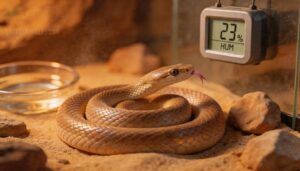
Even with the best setup, humidity will drift—that’s just the reality of keeping desert snakes indoors.
The good news is that most problems follow recognizable patterns, and once you know what to look for, fixing them is straightforward.
Here’s what to watch for and how to respond.
Signs Humidity is Too Low
When humidity drops too low, your desert snake won’t stay quiet about it — the signs show up fast. Incomplete shed, retained eye caps, and dehydrated skin are the clearest red flags in the shedding process, often signaling dysecdysis before it becomes serious.
| Warning Sign | What It Means |
|---|---|
| Stuck sheds / patchy skin | Humidity too low during shedding |
| Excessive drinking or soaking | Snake compensating for dry enclosure air |
| Respiratory wheeze or increased hiding | Chronic moisture deficit affecting health |
Check your dry hides and hygrometers immediately when you identify signs of dehydration in snakes.
Signs Humidity is Too High
Too much moisture is just as dangerous as too little. Watch for condensation on glass walls, sticky air sensation inside the enclosure, and fuzzy substrate spots — all classic overhumidification signals.
Wall water stains, scale rot, and mold and bacterial growth follow quickly when ventilation fails. Respiratory distress indicators like open-mouth breathing or audible wheezing confirm the problem has already progressed beyond condensation control.
Preventing Bad Sheds and Retained Eye Caps
Bad sheds don’t happen overnight — they’re the result of missed humidity cues and poor setup. Shedding cue detection starts when you notice dull skin and blue eyes, signaling it’s time to tighten your humidity management. Dysecdysis and stuck sheds follow when you ignore those signs.
Watch for these prevention fundamentals:
- Eye cap checks after every shed, confirm nothing was retained
- Rubbing surface provision — branches and cork bark help the snake strip cleanly
- Hydration support methods, like a humid hide with damp sphagnum moss
- A nutrient rich diet promotes healthy skin turnover throughout the shedding process
- Meeting species-specific humidity requirements prevents recurring problems without overdampening
Avoiding Scale Rot, Mold, and Bacteria
Scale rot doesn’t announce itself — it creeps in through wet substrate and poor Airflow Management.
Hide Dryness, regular Substrate Rotation, and solid ventilation cut off the conditions that fuel bacterial growth, preventing mold and bacterial growth start there.
If illness appears, Quarantine Isolation protects your other animals, and Tool Sterilization between enclosures stops cross-contamination, cold.
Keep humidity control tight, not sloppy.
Seasonal Humidity Adjustments for Indoor Heating
Winter Heating Impact hits desert enclosures harder than most keepers expect — Thermostat Cycle Effects pull moisture from the air fast, and your hygrometer readings can shift noticeably within hours.
Make Gradual Humidity Bumps using passive substrates and larger water bowls rather than heavy misting.
Room Airflow Management matters too, so maintain your Seasonal Calibration Schedule and check both enclosure zones weekly throughout heating season.
Frequently Asked Questions (FAQs)
How humid is too humid for a snake?
Too much humidity means sustained dampness—not a brief spike. Once levels stay above species thresholds consistently, scale rot, respiratory health issues, and bacterial buildup follow fast.
Can a snake plant handle high humidity?
Snake plants handle low humidity well but struggle when it stays high.
Their humidity tolerance tops out around 50%—excess moisture risks root rot, so skip misting and maintain strong air circulation.
Is 30 degrees too hot for a corn snake?
No, 30°C isn’t too hot for a corn snake—it falls within the standard basking spot temperature range.
What matters most is thermal gradient design: your snake must always have a cooler retreat available.
Can desert snakes share enclosures with humidity differences?
Keeping desert snakes together is like sharing one thermostat between two people who can’t agree on temperature — species-specific humidity requirements rarely align, and microclimate partitioning can’t fully compensate for fundamentally incompatible needs.
How does diet affect a desert snakes hydration needs?
Diet directly affects hydration balance—prey water content helps, but protein digestion cost increases water demand, triggering meal-induced thirst.
Always make sure water access timing aligns with feeding to prevent dehydration.
Do hatchlings require different humidity than adult snakes?
Yes — hatchlings lose moisture faster than adults and need tighter humidity control. Their smaller bodies have less hydration margin, making stable microclimates essential during early developmental skin shedding stages.
Because airflow affects how quickly moisture escapes, proper ventilation for a snake enclosure helps you keep humidity steady without letting the air turn stale.
How does geographic origin influence individual humidity tolerance?
A snake species’ wild home shapes how its skin regulates water loss.
Burrow microclimate, regional rain patterns, and edge range adaptation all drive population humidity variation far more than the label "desert" alone suggests.
Can soaking replace enclosure humidity for desert snakes?
Soaking feels like a quick fix, but it can’t replicate consistent enclosure humidity.
Over-soaking causes stress and strips protective skin oils — proper humidity regulation through substrate and humid hides remains the only reliable solution.
Conclusion
thousand failed sheds can trace their origin to a single misread hygrometer or a water bowl placed one inch too close to the warm end. Desert snake humidity care isn’t about choosing between wet and dry—it’s about engineering a gradient that mirrors what the wild does naturally.
Lock in your target ranges, trust your calibrated gauges, and build those localized humid zones. snake won’t just survive the setup. thrive inside it.