This site is supported by our readers. We may earn a commission, at no cost to you, if you purchase through links.

Rough green snakes spend most of their lives invisible. They hang motionless in a vine tangle, and even a careful eye slides right past them. That camouflage isn’t just striking; it’s a direct window into what keeping one actually demands.
Keeping rough green snakes as pets rewards patience over novelty. They don’t tolerate frequent handling, they need precise humidity and UVB, and a wild-caught specimen will likely stress itself to death inside a month. Get those fundamentals right, though, and you’ll have a captive-bred animal that’s hardy, long-lived, and genuinely fascinating to observe.
This guide covers every variable you need to get it right.
Table Of Contents
- Key Takeaways
- Are Rough Green Snakes Good Pets? Temperament, Lifespan, Cost, and Sourcing
- How Do You Set Up a Rough Green Snake Enclosure?
- What Temperature, UVB, and Humidity Do Rough Green Snakes Need?
- What Do Rough Green Snakes Eat, and How Often?
- How Do You Handle a Rough Green Snake and Keep It Healthy?
- Frequently Asked Questions (FAQs)
- Do rough green snakes make good pets?
- How much does a rough green snake cost?
- What’s the friendliest snake to have as a pet?
- Will a rough green snake bite you?
- What Regulations Should I Check Before Acquiring a Green Snake?
- Are Rough Green Snakes Suitable for Beginners?
- What Dietary Supplements Should I Provide My Green Snake?
- How Often Should I Feed My Green Snake?
- What Are Some Signs of Health Issues in Green Snakes?
- How big of a tank does a rough green snake need?
- Conclusion
Key Takeaways
- Always source captive-bred specimens — wild-caught rough green snakes carry disease, resist taming, and typically die from stress within a month.
- UVB lighting isn’t optional: a 5–7% UVB tube running 10–12 hours daily is a biological requirement, and skipping it leads directly to chronic health decline.
- These snakes are observers, not companions — limit handling to under ten minutes, two or three times weekly, and watch for color shifts or tail whipping as clear stress signals.
- Food refusal almost always traces back to a fixable cause — a tank that’s too cool, an approaching shed, or stress — so diagnose the environment before assuming illness.
Are Rough Green Snakes Good Pets? Temperament, Lifespan, Cost, and Sourcing

For a keeper drawn to arboreal insectivores, rough green snakes are a practical choice. Their calm, shy temperament makes them manageable, but don’t expect a snake that actively seeks handling. Most tolerate gentle contact once acclimated, though some individuals stay reclusive regardless.
For a deeper look at how rough green snakes compare temperamentally to their ground-dwelling cousins, rough vs. smooth green snake differences in personality and handling offers useful context for choosing between the two.
Lifespan runs 4 to 6 years in captivity, shorter than many popular species, so factor that into your commitment.
Setup costs fall between $200 and $600, covering the enclosure, UVB lighting, and décor. Yearly expenses run roughly $100 to $250. Hatchlings cost $20 to $60 each.
Sourcing matters. Wild specimens carry significant disease risk and resist taming. Always choose specimens bred in captivity. Reputable breeders provide care documentation, and local reptile clubs can help if availability is limited.
How Do You Set Up a Rough Green Snake Enclosure?
Once you’ve sourced a captive-bred snake, setup comes next. Enclosure size matters: a single adult needs a glass or acrylic tank at least 24 inches long. Go vertical. These snakes climb constantly, so tall arboreal enclosures between 18 and 24 inches high serve them better than wide, flat ones.
Habitat setup should include:
- Securely anchored branches of varying diameter for natural climbing
- Dense planting with live or artificial foliage for cover and security
- Two hide boxes placed at opposite ends of the tank
- Paper towels or reptile carpet as substrate
- A snug screen lid to prevent escapes
Temperature and lighting fixtures attach to the top of the screen. Position your misting points thoughtfully, keeping humidity levels consistent throughout the enclosure.
Pairing your setup with the right reptile substrate choices helps maintain that stable humidity while supporting healthy foot traffic along the enclosure floor.
What Temperature, UVB, and Humidity Do Rough Green Snakes Need?

Once your enclosure is built, the parameters inside it are what keep your snake alive.
Temperature gradients, humidity, and lighting cycles all matter — proper corn snake care covers exactly how to dial in each one.
Temperature and lighting depend on each other. Set your basking spot to 88-92°F, your warm side to 82-86°F, and let the cool end settle at 72-78°F. That range gives your snake room for temperature regulation across the tank. Night temps can drop naturally to 72-75°F. Use a thermostatic probe.
UVB required isn’t negotiable. A 5-7% UVB tube running 10-12 hours daily, placed 12-18 inches above the basking spot, is the standard. Replace the bulb every six to twelve months.
Reptile humidity control should sit at 40-60%. Bump to 65% during shedding. Mist two to four times weekly, and keep your ventilation solid to prevent mold.
If you’re ever unsure whether your setup is holding steady, rough green snake humidity and ventilation tips offer a useful cross-reference for dialing in moisture without inviting mold.
What Do Rough Green Snakes Eat, and How Often?
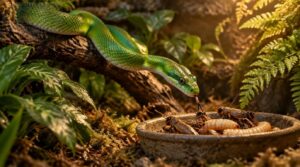
Your temperature gradient does half the feeding work for you. A warm snake digests; a cool one refuses food. That’s why the insectivore diet of this species starts with heat.
The crickets staple feeder rule applies here, but rotation matters. Gutloading feeder insects 24 hours before offering them turns prey into nutrition.
Plan your feeding frequency around the adult schedule:
- Two to three crickets per meal, no larger than the snake’s head width
- Small roaches or silkworms rotated in weekly
- One pinkie mouse occasionally for larger adults
- Prey offered in the evening after basking hours
- Uneaten insects removed within 12 to 24 hours
Watch for tongue flicking at the enclosure glass. That’s hunger. Refusal usually means the tank ran too cool, a shed is coming, or your snake is stressed. Fix the cause. Never force-feed.
A snake that stops eating is sending a message—decode it before assuming the worst
How Do You Handle a Rough Green Snake and Keep It Healthy?
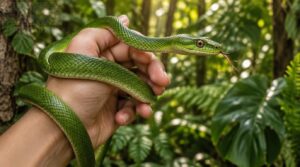
Rough green snakes don’t demand much from you, but what they do demand, you need to get right. Handling technique and health awareness are the two areas where most keepers either build trust with their snake or quietly stress it out. Here’s what you need to know about both.
Low-Stress Handling and Behavior
Rough green snakes aren’t built for frequent contact. Their stress-sensitive, slender build means handling sessions should stay under ten minutes, two or three times weekly.
Support the body loosely, letting the snake move freely through your hands. Sudden grips trigger flight responses. Watch for color shifts to blue-gray, tail whipping, or chronic avoidance. These are stress signals you can’t ignore.
In the wild, rough green snakes rely on camouflage as primary defense, which explains why captive individuals remain highly sensitive to perceived threats.
Shedding, Illness, and Veterinary Care
During a shed, watch for retained eye caps or stuck tail skin. These signal low humidity. Fix moisture first before anything else. A reptile shedding aid spray can help loosen stubborn skin when boosting ambient humidity alone isn’t enough.
Respiratory infection signs like open-mouth breathing need immediate vet attention. Scale rot and internal parasites can look subtle early.
Consistent parasite prevention starts with quarantine and clean sourcing. Don’t delay evaluation. These snakes decline fast when something’s wrong.
Frequently Asked Questions (FAQs)
Do rough green snakes make good pets?
They’re docile but fragile, stressing easily when handled often. If you want an observational pet from a captive-bred source, they can be genuinely rewarding. Expect a lifespan of 5 to 10 years with consistent care.
How much does a rough green snake cost?
Captive-bred hatchlings usually cost $25 to $80, with most reputable breeders landing somewhere between $40 and $60. Local pet shops mark that price up 10 to 30 percent. Skip wild-caught; they’re pricier and legally risky.
What’s the friendliest snake to have as a pet?
Like a calm river, corn snakes don’t fight back. Their gentle nature and minimal handling resistance keep reptile handling stress low. You can verify this through reptile behavioral observation: they rarely react to steady contact.
Will a rough green snake bite you?
It’s almost impossible to provoke a rough green snake into biting you. They’re non-aggressive by nature, always fleeing well before they’d ever consider fighting back. If one nips you, their tiny teeth barely break skin.
What Regulations Should I Check Before Acquiring a Green Snake?
Before you buy, verify your state wildlife laws and local ordinances first. Some jurisdictions ban non-native species outright or require permits to legally keep them. If you’re importing, expect documentation proving captive-bred origin as well.
Are Rough Green Snakes Suitable for Beginners?
Rough green snakes simply aren’t ideal for beginners. They’re prone to stress, resist frequent handling, and demand precise humidity, UVB exposure, and a consistently calm environment that takes solid reptile keeping experience to manage well.
What Dietary Supplements Should I Provide My Green Snake?
Feeder insects lose nearly half their nutrients after capture. Dust your insects with calcium powder two to three times weekly, gutload prey the night before, and skip D3 supplementation if you’re already running adequate UVB.
How Often Should I Feed My Green Snake?
Adults need feeding two to three times weekly. Use live insects, gut-loaded 24 hours before each session, and dust them with calcium powder. Limit each feeding to 20 minutes and adjust based on body condition.
What Are Some Signs of Health Issues in Green Snakes?
Lethargy, food refusal, open-mouth breathing, or incomplete sheds are common health issues you need to catch early. Abnormal stools always warrant reptile parasite screening. Don’t delay a vet visit if these health issue signs appear.
How big of a tank does a rough green snake need?
Target an enclosure size of at least a 20 gallon tall tank, but a 30 gallon or 40 gallon high-profile enclosure works best for most adults. Build a vertical terrarium setup for your arboreal snake habitat.
Conclusion
A keeper who skipped UVB for six months watched a healthy specimen gradually fade into chronic lethargy, then stop eating entirely. That outcome is entirely preventable.
Rough green snakes as pets aren’t forgiving of shortcuts, but they’re remarkably durable when you honor their actual biology. Get the enclosure right. Source captive-bred. Keep handling minimal. Do that consistently, and what you’ll maintain isn’t just a snake but a living proof of what precision husbandry can produce.