This site is supported by our readers. We may earn a commission, at no cost to you, if you purchase through links.

A $3 humidity probe can drift 15 to 20 percent without a single warning light. Your boa tub reads 80%, so you relax. Meanwhile the real number sits at 60, and your snake is halfway through a bad shed.
That’s the quiet risk of running a rack on guesswork. Boas want 70-90% RH, kingsnakes want 30-50%, and one sticky gauge can wreck both. Cheap sensors fail fast, especially near condensation or adhesive fumes.
The right humidity gauges for multi snake racks cost about $2.37 to $11.99 per tub. Here’s how four popular options hold up, and how to keep them honest.
Table Of Contents
- Key Takeaways
- Humidity Gauges for Multi-Snake Racks Compared
- Compare Rack Gauge Accuracy, Features, and Cost
- Plan Humidity Gauge Coverage Across Snake Tubs
- Position Humidity Gauges Inside Snake Rack Tubs
- Check Rack Gauge Accuracy and Track Humidity
- Frequently Asked Questions (FAQs)
- Where should the humidity gauge be in a snake enclosure?
- What is a good humidity level for a snake?
- What is the most accurate hygrometer for reptiles?
- How to keep humidity high in a snake enclosure?
- What humidity do ball pythons need during shedding?
- Why is a humid hide essential for snakes?
- Can high humidity cause respiratory problems in reptiles?
- How often should gauge batteries be replaced?
- What humidity do bearded dragons and leopard geckos need?
- Conclusion
Key Takeaways
- Cheap humidity probes can drift 15 to 20 percent without warning, so your 80% reading might really be 60% and quietly cause bad sheds.
- Check every gauge with a salt test (saturated salt reads 75% RH after 8 to 24 hours sealed together), replace any unit that’s off by more than a few points, and log the results.
- Put each probe on the substrate surface in the middle of the tub, away from the water bowl and misting path, and add a second one in the humid hide for shed checks.
- Prioritize gauges for shedding or gravid snakes, quarantine tubs, and tubs at the rack’s top and bottom, and match each tub’s target to its species, such as 70-90% for boas and 30-50% for kingsnakes.
Humidity Gauges for Multi-Snake Racks Compared
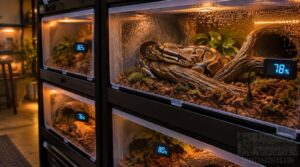
Running a snake rack means one cheap gauge won’t cut it. Below, you’ll find four multi-enclosure humidity gauge options, each suited to a different rack size and budget. Pick the one that fits your setup, and your tubs will stop keeping secrets from you.
If you’re weighing probe placement against wireless sensors for a larger rack, this best humidity gauge for snakes breakdown shows which readings you can trust tub to tub.
Antonki 2-Pack Review
A pair of Antonki 2Pack Indoor Thermometer Hygrometer units gives you a cheap start on multi enclosure coverage. Each unit reads ±5%RH and updates every 10 seconds. Magnets and a kickstand help. Each unit also needs 3~5 minutes of automatic calibration time after you turn it on, so wait before trusting the first readings. Battery life expectancy depends on that CR2032, so use the off button.
Expect the pair to disagree slightly. Is that a dealbreaker for reptile terrariums? Not if you cross-check.
JEDEW 4-Pack Review
Want tighter numbers? The JEDEW 4Pack Digital ThermoHygrometer reads ±1°F and ±3% RH, updating every 10 seconds. At about $3.55 per unit, multienclosure coverage gets cheap, and four units make multipoint humidity sensing realistic. Spare batteries come included.
Verify calibration right out of the box, since some units arrive off. The LCD is hard to read in dim rack rooms.
Geevon 6-Pack Review
Need more coverage? The Geevon Mini Digital Hygrometer 6 Pack costs $6.66 per unit, perfect for multipoint humidity sensing.
- Reads ±1°C and ±5% RH.
- Refreshes every 10 seconds.
- Mounts on a table, wall, or magnet.
- Has no backlight or alerts.
This temperature and humidity monitor suits reptile terrariums and bioactive enclosures, but calibrate it first.
If you’re unsure how the probe and display work together, this guide to how reptile thermometers work in terrariums explains why placing the sensor correctly matters.
REPTI ZOO Dual Gauge Review
Want simplicity? The REPTI ZOO Dual Gauge Review starts with its price: $11.99 for one unit. It’s a basic reptile enclosure monitoring tool, not a temperature and humidity logger, so you won’t get app data.
| Spec | Value | Note |
|---|---|---|
| Humidity | 10-99% RH | ±3% |
| Temperature | 14-140°F | ±1°C |
| Power | Air | No batteries |
Use sensor calibration methods before trusting it for enclosure zone monitoring.
Compare Rack Gauge Accuracy, Features, and Cost
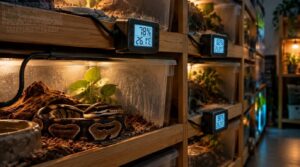
Four factors separate a gauge you can trust from one that just looks busy on your rack. We’ll check accuracy and sensor drift, multi-enclosure features, display and mounting options, and what each unit costs per enclosure.
Keep those four in mind as you scan the list below, because the cheapest gauge isn’t always the one that saves you money.
Accuracy And Sensor Drift
Is your humidity gauge lying to you? Probably, a little. Even a Sensirion SHTC3 holds ±2% RH accuracy, drifting under 0.25% a year. Cheap probes swing 15-20%.
Since accuracy matters most when a snake is about to shed, check this guide to ideal moisture levels during shed and calibrate your hygrometer against a salt test first.
- Run a salt test: saturated NaCl reads 75% RH.
- Log installation date and offset.
- Cross-check against a spare.
Condensation and adhesive fumes speed drift, so verify often.
Multi-Enclosure Monitoring Features
You don’t want to check twenty tubs by hand. That’s where multienclosure monitoring earns its keep.
Remote monitoring pushes alerts to your phone when a tub drifts out of range, and a multienclosure gateway system logs trends for every rack.
Realtime environmental feedback exposes microclimates, but sensor placement accuracy still matters. Is your top row really drier than the bottom?
Display And Mounting Options
Mounting is the glue holding your rack together, so choose wisely.
- Antonki: kickstand, magnet, keyhole, adhesive.
- Geevon: stand, wall, magnetic, backlight for display readability in low light.
- REPTI ZOO: adhesive mounting only.
- JEDEW: freestanding only.
- None are USB powered.
Pick Antonki for mounting flexibility options; metal racks love a magnetic back, and tubs love reachable gauges. Simple as that, really.
Cost Per Enclosure
JEDEW’s 4-pack costs $9.97, which puts your Cost Per Enclosure at about $2.49. Antonki runs $4.74, Geevon $6.67, and REPTI ZOO $12.00.
These budget digital gauges are cost-effective monitoring solutions, but check battery life optimization and adhesive mounting options before buying. Cheap stops being cheap when you’re replacing batteries monthly. Spend wisely, since racks multiply every small mistake across many tubs.
Plan Humidity Gauge Coverage Across Snake Tubs
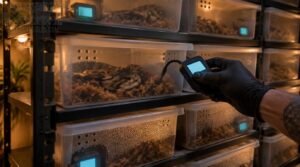
Would you hand every snake in your rack the same humidity and hope for the best? That’s how shed problems start.
Full coverage for every tub is ideal, but it’s not always realistic. A smart plan gets you most of the way there. Start with one gauge per tub where it matters most, then use a portable unit for routine multitank monitoring.
Cover these first:
- Shedding snakes and gravid females, since they need 2-3x more frequent checks.
- Quarantine tubs and new arrivals, where stress hits hardest.
- Tubs at rack extremes, where temperature gradient management and humidity drift are most pronounced.
Top tubs run drier. Bottom tubs hold moisture. Map each reptile enclosure by species too, with boas at 70-90% and kingsnakes at 30-50%.
Rotate one calibrated gauge weekly, and verify every tub every 7-10 days.
Position Humidity Gauges Inside Snake Rack Tubs
Where you stick the probe matters as much as which gauge you buy. Put it in the wrong spot and you’re just collecting fiction.
Even the best humidity gauge is useless if you put the probe in the wrong spot, because bad placement just collects fiction
Set the sensor on the substrate surface, in the middle of the tub, where your snake actually lives. Don’t bury it. Check that it’s still exposed every time you service the rack, because a shifting substrate line can swallow a probe fast.
Keep it away from the water bowl and out of the misting path. Both give you spiked, misleading numbers.
For humidity gauges for multiple enclosures, mount each one on the tub wall at mid-height so you can read it through the rack vent gaps. Hot glue or Velcro keeps it from wandering. Add a second gauge in the humid hide for shed checks. That’s real multipoint environmental sensing.
Check Rack Gauge Accuracy and Track Humidity
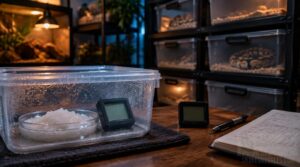
Good placement gets you honest readings. Now you need to know whether those readings are honest numbers.
Cheap gauges lie. Some drift a few points every month, and you’ll never notice until a snake stuck in shed tells you. Calibration against a salt test fixes that.
- Dampen table salt into a slurry and seal it in a small container with your gauge.
- Wait 8 to 24 hours without opening the lid.
- Compare the reading to 75% RH.
Off by more than a few points? Replace it.
Run this on every unit in your rackmounted sensor system, then log the results with the date. That’s sensor drift detection that actually works. Steady humidity monitoring beats guesswork, and multipoint environmental sensing only helps if every point is trustworthy.
Frequently Asked Questions (FAQs)
Where should the humidity gauge be in a snake enclosure?
Gauges are spies. Where should the humidity gauge be in a snake enclosure? Plant yours at the hide or substrate line. Sensor mounting height accuracy matters; warm side and cool side split the thermal gradient.
What is a good humidity level for a snake?
Your corn snake sheds badly at 70%? Aim for a target humidity of 40-50%. Ball pythons want 50-60%. Humidity level monitoring, substrate moisture tracking, and humid hide effectiveness matter, plus reptile hydration via dew licking.
What is the most accurate hygrometer for reptiles?
The SensorPush HTP.xw wins on accuracy, with ±5% typical error from 0-80% RH. Its capacitive humidity sensors still drift, so run sensor calibration procedures every six months to keep your reptile habitat climate control honest.
How to keep humidity high in a snake enclosure?
Cut ventilation first. Cover part of the screen top with plastic or HVAC tape. Then add moist sphagnum moss and mist daily. Keep your water dish in a warm spot. Stable humidity maintenance beats guesswork, so track it.
What humidity do ball pythons need during shedding?
Sure, it sounds fussy, but target humidity matters here. Aim for 60–70% during shedding management, then drop back to 50–60%. Your ball python enclosure monitoring should track humidity levels as a trend, not one reading.
Why is a humid hide essential for snakes?
A humid hide heads off shedding problems in snakes. Your enclosure environment stays dry, so this damp pocket lets your snake soak old skin. Gauges covering 10 to 99 RH confirm levels in reptile terrariums.
Can high humidity cause respiratory problems in reptiles?
Funny how a gauge reading 80% can scare you more than a wheezing snake should. High humidity alone won’t cause respiratory trouble. Soggy, stagnant tubs, cold temperatures, and poor ventilation together might, so check all three.
How often should gauge batteries be replaced?
Two years per battery? Rarely. Battery life estimates say 12 to 24 months, but rack heat trims that.
Replace yearly. Battery powered gauges use user-replaceable batteries, so swap before low-battery alerts. Keep spares nearby, too.
What humidity do bearded dragons and leopard geckos need?
Think of humidity as a thermostat for skin: set it wrong and everything itches. Bearded dragons and leopard geckos both want 30-40% humidity. Leopard geckos also need a 70-80% humid hide for shedding.
Conclusion
A 15 to 20 percent drift is enough to turn an 80% reading into a 60% reality. That’s the whole argument for checking your gauges, not just buying them.
Pick humidity gauges for multi snake racks that fit your budget and your tubs, then run a salt test every month. Verified readings keep boas lush, kingsnakes comfortable, and sheds clean. Your snakes can’t read a display, so you have to double-check it.