This site is supported by our readers. We may earn a commission, at no cost to you, if you purchase through links.

Your corn snake can’t warm itself on its own. It depends on you for every degree, and a heat rock sold at the pet store will happily burn it instead.
Corn snakes need a temperature gradient: 85°F on the warm side, 75°F on the cool side, and a surface basking spot near 88-90°F. Miss those numbers and digestion stalls, shedding goes wrong, and your snake gets sick.
The right snake enclosure heaters for corn snake habitats hold those temperatures night after night, but only with a thermostat and smart placement. Here are nine heaters worth your money, plus the setup that keeps your snake safe.
Table Of Contents
- Key Takeaways
- Corn Snake Temperature Requirements and Heat Gradients
- Choosing Heat Mats Versus Overhead Heaters
- Top 9 Heaters for Corn Snake Enclosures
- 1. Vivarium Electronics 40W Radiant Heat Panel
- 2. Aiicioo 16W Reptile Under Tank Heater
- 3. Oiibo Reptile Heating Panel Adjustable
- 4. BN-LINK 6×8 Inch Reptile Heat Pad
- 5. KABASI 25W Reptile Heat Mat
- 6. REPTI ZOO Adjustable Reptile Heat Panel
- 7. BN-LINK 8x12in Reptile Under Tank Heater
- 8. VIVOSUN Reptile Heating Pad with Thermostat
- 9. Aiicioo Reptile Heating Pad 8W
- Thermostat Selection, Probe Placement, and Temperature Monitoring
- Safe Heater Installation for Corn Snake Enclosures
- Maintaining Corn Snake Heating Through Seasonal Changes
- Frequently Asked Questions (FAQs)
- What is the best heat source for a corn snake?
- Does a corn snake need a heater?
- How warm does a corn snake enclosure need to be?
- How long do corn snake heaters typically last?
- Can heaters stay on during power outages?
- What should I do if my heater fails?
- Do baby corn snakes need different heating?
- Does enclosure size affect which heater works best?
- Conclusion
Key Takeaways
- You need a temperature gradient with an 85°F warm side, a 75°F cool side, and an 88-90°F basking spot measured on the surface, because your corn snake can’t warm itself and digestion and shedding suffer when you miss those numbers.
- You’re better off using overhead heat as your main source and adding a heat mat under no more than a third to a half of the floor, so your snake always has a cool zone to retreat to.
- You must run every heater through a thermostat, with the probe secured inside the warm hide and checked against a separate thermometer, since several of the nine products listed have no built-in control or can overheat the tank.
- You should never use heat rocks or put any heater inside the enclosure, and you’ll need to recheck your temperatures each season and adjust your setup when room temperatures drop.
Corn Snake Temperature Requirements and Heat Gradients
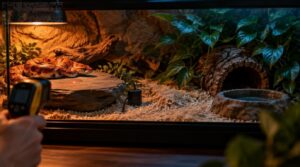
A corn snake can’t make its own heat, so you have to build it into the enclosure. Get this wrong and your snake suffers.
Because corn snakes come from warm, varied habitats, a corn snake natural habitat and care guide can help you copy their ideal temperature gradient at home.
A corn snake can’t generate its own warmth, so you must build that heat into its enclosure, or it will suffer
Create a temperature gradient with a warm side near 85°F and a cool side near 75°F. Your snake needs to move between them freely.
Aim for a basking spot temperature of 88-90°F, measured on the surface with an infrared thermometer. Air readings won’t tell you the truth.
Belly heat drives digestion, so a heat mat under one end works well when a thermostat controls it. Nights can dip to 70°F. Juveniles under one year shouldn’t fall below 75°F.
Check your numbers daily. Never guess, and never trust a single reading. Stable heat keeps your snake healthy.
Choosing Heat Mats Versus Overhead Heaters
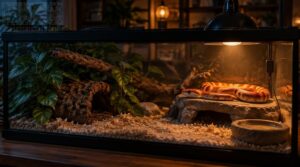
You’ve got your target numbers. Now you need the right tool to hit them. A heat mat and overhead heat do very different jobs, and mixing them up wrecks your thermal gradient.
- A heat mat gives belly heat only, so it won’t warm the air.
- Overhead heat warms air and objects, which suits taller enclosures.
- Both need a thermostat, no exceptions.
In a cool room, a heat mat alone won’t cut it. Deep substrate makes it worse, because bedding insulates your snake from the warmth below. Choose overhead heat as your main source, then add a heat mat at one end as a warm hide. Keep the mat under a quarter of the floor length. That leaves a cool zone. A halogen overhead lamp paired with a thermostat creates a focused warm zone, but it should be switched off at night to preserve a normal day-and-night cycle.
Top 9 Heaters for Corn Snake Enclosures
You’re about to compare nine heaters built to hold your corn snake’s 85–90°F basking zone. Each one below gets judged on how well it fits a proper gradient and how safely it runs with a thermostat. Pick the one that matches your enclosure size, and you’ll control your setup instead of guessing at it.
1. Vivarium Electronics 40W Radiant Heat Panel
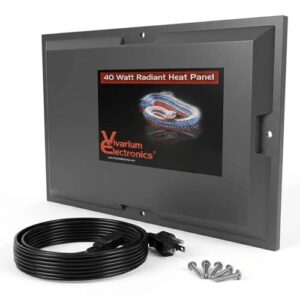
Think of this panel as a sunbeam you can plug in. It mounts to the enclosure roof and delivers focused radiant heat within 16 inches below it.
At 40 watts, it suits 2’x4′ enclosures or smaller. Pair it with a proportional thermostat so you control the output.
Know its limits. It heats the basking area only, not the whole enclosure, and it works best in rooms above 75°F. Some owners report weak warmth in cooler rooms.
A thermal fuse protects.
| Best For | Reptile keepers with a medium enclosure (2’x4′ or smaller) in a room above 75°F who want focused radiant heat over a basking spot. |
|---|---|
| Power | 40 watts |
| Dimensions | 12.5 x 12.5 x 1.75 in |
| Weight | 2.27 lbs |
| Heater Type | Radiant panel |
| Mounting Method | Screw-mounted overhead |
| Thermostat Support | Pair with proportional thermostat |
| Additional Features |
|
- Delivers focused radiant heat within 16 inches below the panel
- Built from durable glass-reinforced Noryl, with a thermal fuse that cuts power if it overheats
- Detachable cord and included screws make mounting and maintenance easy
- Heats only the basking area, not the entire enclosure
- Works best in rooms above 75°F, and some users report weak warmth in cooler rooms
- Needs a separate proportional thermostat for temperature control
2. Aiicioo 16W Reptile Under Tank Heater
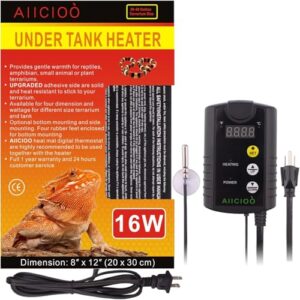
Overhead panels warm the air. This one warms the floor, giving your corn snake belly heat from below.
Since the adhesive may not hold, check the pad often, and if you’re eyeing a bigger snake, read about boa constrictor friendliness as pets.
The Aiicioo is an 8" x 12" pad rated at 16 watts and 120 volts. Its output runs 104°F to 122°F, and it fits 30 to 40 gallon tanks. The digital thermostat has three buttons and switches between Fahrenheit and Celsius.
Stick it to glass only. Skip plastic, acrylic, and water tanks. Set the probe, or your readings will lie to you.
| Best For | Corn snake owners with a 30 to 40 gallon glass terrarium who want steady belly heat from below. |
|---|---|
| Power | 16 watts |
| Dimensions | 8 x 12 in |
| Weight | N/A |
| Heater Type | Under-tank pad |
| Mounting Method | Adhesive, bottom/side |
| Thermostat Support | Built-in digital thermostat |
| Additional Features |
|
- Provides gentle, steady 24-hour heat from below, with an output range of 104°F to 122°F
- Digital thermostat with a three-button interface switches between Fahrenheit and Celsius and lets you monitor and control the temperature
- Waterproof adhesive grips glass well, and the included rubber feet allow mounting on the bottom or side of the terrarium
- Not recommended for plastic, acrylic, or water tanks, since it needs a glass surface for the adhesive to work well
- Probe placement and setup are required for accurate temperature readings
- Sized for 30 to 40 gallon terrariums, so it may not suit smaller or larger enclosures
3. Oiibo Reptile Heating Panel Adjustable
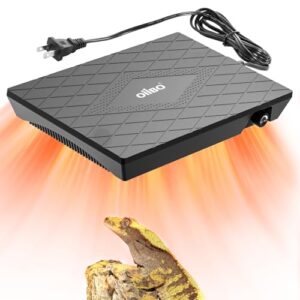
Heat panels like the Oiibo draw just 30 watts, and they glow with no visible light. That keeps your corn snake’s day and night cycle intact.
A built-in fan spreads warmth evenly, so you won’t get hot spots. Turn the knob to dial in your output. Housing is ABS plastic.
Here’s the catch. You can’t use a thermostat or timer with this panel. That’s a real control problem. Some owners also report weak heat and mixed reliability. Test it for 24 hours before your snake goes in.
| Best For | Reptile and amphibian keepers, such as owners of snakes, crested geckos, or turtles, who want gentle, light-free heat around the clock and don’t need a thermostat or timer. |
|---|---|
| Power | 30 watts |
| Dimensions | N/A |
| Weight | N/A |
| Heater Type | Air heater |
| Mounting Method | N/A |
| Thermostat Support | Cannot use thermostat |
| Additional Features |
|
- Uses just 30 watts and gives off no light, so it keeps your pet’s day and night cycle intact
- Built-in fan spreads warmth evenly to help prevent hot spots
- Adjustable knob lets you set the heat output to suit your terrarium
- Cannot be used with a thermostat or timer, which limits your control over temperature
- Some users report the heat output is too weak in practice
- Customer feedback on overall functionality and reliability is mixed
4. BN-LINK 6×8 Inch Reptile Heat Pad
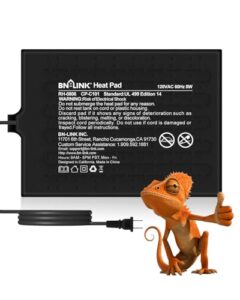
Heat output from this 6×8 inch pad is gentle. At 8 watts and 120 volts, it runs cheap and warms up to 104°F to 122°F, which suits a 10-20 gallon corn snake tank.
Pair it with a thermostat. Never run it unregulated. Your snake’s safety depends on control.
The adhesive backing grips glass, but customer feedback on hold strength is mixed. Some users report durability concerns over time, so check the pad regularly. The listed 1 gram weight looks incomplete.
| Best For | Owners of small 10-20 gallon terrariums, such as a corn snake, lizard, or hermit crab setup, who want a low-cost, low-power under-tank heater and plan to run it with a thermostat. |
|---|---|
| Power | 8 watts |
| Dimensions | 6 x 8 in |
| Weight | 1 gram (listed) |
| Heater Type | Under-tank mat |
| Mounting Method | Adhesive backing |
| Thermostat Support | Compatible with controllers |
| Additional Features |
|
- Waterproof design with an energy-efficient 8-watt draw at 120 volts
- Warms to 104°F to 122°F, which suits 10-20 gallon terrariums
- Works with a range of animals, including turtles, lizards, frogs, snakes, and hermit crabs, and can be paired with a temperature controller
- Customer feedback on the adhesive backing is mixed
- Some users report durability concerns over time
- The listed 1 gram weight looks incomplete, so some product details may be unreliable
5. KABASI 25W Reptile Heat Mat
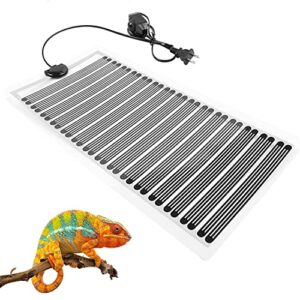
This mat takes about 30 minutes to reach proper temperature, so don’t judge it too early. The KABASI 25W measures 16.5 x 8.7 inches and weighs just 4.6 ounces. It’s non-adhesive, so you can reposition it easily.
Always pair it with a separate thermostat. Without one, the 25W output can overheat your enclosure and crack the tank.
The power cord is short, so plan your placement carefully first. Never cover the pad with wood chips, coconut soil, or quilt towels.
| Best For | Reptile, amphibian, and invertebrate keepers with a small to mid-size tank, around 20 gallons, who want gentle, removable belly heat and already have or plan to buy a separate thermostat. |
|---|---|
| Power | 25 watts |
| Dimensions | 16.5 x 8.7 in |
| Weight | 4.6 oz |
| Heater Type | Under-tank pad |
| Mounting Method | Removable, no adhesive |
| Thermostat Support | Requires separate thermostat |
| Additional Features |
|
- Slow, even heating design with overheat protection suits a wide range of animals, from geckos and snakes to hermit crabs and spiders.
- Non-adhesive and lightweight at 4.6 ounces, so you can place it under, inside, or on the side of a tank and move it whenever you need.
- Works well in a 20-gallon tank for keeping temperatures steady through season changes.
- Needs a separate thermostat; without one, it can overheat the enclosure and crack the tank.
- The short power cord limits where you can place it.
- It takes about 30 minutes to warm up, and covering it with wood chips, coconut soil, or quilt towels blocks the heat.
6. REPTI ZOO Adjustable Reptile Heat Panel
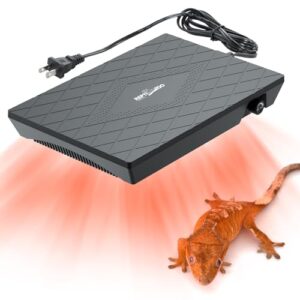
You might worry a fan belongs nowhere near a snake room. Some owners find it loud.
The AH02 is a black, 9.12 x 5.98 x 1.16 inch panel that heats a wider area than a lamp. Its fan circulates air and prevents hot spots. A simple knob lets you adjust output.
It emits no light, so it works as a night heater.
Don’t trust it blindly. Some units run cold, smell chemical, or fail within two weeks. Verify temperatures daily.
| Best For | Owners of nocturnal or heat-loving reptiles like leopard geckos, snakes, and hermit crabs who want a light-free night heater and are willing to check temperatures daily. |
|---|---|
| Power | N/A |
| Dimensions | 9.12 x 5.98 x 1.16 in |
| Weight | N/A |
| Heater Type | Air heater |
| Mounting Method | N/A |
| Thermostat Support | N/A |
| Additional Features |
|
- Heats a wider area than a traditional heating lamp
- Built-in fan circulates air to help prevent hot spots
- Emits no light, so it works well as a night heater for nocturnal reptiles
- Some units run too cold or give inconsistent temperatures
- Durability is mixed, with some units failing within two weeks
- Some customers report a chemical smell and loud fan noise
7. BN-LINK 8x12in Reptile Under Tank Heater
No thermostat, no safety net. That’s the catch with this heater, and you need to know it before you stick it on glass.
The BN-LINK 8x12in pulls 16 watts at 120 volts and holds surfaces between 104°F and 122°F. It fits 10-20 gallon tanks. The plastic build is waterproof and flexible, and it weighs just 1 gram.
Pair it with a thermostat. Always.
Watch the adhesive too. It can fail over time, especially on tank edges, and users report mixed heating consistency.
| Best For | Reptile, amphibian, or small animal keepers with a 10-20 gallon terrarium who already own a thermostat and want an inexpensive, low-profile heat source stuck to the glass. |
|---|---|
| Power | 16 watts |
| Dimensions | 8 x 12 in |
| Weight | 1 gram (listed) |
| Heater Type | Under-tank pad |
| Mounting Method | Adhesive backing |
| Thermostat Support | No built-in thermostat |
| Additional Features |
|
- Waterproof, flexible plastic construction that weighs just 1 gram
- Holds surface temperatures between 104°F and 122°F on only 16 watts
- Adhesive backing attaches directly to glass, and the 8 by 12 inch size suits 10-20 gallon tanks
- No built-in thermostat or temperature control, so you need to buy a separate one
- Adhesive may fail over time, especially on tank edges
- Mixed reports on heating consistency and long-term durability
8. VIVOSUN Reptile Heating Pad with Thermostat
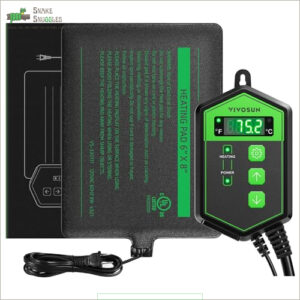
Want control over your warm spot? This pad gives it to you.
The VIVOSUN (model HM001J) measures 6 x 8 x 1 inches, weighs 1.23 pounds, and uses far-infrared heating for even warmth. Its IP67-rated surface wipes clean fast, and the UL-certified materials add peace of mind.
The thermostat covers 40–108°F. Dial in your target and place the probe near the warm side. Mixed feedback exists on consistency, and some users report weak adhesive. Never place objects on the pad.
| Best For | Owners of turtles, lizards, frogs, or other small reptiles who want an easy-to-clean, adjustable warm spot in their enclosure. |
|---|---|
| Power | N/A |
| Dimensions | 6 x 8 x 1 in |
| Weight | 1.23 lbs |
| Heater Type | Under-tank pad |
| Mounting Method | 3M adhesive, bottom/side |
| Thermostat Support | Temperature control included |
| Additional Features |
|
- Far-infrared heating spreads warmth evenly, and the thermostat covers 40–108°F so you can set your target.
- The IP67-rated, water-tight surface wipes clean easily, and the UL-certified materials add peace of mind.
- Strong 3M adhesive allows bottom or side mounting, and the flexible design folds easily for storage.
- Customer feedback is mixed on temperature consistency past 72°F.
- Some users report that the adhesive quality is inconsistent.
- Nothing can be placed on the pad while it is in use.
9. Aiicioo Reptile Heating Pad 8W
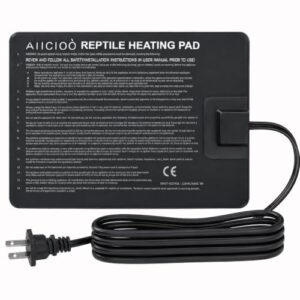
Prefer simple over adjustable? This pad skips the dial entirely.
The Aiicioo 8W runs on 120 volts and measures 10.8 x 4.9 x 1 inches. It weighs 6.4 ounces. Solid-state nichrome wire provides 24-hour warmth, and the upgraded adhesive cuts the risk of melting and separation.
You get no thermostat, so pair it with an external controller. Feedback on heat output is mixed, a 10-gallon tank may stay too cool. Use it on glass, never plastic, acrylic, or water tanks.
| Best For | Keepers of small tropical reptiles, amphibians, or plant terrariums in small glass enclosures who want a simple, always-on heat source and are willing to add their own thermostat. |
|---|---|
| Power | 8 watts |
| Dimensions | 10.8 x 4.9 x 1 in |
| Weight | 6.4 oz |
| Heater Type | Under-tank heater |
| Mounting Method | Adhesive, bottom/side |
| Thermostat Support | No thermostat capability |
| Additional Features |
|
- Runs 24 hours a day as a primary or secondary heat source, using durable solid-state nichrome wire.
- Upgraded adhesive lowers the risk of melting and separation, and included rubber feet allow mounting on the bottom or side of a terrarium.
- Versatile enough for reptiles, amphibians, small animals, and plant terrariums, and it can even warm seedlings on ceramic tiles with raised supports.
- Has no thermostat or temperature adjustment, so you need an external controller to manage the heat.
- Feedback on heat output is mixed, and it may not warm larger tanks such as a 10-gallon.
- Not recommended for plastic, acrylic, or water tanks, which limits the enclosures it can be used with.
Thermostat Selection, Probe Placement, and Temperature Monitoring

Even the best heater fails without control, so Thermostat Selection comes first. Run a simple on/off unit with a heat mat. Pair any radiant panel or ceramic emitter with a proportional or dimming model, like a Herpstat, so it won’t cycle and create hot spots.
Probe Placement decides what you actually control. Set the probe inside the warm hide, on top of the substrate, never between the mat and the tank floor. Secure it with a clip, zip tie, or superglue so your snake can’t shift it.
Verify everything. Put a separate digital thermometer beside the probe for Thermostat Calibration, then check surfaces with an infrared gun.
Temperature Monitoring doesn’t stop at setup. Check the probe after every feeding and shed, and keep nights above 65°F for adults, 75°F for juveniles.
Safe Heater Installation for Corn Snake Enclosures
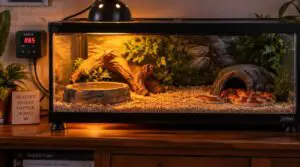
Once your thermostat and probe are set, the hardware has to go in right. Start with enclosure design, because it decides everything else.
Stick the heat mat to the outside underside of the tank. Cover only one-third to one-half of the floor, so your snake can cool off on the other side. Lift the tank on risers. Trapped heat damages glass and plastic.
Mount every ceramic heat emitter on top of the enclosure, never inside. Your snake will climb into a bulb cage and burn.
Keep all heaters, bulbs, and guards out of reach. Never use heat rocks. They malfunction and cause severe burns.
For electrical safety, keep cords off the floor, away from water, and plug everything into your thermostat.
Maintaining Corn Snake Heating Through Seasonal Changes

Your setup is installed. Now keep it accurate as the year turns.
Seasonal heat cycling starts with your thermal gradient. In winter, drop the warm-side basking spot to 85-87°F. In summer, raise it to 89-91°F. Keep the cool side at 72-75°F year-round, and let nights fall to 68-70°F in winter.
Run thermostat calibration every season. Check your probe against a digital thermometer, and adjust the setpoint if they disagree.
Temperature monitoring matters most when rooms swing. If your room drops below 65°F, add supplemental under-tank heat or a ceramic emitter on its own thermostat. Move enclosures away from cold windows and exterior walls.
Heat source optimization also means watching humidity. Heating systems dry the air, so keep it at 40-50%.
Frequently Asked Questions (FAQs)
What is the best heat source for a corn snake?
Think of heat as the engine of your snake’s health. An under-tank heat mat wins. It delivers belly heat for digestion and builds a proper temperature gradient. Run it on a thermostat. Heat tape works too.
Does a corn snake need a heater?
Would you gamble on your snake’s health? Does a corn snake need a heater? Yes.
Without belly heat from a heat mat, digestion stalls. Add a thermostat today and build a proper temperature gradient.
How warm does a corn snake enclosure need to be?
Build a proper thermal gradient. Your basking spot temperature should hit 90°F, the warm side 85°F, the cool side 75°F. Run a heat mat on a thermostat. Don’t skip this temperature gradient, or digestion suffers.
How long do corn snake heaters typically last?
Heater lifespan depends on type. Radiant panels last 10+ years, heat mats 3-5, and ceramic heat emitters just 6-12 months.
A proportional thermostat slows equipment degradation. Replace cracked or underperforming units immediately for heating safety.
Can heaters stay on during power outages?
Wondering what happens when the lights go out? Your heater dies instantly.
Use backup power, wrap the tank for heat retention, and check nighttime heating often. Proportional control and heat cycling settings need reprogramming afterward.
What should I do if my heater fails?
Check the thermostat probe first, since a dislodged one often mimics failure.
Then wrap chemical heat packs in towels, tuck them beside your snake’s insulated tub, and skip feeding.
Keep backup power ready, and never press heat directly against scales.
Do baby corn snakes need different heating?
No. Hatchlings need the same temperature gradient as adults: 29–31°C warm, 24–26°C cool. Skip extra belly heat. In small tanks, an oversized undertank heater (UTH) wrecks thermal zoning; substrate heating can’t replace a cool retreat.
Does enclosure size affect which heater works best?
Yes, enclosure size changes everything. A bigger footprint stretches your thermal gradient, so a small mat can’t cover it. Match the heat source to the floor area, use a thermostat, and verify your basking spot temperature.
Conclusion
Picture a keeper named Dana who checks her corn snake’s tank at midnight and finds the warm side at 86°F, the cool side at 76°F, and her snake coiled calmly between them. That’s the goal. The right snake enclosure heaters for corn snake habitats make it routine, but only when a thermostat controls every watt.
Pick one heater today. Set your probe at belly level. Verify the temperature gradient weekly, and your snake will thrive.