This site is supported by our readers. We may earn a commission, at no cost to you, if you purchase through links.

A snake that can’t shed cleanly is a snake under serious stress. The skin doesn’t just fall off—it separates through a precise biological process that depends almost entirely on moisture. When humidity drops too low, that process stalls, and you end up with torn patches, retained eye caps, and a snake that’s uncomfortable at best, injured at worst.
Moisture requirements during shed aren’t complicated, but they’re easy to miscalculate. Each species has a different baseline, and shedding pushes those needs even higher. Getting it right means knowing your numbers, reading the signs early, and having the right tools ready before the blue phase hits.
Table Of Contents
- Key Takeaways
- Why Moisture Matters During Shedding
- Ideal Shedding Humidity by Snake Species
- When to Increase Humidity
- Safe Ways to Raise Humidity
- Set Up a Humid Hide
- Prevent Stuck Shed Problems
- Frequently Asked Questions (FAQs)
- What should the humidity be in a shed?
- Can soaking help remove a retained shed?
- How does shedding frequency change with age?
- Should humidity differ between day and night cycles?
- Do feeding schedules affect the shedding process?
- How long does a healthy full shed take?
- Does feeding schedule affect shedding moisture needs?
- How does enclosure size impact humidity retention?
- Should humidity differ for gravid or pregnant snakes?
- Conclusion
Key Takeaways
- Humidity below 40% causes skin tearing, retained eye caps, and respiratory stress, so match your target range to your snake’s species before the shed cycle begins.
- Start raising humidity before the blue phase hits — waiting until eyes cloud over means you’re already behind the biological process.
- A snug humid hide packed with lightly damp sphagnum moss on the warm side handles most shed problems without soaking the whole enclosure.
- If stuck shed keeps recurring after you’ve fixed humidity, stop troubleshooting your setup and book a reptile vet appointment — it’s a health issue, not a husbandry one.
Why Moisture Matters During Shedding
Shedding isn’t just about your snake outgrowing its skin — moisture is what makes the whole process work. Without enough humidity, that old layer won’t release cleanly, and your snake will feel it. Here’s why getting the moisture right is the most important thing you can do during this phase.
If you’re not sure what levels to aim for, this guide on ideal humidity ranges for a healthy shed breaks it down by species and enclosure type.
Keeping humidity in that sweet spot is especially critical for young snakes, and a solid boa constrictor baby setup guide can help you dial in the right environment from the start.
Skin Separation and Hydration
Shedding starts beneath the surface. As your snake gets ready to molt, keratin filament patterns shift — hydration loosens the bonds holding old skin cells together. Water expands intercellular spaces in the stratum corneum, letting corneocytes release cleanly rather than tearing.
Maintaining high humidity helps prevent transepidermal water loss that can lead to stuck shed.
Key processes moisture drives:
- Lipid matrix spacing widens, softening the outer layer
- Molecular moisture mobility triggers corneocyte release
- Swelling reduces friction between old and new skin
- Enzymatic activity separates the skin layers cleanly
The Role of Humidity
Those enzymatic processes depend on relative humidity to function. The air’s moisture content dictates how cleanly old skin releases.
| Humidity Level | Shedding Effect |
|---|---|
| Below 40% | Skin tears; incomplete shed |
| 40–60% | Workable for desert species |
| 60–70% | Ideal for most snakes |
| 70–85% | Needed for tropical species |
| Above 90% | Mold and respiratory risk |
Humidity regulation keeps the entire shedding cycle stable.
Risks of Dry Air
When relative humidity drops below 40%, dry air works against every shed stage:
- Skin dehydration causes crusty scales that tear instead of sloughing cleanly.
- Accelerated transepidermal water loss reduces elasticity, inviting minor injuries.
- Airway dryness raises infection risk and triggers labored breathing.
- Eye irritation produces redness and frequent rubbing.
- Thermoregulation stress from humidity-heat imbalance disrupts feeding and activity.
Signs Moisture is Too Low
Dry air leaves clear clues. Your snake’s eyes go cloudy or dull during the blue phase, and the skin feels tacky rather than smooth. Substrate turns powdery. Nasal secretions thicken, and breathing may sound louder than normal.
If your relative humidity reads consistently below 40%, those signals confirm your enclosure’s internal humidity needs immediate attention.
Ideal Shedding Humidity by Snake Species
Not every snake needs the same humidity level, and getting this wrong during a shed can cause real problems. Whether you keep a ball python, a corn snake, or a boa, the target range shifts depending on where that species originally comes from. Here’s what each one actually needs.
Ball Python Humidity Needs
Ball pythons need 55–70% baseline humidity year-round. During shedding, raise that to 75–85% — especially inside a humid hide.
A humid hide designed for ball pythons makes it much easier to maintain that 75–85% moisture pocket right where your snake needs it most during a shed.
Place your digital hygrometer at mid-enclosure height for accurate readings. Moisture-retentive substrates like coconut fiber hold ambient humidity well. In winter, ambient air dries out fast, so check levels daily. Avoid soaking the enclosure; that risks skin maceration.
Corn Snake Humidity Needs
Corn snakes are forgiving. Keep enclosure humidity between 40 and 60 percent day-to-day, targeting around 50 percent for smooth, clean sheds.
A digital hygrometer at snake level gives you accurate readings — not guesswork. Coconut fiber mixed with a little sphagnum moss holds moisture without staying wet, protecting respiratory health while maintaining a drier basking zone.
Boa Constrictor Humidity Needs
Boas demand more than most colubrids. Keep humidity between 60 and 75 percent day-to-day, raising it to 75–85 percent during shedding.
A hygrometer placed away from direct mist gives you an honest reading. Use coconut fiber or sphagnum moss to hold ambient moisture without waterlogging the enclosure — skin cracking and dehydration follow quickly when levels drop.
Juvenile Versus Adult Needs
Young snakes have a higher metabolic water turnover and a greater surface area relative to their body mass — meaning they dry out faster. Keep juvenile enclosures at the higher end of the humidity range and mist more often.
Adults regulate hydration more efficiently. Stable temperature and humidity matter more than frequent adjustment. Consistent conditions beat constant intervention.
Desert Versus Tropical Species
Where a snake comes from shapes everything. Desert species—like sand boas—evolved for temperature fluctuations and scarce water, targeting 40–60% humidity even during shedding. Tropical species need 80–90% to replicate dense, moisture-rich habitats.
Match your setup to your snake’s origin, and shedding becomes straightforward. Get it wrong, and you’re fighting the animal’s biology every cycle.
Match your snake’s habitat to its origins, or fight its biology every shed
When to Increase Humidity
Timing matters just as much as the humidity level itself. Your snake will show you clear signals before and during the shed cycle that it’s time to act. Here are the key moments when you should bump up the moisture in the enclosure.
Before The Blue Phase
Start raising humidity before visible signs appear. The pre-shed cycle begins with subtle color dulling and slight skin loosening — easy to miss. That’s your window. Waiting until eyes cloud over means you’re already behind.
Bump ambient humidity toward species-specific targets now. Moisture management at this early stage gives the enzymatic fluid time to build, making the entire shed smoother.
During Cloudy Eyes
Cloudy eyes confirm the shed cycle is now active. Corneal transparency shifts happen as eye caps loosen — vision impairment signs like rubbing or light avoidance follow quickly.
- Target 60–70% ambient humidity now
- Check hygrometer readings twice daily
- Monitor eye opacity each morning
- Add damp moss to the humid hide
Don’t wait. Humidity control is time-sensitive here.
After Appetite Changes
A snake refusing food is often the first signal the shed cycle has begun. Appetite drops as hormonal shifts redirect energy toward skin renewal — ghrelin rises, hunger cues fluctuate, but the body is simply rebalancing.
That’s your cue to raise humidity now. Don’t wait for cloudy eyes. Target 65–70% immediately and keep the humid hide damp throughout.
Until Shed is Complete
Keep humidity at 65–70% from the first shed sign until the old skin comes off completely — not just during cloudy eyes.
- Add damp sphagnum moss to the humid hide
- Use moisture-retaining substrate like coco coir
- Provide a larger water dish for extra hydration
- Cover part of the vent to trap humidity
- Confirm a complete one-piece shed before dropping humidity levels
After Incomplete Shedding
If your snake didn’t shed cleanly, raise humidity to 70–80% immediately. Look for dull patches along the midsection, a thin film hugging the tail, or pinkish new skin still partially covered. Rubbing against decor is a clear signal something’s stuck.
Vent area retention is urgent — it can trap waste and restrict movement.
Safe Ways to Raise Humidity
Raising humidity doesn’t have to mean soaking everything or guessing your way through it. A few targeted adjustments inside the enclosure can make a real difference without creating a damp, problematic environment. Here are the safest and most effective ways to get it right.
Mist Lightly and Carefully
A fine mist nozzle is non-negotiable — heavy spray pools fast and stresses your snake.
Apply short, controlled bursts once or twice daily, targeting enclosure walls, not the animal. Let air circulate after each session to prevent condensation and mold.
- Aim for 60–70% ambient humidity
- Mist sides, never directly onto the snake
- Use plain, room-temperature water only
- Allow partial evaporation between sessions
- Watch for mold after each application
Add a Larger Water Bowl
Swap your small dish for a wider, heavier bowl — ceramic or stainless steel works best. Both resist rust, clean easily, and won’t tip when your snake investigates. A larger surface area means water evaporates gradually, nudging ambient humidity toward 60–65% without sudden spikes.
Place it on the warm side. That gentle heat drives slow, steady evaporation — exactly what a shedding snake needs.
Use Moisture-holding Substrate
Choosing the right substrate does a lot of the heavy lifting. Coconut coir and peat-perlite blends hold 60–70% field capacity while keeping 12–17% air porosity — damp enough to release humidity steadily, dry enough to prevent rot.
- Coconut coir improves structure and oxygenation
- Peat-perlite mixes balance moisture and airflow
- Sphagnum moss retains more than bark blends
- Mixed particle sizes stabilize moisture release
- pH stays stable between 5.5–7.0
Keep it lightly damp, never soggy.
Cover Part of Ventilation
Blocking part of the mesh keeps humid air from escaping too fast. Tape or foil over 30–50% of the top vents slows passive ventilation just enough to stabilize moisture without sealing the enclosure entirely.
Leave lower vents open for air intake. Warm, moist air rises and exits through whatever exhaust remains uncovered — that natural airflow pattern still works, just slower.
Avoid Soaking The Enclosure
Soaking the entire enclosure is the one shortcut that creates more problems than it solves. Saturated substrate breeds mold and bacteria fast, and pooling water near heat mats or thermostats is a genuine electrical hazard.
Excess moisture also pushes ambient humidity past safe limits, putting respiratory health at risk. Use a humid hide instead — targeted, controlled, and far safer.
Set Up a Humid Hide
A humid hide gives your snake a private spot to finish shedding without needing the whole enclosure to feel like a rainforest. Getting it right comes down to a few simple choices — the container, the material inside, and how you maintain it. Here’s exactly what to do.
Choose a Snug Hide
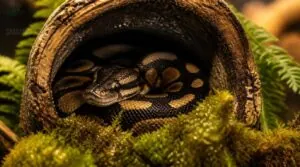
The hide itself sets the stage. For hatchlings, aim for 5.5 to 6.5 inches long with a 1.25 to 1.75-inch interior width — snug enough that the snake touches all four walls. That wall contact calms them.
Go with HDPE or sealed cork: both resist moisture damage and clean up fast. Avoid cedar or pine entirely.
Add Damp Sphagnum Moss
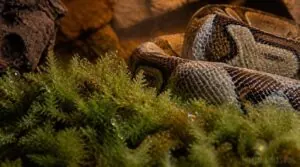
Sphagnum moss is your humidity workhorse inside the hide. Rinse it, soak briefly, then squeeze until it feels lightly damp — not dripping.
Use rain or dechlorinated water to avoid mineral buildup on enclosure surfaces.
- Fluff the moss to keep air pockets intact
- Replace every 2–4 weeks or when it looks dull
- Inspect weekly for mold and remove spoiled sections immediately
Place on Warm Side
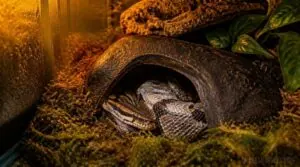
Once the moss is prepped, place the humid hide on the warm side of the enclosure.
Temperatures there — usually 28 to 32°C — keep moisture active and help your snake’s metabolism stay high enough to support the shed process. A cool-side hide won’t deliver the same result; the warmth is what makes the microclimate work.
Keep Medium Lightly Damp
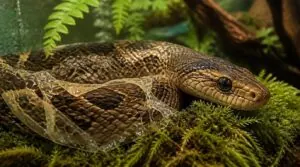
The moss does the heavy lifting — but substrate moisture levels matter too. Aim for barely damp, not wet.
Run your finger across the surface. If it comes away damp but not dripping, you’re set. Water pooling signals oversaturation.
Keep it balanced with these checks:
- Press the moss — no water should squeeze out
- Inspect corners for standing moisture daily
- Mist lightly if dryness returns
- Replace moss if it smells off
Clean to Prevent Mold
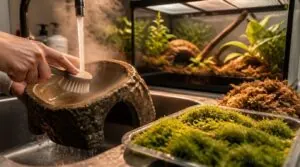
Damp moss creates ideal conditions for mold and mildew if left unchecked. Clean the hide every 5–7 days.
Remove old moss, scrub the container with hot water and detergent — no ammonia — then rinse and dry it completely before adding fresh moss. Good air circulation during drying matters. Discard moss that smells musty; it’s not worth the risk.
Prevent Stuck Shed Problems
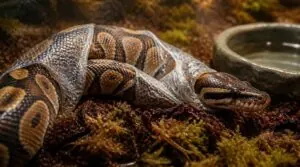
Stuck shed is one of the most common problems keepers run into, and it’s almost always preventable. Catching it early makes all the difference — a missed eye cap or retained tail tip can turn into a real issue fast. Here’s what to check and when to act.
Check Eye Caps
After a shed, check the eye caps first. These are the thin, scale-like coverings over each eye — if they didn’t come off cleanly, your snake is at risk of vision problems and infection. Look for a dull or cloudy appearance where the eye cap should be. Don’t attempt removal yourself; a reptile vet can take care of that safely.
Inspect Tail Tips
After every shed, move straight to the tail tip. Retained skin here is easy to miss.
Check for:
- Scale integrity — scales should lie flat, no peeling edges
- Color uniformity — no dark or purple patches signaling circulation loss
- Tail movement — gentle touch should prompt a slight twitch
- Tissue swelling — any puffiness needs prompt attention
- Shed residue — thin strips trap moisture and invite mold
Monitor With a Hygrometer
How do you know your internal humidity is actually on target? A hygrometer removes the guesswork.
Digital vs analog — digital wins for speed and tracking humidity fluctuations via min/max memory. For sensor placement tips, position it at snake eye level, away from water dishes. This is the foundation of solid humidity management and controlling humidity in a shed environment.
| Feature | Digital | Analog |
|---|---|---|
| Accuracy | ±2–5% | ±5–10% |
| Min/Max Memory | Yes | No |
| Remote Monitoring | Available | No |
| Calibration | Simple | Complex |
| Lifespan | 3–5 years | 2–4 years |
Hygrometer accuracy calibration annually keeps readings reliable. Remote monitoring technology can push alerts to your phone when moisture content drops and moisture problems develop overnight.
Balance Heat and Humidity
Heat and humidity don’t operate independently. When your warm side climbs above 32°C, evaporation rate increases fast, pulling moisture out of the enclosure and dropping relative humidity below target.
Thermostat pulse control keeps temperatures locked between 28–32°C on the warm side. That stability limits unpredictable moisture spikes and protects temperature gradient stability throughout the shed cycle.
Seek Reptile Vet Help
Stuck shed that keeps returning isn’t a humidity problem — it’s a diagnosis waiting to happen. A reptile-focused vet can assess dehydration, skin integrity, and hidden illness that no hygrometer will catch.
Before your appointment, compile a symptom timeline and note your enclosure’s temperature and humidity readings. That detail helps the vet skip guesswork and get straight to answers.
Frequently Asked Questions (FAQs)
What should the humidity be in a shed?
Think of your shed as a living space for your tools — target RH of 40 to 60 percent keeps condensation, rust, and mold from taking hold without drying out stored wood.
Can soaking help remove a retained shed?
Yes, soaking can help. Warm water softens keratin, making stuck shed easier to loosen. Use a shallow dish at 85–90°F for 10–20 minutes. Pat dry after, then return your snake to its humid hide.
How does shedding frequency change with age?
Young snakes shed every 2–4 weeks during juvenile growth spurts. As growth slows, that drops to 3–6 times yearly in adults. Aging or stressed reptiles may shed irregularly, especially with nutrient deficiencies or declining skin quality.
Should humidity differ between day and night cycles?
Nighttime humidity naturally rises as temperatures drop — even without any changes to moisture sources. That pattern mirrors what snakes experience in the wild, so letting indoor humidity follow the same diurnal cycle helps maintain stable overnight hydration.
Do feeding schedules affect the shedding process?
Feeding schedules do affect shedding. A stable metabolic cycle keeps shed timing predictable. Erratic meals or obesity can disrupt molting. Consistent feeding helps nutrient-driven skin health, making each shed cleaner and more complete.
How long does a healthy full shed take?
A clock in, clock out process, shedding runs 1 to 2 weeks for most snakes. Ball pythons often finish in 4 to 7 days. Juveniles shed faster than adults.
Does feeding schedule affect shedding moisture needs?
Yes. A large meal increases hydration demand for digestion. Prey moisture content also contributes. Space meals consistently so moisture needs stay predictable during the shed cycle and skin stays pliable.
How does enclosure size impact humidity retention?
Bigger enclosures hold more air, so humidity rises slower after misting. A 20-liter tank peaks faster than a 60-liter one. More air volume dilutes moisture, giving you steadier, more manageable humidity levels throughout the shedding cycle.
Should humidity differ for gravid or pregnant snakes?
Gravid snakes need higher humidity. Boost ambient levels by 5–10% during late gestation to prevent embryo desiccation. Monitor daily with a hygrometer and adjust misting or substrate to keep moisture stable without causing mold.
Conclusion
Like Houdini escaping every chain, your snake sheds its skin when conditions are exactly right. Nail the moisture requirements during shed and you’re giving it everything it needs.
Check your hygrometer daily. Set up the humid hide before blue phase hits. Keep substrate damp, not soaked. Most incomplete sheds trace back to one overlooked drop in humidity—a small failure with real consequences. Consistency is the tool that makes every shed clean, complete, and stress-free.