This site is supported by our readers. We may earn a commission, at no cost to you, if you purchase through links.

A 100-pound boa needs more than a bowl of water—it needs the right one. Too small, and the snake won’t soak properly, leading to stuck sheds and dehydration. Too light, and you’re mopping up a flooded enclosure every other day.
Snake water dishes for large constrictors sit at the intersection of physics and biology: the bowl has to accommodate a serious animal without tipping, cracking, or turning into a petri dish overnight.
Get the size, material, and design right, and hydration basically takes care of itself. Get it wrong, and you’re solving problems that shouldn’t exist.
Table Of Contents
- Key Takeaways
- Choosing The Right Bowl Size
- Best Materials for Large Constrictors
- Stable Designs That Prevent Tipping
- Top 5 Snake Water Dishes
- Cleaning and Replacing Water Bowls
- Frequently Asked Questions (FAQs)
- How big should a snakes water dish be?
- What to use as a snake water bowl?
- Can I put ice in my snakes water bowl?
- How does dehydration affect a large constrictors health?
- What water depth prevents drowning during snake soaking?
- How quickly can dehydration symptoms appear in boas?
- Does soaking water temperature affect a snakes thermoregulation?
- Conclusion
Key Takeaways
- Match your boa’s water dish diameter to 1.5–2× its widest body point, and keep water depth between 2–4 inches to support soaking, shedding, and hydration without overflow or drowning risk.
- Ceramic and solid resin outlast lightweight plastics for large constrictors — their non-porous surfaces resist bacteria, odors, and cracking through repeated heavy use and sanitation cycles.
- Wide, low-profile bowls with heavy bases and smooth rounded rims are the only designs that reliably stay put when a 60–100 lb snake climbs in.
- Change water daily, scrub with hot water and mild detergent regularly, deeply sanitize monthly with diluted bleach or chlorhexidine, and replace any bowl showing cracks, rough patches, or persistent odor.
Choosing The Right Bowl Size
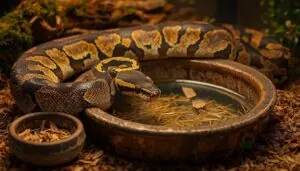
Getting the size right matters more than most keepers expect. A bowl that’s too small frustrates your snake, while one that’s too deep becomes a hazard.
A good rule of thumb: match the dish to your snake’s widest point, as explained in this guide to choosing the right water dish size for snakes.
Here’s what to look for before you buy.
Match Diameter to Your Boa’s Body Width
Size matters more than most keepers realize. Measure your boa at its widest point — that’s your baseline for girth measurement methods. Target a bowl diameter 1.5 to 2 times that width for proper head clearance sizing.
- scaling ratio guidelines: 10–14 inches for most large adults.
- Track growth with a monthly growth tracking schedule.
- Large capacity snake water bowls prevent cramped entry.
- Custom bowl fitting means wide bases, not just deep ones.
Use 2–4 Inches of Water Depth for Safe Soaking
Once you’ve nailed the diameter, depth is your next decision. For large boas, keep the soaking spot between 2 and 4 inches.
That range hits the buoyancy balance sweet spot — enough water for shedding assistance and kidney health support, without overflow risk.
Thermal regulation stays consistent too.
Watch for stress indicators like restless circling; that’s your cue to adjust depth.
Leave Enough Room for Easy Entry and Exit
Depth sorted. Now think about how your boa actually gets in and out.
A low-profile design with a Low Rim Height — around 1.5 inches — makes entry easy. Pair that with a Wide Opening and Spacious Floor Area, and you’ve got a large water dish that works with your snake, not against it.
For Unobstructed Placement and a Clear Pathway every time:
- Match bowl diameter to one-third of your boa’s body width
- Keep rim height under 1.5 inches for smooth entry
- Position the large capacity water bowl flush with the enclosure floor
- Make sure there is a wide open top for quick, turn-free access
- Factor in size and capacity considerations for reptile water dishes when choosing a low-profile design
Choose Separate Bowls for Multi-snake Setups
Running multiple large boas? Each snake needs its own bowl — no exceptions. Shared dishes invite competition, dehydration, and cross‑contamination.
Implement a simple Labeling Protocol using Color Coding to separate each animal’s bowl and simplify Hydration Monitoring. This facilitates Territorial Segregation and Cross‑Contamination Control without guesswork.
Size and capacity considerations for reptile water dishes apply per snake, not per enclosure. Adhering to the recommended bowl width helps each snake soak comfortably.
Best Materials for Large Constrictors
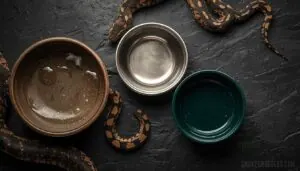
The bowl’s material matters more than most keepers expect. It affects how long the dish lasts, how clean it stays, and how safe it’s for your snake.
Here’s how the most common options stack up.
Compare Ceramic, Resin, and Recycled Plastic
Each material tells a different story.
Ceramic wins on weight stability and temperature retention — it stays cool longer and won’t budge when your boa climbs in.
Resin offers better durability and toughness with solid impact resistance at a mid-range cost.
Recycled plastic is cheapest and lightest, though it warms fast.
For full setup guidance, boa constrictor hide and water dish options can help you balance budget-friendly materials with proper temperature management.
For large boas, ceramic or resin outperforms recycled plastic long-term.
Prefer Non-porous Surfaces for Easier Sanitation
Surface matters more than you think.
Nonporous bowls don’t absorb liquids — contaminants stay on top, making rapid cleaning genuinely fast.
No biofilm reduction guesswork, no bacterial contamination hiding in micro‑scratches.
Chemical safety stays simple too: dilute bleach or 70% ethanol works fine without special protocols.
Key material hygiene considerations for reptile dishes:
- Stain resistance keeps bowls inspection‑ready longer
- Easy to clean with standard wipers
- Deep sanitization needs no sealing treatments
- Maintenance efficiency improves with continuous, smooth finishes
Look for Materials That Resist Cracking and Odor Buildup
Cracks and odors don’t show up overnight — they sneak up on you. Non-porous ceramics and UV-stabilized resin resist both, with reinforced edge designs handling accidental drops without chipping.
Food-grade resin with antimicrobial additives slows bacterial growth between cleanings.
Heat-resistant materials tolerate 60°C sanitation without warping.
Nonporous surfaces simply don’t trap odor compounds the way cheaper alternatives do.
Avoid Lightweight Bowls That Wear Out Quickly
A flimsy bowl isn’t a bowl — it’s a countdown timer. HDPE plastic hits its weight thresholds quickly under a large boa’s pressure, flexing and cracking long before ceramic or solid resin would. Material fatigue shows up as warping, micro-cracks, and surface roughness. That’s a replacement cost you keep repeating.
A flimsy bowl isn’t a bowl — it’s a replacement cost you keep repeating
Choose durable construction built for the long haul:
- Ceramic resists impact and stays tip-resistant under heavy snakes
- Solid resin passes durability testing for bites and pressure loads
- Reinforced bases prevent flexing that accelerates material fatigue
- Non-porous finishes hold up through repeated sanitation cycles
- Heavy weight design pays off as a genuine long-term investment
Stable Designs That Prevent Tipping
A large boa doesn’t care about your water dish — it’ll step right into it and send water everywhere. That’s why stability isn’t a nice-to-have; it’s a design requirement.
Here are the features that actually keep the dish in place.
Choose Wide, Low-profile Bowls for Better Balance
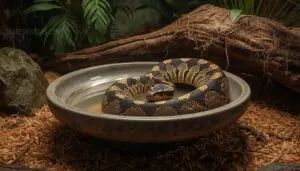
Think of it like a wide stance — the lower and broader the base, the harder it is to knock over. Wide-rim, low-profile designs increase substrate contact and keep the center of gravity close to the ground.
That means better stability and design overall, even when a 60-pound boa slides in. Look for edge beveling and proper bowl placement to reduce tipping risk with large capacity snake water bowls.
Use Heavy Bases to Stop Spills and Shifting
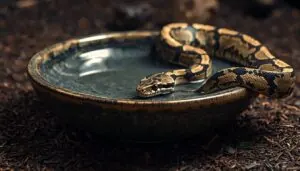
A heavy base isn’t just about weight — it’s about keeping your snake’s water exactly where it belongs.
Base Material Density and Friction Enhancements work together to prevent shifting on smooth enclosure floors.
Here’s what matters for a stable hydration source:
- Base Weight Optimization lowers the center of gravity
- Weighted Fill Options let you customize stability
- Dense ceramic or resin reduces tipping risk substantially
- Tip-resistant construction protects large capacity snake water bowls
Pick Corner-fit Designs for Tighter Enclosure Layouts
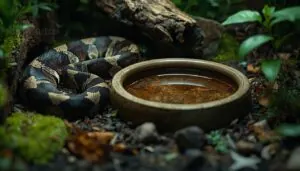
Once you’ve got the weight dialed in, placement is the next win.
Corner fit designs solve a real problem for large boas — floor space disappears fast. Corner water bowls for tank corners use Space Optimization by keeping roughly 80% of the corner open for movement.
Corner Mounting Mechanics with magnetic or clip fasteners resist tipping, while natural coloring enhances Visual Camouflage, reducing snake stress.
Smart corner placement also aids Temperature Regulation near cooler enclosure zones, and quick-detach trays make Ease of Access easy during water changes.
Favor Smooth Edges and Tip-resistant Construction
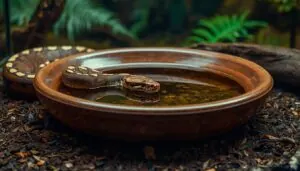
Smooth edges matter more than most keepers realize. Rounded rims — at least 3 mm radius — deliver real Snout Injury Prevention, protecting your boa’s jaw during feeding. Edge Rounding Benefits also speed up daily scrubbing.
Pair that with Tip-Resistant Mechanics: a weighted Non‑Slip Base, wide footprint, and Anti‑Spill Design keep large boas from launching water mid‑soak. Less mess, fewer injuries.
Top 5 Snake Water Dishes
Not every water dish can handle a large constrictor — the wrong one tips, cracks, or turns into a bacterial swamp within days. These five options hold up under real conditions and cover different setups, budgets, and snake sizes.
Here’s what’s worth your money.
1. Zoo Med Rock Corner Water Dish
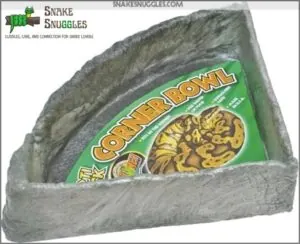
The Zoo Med Rock Corner Water Dish earns its spot through smart geometry. Its triangular footprint tucks flush into any corner, reclaiming floor space without sacrificing capacity — roughly one gallon, enough for a large boa to soak comfortably.
At 13.8 × 13.2 × 3.2 inches and 3.8 lbs empty, it stays put when your snake climbs in.
The recycled plastic resists cracking, cleans easily, and the dishwasher‑safe surface makes daily maintenance straightforward.
One caveat: the random color assignment means you’re not picking the shade.
| Best For | Owners of large reptiles — boas, bearded dragons, or turtles — who want a stable, roomy water dish that fits neatly into a corner without eating up enclosure floor space. |
|---|---|
| Material | Rigid plastic |
| Capacity / Depth | 3.2 in deep / ~1 gal |
| Easy to Clean | Dishwasher safe |
| Tip Resistance | Heavy base, 3.8 lb |
| Enclosure Fit | Corner-mount design |
| Species Suitability | Large snakes, turtles, dragons |
| Additional Features |
|
- Corner design saves floor space and keeps the dish from shifting around
- Holds about a gallon of water, giving big reptiles plenty of room to soak
- Dishwasher safe and built tough — easy to clean and built to last
- High sides can be tricky for smaller or less mobile reptiles to climb in and out
- Color is randomly assigned, so it might not match your setup
- Gets heavy fast once filled, making it a bit of a hassle to move or empty
2. Flushbay Reptile Bathing Pool with Ramp
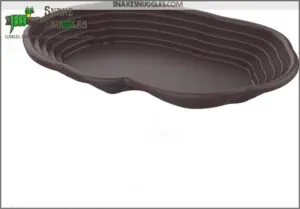
If corner geometry isn’t your priority, the Flushbay Reptile Bathing Pool takes a different approach — built wide rather than compact. At 39 × 27 × 5 cm, it gives a large boa real room to settle in without crowding the enclosure.
The integrated ramp is the standout feature: a gradual incline your snake can actually use, no awkward scrambling over a vertical lip. The textured ramp surface adds grip where it matters most.
ABS plastic keeps cleanup simple.
| Best For | Reptile owners with larger species — boas, tortoises, or big lizards — who need a spacious soak area with easy entry and exit. |
|---|---|
| Material | ABS plastic |
| Capacity / Depth | 5 cm deep |
| Easy to Clean | Non-porous, rinse-friendly |
| Tip Resistance | Stable, lightweight |
| Enclosure Fit | Embeds in substrate |
| Species Suitability | Snakes, turtles, frogs, lizards |
| Additional Features |
|
- The built-in ramp makes climbing in and out effortless, which is a real plus for snakes and turtles that struggle with steep walls.
- Huge surface area (39 × 27 cm) gives bigger reptiles plenty of room to soak comfortably.
- ABS plastic is tough, non-toxic, and wipes down fast — no fuss between uses.
- The footprint is big, so smaller enclosures will feel the squeeze.
- Only 5 cm deep, which won’t cut it for species that need a proper deep soak.
- Nooks around the ramp can trap grime and take more scrubbing to get fully clean.
3. Exo Terra Large Reptile Water Bowl
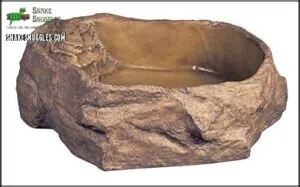
The Exo Terra Large Reptile Water Bowl earns its spot through sheer practicality. At 9.7 × 10 × 2.5 inches, it fits most standard enclosures without dominating the floor space.
The food-grade resin interior is smooth and non-porous — bacteria don’t get a foothold, and cleanup takes seconds.
Built-in safety steps help smaller tank inhabitants escape if they wander in. Heavy enough to resist tipping when your boa decides to climb in dramatically.
Neutral stone finish blends without looking out of place.
| Best For | Owners of large reptiles like tortoises, ball pythons, or corn snakes who want a sturdy, easy-to-clean water dish that looks natural in the enclosure. |
|---|---|
| Material | Food-grade resin |
| Capacity / Depth | 2.5 in deep / 16 oz |
| Easy to Clean | Smooth non-porous interior |
| Tip Resistance | Heavy, ~1 lb |
| Enclosure Fit | Freestanding, neutral color |
| Species Suitability | Tortoises, ball pythons, corn snakes |
| Additional Features |
|
- Smooth, non-porous interior makes cleaning quick and keeps bacteria from building up
- Heavy construction stays put even when active animals climb in or knock around the tank
- Built-in ramp helps smaller critters escape the water safely
- Reported sizing inconsistencies mean the dish might not fit your enclosure the way you’d expect
- The ~1 lb weight makes it a bit of a hassle to move around when you need to reposition things
- Too deep for very small amphibians or insects that do better with shallow water
4. Zoo Med Reptile Rock Water Dish
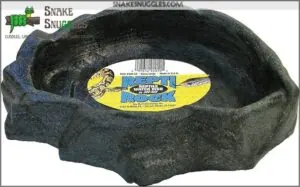
Built from 100% recycled plastic, the Zoo Med Reptile Rock Water Dish punches above its weight for large constrictors. At 11 inches wide and 2 inches deep, it gives your boa enough room to soak without flooding the enclosure.
The non-porous surface wipes clean fast — no scrubbing crevices, no odor traps. Molded stairs reduce drowning risk for smaller tank inhabitants.
Heavy enough to stay put when your snake climbs in. Natural rock finish blends right into the setup.
| Best For | Reptile and amphibian owners who want a naturalistic, easy-to-clean water dish that works for everything from bearded dragons to frogs and small snakes. |
|---|---|
| Material | Food-grade resin |
| Capacity / Depth | 2 in deep |
| Easy to Clean | Smooth non-porous interior |
| Tip Resistance | Heavy, 2.2 lb |
| Enclosure Fit | Freestanding, compact |
| Species Suitability | Ball pythons, tortoises, tree frogs |
| Additional Features |
|
- Non-porous surface means no hidden bacteria traps — a quick rinse and it’s good to go.
- The molded stairs are a nice touch, giving smaller critters a way out if they wander in.
- Heavy enough to stay put even when active animals climb in or bump around.
- You don’t get to pick your color — whatever shade they send is what you get.
- The curved base can rock on smooth surfaces, so it works better on substrate than bare glass.
- Some buyers feel the size runs smaller than "extra-large" suggests, so measure your setup first.
5. KooingTech Tortoise Water Dish
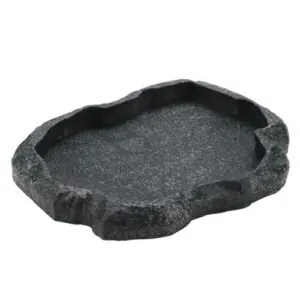
At $12.99, the KooingTech Tortoise Water Dish won’t break the bank — but it does have limits worth knowing.
The wide, low-profile base holds steady when your snake leans in, and the non-porous ABS resin wipes down fast.
That imitation stone finish actually looks decent inside a naturalistic setup.
Just don’t count on it for deep soaking. At 0.79 inches deep, it’s better suited for drinking and light hydration than a full soak session for large constrictors.
| Best For | Small to mid-sized reptiles like tortoises, geckos, and bearded dragons that need a safe, shallow water or food dish inside a naturalistic tank setup. |
|---|---|
| Material | Recycled polystyrene |
| Capacity / Depth | 2 in deep |
| Easy to Clean | Non-porous, no crevices |
| Tip Resistance | Weighted base, 1.46 lb |
| Enclosure Fit | Freestanding, rock-shaped |
| Species Suitability | Dragons, frogs, snakes, birds |
| Additional Features |
|
- The fake stone texture looks surprisingly natural and blends right into a reptile enclosure without looking cheap.
- ABS resin is easy to rinse clean and won’t absorb bacteria the way porous materials can.
- Shallow depth makes it safe for hatchlings and small reptiles — no drowning risk.
- At under an inch deep, it’s not going to cut it for larger reptiles that need a proper soak.
- Overfill it slightly and you’re mopping up water — there’s not much room for error.
- Prolonged exposure to strong heat lamps can warp or discolor the resin over time.
Cleaning and Replacing Water Bowls
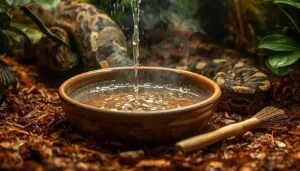
clean water dish does more than look nice — it’s the difference between a healthy snake and a vet bill. Bacteria move fast in warm enclosures, so your cleaning routine needs to keep up.
that routine should look like.
Change Water Daily to Reduce Bacterial Growth
Daily water changes are your first line of defense against bacterial growth. Stale water warms quickly in a heated enclosure — and warm, stagnant water is where microbial load monitoring actually matters most.
Three reasons to change it every day:
- Biofilm prevention — bacteria attach to dish walls within hours
- Temperature control — fresh water resets the growth window
- Cross-contamination risks — snake saliva and shed debris spike pathogen levels quickly
Scrub With Hot Water and Mild Detergent
Hot water does the heavy lifting here. Aim for 45–60°C — hot enough to break down grease and loosen biofilm, but not so hot it warps plastic or cracks ceramic.
Let the dish soak 5–10 minutes with a fragrance‑free, dye‑free mild detergent. Then scrub, rinse thoroughly with clean warm water, and air dry completely.
Skipping that last step? You’re just inviting microbial growth back in.
Deep Clean With Bleach Dilution or Chlorhexidine
Once a month, go beyond scrubbing — your boa needs a true reset.
For deep sanitization, pick one:
- Use a 1:50 bleach dilution for routine reptile water bowl maintenance
- A 1:10 ratio manages tougher contamination
- Chlorhexidine contact time matters — let it sit fully before rinsing
- Residue rinsing protocol: rinse twice, then air dry completely
- Solution freshness frequency: mix new solution every single time
Wear gloves. Ventilate. Stale solutions protect nothing — snake health depends on consistency.
Replace Bowls With Cracks, Odors, or Rough Surfaces
Deep cleaning only works if the bowl’s worth saving. Cracked bowl hazards are real — fissures trap bacteria, no bleach can fully reach and create sharp edges that nick scales.
Rough surface bacteria thrive in pitted texture. Odor-induced stress signals a bowl past its prime.
Regular visual damage inspection catches these early. Follow replacement timing guidelines: persistent smell, visible cracks, or rough patches mean it’s done.
Keep Dishes Sanitary to Support Hydration and Shedding
A clean bowl ties everything together. Daily Water Rotation is the foundation — stale water invites biofilm fast.
Scrub thoroughly, then deep sanitize monthly using diluted bleach or chlorhexidine for solid Odor Control Strategies. Some keepers explore UV Light Sterilization or Microbial Swab Testing for extra assurance.
Sanitary dishes directly support snake shedding and steady hydration — skip this step, and every other effort starts unraveling.
Frequently Asked Questions (FAQs)
How big should a snakes water dish be?
Size depends on your snake’s body width. For a 3-foot boa, aim for 6–8 inches in diameter. A 5–6 footer needs 10–12 inches. Keep water depth between 2–4 inches.
What to use as a snake water bowl?
Ceramic and high-quality resin are your best bets. Both offer nonporous surfaces that clean fast and resist odor. For large boas, skip lightweight plastics — they crack, warp, and tip.
Can I put ice in my snakes water bowl?
Skip the ice. It’s a thermometer spike in reverse — jarring and stressful. Stable, room-temperature water helps snake hydration, thermoregulation, and consistent shedding far better than any chilled shortcut.
How does dehydration affect a large constrictors health?
Dehydration hits hard and fast. Skin elasticity drops, blood circulation strains, and thermoregulation disruption slows digestion.
Kidney stress builds quietly. Shedding complications follow.
These reptile health issues compound quickly — proper reptile hydration isn’t optional.
What water depth prevents drowning during snake soaking?
Keep it at two to four inches. That’s deep enough to hydrate and soften a shed; shallow enough that your boa lifts its head and breathes without effort.
Simple rule; serious consequence if ignored.
How quickly can dehydration symptoms appear in boas?
Symptoms can show up fast — within 3 to 5 days. Watch for dull scales, lethargy onset, and eye cap cracking. Poor sheds and shedding difficulty follow quickly if dehydration goes uncorrected.
Does soaking water temperature affect a snakes thermoregulation?
Yes.
Think of your boa as a living thermostat — soaking water is one dial it uses.
Cool water lowers core temperature fast; warm water raises it.
Large boas feel this shift more due to heat inertia effects.
Conclusion
Picture a 100-pound boa sliding into a perfectly sized bowl—no spills, no struggle, clean water waiting. That’s what the right choice delivers.
Snake water dishes for large constrictors aren’t afterthoughts; they’re daily-use tools that directly affect hydration, shedding, and long-term health.
Get the size, material, and stability right once, and you won’t revisit the problem. Your snake won’t either.
Simple decisions, consistently made, are what separate good husbandry from reactive damage control.