This site is supported by our readers. We may earn a commission, at no cost to you, if you purchase through links.

A bare glass tank won’t kill your snake outright, but the wrong setup will wear it down slowly through stress, dehydration, or a burn from an unshielded heat source. Snakes don’t show pain the way mammals do, so problems often go unnoticed until shed cycles stall or appetite drops.
The right snake tank accessories change that equation entirely, giving your snake the hides, humidity, and thermal gradients it needs to actually thrive instead of merely survive. From secure hides to precision thermometers, the gear you choose shapes your snake’s daily comfort more than the tank itself ever will.
Table Of Contents
- Key Takeaways
- Snake Tank Accessory Essentials
- Top 10 Snake Tank Accessories
- 1. Interlocking snake climbing enrichment rings
- 2. PietyPet Terrarium Plant Set
- 3. Sukh Sphagnum Moss Terrarium Substrate
- 4. Stainless Steel Reptile Feeding Tongs
- 5. Runania Reptile Habitat Accessory Set
- 6. Natural Coral Driftwood Aquarium Decor
- 7. Dual Digital Reptile Thermometer Hygrometer
- 8. Acrylic Snake Climbing Rings
- 9. Long Stainless Aquarium Tweezers Set
- 10. Adjustable Reptile Climbing Stick
- Choosing Safe Snake Decor
- Creating Naturalistic Snake Enrichment
- Buying Snake Accessories Wisely
- Frequently Asked Questions (FAQs)
- What do snakes like in their tank?
- What is the best decor for a snake tank?
- What can I use in a snake tank?
- What are the different types of snake cage accessories?
- Are reptile tanks good for lizards?
- Where can I buy a reptile enclosure?
- What should I put in a snake tank?
- What does a snake need in their enclosure?
- How often should I mist my snakes tank?
- What security features prevent snake escapes?
- Conclusion
Key Takeaways
- A safe snake enclosure depends on five core essentials—secure hides, stable water bowls, climbing structures, humidity control, and temperature monitoring—since problems like stress or dehydration often go undetected until shedding or appetite issues appear.
- All accessories should be made from non-toxic, non-porous, easy-clean materials like stainless steel, glazed ceramic, or safety-rated polymer, while avoiding cedar, painted resin, or unglazed clay.
- Proper sizing and placement matter as much as material choice, so hides, bowls, and climbing gear should be secured against tipping, fitted with gap-free seams under 5mm, and matched to your snake’s adult size rather than its current juvenile dimensions.
- Building a naturalistic habitat with driftwood, moss, vines, and modular climbing components supports long-term health and enrichment, while planning for durability and future upgrades helps you avoid costly replacements as your snake grows.
Snake Tank Accessory Essentials
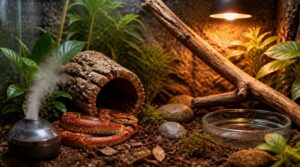
A well-built snake enclosure comes down to five essentials: hides, water, climbing space, humidity, and temperature control.
Getting these basics right also supports your snake’s overall health, which is why routine checkups matter—here’s how to find trusted veterinary care for pet snakes.
Get these right, and your snake stays healthy, calm, and true to its natural instincts. Here’s what each essential looks like in practice, starting with the accessories that make it happen.
If you’re still deciding which species suits your lifestyle, this pet snake breed comparison guide breaks down temperament, size, and care needs side by side.
For safe, low-stress trips, explore boa constrictor travel enclosure options suited to your snake’s size and needs.
Secure Hides
Because a stressed snake is a sick snake, secure hides top your accessory list. Look for realistic rock hides like the Exo Terra Reptile Cave—non-toxic, low outgassing risk, stable bases resisting tips.
Good hides deliver:
- Thermal buffering for warm/cool sides
- Microclimate creation for humidity choice
- Cleaning accessibility via smooth interiors
Skip flimsy shelters; stability and safety come first.
Safe Water Bowls
Water tanks fail snakes in one of two ways: tipping over or growing bacteria nobody notices. Spill-resistant rims and non-toxic, food-grade materials fix both, while antimicrobial coatings cut cleaning time in half.
| Size | Capacity | Best For |
|---|---|---|
| Assorted Small Bowl | 8–16 oz | Hatchlings |
| Assorted Large Bowl | 16–32 oz | Adults |
| Assorted Extra Large Bowl | 32+ oz | Big-bodied species |
Match your reptile feeding and water stations to your snake’s actual size, not guesswork.
Climbing Enrichment
Bored snakes get restless, so climbing structures for snakes matter as much as bowls do.
Vertical ring systems and modular ledge sets create real ascent challenges, while branch texture variety builds grip strength.
Consider:
- Tension cable mesh for belly-scale traction
- Moss bench microclimates for humid rest stops
- Staggered ledges for species-appropriate height
Non-slick surfaces and secure anchoring prevent slips during active climbing enrichment.
Humidity Support
Climbing structures keep muscles active, but habitat humidity control keeps skin, eyes, and lungs functioning correctly. Target 50–70% relative humidity using damp substrate zones and sphagnum moss as humidity retainers near hides.
Place hygrometers at mid-enclosure height for accurate readings. Time misting cycles around shed cycles, and watch for condensation—early sign of mold prevention needs. Fogger systems deliver quick humidity spikes without soaking substrate.
Temperature Monitoring
Nothing tanks a snake’s health faster than an unmonitored thermal gradient. Sensor placement at basking spots, cool zones, and substrate level catches dangerous swings before they cause harm.
Implementing continuous monitoring detects excursions can prevent equipment damage in reptile setups.
A 1000 Watt Thermostat with Probe paired with data logging and alarm thresholds automates thermal regulation for snakes.
- glowing basking bulb humming under a probe
- cool-side corner reading steady digits
- alert pinging your phone at midnight
Calibration accuracy and humidity resistance keep readings trustworthy long-term.
Top 10 Snake Tank Accessories
You’ve got the essentials down, so now it’s time to fill your snake’s tank with accessories that actually earn their space. The next ten picks cover climbing, humidity, feeding, and monitoring needs, each chosen for build quality and everyday practicality. Here’s what belongs on your shopping list.
1. Interlocking snake climbing enrichment rings
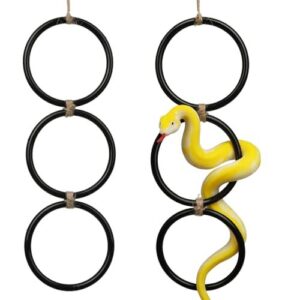
A snake pressed against glass, testing every surface, is a snake begging for a vertical challenge. Interlocking climbing rings answer that call with a modular lattice of 4.6-inch rings, expandable to 28 inches of tunnel length.
Built from recycled ABS plastic with rounded, scale-safe edges, these rings hook securely to mesh lids. Ball Pythons and Corn Snakes up to five feet thrive here, coiling and threading through interlocking paths that build muscle and curb stress-related fasting.
| Best For | Owners of Ball Pythons, Corn Snakes, Bearded Dragons, and Chameleons up to five feet long who want to add climbing enrichment to a bioactive or mesh-lidded enclosure. |
|---|---|
| Material | ABS plastic |
| Primary Use | Climbing enrichment |
| Installation Method | Mesh lid hooks |
| Target Species | Ball Pythons Corn Snakes |
| Cleaning/Maintenance | Wipeable |
| Weight | Not specified |
| Additional Features |
|
- Modular rings let you customize tunnel length up to 28 inches for multi-directional climbing
- Rounded, scale-safe edges made from recycled ocean-bound ABS plastic protect your reptile while supporting sustainability
- Encourages natural exercise and exploration, helping reduce stress-induced fasting
- Requires a mesh lid or compatible structure, so it won’t work with every enclosure setup
- Modular connectors can be easy to misplace, requiring replacement parts
- Fit and safety depend on your specific reptile’s size and species, so not all pets will benefit equally
2. PietyPet Terrarium Plant Set
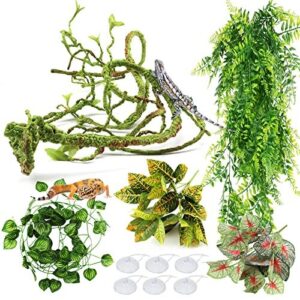
Eight to twenty-five plastic plant pieces, each anchored on a pedestal base, give your enclosure convincing ground cover without soil or roots to manage.
Heights run 2 to 12 inches, so you can layer broad leaves near hides and blade-like fronds along open corners. The non-toxic plastic won’t harm curious tongue-flicks, and smooth leaf edges won’t abrade delicate scales.
Wipe pieces clean with a damp cloth between sheds. Pair them with real moss for a naturalistic, low-fuss finish.
| Best For | Reptile and amphibian keepers who want realistic, low-maintenance ground cover for their terrarium without dealing with soil, roots, or live plant upkeep. |
|---|---|
| Material | Foam/plastic/iron wire |
| Primary Use | Decorative foliage |
| Installation Method | Suction cups |
| Target Species | Bearded dragons geckos |
| Cleaning/Maintenance | Rinse or brush |
| Weight | 10.22 oz |
| Additional Features |
|
- Pedestal bases mean no soil or root management required
- Wide height range (2 to 12 inches) allows for natural-looking, layered arrangements
- Non-toxic, smooth-edged plastic is safe for curious tongues and delicate scales
- Ground-based pieces don’t offer the climbing or hiding spots that vine-style decor provides
- Pedestal bases may take up more floor space than draped or mounted foliage
- Requires manual wiping to keep clean rather than a quick rinse
3. Sukh Sphagnum Moss Terrarium Substrate

Humidity swings can stress a shedding snake fast, and sphagnum moss solves that with excellent moisture retention. Sold vacuum-sealed for cleanliness, this soft, fibrous substrate holds several times its dry weight in water and releases it slowly.
Use it as a top layer over drainage material, or pack it into hide boxes to boost localized humidity during shed cycles. Keep it moist, not soggy — overly wet moss invites mold and bacterial growth, undermining the clean environment you’re working to maintain.
| Best For | Keepers of snakes, turtles, frogs, and geckos who need a reliable way to maintain humidity and support natural behaviors like burrowing and egg-laying. |
|---|---|
| Material | Natural fiber |
| Primary Use | Humidity substrate |
| Installation Method | Loose placement |
| Target Species | Snakes turtles frogs geckos |
| Cleaning/Maintenance | Re-hydrate as needed |
| Weight | 5.6 oz |
| Additional Features |
|
- Retains moisture exceptionally well, helping stabilize humidity during shed cycles and beyond
- Vacuum-sealed for a clean, contamination-free start
- Soft, fibrous texture works well for hides, nesting, and even plant propagation
- Needs regular monitoring to stay moist without becoming soggy, which can invite mold
- Not meant to be used alone — works best mixed with other substrate materials
- Can dry out into a dusty, powdery state if not stored properly, requiring re-hydration
4. Stainless Steel Reptile Feeding Tongs
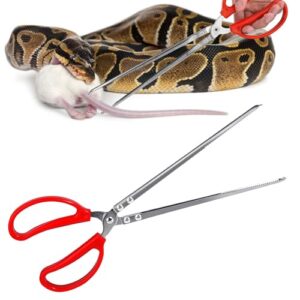
Your bare hand should never make first contact with a feeding snake — that’s what these tongs are for. Built from rust-resistant stainless steel with serrated jaws, they grip prey securely while silicone-sleeved grips keep your fingers comfortable and slip-free.
At 15 inches, you’ll maintain safe distance during feedings, cutting down on hand fatigue and defensive strikes. Beyond mealtime, they double for aquarium cleaning and debris removal — one tool, several jobs, minimal mess.
| Best For | Reptile owners who feed snakes, bearded dragons, geckos, or similar medium-sized reptiles and want a safe, bite-free way to do it. |
|---|---|
| Material | Stainless steel |
| Primary Use | Feeding tool |
| Installation Method | Handheld |
| Target Species | Reptiles general |
| Cleaning/Maintenance | Rinse after use |
| Weight | 6.74 oz |
| Additional Features |
|
- Serrated stainless steel jaws grip prey securely while keeping hands well away from strikes
- Silicone-sleeved handles stay comfortable and non-slip, even through repeated feedings
- Doubles as an aquarium cleaning tool, adding extra value beyond feeding time
- Jaw width isn’t suited for very large prey items
- Not ideal for large constrictors, which need heavier-duty tools
- Silicone grip may wear down with heavy chemical exposure or aggressive cleaning
5. Runania Reptile Habitat Accessory Set

Want a full setup in one box instead of piecing together five separate purchases? The Runania set covers it: interlocking climbing rings, compact dens with smooth, snag-free interiors, and a sponge-based humidity gauge for quick readouts.
Everything’s sized for 20-40 gallon enclosures, non-porous for easy disinfecting, and built to resist tipping against glass walls. Rounded edges protect delicate scales during exploration, while tool-free replacement parts mean a cracked piece won’t derail your entire habitat.
| Best For | Reptile owners with 20-40 gallon enclosures who want an all-in-one habitat upgrade without sourcing separate accessories. |
|---|---|
| Material | Seagrass/wood/iron wire |
| Primary Use | Climbing decor set |
| Installation Method | Suction cups |
| Target Species | Snakes bearded dragons geckos |
| Cleaning/Maintenance | Wipeable |
| Weight | 1.68 lb |
| Additional Features |
|
- Interlocking climbing rings and compact dens add enrichment and shelter in a single, coordinated set
- Non-porous, snag-free surfaces make cleaning and disinfecting simple while protecting delicate scales
- Tool-free replacement parts let you swap out damaged pieces without redoing the whole setup
- Only fits enclosures within the 20-40 gallon range, limiting use for smaller or larger tanks
- Sponge-based humidity gauge may require regular checks or replacement to stay accurate
- Tipping resistance is designed for glass walls, so it may not perform as well in other enclosure types
6. Natural Coral Driftwood Aquarium Decor

Sturdy hardwood branches, 6 to 10 inches long, bring irregular arches and overhangs that create genuine hiding spots rather than decorative filler.
Each piece is manually selected, so curve and texture vary naturally, giving your snake real terrain to investigate.
The wood endures prolonged submersion or bone-dry terrarium air without breaking down. Boil and soak pieces beforehand to cut tannin release and help them sink or settle properly.
Rinse regularly, since biofilm can develop and slightly tint water or surfaces if left unchecked.
| Best For | Aquarium and reptile terrarium owners who want natural-looking hardwood branches to create hiding spots, climbing structures, or aquascaping features for fish, plants, and reptiles alike. |
|---|---|
| Material | Natural hardwood |
| Primary Use | Aquascape/climbing wood |
| Installation Method | Loose placement |
| Target Species | Fish reptiles |
| Cleaning/Maintenance | Boil and soak |
| Weight | ~1 lb per branch |
| Additional Features |
|
- Sturdy hardwood holds up to prolonged submersion or dry terrarium conditions without breaking down
- Each manually selected branch has a unique natural shape and texture, giving tanks and terrariums genuine, varied terrain
- Versatile enough for freshwater aquascapes, moss trees, decorative arches, and reptile climbing structures
- Requires boiling and extended soaking before use to reduce tannin release and help pieces sink
- Exact shape and size vary piece to piece, so the branch you get may look different from photos
- Can develop biofilm over time, requiring regular rinsing and occasional water parameter checks
7. Dual Digital Reptile Thermometer Hygrometer
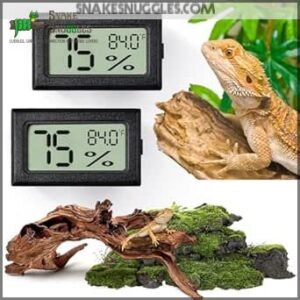
Once your driftwood is settled, the next priority is knowing what’s actually happening inside the tank. A dual digital thermometer hygrometer reads temperature and humidity simultaneously, with ±0.9°F accuracy, so you’re not guessing at gradients.
Placing probes in warm and cool zones reveals real conditions, not assumptions. The LED display toggles Fahrenheit to Celsius instantly, and adhesive backing means tool-free mounting — no wiring clutter, no water-damage risk near your enclosure walls.
| Best For | Reptile and amphibian keepers who need accurate, at-a-glance temperature and humidity readings across multiple zones in their terrarium. |
|---|---|
| Material | Plastic housing |
| Primary Use | Temp/humidity monitor |
| Installation Method | Adhesive backing |
| Target Species | Terrarium reptiles general |
| Cleaning/Maintenance | None needed |
| Weight | Not specified |
| Additional Features |
|
- High-precision ±0.9°F (±0.5°C) accuracy keeps temperature gradients reliable
- LED display with instant °F/°C toggle makes readings easy day or night
- Tool-free adhesive mounting keeps the tank interior clutter-free and wiring-safe
- Humidity accuracy isn’t specified, which may not suit sensitive species
- Adhesive can weaken over time on very wet or textured surfaces
- Battery type and lifespan aren’t disclosed, so replacements require extra guesswork
8. Acrylic Snake Climbing Rings
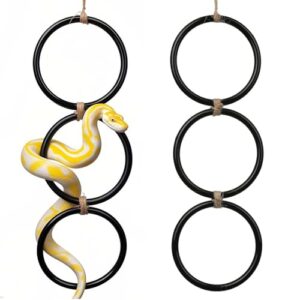
Once temperature and humidity are dialed in, give your snake something to do with that space. Clear acrylic climbing rings resist moisture, won’t roughen scales, and hang from the enclosure ceiling on adjustable cords — no drilling required.
Inner diameters run 3.5 to 4 inches, letting snakes traverse comfortably, while transparent construction keeps visual stress low. Check weekly for cracks or cloudy wear, and skip solvent-based cleaners — they degrade acrylic fast.
| Best For | Ball pythons and similarly sized reptiles that need extra climbing, basking, and hiding opportunities in their enclosure. |
|---|---|
| Material | Acrylic |
| Primary Use | Climbing ring |
| Installation Method | Tool-free mount |
| Target Species | Ball pythons |
| Cleaning/Maintenance | Wipeable |
| Weight | 5.9 oz |
| Additional Features |
|
- Tough, reinforced acrylic construction with a smooth, rounded surface that won’t abrade scales
- Tool-free setup that installs vertically or horizontally in minutes
- Supports up to 5 lb, encouraging muscle development and reducing stress through enrichment
- 5 lb weight limit makes it unsuitable for larger or heavier reptiles
- Black coloring may clash with certain tank decor styles
- Extended UV exposure can make the acrylic brittle, so periodic inspection is needed
9. Long Stainless Aquarium Tweezers Set
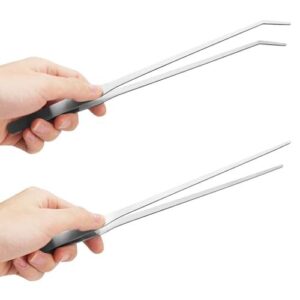
Climbing rings keep snakes active, but daily feeding is where hand safety actually matters. This set pairs a straight and curved 10.6-inch stainless steel tweezer, both serrated for secure grip on prey items or plant debris.
The extra reach keeps your fingers clear of strikes and heat lamps alike. Rinse promptly after saltwater contact to avoid pitting, and skip excessive force near delicate tissue — the serrations hold plenty well without it.
| Best For | Reptile, amphibian, and aquarium keepers who want a safe way to feed and handle prey items, plants, or décor without putting their hands near strikes, heat lamps, or delicate tank inhabitants. |
|---|---|
| Material | Stainless steel |
| Primary Use | Feeding tool |
| Installation Method | Handheld |
| Target Species | Fish reptiles amphibians |
| Cleaning/Maintenance | Rinse and dry |
| Weight | Not specified |
| Additional Features |
|
- Extra-long 10.6-inch reach keeps fingers safely away from bites and hot surfaces
- Straight and curved serrated tweezers offer secure grip for feeding, aquascaping, and precise placement tasks
- Corrosion-resistant stainless steel cleans easily and holds up to regular use
- Length can feel unwieldy in small tanks or tight enclosures
- Needs prompt rinsing after saltwater exposure to avoid pitting over time
- Serrated tips can damage delicate tissue or fragile items if too much pressure is applied
10. Adjustable Reptile Climbing Stick

Twelve inches doesn’t stay twelve inches forever, especially with growing arboreal species. This climbing stick telescopes to 36 inches, locking at three collars so you customize height without tools.
Textured rubber rungs channel moisture away, keeping grip solid even in humid enclosures. The aluminum alloy frame resists corrosion, and reinforced clamps fit walls from 0.5 to 1.5 inches thick.
Rated for three pounds per segment, it’s built for real climbing loads, not decoration. Rinse with mild soap, air dry, and you’re set.
| Best For | This climbing stick is best for reptile keepers with smaller arboreal or climbing species—like geckos, small lizards, frogs, and crabs—looking to add vertical enrichment to a desert or rainforest-themed terrarium. |
|---|---|
| Material | Plastic/metal |
| Primary Use | Climbing branch |
| Installation Method | Adhesive hooks |
| Target Species | Snakes lizards geckos |
| Cleaning/Maintenance | Wipeable |
| Weight | 4.54 g |
| Additional Features |
|
- Tool-free locking mechanism makes it quick and easy to adjust the length as needed
- Adjustable from about 11.69 to 21.65 inches, so it fits a variety of tank sizes
- Comes with two adhesive hooks and a 45-inch simulated vine for extra grip and natural styling
- Adhesive hooks may not stick well to glass and can slide without additional support
- The extension and locking mechanism can feel stiff, making adjustments tricky for some users
- Not ideal for larger or heavier snakes, since it may risk glass damage or lose its grip
Choosing Safe Snake Decor
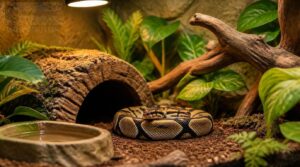
Not every accessory that looks good in a tank belongs there. Your snake’s safety depends on material choices, placement, and sizing just as much as appearance. Here’s what separates decor worth buying from decor worth skipping.
Non-toxic Materials
Nontoxic isn’t a marketing word—it’s the baseline every accessory in your enclosure must meet.
| Material | Safety Trait | Example Use |
|---|---|---|
| Polymer | Meets safety standards, non-porous | Hides, ledges |
| Stainless Steel | Corrosion-resistant, no leaching | Bowls, tongs |
| Glazed Ceramic | Lead-free, vitrified | Shelters |
Skip cedar, painted resin, or unglazed clay. These materials protect skin, digestion, and respiratory health long-term.
Easy-clean Surfaces
Under bacteria and mold’s favorite hiding spots—grout lines and rough textures—lies the real test of good reptile care accessories. Smooth, non-porous surfaces shed waste fast. Look for hydrophobic coatings on hides and ledges; water beads up instead of soaking in.
Glazed ceramic and polymer decor wipe clean with basic cleaners. Scratch-resistant finishes stay smooth, so grime can’t hide in micro-scratches over years of handling.
Stable Accessory Placement
A snake pushing against a loose ledge can topple it in seconds. Secure mounting methods matter: suction cups or adhesive pads work on glass, while wall-stud brackets support heavier branches without sagging.
Wide base footprints and centralized attachment points cut force, keeping climbing structures from tipping when your snake explores. Stable placement isn’t decoration—it’s essential reptile enclosure design that prevents injury and collapse.
Species-appropriate Sizing
A ball python and a reticulated python have nothing in common size-wise, so décor sized for one can injure the other.
Match accessories to adult length, not hatchling size:
- Hides sized for full-grown adults, not juveniles
- Climbing branches rated for adult body mass
- Enclosures reflecting mature length and vertical space needs
Buying for growth boundaries now prevents costly replacements—and unsafe crowding—later.
Escape-safe Designs
Escape artists deserve better than a loose-fitting lid. Every hide needs gap-free hide fit (under 5mm) and snag-free hide edges—rounded, polished, no snagging.
| Feature | Safety Standard |
|---|---|
| Hide gaps | Under 5mm |
| Bowl base | Anti-tipping, non-slip |
| Anchoring | Secure methods |
| Rims | Smooth |
| Openings | No advantage points |
Secure anchor methods and anti-tipping bowl bases keep enclosure accessories from becoming escape tools.
Creating Naturalistic Snake Enrichment
A bare tank keeps your snake alive, but it doesn’t give it much of a life. Real enrichment comes from layering in the right mix of cover, texture, and climbing options that mimic what your snake would find in the wild. Here’s where to start building that naturalistic setup, piece by piece.
Adding a few sturdy, snake-safe live plants is a great place to start, and this guide to choosing the best plants for a snake enclosure walks through which species hold up best to slithering and burrowing.
A bare tank keeps a snake alive, but real enrichment comes from mimicking the cover, texture, and climbing it would find in the wild
Plants and Vines

Whether you choose live pothos or artificial foliage, vertical growth structures like mesh backgrounds turn flat walls into climbing terrain. Assorted vines with twining stems or adhesive pads grip securely, while non-toxic foliage stays sap-free and safe.
Natural-ooking vines maintain 50-70% humidity zones when misted regularly. Synthetic plants for terrariums offer zero-maintenance greenery—no fertilizing, no wilting, just permanent cover your snake will actually use.
Driftwood and Branches
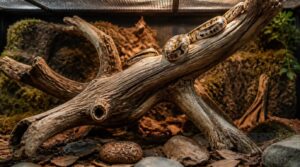
Vines get your snake climbing sideways; driftwood gives it real vertical texture. Look for hardwoods like oak, cured and dried to prevent cracking, with no mold or borer holes.
- Soak weeks to leach tannins
- Inspect for splinters before placing
- Anchor with multiple contact points
- Choose weathered, non-toxic pieces
Stability matters most—wobbly branches invite injury, not enrichment.
Moss and Humidity Zones
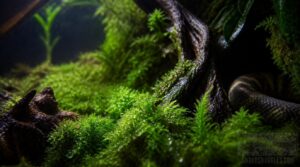
Wood provides the structure; moss provides the humidity. Sphagnum moss holds water like a sponge, keeping 60–90% humidity without soaking substrate. Try Galapagos Green Sphagnum Moss 4qt for reliable moisture retention.
| Moss Type | Best Use |
|---|---|
| Sphagnum | High humidity zones |
| Sheet | Mixed displays |
| Preserved | Low-maintenance cover |
| Live | Naturalistic terrariums |
Mist daily, avoid pooling—rot ruins moss fast.
Climbing Opportunities
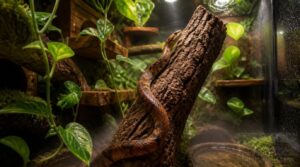
Moisture keeps skin supple; climbing keeps muscles working. Add vertical climbing structures with textured, non-slip surfaces sized to match branch diameter for your species. Modular wall segments let you expand routes over time.
Space enrichment rings provide secure grip points, mimicking arboreal reptile climbing aids used in naturalistic setups—giving even ground-dwelling snakes room to explore upward safely.
Cozy Visual Cover
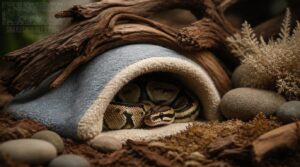
Under low tank lighting, a snake’s sense of security depends on what it sees, not just what it touches.
Soft color palettes in pastel blues and creams, paired with felt or microfiber textures, soften glare. Tuck hides and shelters beneath driftwood, letting diffused light create depth without harsh hotspots.
The result: a naturalistic setup with a non-intimidating silhouette your snake will actually use.
Buying Snake Accessories Wisely
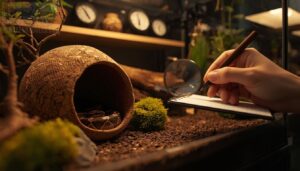
Not every accessory that looks good in a tank earns its place inside one. Smart buying comes down to a handful of practical checks you can run before you swipe your card. Here’s what actually matters once you start comparing options.
Match Enclosure Size
Bigger isn’t always better — accessories need to fit the tank you actually have, not the one you’ll own someday.
- Corn snakes: 40–55 gallons juvenile, 75–125 adult
- Ball pythons: similar range, adjust for growth
- Check vertical clearance for climbers
- Match hides to floor space, not guesswork
Buy for current size, upgrade as your snake grows.
Prioritize Daily Function
Before checking a feature’s looks, ask what it does for your snake today. Daily rituals matter more than novelty items.
| Task | Purpose |
|---|---|
| Water change | Hydration, stress prevention |
| Temperature check | Health monitoring |
| Spot clean | Outcome tracking |
Pick reptile care supplies supporting consistency strategies — accessories earning their space through function, not just visual enrichment.
Compare Durability
Not all materials age the same way. Stainless steel holds up for years with minimal pitting, while ABS plastic loses 5-8% surface gloss after just one year of daily handling. UV exposure fades HDPE color within 3-5 years indoors.
For reptile enclosure décor, humidity resistance testing matters too — check that substrates resist delamination through repeated cleaning cycles before committing.
Balance Cost and Safety
Cheap doesn’t mean unsafe, and expensive doesn’t guarantee it. Focus spending on safety-critical items first — secure lids, weighted water dishes, non-toxic hides — before cosmetic upgrades.
- Affordable non-toxic materials: inert resin decor and treated woods
- Long-term value: compare replacement frequency, not just sticker price
- Maintenance vs. replacement: easy-clean surfaces save money over years
Budget-friendly reptile supplies exist without cutting corners on enclosure safety standards.
Plan Future Upgrades
Today’s setup won’t fit tomorrow’s snake. Choose modular components that swap in without tearing down the whole enclosure — expandable racks, interlocking climbing rings, standardized mounts.
Build a simple 12-month timeline with quarterly checkpoints, and set aside a small contingency fund for surprises. Train keepers on new gear as you add it. Smart reptile habitat design plans for growth, not just today’s needs.
Frequently Asked Questions (FAQs)
What do snakes like in their tank?
Snakes want secure hides on both warm and cool sides, stable water bowls, and a genuine thermal gradient. They also crave climbing structures, naturalistic textures, and visual security—cover that lowers stress while supporting natural exploration and habitat enrichment instincts.
What is the best decor for a snake tank?
The best decor combines secure hides, non-porous climbing structures, and heavy water bowls in non-toxic materials.
Prioritize stable mounting, grippable texture, and easy-clean surfaces—naturalistic pieces like driftwood and moss zones add enrichment while meeting reptile enclosure safety standards.
What can I use in a snake tank?
Rigid secure hides, heavy water bowls, and coconut fiber or cypress mulch substrate all belong in the setup. Add climbing branches, sphagnum moss for humidity, and a dual digital thermometer-hygrogen combo—your snake gets safety, enrichment, and species-appropriate comfort in one enclosure.
What are the different types of snake cage accessories?
Cage accessories break into five categories: secure hiding spots, essential hydration tools, thermal regulation gear, enrichment climbing structures, and substrate moisture aids.
Each fulfills a distinct husbandry function, from digital thermometers monitoring basking zones to sphagnum moss maintaining humidity for proper shedding.
Are reptile tanks good for lizards?
Picture a skyscraper built for climbers, not just floor space: that’s what a proper reptile tank offers. Yes, they suit lizards well when sized for species specific sizing, offering vertical space benefits, ventilation, and stable humidity for healthy microclimates.
Where can I buy a reptile enclosure?
Check an online reptile store for reviews and selection, visit local shops for hands-on fit-testing, or commission a custom build (1–6 week leadtime). Secondhand units work too—just inspect hinges, seals, and ventilation before buying.
What should I put in a snake tank?
Two secure hides, a heavy non-tip water bowl, and climbing branches cover the basics. Layer in humidity-holding substrate and a digital thermometer/hygrometer pair so warm and cool zones stay accurate and your snake thrives safely.
What does a snake need in their enclosure?
Simplicity looks like a bare tank, yet real safety demands complexity underneath. Your snake needs secure hides on both ends, a thermal gradient, deep water for soaking, climbing structures, and microclimate variety through humidity zones and species-appropriate substrate.
How often should I mist my snakes tank?
Misting frequency depends on species humidity needs—tropical snakes want daily to twice-daily misting, desert species far less.
Watch substrate moisture and shedding cycles, adjusting seasonally to prevent mold growth while supporting healthy sheds and stable humidity control.
What security features prevent snake escapes?
Given enough pressure, a snake will find any weak seam. Reinforced wall integrity, locking lid mechanisms, sealed vent design, and redundant latching systems close those gaps, keeping enrichment, hides, and handling tools exactly where you left them.
Conclusion
A tank with bare glass and nothing else is a snake living on borrowed comfort, not thriving. The right snake tank accessories close that gap, turning a plain enclosure into a functional habitat with hides, humidity, and secure footing your snake actually uses.
Skip the guesswork. Choose materials built for daily wear, place each piece with purpose, and watch feeding, shedding, and basking fall into a steady rhythm. That’s what thoughtful setup delivers: a snake settled, secure, and unmistakably at home.