This site is supported by our readers. We may earn a commission, at no cost to you, if you purchase through links.

A snake that refuses to eat, hides for weeks, or constantly presses its nose against the glass isn’t being difficult—it’s telling you something’s wrong. Snakes don’t adapt to poor environments the way dogs or cats might.
Their stress response is slower, quieter, and far easier to miss until real damage is done.
The good news: most of what makes a snake feel safe comes down to five specific, controllable factors inside the enclosure. Nail those, and your snake’s behavior will shift in ways that are hard to ignore.
Table Of Contents
Key Takeaways
- Enclosure size drives everything — your snake needs floor space at least 1.2× its snout-to-vent length, with room to stretch, thermoregulate, and decompress.
- Two snug hides (one on the warm side, one on the cool) give your snake real choices and trigger a measurable drop in stress behavior.
- true temperature gradient — warm side at 88–95°F, cool side at 70–78°F — controlled by a thermostat, isn’t optional; it’s what keeps your snake feeding and behaving normally.
- Where you place the enclosure and how often you disturb it matter as much as what’s inside — low-traffic, vibration-free placement and minimal handling changes protect your snake’s baseline calm.
Choose The Right Enclosure Size

Getting the size right is the single biggest factor in whether your snake feels secure or stressed. A cramped enclosure forces a snake to stay tense — there’s simply no room to thermoregulate or decompress.
Getting the dimensions right from the start saves a lot of headaches — these snake terrarium sizing factors walk you through exactly what to consider before you buy.
Here’s what to look at when sizing your snake’s space.
Match Floor Space to Your Snake’s Adult Length
Before you buy that enclosure, do the math — snake’s adult size should drive every decision.
- Match floor length to your snake’s SVL ratio guidelines: aim for at least 1.2× their snout-to-vent length.
- Apply floor area scaling as they grow — increase space 20% when they hit 80% of adult size.
- Use modular enclosure design to expand without starting over.
- Run growth projection calculations early so you’re never scrambling for a last‑minute upgrade.
Remember that the minimum enclosure length should match the snake’s full body length for proper stretching.
Give Active Species Room to Stretch and Coil
Floor space isn’t just about length — active species like corn snakes need open floor lanes and coil-ready zones to move naturally. Without room to stretch and recoil, snakes pace restlessly.
Aim for a flexible decor layout that preserves clear corner pathways and multi-directional entry around hides. Species-specific enclosure requirements vary, but every setup benefits from open zones across the full thermal gradient.
Upgrade Cramped Enclosures as Your Snake Grows
A cramped snake is a stressed snake. Gradual size scaling is your best strategy — upgrade when your snake’s body length exceeds 1.75 times the enclosure’s interior length.
Growth monitoring metrics like monthly length checks make timing easy.
Changing habitat planning works best with modular enclosure design, letting you add vertical space expansion and familiar furnishings so your snake adjusts without unnecessary disruption.
Use Enclosure Width and Length to Reduce Stress
Width and length work together to create Microclimate Zoning — distinct warm and cool areas your snake can actually choose between. Proper Heat Spot Distance prevents the whole enclosure from feeling uniformly hot.
A wider footprint builds real Spatial Choice Points and clear Movement Pathways, supporting Crowding Prevention. Choosing appropriate enclosure size for snakes, following species-specific habitat requirements, makes enclosure size guidelines practical rather than theoretical.
Add Hides and Visual Barriers
Snakes don’t feel safe in open, exposed spaces — they’re wired to seek cover.
The right hides and visual barriers make a real difference in how settled and stress‑free your snake feels day‑to‑day.
Here’s what to include in the enclosure.
Place One Hide on The Warm Side

Your snake’s warm hide isn’t just décor — it’s a thermal retreat access point that determines whether your snake feels safe while thermoregulating.
Pairing your hide with the right substrate for baby snakes — like aspen or cypress mulch — keeps the retreat feeling secure and regulates moisture without stressing your snake out.
Warm hide proximity to the heat mat matters more than most keepers realize. Follow these five placement principles:
- Heat Source Alignment — Position the hide directly over or beside the heat mat
- Compact Entrance — Choose a snug opening that mimics a natural crevice
- Secure Hide Anchoring — Make sure it won’t shift when your snake coils inside
- Gradient Positioning — Keep it fully within the warm zone of the temperature gradient
- Inward-facing entrance — Orient the opening toward the enclosure’s interior for added security
Place One Hide on The Cool Side
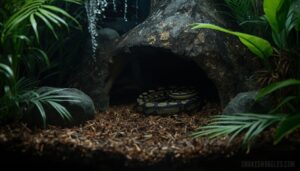
The cool hide works hardest when it’s placed as far from the heat source as possible. That Heat Source Distance keeps the Cool Hide Entrance genuinely cooler, giving your snake a real choice along the temperature gradient. Position it against a side wall, behind decor that adds Noise Reduction and acts as a Humidity Buffer. This facilitates thermal gradient management, environmental enrichment, and Escape Prevention simultaneously.
| Placement Factor | Goal | Result |
|---|---|---|
| Far from heat | Lower interior temp | True cool retreat |
| Behind decor | Reduce disturbance | Calmer resting snake |
| Side-wall position | Block drafts | Stable humidity regulation |
Choose Hides That Fit Snugly and Fully Enclose The Body
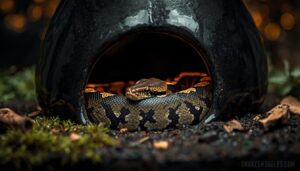
Hide size matters more than most keepers realize. A proper hide should press lightly against your snake’s sides — that snug contact triggers real stress reduction.
Look for Opaque Hide Materials, Rounded Hide Corners to prevent scale snags, and a low Hide Entrance Dimensions that limit glare.
Microclimate Insulation keeps interior temps stable, while Hide Placement Stability and escape prevention guarantee the enclosure stays secure.
Add Branches, Plants, or Decor to Break Up Open Space

An empty enclosure isn’t just boring — it’s stressful. Breaking up open space with enrichment decor gives your snake defined paths, shelter, and purpose.
- Place a Vertical Branch Placement near the warm side as a natural focal point
- Create Live Plant Zones on the cool side using Pothos or Spider Plant
- Use Sculptural Rock Hides and cork bark for texture and shadowed retreats
- Add Multi Level Platforms and climbing structures for arboreal species
Color Contrast Privacy — mixing neutral greens, browns, and visual barriers — makes the enclosure feel like a real habitat, not a glass box.
Set Safe Heat and Humidity

Getting the heat and humidity right isn’t just about comfort — it directly affects how safe and settled your snake feels. Even small fluctuations can trigger stress, feeding refusals, or health problems you’d rather avoid.
Here’s what to get right.
Create a Clear Warm-to-cool Temperature Gradient
Your snake can’t regulate its body temperature without a real choice — and that means a true temperature gradient, not just a warm room.
Place your heat mat or ceramic heat emitter on one end only. Heat source placement matters: centering it flattens everything.
| Zone | Target Temp | Tool |
|---|---|---|
| Warm side | 88–95°F | Thermostat-controlled mat |
| Mid-enclosure | 80–84°F | Gradient stability |
| Cool side | 70–78°F | No heat source |
Thermometer positioning — floor level, both ends — confirms the gradient actually exists.
Use Thermostat-controlled Heating Only
A runaway heat mat can cook your snake before you notice anything’s wrong. That’s why thermostat-controlled heating only — no guesswork — is non-negotiable.
A runaway heat mat can cook your snake before you notice, making thermostat-controlled heating non-negotiable
- Pair your thermostat-controlled mat or ceramic heat emitter with proper relay compatibility for safe on/off switching
- Set deadband settings to prevent rapid cycling and wasted energy
- Enable overheat protection so temperatures never spiral past safe limits
- Schedule calibration frequency checks every 1–2 months to maintain ±1–2°F accuracy and reliable thermostat placement
Keep Humidity Within The Species’ Target Range
Temperature is only half the equation. Humidity targets matter just as much for your snake’s comfort and health.
| Species | Humidity Range |
|---|---|
| Ball Python | 60–70% |
| Corn Snake | 40–60% |
| Tropical Species | Up to 80% |
A consistent misting schedule, proper ventilation balance, and smart water bowl placement near the warm side all support stable humidity. Add a humid hide and substrate moisture control to smooth out seasonal humidity swings.
Monitor Temperature and Humidity With Digital Gauges
Guessing at conditions puts your snake at risk. Two digital gauges — one per side — give you real visibility into what’s actually happening inside the enclosure.
- Sensor Placement: mount each hygrometer at snake eye level
- Alert Thresholds: set alarms at ±8% relative humidity
- Data Logging: review 24-hour trends weekly
- Calibration Schedule: recalibrate sensors quarterly
- Power Management: use battery gauges with low-battery indicators
Use Substrate That Feels Secure
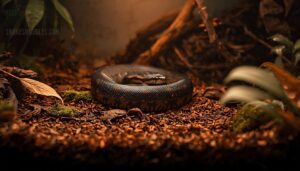
The ground beneath your snake matters more than most people realize. What you line the enclosure with directly affects how secure, comfortable, and stress-free your snake feels every single day.
Here’s what to keep in mind when choosing and maintaining the right substrate.
Pick Safe, Species-appropriate Substrate Materials
safe substrate materials starts with knowing what your species actually needs. Aspen bedding works well for dry-climate snakes — it’s dust-low and burrow-friendly. Coconut coir and coconut fiber hold moisture beautifully for tropical setups. Paper bedding is a clean, low-fuss option for sensitive animals. Hemp bedding and bioactive soil round out your choices.
toxic substrates such as pine and cedar is non-negotiable — those oils damage airways fast.
Add Deeper Substrate for Burrowing Species
Once you’ve nailed safe substrate materials, depth becomes the next variable that actually matters. Burrowing species need 6 to 12 inches of substrate — enough for real tunnel networks with thermal properties that stay stable overnight.
Coconut fiber and aspen both offer the texture stability and drainage balance that burrowing species rely on.
Proper substrate depth directly promotes hygiene safety and natural burrow depth behavior.
Avoid Dusty, Aromatic, or Toxic Bedding
Pine and cedar are off the table — full stop. Both release aromatic compounds that irritate your snake’s respiratory tract and eyes.
Stick with dust free bedding like coconut fiber, aspen, or other natural fiber options built from low emission materials. Avoid anything heavily treated or artificially scented. When selecting safe substrate materials, look for certified textiles or verified chemical-free products.
Your snake breathes what it lives in.
Keep Substrate Clean, Dry, and Free of Compaction
Clean substrate isn’t just tidy — it’s foundational to your snake’s sense of security. Use a spot cleaning technique to remove waste without flattening the bedding. Uniform substrate depth keeps burrowers comfortable and prevents compaction over time.
- Remove wet clumps immediately — they harden fast
- Practice weight handling avoidance near the enclosure floor
- Apply clump prevention methods by fluffing disturbed areas
- Allow a proper drying interval management between moisture events
Secure The Enclosure and Keep It Calm
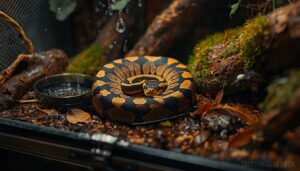
A snake that can’t escape won’t constantly test the walls — and that sense of containment actually calms it down. Beyond just locking the lid, where you place the enclosure and how often you disturb it matter just as much.
Here’s what to get right.
Lock Lids With Latches, Clips, or Magnetic Catches
A snake that finds a gap in the lid will find a way out—guaranteed. That’s why escape prevention starts with the right hardware, not hope.
| Latch Type | Best For | Key Advantage |
|---|---|---|
| Magnetic Catch | Lightweight lids | Recessed Latch Design keeps surfaces flush |
| Cam/Toggle Latch | Heavy or uneven lids | Tamper Resistant closure |
| Dual Clip System | Humidity enclosures | Dual Catch Balance + Gasket Seal Integration |
Match Magnetic Strength Selection to your lid’s weight. Preventing escapes with secure lids and mesh means checking hardware monthly for misalignment—escapeproofing your snake enclosure isn’t a one-time task.
Use Proper Ventilation Without Creating Drafts
Good ventilation keeps your snake breathing clean air — but a poorly placed vent can feel like standing in front of an air conditioner.
Focus on strategic Vent Placement: position openings high on side walls, not directly facing your snake’s resting spots.
Use Airflow Baffles to diffuse incoming air gently, and rely on Passive Vents for steady, low-velocity exchange.
Smart Vent Area Control and Draft Shielding balance airflow management without sacrificing humidity retention.
Place The Enclosure in a Low-traffic Area
Where you put the enclosure matters more than most keepers realize. Quiet room placement — away from doorways, pet routes, and appliances — is one of the most overlooked safety measures in reptile husbandry.
If your snake does react to the stress of nearby activity, knowing how to spot early warning signs of snake aggression helps you respond calmly before the situation escalates.
Your snake reads the world through vibration and shadow, so a vibration-free location protects its baseline calm.
- Keep it off high-traffic hallways
- Minimize visual lines from sofas or entry points
- Enforce pet route separation with a baby gate or closed door
- Avoid walls shared with washers, dryers, or subwoofers
Keep Handling and Enclosure Changes to a Minimum
Every change you make is a disruption your snake has to process. Gradual item introduction — one new hide or branch at a time — lets you track stress signals without guessing. Keep limited handling sessions consistent in timing and length.
A spot cleaning routine beats full teardowns. Climate stability and enclosure safety depend on doing less, not more.
Frequently Asked Questions (FAQs)
How to make a snake feel safe?
A secure home is a happy home."
To make a snake feel safe, maintain a temperature gradient, regulate humidity, provide snug hides, maintain quiet environment, offer enrichment variety, and use gentle handling consistently.
How often should I feed my pet snake?
Feed your snake based on age-based intervals and species metabolism. Hatchlings eat every 5–7 days; adults generally every 10–14 days. Match prey size to body condition, and you’ll maintain dietary adequacy effortlessly.
Can snakes recognize their owners over time?
Yes, snakes can — scent memory plays the biggest role. Through handling consistency, your snake learns your scent, showing calmer behavior over time.
Species differences matter: ball pythons and corn snakes recognize owners most reliably.
What signs indicate my snake is stressed or unwell?
Watch for appetite changes, lethargic behavior, weight loss, respiratory distress like wheezing or open-mouth breathing, shedding difficulties such as retained shed, and scale rot — all signal your snake needs immediate attention.
Should I use a water bowl or misting for hydration?
water bowl wins for hydration reliability — misting manages humidity regulation, not drinking behavior.
Change bowl water daily for bowl hygiene, and use misting timing to support surface moisture without soaking the substrate.
How do I safely introduce a new snake to a home?
Start with a 48-hour quiet period in its transport container. Skip initial handling, schedule a veterinary check, and follow a consistent feeding schedule.
Good quarantine procedures protect both your snake and any other pets.
Conclusion
A snake that finally settles isn’t lucky—it’s housed correctly. When you understand how to make a snake feel safe in its enclosure, the transformation is unmistakable: steady feeding, calm movement, and no desperate nose-rubbing against the glass.
Every hide placed, every temperature dialed in, every substrate layer added tells your snake the same thing—this space belongs to you.
Get those five factors right, and the animal you thought was difficult becomes the one you always hoped for.