This site is supported by our readers. We may earn a commission, at no cost to you, if you purchase through links.
A Biak neonate hatches blazing red. An Aru hatchling comes out buttery yellow. Same species, wildly different start. That’s the magic of green tree python morphs, and it’s why locality matters more than most keepers realize.
Buy the wrong line and you’ll watch that electric red fade to mud by month three. Cross localities and your color genetics turn into a coin flip. Get it right, though, and you can raise a snake that shifts from fire-engine neonate to saturated emerald (or locked-in dorsal blue) with zero surprises.
Here’s every locality, morph, and genetic quirk worth knowing.
Table Of Contents
- Key Takeaways
- Papuan Highlands Green Tree Python Morphs
- Sorong Green Tree Python Morphs
- Biak, Aru, and Other Locality Morphs
- Popular Captive-Bred Green Tree Python Morphs
- Green Tree Python Color Genetics and Selection
- Frequently Asked Questions (FAQs)
- What are the different variants of the green tree python?
- What’s the rarest ball python morph?
- How much is a green tree python worth?
- What is the rarest python color?
- What are green tree python morphs?
- What is the wrong morph of green tree pythons?
- What is a morph Python?
- Are green tree python morphs a good pet?
- Where can I buy green tree pythons?
- What is a high-blue morph green tree python?
- Conclusion
Key Takeaways
- Locality origin determines neonate color and adult outcome, so buying a Biak, Aru, Sorong, or Highlands line without documented lineage is a gamble you’ll lose when the colors fade or drift unpredictably.
- Green tree pythons undergo a complete color reinvention over 9–12 months, meaning the hatchling’s red or yellow phase is temporary and only pure bloodlines deliver the reliable adult coloration you’re actually paying for.
- Hybridizing localities corrupts color genetics within just two generations, causing traits like Biak red, Aru yellow, and Sorong blue patterning to break down fast and irreversibly.
- Captive-bred morphs like High Blue, Calico, Albino, and Melanistic exist because of disciplined multi-generation selective breeding, and shortcuts like backcrossing with wild-type stock collapse those hard-won traits just as quickly.
Papuan Highlands Green Tree Python Morphs
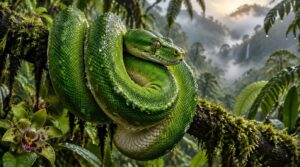
One look at a Papuan Highlands Green Tree Python and you’ll get it. These localities crank out some of the cleanest emerald green you’ll ever see, and neonates often hatch vivid green right out of the egg, skipping much of the yellow phase.
If you’re weighing a green tree python against other beginner-friendly snakes, our guide to common snake species for beginners breaks down what each one really demands.
Here’s the kicker: geographic isolation has carved out distinct Highland alleles, separate from northern and southern lineages elsewhere on the island. That isolation matters. Mix in non-Highland stock and your color genetics get messy fast, with unpredictable outcomes.
Want that saturated green locked in? Hold temps steady at 24–28°C, keep humidity at 70–85%, and don’t let swings top 30°C. Stress dulls them. Pure Highlands also show rougher ventral scales and minimal orange, so check your locality certificates before you buy.
Sorong Green Tree Python Morphs
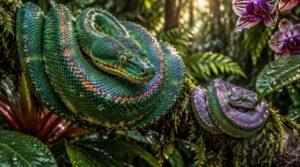
If Highlands are the clean purists, Sorong Green Tree Pythons are the showboats. You’ll spot orange-red dorsal streaks in some subgroups, and hatchlings shift fast. Green-purple neonate at six months? Teal by year one. That’s Sorong magic.
Size-wise, they mature smaller, roughly 70–90 cm, so they’re easier to house than most localities. And that ontogenetic color shift? Pure theater. Some lines throw blue, some yellow, and sellers will happily market you a "Sorong blue" or "Sorong yellow." Buyer beware, though. Demand documented genetic lineage, because mixed-origin snakes get sold as Sorong constantly.
Your Sorong keeper’s cheat sheet:
- 26–30°C stable, no wild swings
- Humidity 70–85%, check every shed
- Carotenoid-rich prey boosts red flanks
- Bright lighting can reveal sulphur tints
- Calibrated pairings yield 25–40% blue outcomes
Keep temps right, keep records tighter.
New to the species? This beginner’s guide to buying a green tree python covers the basics before you commit to a locality.
Biak, Aru, and Other Locality Morphs
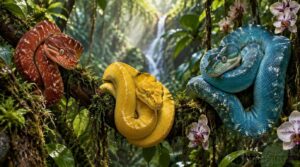
Now we’re getting to the localities that really get breeders talking. Biak red neonates, Aru yellow hatchlings, and the Australian lines each carry their own origin story and quirks. Here’s the breakdown you need before picking your next bloodline.
If you want to see how these rare localities stack up against morphs like the motley and Argentine rainbow, this guide to rare and unique boa morphs covers the full spectrum.
Biak Red Neonates
Picture a hatchling that looks lit from within, a live ember coiled on the perch. That’s your Red Neo Biak.
These Biak Green Tree Python babies hatch blazing red, holding color 6–8 weeks before shifting. Keep humidity at 65–75%, feed 3–5% body weight, and photograph early. Reptile genetics favor pure lines; hybrids dilute that fire fast. Document everything.
Aru Yellow Hatchlings
If Biaks burn red, Aru Yellow Hatchlings glow lemon. Pale, almost buttery at hatch, they hold that peak brightness 4–8 weeks, then shift toward olive by 3–6 months. Keep your camera ready.
Pure Aru lines stay more consistently yellow; mixed localities muddy fast. Watch for faint green speckling around 8–12 weeks, minimal dorsal crossbands, and document every shed.
Snake genetics rewards patience here.
Australian Localities
While Papua New Guinea lines dominate most collections, Australian locality greens bring something genuinely distinct to the table.
Their coil-shaped dorsal patterning and noticeably higher dorsolateral scale counts create a visually denser look that reads as deeper, more intricate canopy camouflage.
If you’re seriously chasing that ultra-textured, almost sculptural appearance in your builds, Australian-derived stock is absolutely worth your attention.
Popular Captive-Bred Green Tree Python Morphs
Regarding captive-bred morphs, breeders have pushed green tree pythons far beyond what you’d ever find in the wild. Selective breeding programs have unlocked some genuinely jaw-dropping color combinations that locality purists could only dream of.
Here’s a breakdown of the morphs you’ll actually see dominating the market right now.
High Blue and High Yellow
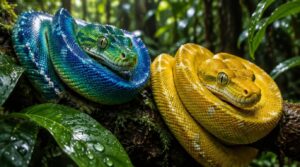
Blue that burns straight through you. That’s what separates truly elite Green Tree Python morphs from the rest of the crowd.
- High Yellow Line specimens show vivid lateral spotting by 18 months
- USCBB Designer Blueline targets sustained dorsal blue through selective breeding
- Stable color patterns require 3-4 generations of consistent selection
Commit to your pure locality stock. Track every molt.
Calico and Tiger Stripe
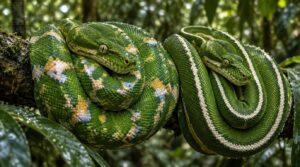
Splattered ink meets razor-thin racing stripes. That’s what calico and tiger stripe look like side by side, and once you see them together, you genuinely don’t forget it.
Calico throws irregular patchwork blotching all across the body; tiger stripe carves clean dorsolateral lines from head to tail.
Selective pairings drive both traits, and smart breeders track stripe continuity across molts.
Albino and Melanistic
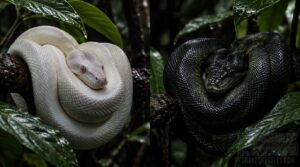
Ghost-white versus near-black. Albino and melanistic morphs represent the extreme ends of Green Tree Python phenotypic variation. Both are rare. Here’s what you need to know:
- Albinos mature to pale yellow or near-white with pink or red eyes
- Melanistics show heavy dark pigmentation with variable green undercolor
- Line-breeding depth keeps both traits stable
- Backcrossing with wild-type stock breaks expression fast
Green Tree Python Color Genetics and Selection
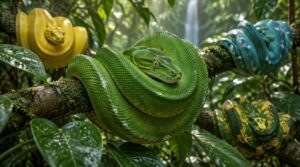
Green tree python genetics are one of the most fascinating rabbit holes in the hobby, and color selection gets complicated fast.
Whether you’re chasing locality purity or working with captive-bred morphs, knowing the science behind the color changes everything about how you breed and buy.
Here’s what you need to understand before making your next move.
Ontogenetic Color Changes
Ontogenetic color change is the wildest transformation you’ll ever witness in all of reptile keeping. Your hatchling doesn’t just grow, it completely reinvents itself over time. Melanin production dips while snake molting cycles accelerate pigment restructuring, pushing that brick-red neonate toward vivid blue. Green Tree Python morphs achieve this through color polymorphism driven by structural scale changes across 9-12 months.
A green tree python hatchling doesn’t just grow—it completely reinvents its color through structural scale changes over 9-12 months
| Color Phase | Typical Timeline |
|---|---|
| Red or Yellow Neonate | Hatch to 3 months |
| Transitional Blue | 4–9 months |
| Adult Coloration | 9–12+ months |
Locality Purity and Hybridization
Locally pure lines are fragile. Mix localities, and hybridization effects hit immediately.
- Papuan crosses boost variance within two filial generations
- Sorong hybrids lose distinctive color block patterning
- Biak red fades faster when crossed with island lineages
- Aru yellows drift green under hybrid pressure
Genetic purity demands 95% locality marker match. Below that, you’ve got a hybrid.
Ethical Captive-Bred Sourcing
Protecting genetic purity starts before you ever buy. Demand breeder certifications, facility licenses, and full chain-of-custody records. If a seller can’t trace lineage back three generations, walk away.
Captive-bred morphs from verified USCBB sources protect wild population conservation by keeping demand off the field. Responsible participation in the exotic pet trade means actively choosing transparency over convenience, every single time.
Frequently Asked Questions (FAQs)
What are the different variants of the green tree python?
Ever wonder why no two green tree pythons look identical? You’ve got Papuan Highlands, Sorong, Biak, Aru, and Australian locality types, plus captive-bred morphs like High Blue, Calico, Tiger Stripe, Albino, and Melanistic.
What’s the rarest ball python morph?
Here’s a kicker: "rarest morph" changes yearly in ball python breeding. Right now, solid black melanistic lines and desert ghost combos top the list. Yesterday’s unicorn becomes today’s $200 pet. Selective breeding moves fast.
How much is a green tree python worth?
How much?" You’d think we’re pricing used cars, not living jewels. Realistically? $800 to $6,000 plus. Locality, morph, and lineage drive everything. Sorong and albino lines top the pet snake market.
What is the rarest python color?
Picture a snake dipped in midnight ink, scales drinking every ray of light. That’s the melanistic Green Tree Python, hands down the rarest color. Albino lines run close, but true melanism, mostly in late-hatch cohorts, almost never shows up.
What are green tree python morphs?
Here’s the theory worth testing: are green tree python morphs just random color quirks? Nope. They’re genetic mutations and locality-driven color patterns, think high blue, calico, albino, shaping snake morphology in captive-bred morphs.
What is the wrong morph of green tree pythons?
There’s no "wrong" morph, but mislabeling happens constantly. Sellers slap Sorong or Biak labels on mixed-origin stock. Without documented lineage, you’re guessing. Demand proven breeder records and verify locality traits before buying.
What is a morph Python?
Ever wonder why two pythons from the same clutch look totally different? A morph is a genetic mutation altering color or pattern. Selective breeding locks in these traits, producing captive-bred morphs beyond wild-type appearances.
Curious how it all works under the hood? reptile genetics for beginners breaks down inheritance and trait expression in a way that’s surprisingly intuitive, even without a science background.
Are green tree python morphs a good pet?
Like a fine sports car, Green Tree Python morphs reward skill, not luck. You’ll love them if you’re experienced: exacting care demands, precise humidity, minimal handling, and careful pet snake care. Beginners, look elsewhere.
Where can I buy green tree pythons?
Hunting a Green Tree Python for Sale? Skip shady listings. Go straight to USCBB-registered breeders, verified online marketplaces, and reptile expos. Ask for lineage docs, health certificates, and Shipping details. Some sellers even offer Free Shipping.
What is a high-blue morph green tree python?
A high-blue morph is a green tree python bred for intense azure dorsal coloration. You’ll see blue deepen after shedding, around 6–9 months, then plateau by 18–24 months. Think USCBB Designer Blueline genetics.
Conclusion
The snake you buy isn’t the snake you’ll keep. Green tree python morphs trade their neonate colors for adult looks you can’t fake, so the hatchling in front of you is only half the story.
Pick pure localities, demand documented bloodlines, and track every shed of that color change.
Do your homework now, and years later you’ll be staring at a locked-in adult that delivers exactly what you paid for.
- https://animaldiversity.org/accounts/Morelia_viridis
- https://www.reddit.com/r/NatureIsFuckingLit/comments/10j83q7/morelia_viridis_yellow_phase
- https://bioone.org/journals/australian-journal-of-zoology/volume-68/issue-2/ZO21002/Geographic-frequency-and-ecological-correlates-of-juvenile-colour-polymorphism-in/10.1071/ZO21002.full