This site is supported by our readers. We may earn a commission, at no cost to you, if you purchase through links.

You spot something pale and oval half-buried near a woodpile, and your pulse jumps: rattlesnake nest. Here’s the twist: that’s biologically impossible. Rattlesnakes don’t lay eggs at all — they’re ovoviviparous, meaning females carry developing young internally and give birth to live snakes, membranes and all.
That live-birth strategy raises a related question worth exploring: do rattlesnakes nurse their young, or are hatchlings left to fend for themselves right away?
So what do rattlesnake eggs look like? Nothing, because they never exist outside the mother’s body. What you likely found belongs to a quail, lizard, or turtle — and knowing the real differences, down to texture, size, and shape, keeps you from mishandling something that isn’t a rattlesnake threat at all, while still respecting whatever laid it.
Table Of Contents
- Key Takeaways
- What Do Rattlesnake Eggs Look Like? Soft, Pale, and Oval
- Rattlesnakes Give Birth to Live Young
- How Rattlesnake Eggs Differ From Other Snake Eggs
- Eggs Commonly Mistaken for Rattlesnake Eggs
- What to Do With Suspected Rattlesnake Eggs
- Frequently Asked Questions (FAQs)
- How do you identify a snake egg?
- How many eggs do rattlesnakes usually lay?
- What to do when you find snake eggs in your yard?
- What does a rattle snake nest look like?
- Can you identify a rattlesnake from an egg?
- Do rattlesnakes have eggs?
- How do you identify snake eggs?
- Are Rattlesnake eggs quail eggs?
- What is the difference between snake eggs and chicken eggs?
- How do you know if a snake egg is rotting?
- Conclusion
Key Takeaways
- Rattlesnakes never lay eggs at all—they’re ovoviviparous, meaning babies develop inside the mother and are born fully formed and ready to move.
- If you find a pale, oval, leathery object near a woodpile, it’s far more likely to be a quail, turtle, or lizard egg than anything related to a rattlesnake.
- Real rattlesnake litters arrive live, typically between August and October, with litter sizes ranging from about 4 to 40 depending on the species and the mother’s health.
- If you spot a suspicious egg, don’t touch it—keep kids and pets away, snap a photo from a safe distance, and call a wildlife professional to identify it.
What Do Rattlesnake Eggs Look Like? Soft, Pale, and Oval

If you’ve ever pictured a rattlesnake egg as some scaly little orb tucked in the grass, you’re about to rewrite that mental image. What these eggs actually look like inside a gravid female is stranger, softer, and more specific than most people guess. Here’s what sets them apart, trait by trait.
Rather than a hard shell, the leathery, porous covering gives eggs a slightly give-y feel, so if you ever come across a clutch, brushing up on proper techniques for safely handling snake eggs helps you avoid damaging that delicate surface.
Elongated, Cigar-Like Shape
Picture a slender cigar, not a chicken egg, and you’ve got the right image. Rattlesnake eggs run about twice as long as they’re wide, with a smooth cylindrical contour and no ridges.
Ends stay rounded, never pointed, giving a uniform oval silhouette that holds steady from ovulation through early gestation, with only minor shape variation across species.
White to Cream Coloring
Color-wise, don’t expect stark white. Fresh eggs read as pale ivory to soft cream, shifting warmer under direct sun and cooler in shade.
That matte, chalky finish (no gloss, no speckling) isn’t cosmetic — it’s camouflage against sunlit soil, keeping color consistent across the clutch while helping eggs disappear into leaf litter and bare ground.
Thin, Leathery Egg Membrane
Run a finger across the surface, if you dared, and you’d feel rubber, not shell. That’s no calcified coating — just a thin membrane, 20–40 micrometers thick, managing gas exchange and moisture retention.
Function over hardness:
- Flexes under pressure instead of cracking
- Breathes, letting oxygen in, carbon dioxide out
- Regulates moisture, resisting desiccation until birth
No Spots or Markings
That rubbery membrane covers a surface with no decoration at all — no speckles, no blotches, nothing. Every rattlesnake egg shows a uniform pale appearance, holding steady even under bright lighting.
This consistent color trait matters for egg identification: no pigment patterns exist, regardless of orientation. It’s a key differentiation from bird eggs, since those viviparous, live-birth reptiles skip the ornamentation entirely.
Why They Aren’t Found Outside
Ever gone digging in your yard hoping to find one? You won’t, and there’s a good reason.
Rattlesnakes are ovoviviparous snakes — eggs hatch inside the mother, protected from predation risk, flooding, and the temperature buffering only a body can provide. That’s internal egg hatching, not outdoor nesting. No burrow humidity control needed when the incubator moves with her.
Rattlesnakes Give Birth to Live Young

So if those eggs never make it outside a female’s body, what actually happens to them? The answer lies in how rattlesnakes reproduce, a process quite different from your typical egg-laying snake. Here’s what unfolds from fertilization to the moment those live young finally arrive.
Rattlesnakes are ovoviviparous, meaning eggs develop and hatch inside the mother, a reproductive quirk explained in more detail in this guide to how often rattlesnakes reproduce each year.
Eggs Develop Inside Females
Picture a nursery with no nest: that’s a female rattlesnake’s body during gestation. Embryos grow via placental-like nutrient transfer, fueled by:
- Yolk reserves
- Maternal blood supply
- Regulated body heat
- Hormonal cues
She adjusts internal temperature and humidity, sustaining internal egg development through a multi-month snake gestation period—true viviparous support, not passive incubation, until neonates are ready.
Ovoviviparity Versus Egg-Laying
So how does this compare with a garden snake laying eggs in leaf litter and walking away? Not even close.
Egg-laying species gamble on soil temperature and predators; ovoviviparous rattlesnakes don’t. Maternal temperature control and yolk-dependent nutrition keep embryos safer internally—an evolutionary advantage among viviparous snakes that boosts hatchling independence the moment birth occurs.
Membranes Rupture Before Birth
Timing matters more than most people realize. Near full term, hormonal shifts weaken the membranes while rising fetal movement adds mechanical stress, causing them to rupture inside the female—before birth even starts.
This spares neonate snakes a fragile shell to fight through. Moisture retention keeps embryos hydrated until rupture, then newborns emerge ready to breathe, move, and survive independently, a hallmark of ovoviviparous snakes built for live birth.
No fragile shell to fight through—rattlesnake newborns emerge already able to breathe, move, and survive on their own
Rattlesnake Birthing Season
Late summer sets the calendar here. Most rattlesnakes give birth August through October, after mating months earlier in spring or early summer.
Gravid females choose a warm, sheltered birthing den—rock crevices, sunlit ledges—where heat and humidity support development. Seasonal temperature swings and rainfall nudge timing by a few weeks, but neonates always emerge into rattlesnake eggs’ absence, ready-made for live birth.
Typical Litter Size
How many young does one female produce? It varies more than you’d think. Small to medium species average 12 to 18 offspring, though timber rattlesnakes may deliver just 5 to 12, while eastern diamondbacks occasionally reach 40.
Maternal health, gestation conditions, and prey availability all shape clutch size—well-fed, parasite-free females in resource-rich habitats simply produce more viable neonates.
How Rattlesnake Eggs Differ From Other Snake Eggs
Not every snake controls reproduction the same way, and rattlesnakes sit on one end of a pretty wide spectrum. Some species lay leathery eggs in nests and walk away, while others carry everything internally until the moment of birth. Here’s where those differences actually show up, point by point.
Internal Versus External Development

Where reptile reproduction gets confusing is the split between strategies. Rattlesnakes are viviparous, relying on internal gestation instead of external egg development. Other snakes stay oviparous, laying shelled eggs outside the body.
Think of it like internal mobility pathways versus external expertise collaboration in a workforce: one nurtures development internally, the other outsources it entirely—two paths, same reproductive goal.
Membrane and Shell Differences
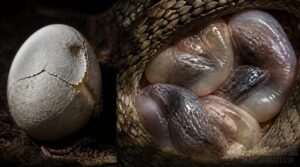
Because rattlesnake eggs never touch soil, they skip the calcified shell entirely. Oviparous snakes need rigid shells for structural support against outside pressures. Rattlesnake membranes stay flexible, relying on the mother’s body instead—prioritizing gas exchange over armor.
Curvature adds strength to hard shells; leathery eggs simply don’t need it, since egg texture and survival strategy are built for identification purposes.
Shape and Texture Comparison

Set a rattlesnake egg beside a garter snake’s clutch and the difference won’t jump out right away—both share an elongated oval shape and pale tone. Look closer, though: rattlesnake eggs run larger, with a smooth surface texture and uniform pale coloring, no mottling.
That thin leathery membrane and lack of markings? Solid clues for snake egg identification among oviparous snakes.
Egg Size Variations

Size isn’t fixed—among oviparous species, eggs can run from 20mm to several times that. Maternal size effect matters most: larger, well-fed females produce bigger eggs with richer yolk allocation.
Seasonal egg changes shift things too, since early clutches often differ from later ones. But rattlesnakes skip this entirely, hiding any variation inside the body until birth.
Incubation Differences

Why bother incubating eggs that never touch open air? Oviparous species juggle temperature effects, humidity, and gas exchange across defined duration stages outside the body.
Rattlesnakes skip that entirely—being ovoviviparous, the mother’s physiology controls substrate role, warmth, and moisture internally, delivering live birth after roughly three to five months, no external incubation differences required.
Eggs Commonly Mistaken for Rattlesnake Eggs

So if rattlesnakes don’t lay eggs, what are people actually finding under that hose box? Nine times out of ten, it’s something else entirely, laid by a creature with no rattle at all. Here’s a rundown of the usual suspects, and what actually sets them apart.
Most likely candidates are gopher snakes or lizards, whose smooth eggs lack a rattlesnake’s texture — and if you’re curious how those same scales let snakes scale surprisingly steep surfaces, check out this guide on how snakes use their belly scales to climb walls.
Spotted Quail Eggs
Speckles cause the confusion. Quail eggs show brown mottling on cream shells, roughly one-fifth a chicken egg’s size, unlike rattlesnakes’ plain, leathery ones. That spotting comes from hen genetics and diet, not danger.
Under hose boxes or pool pumps, discoloration or mold sometimes develops if abandoned, but the pattern’s permanent, calcified texture gives it away instantly.
Other Ground-Nesting Bird Eggs
Quail aren’t the only ground nesters leaving eggs behind. Killdeer, meadowlarks, and sparrows tuck shallow, camouflaged nests into meadow edges and shorelines, using grasses and twigs for insulation.
Their eggs vary from 0.5 to 1.5 inches, pale blue-green to off-white, sometimes speckled. Parents rotate incubation duties near 100°F. Hatchlings emerge with minimal down, unlike any rattlesnake — which produces none at all.
Turtle and Lizard Eggs
Turtles complicate things further. Their eggs are round to oval, white to cream, with a soft leathery shell — buried 10–50 cm deep, incubating 45–75 days.
Lizard eggs run smaller, leathery too.
Snake eggs tend to be oval and oblong in shape with uniformly soft, leathery shells, differing from lizard eggs which may show greater shape diversity and some harder-shelled varieties in arid habitats. Snake eggs tend to be oval and oblong in shape
Why Nest Location Misleads
Location fools people fast. Ground cover, warm microhabitats, proximity to structures — birds and reptiles share them all, so habitat mimicry breeds confusion regardless of species.
Consider what’s stacking the odds against you:
- Seasonal nesting overlap between species
- Observer bias toward assuming "threat"
- Similar debris (shed skins, shell bits)
- Location used alone, without egg-specific cues
Site alone never confirms identity.
Key Identification Clues
So how do you actually tell egg from impostor? Check shape first: true snake eggs run oval and elongated, not round. Color should read pale cream to white, with no speckling whatsoever. Texture matters too — genuine eggs feel leathery, not gritty, and measure roughly 2.5–4.5 cm.
Since rattlesnakes are ovoviviparous, birthing live young, any eggs you find likely belong to something else entirely.
What to Do With Suspected Rattlesnake Eggs

So you’ve found something oval, pale, and suspicious near the garden hose. Before you touch it, poke it, or Google "how to hatch snake eggs," you need a game plan. Here’s exactly what to do—and what to avoid—if you stumble on eggs you think might belong to a rattlesnake.
Avoid Touching Unknown Eggs
Found something egg-shaped in the mulch? Resist the urge to pick it up. You can’t always tell snake from quail on sight, and mishandling risks a defensive strike, disease transfer, or a crushed membrane.
Wildlife disturbance carries real consequences — for the animal and for you. Skip gloves-as-armor thinking, too; leather won’t stop fangs. Observe, don’t touch.
Keep Pets and Children Away
Not touching it yourself is step one. Keeping curious hands and paws away is step two.
Set up pet safety barriers — a gate, a closed door — and enforce child supervision rules on the spot. Remember, ovoviviparous snakes still guard newborns fiercely. Whatever’s nesting there, treat it as venomous snakes territory until proven otherwise, with an adult present at all times.
Photograph From a Safe Distance
Documentation beats memory, and a photo gives wildlife professionals real data to work with.
- Shoot from ten feet away with a 300mm telephoto
- Wear neutral clothing, skip sudden movements
- Position yourself elevated, escape route mapped behind you
- Use a remote trigger instead of leaning in
Since ovoviviparous snakes may guard nests nearby, resist tighter framing. Distance protects you and the shot.
Contact a Wildlife Professional
That photo in hand, your next call matters more than the photo itself. Ring animal control or a herpetologist experienced with venomous species — they’ll verify species-specific identification, document coordinates, and follow permit requirements before touching anything.
This applies whenever pets, kids, or repeated encounters are involved. Skip the guesswork; wildlife misidentification happens constantly, and professionals confirm live birth biology over egg myths in minutes.
Never Attempt Home Incubation
Tempting as it sounds, don’t try hatching suspected eggs yourself. Rattlesnakes don’t lay eggs anyway — they’re ovoviviparous, so anything you’ve found belongs to another species entirely.
Home setups can’t match professional incubation standards: precise temperature and humidity control, contamination prevention, and backup power. One equipment failure kills embryos fast. Leave it to licensed wildlife facilities equipped for proper care.
Frequently Asked Questions (FAQs)
How do you identify a snake egg?
Egg-cellent question. Check for leathery texture, oval shape, and cream discoloration. Hold it to light for translucency, note the clutch size, and consider nest location—hidden spots suggest reptile origin, not exposed bird nests.
How many eggs do rattlesnakes usually lay?
None—there’s no clutch size, since rattlesnakes don’t lay eggs at all. Instead, litter size ranges from 4 to 10 live neonates, shaped by maternal size, species, and environmental conditions during the three-to-five-month gestation period.
What to do when you find snake eggs in your yard?
Keep a safe distance, mark the area, and skip handling anything. Contact a wildlife expert for identification, keep kids and pets clear, and let any hatchlings disperse naturally rather than intervening yourself.
What does a rattle snake nest look like?
Picture a rocky crevice or burrow on a south-facing slope, dry and sandy, hidden under debris. Rattlesnakes favor concealment over comfort, choosing spots offering sun exposure and predator protection rather than visible, exposed nests.
Can you identify a rattlesnake from an egg?
No—identification by egg is impossible. Ovoviviparity means embryos develop and hatch inside the female, so no external egg ever exists to examine. Live birth, not oviparity, defines rattlesnakes, making egg-based species identification a moot question entirely.
Do rattlesnakes have eggs?
No—rattlesnakes are ovoviviparous, not egg-layers. Eggs hatch internally, inside thin leathery membranes, and mothers deliver fully formed neonates through live birth. That’s true snake reproduction at work: no shells, no nests, just direct, well-protected rattlesnake biology.
How do you identify snake eggs?
Run your fingers over it first: true snake egg identification starts with texture. Feel for a soft, leathery surface, oblong shape over an inch long, and cream-to-white color with little discoloration—then check the clutch size and hiding spot.
Are Rattlesnake eggs quail eggs?
A speckled shell tucked under a hose box isn’t a snake clutch—it’s a quail egg. Quail eggs are hard-shelled and spotted; rattlesnake "eggs" don’t exist externally, since live birth replaces external laying entirely.
What is the difference between snake eggs and chicken eggs?
Crack a chicken egg and you’ll find a rigid, calcified shell. Snake eggs never harden that way—their leathery covering stays pliable for gas exchange, while yolk proportions, incubation needs, and even overall size and shape diverge sharply between the two.
How do you know if a snake egg is rotting?
A sagging shell, sulfurous foul odor, and slimy film signal trouble. Discoloration patterns, soft shell feel, and a shrinking, mushy texture mean bacteria breached the permeable membranes — that egg’s development has stopped for good.
Conclusion
Picture a hiker in Arizona who nearly relocates pale, oval eggs, convinced she’s protecting others from a rattlesnake nest — only to learn they belonged to a whiptail lizard. That mix-up happens constantly.
Once you understand what do rattlesnake eggs look like — namely, nothing, since live birth replaces shells entirely — every pale oval near a woodpile becomes a puzzle worth solving, not a threat.
Curiosity, paired with careful observation, protects you and whatever quietly hatches nearby.