This site is supported by our readers. We may earn a commission, at no cost to you, if you purchase through links.

Corn snakes don’t breed on your schedule—they breed on their biology’s schedule. Get that wrong, and you’ll pair healthy animals that simply ignore each other, lay infertile clutches, or produce hatchlings too fragile to thrive past their first shed.
The difference between a failed season and 15 healthy hatchlings usually comes down to preparation most keepers skip: proper brumation timing, accurate sexing, and a female conditioned well before you ever introduce a male. Every step in this process builds on the last, and skipping one costs you weeks.
Table Of Contents
- Key Takeaways
- Preparing Corn Snakes for Breeding
- Brumation and Seasonal Conditioning
- Mating and Courtship Behavior
- Egg Laying and Incubation
- Hatchling and Adult Aftercare
- Frequently Asked Questions (FAQs)
- How often do corn snakes reproduce?
- How to breed corn snakes step by step?
- What are the behaviors of corn snakes breeding?
- Are corn snakes easy to breed?
- How long do corn snakes breed for?
- How long does a corn snake stay pregnant?
- How do corn snakes breed?
- Can corn snakes reproduce?
- How long does it take to breed a corn snake?
- Can corn snakes breed in the winter?
- Conclusion
Key Takeaways
- Brumation isn’t optional — cooling your snakes to 41–59°F for 60–75 days is what triggers the hormonal cycle that makes successful mating possible.
- A female needs to hit 250–350g and roughly 90cm before pairing; skip the weight check and you risk infertile clutches or eggs that collapse in the incubator.
- Copulation is confirmed by cloacal alignment lasting 15–60 minutes, but the real window opens only 6–8 weeks after brumation ends — rush the introduction and you’ll waste the season.
- Incubation at 82°F and 85–95% humidity is where hatchlings are made or lost; never rotate eggs after placement, and candle at day 14 to pull any infertile eggs before mold spreads.
Preparing Corn Snakes for Breeding
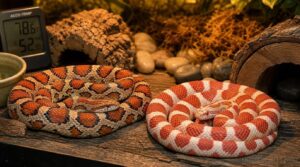
Before a single pairing happens, the work starts well before you ever introduce two snakes. Getting this prep phase right is what separates a successful clutch from a wasted season.
Brushing up on ball python breeding fundamentals before the season starts helps you spot problems early and make smarter decisions throughout the process.
Here’s what to check before you move forward.
Ideal Breeding Age, Weight, and Length
Before you even think about pairing, your snakes need to hit specific benchmarks. Adult females should reach 90 cm and 250–350 g — ideally around age three. Adult males are ready at 75–90 cm and 200–300 g, usually by 18–24 months.
For first-time breeders, prioritize condition scoring over age alone. Weight monitoring across consistent growth curves tells you more than a calendar ever will.
Follow the breeding readiness criteria to make sure females meet the Rule of 3s.
Health Checks Before Pairing
Size benchmarks matter, but they don’t tell the whole story. A thorough prebreeding health assessment separates snakes ready to breed from snakes that only look ready.
- Fecal Testing – Run parasite screening on both animals. Pair only snakes with a confirmed negative fecal test.
- Respiratory Examination – Clear, quiet breathing only. No mucus, bubbles, or open-mouth gaping.
- Skin Integrity – No active lesions, mites, or stuck shed.
- Body Condition Scoring – Steady weight trend, no sunken tail base or visible spine prominence.
Accurate Sexing and Pair Selection
Once your health assessment clears both snakes, accurate sexing is your next non-negotiable step.
Tail Morphology is the starting point. Males carry longer, thicker tails past the cloaca; females taper off sharply. Sexual dimorphism is subtle in juveniles but obvious in adults.
| Method | Reliability | Risk Level |
|---|---|---|
| Tail Morphology | Moderate | None |
| Cloacal Probing | High | Low (if skilled) |
| Genetic Testing / Hormonal Assays | Highest | None |
Misidentifying a pair wastes an entire breeding season — and stresses both animals needlessly.
Avoiding Inbreeding and Weak Bloodlines
Knowing your snakes’ sex gets you to the starting line. Staying out of the inbreeding trap keeps you in the game long-term.
Responsible breeding demands deliberate bloodline management:
- Log every parent, hatch date, and morph — Lineage Documentation isn’t optional
- Use an Outcross Strategy: source animals from separate breeders
- Practice Bloodline Rotation across seasons
- Apply Recessive Gene Monitoring before pairing carriers
- Run Genetic Health Screening to flag hidden risks early
Inbreeding avoidance and genetic diversity protect your program’s future.
Selecting Morphs and Genetic Traits
Before pairing, map out your morph genetics on paper. Allele inheritance follows predictable Mendelian rules — recessive color morphs only appear when both parents carry the right allele.
Use morph probability calculators to estimate outcomes per pairing. Carrier identification matters here: genetic testing and DNA analysis reveal hidden traits before they surprise you.
Trait linkage can keep certain combinations locked together, so know your lines.
Brumation and Seasonal Conditioning
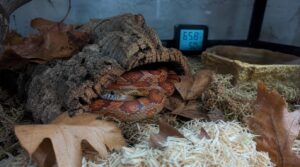
Brumation is the seasonal cooling period that tells your corn snake’s body it’s time to shift into breeding mode — skip it, and you’ll likely skip a successful season. Getting this stage right takes more than just dropping the temperature; timing, feeding, and monitoring all have to line up.
Even small details matter once eggs arrive — like marking each egg before incubation to avoid accidental flipping, which can be fatal to developing embryos.
Here’s what you need to cover before your snake even thinks about mating.
When to Start Brumation
Start brumation in late November or early December — when photoperiod cues shorten and seasonal temperature signals naturally drop. Before cooling begins, confirm your snakes meet hormonal maturity indicators: females at 300–450 grams, males proportionally conditioned.
Run a quick body condition scoring check and note environmental humidity trends.
Preparing for brumation on this seasonal cycle simulation for breeding success keeps your timeline tight and reproductive preparation on track.
Safe Brumation Temperature Range
Keep your brumation setup locked between 41–59°F (5–15°C) throughout the entire cooling period. Cold shock prevention starts with cooling device selection — a dedicated mini-fridge with thermostat settings dialed to that window beats any ambient room setup.
Temperature logkeeping catches drift before it becomes a problem. Use temperature alarm alerts to flag cold spot mitigation issues overnight. Consistency is everything here.
Gradual Cooling and Warm-Up Schedule
Think of this phase as walking a tightrope — rush either direction and you’ll lose the snake.
Rush the cooling or the warm-up, and you’ll lose the snake
Drop temperatures by no more than 10°F (5.5°C) over 6–8 weeks, using Thermostat Programming to hold nightly lows at 60–65°F. Reverse that pace during warm‑up.
Temperature Gradient Calibration, Humidity Control Timing, and Light Cycle Adjustment all signal Warm-Up Indicators that confirm brumation conditioning and reproductive preparation is complete.
Feeding Before and After Brumation
Feeding flanks brumation on both sides — and both matter equally. Stop meals three weeks out to allow Pre-brumation Gut Clearance; undigested food rots during dormancy. That’s your Gradual Feeding Reduction window.
After wake-up, prioritize Post-brumation Rehydration before anything else. Your First Post-Brumation Meal should be 60–70% of normal prey size.
Follow a strict Feeding Hygiene Protocol throughout — clean tools, separate enclosures, no shortcuts.
Hydration and Weekly Health Monitoring
Brumation isn’t a set-it-and-forget-it phase. Fresh water stays available every single day — Water Dish Cleanliness isn’t optional, since algae or debris build up quickly in cooler conditions.
Your Weekly Health Checklist should cover three non-negotiables:
- Weight Trend Tracking — weigh weekly, same day, log it
- Urine Consistency — chalky white urates signal good hydration
- Shed Hydration Support — check humidity levels and refresh sphagnum moss in the moisture hide
Signs a Snake is Not Ready
Not every snake comes out of brumation breeding-ready.
Watch for these red flags: insufficient brumation duration, cutting hormonal cycling short, lack of appetite two weeks post-warming, immature physical development in snakes under 18–24 months, respiratory issues like wheezing or open-mouth breathing, and abnormal shedding cycles.
Any one of these signals that your snake needs more time before prebreeding conditioning begins.
Mating and Courtship Behavior

Once brumation is behind you, it’s time for the part most breeders actually look forward to. Introducing your pair correctly — and knowing what to watch for — makes the difference between a productive season and a wasted one.
Here’s what the mating process looks like from start to finish.
When to Introduce Breeding Pairs
Wait at least 6–8 weeks after seasonal brumation before attempting pairing introductions. Post‑brumation recovery isn’t just a buffer — it’s when hormone peak detection matters most.
Watch for your snake’s first post‑brumation shed and a clear temperature spike timing response before you act.
Prebreeding conditioning, stress level monitoring, and photoperiod adjustment all converge here.
Rush it, and the season’s a loss.
Common Corn Snake Courtship Signs
Once you’ve made your pairing introductions, watch the male closely. He’ll start with chin rubbing along her body, then shift into body coiling and rhythmic tail twitching — these aren’t random movements. Pheromone detection drives the whole sequence.
She flicks her tongue constantly as courtship timing tightens.
Expect exploratory passes before mounting attempts begin.
That buildup, from scenting technique to sustained parallel alignment, tells you everything’s on track.
Confirming Successful Copulation
Courtship signs get you started, but cloacal alignment is what confirms it. Look for the male’s tail curling under hers — that’s the lock. Copulation duration usually runs 15–60 minutes. After separation, watch for female swelling near the cloaca and a quiet post-mating period lasting 24–48 hours. Document everything to track fertilisation success over time.
- Observe visible cloacal alignment during sustained body contact
- Time each event — 15–60 minutes confirms full copulation
- Check for brief postovulation swelling around the female’s cloaca afterward
- Note scent marking behavior and reduced male activity post-session
- Log date, duration, and pair IDs in your breeding records
Managing Aggression or Stress
Not every pairing goes smoothly — aggression signals you to act, not push through. Remove the male immediately if she hisses, bites, or flees. Use Low Disruption Introductions: quiet room, minimal traffic, steady enclosure temperatures. Stress Signal Identification keeps you ahead of escalation.
| Stress Signal | Handling Techniques | Environmental Adjustments |
|---|---|---|
| Rigid, stiff body | Support fully underneath | Check stable temperatures |
| Tight defensive coils | Pause, don’t restrain | Reduce humidity fluctuations |
| Repeated fleeing | Separate immediately | Restore Enclosure Quietness |
| Biting or hissing | Return to familiar hide | Eliminate temperature fluctuations |
| Gripping hard | Apply Stress First Response | Verify humidity control |
Retry after 3–5 days.
How Often Corn Snakes Reproduce
Most corn snakes follow an Annual Breeding Cycle — one clutch per year tied to Seasonal Reproduction patterns. That’s your baseline.
Clutch Frequency can stretch to two in a single season if your female is well-conditioned and recovers fully.
Reproductive Timing depends on brumation and seasonal breeding: a proper cool-down resets her reproductive cycle.
Push mating frequency without rest, and Second Clutch Potential drops fast.
Egg Laying and Incubation
Once mating is confirmed, the clock starts — and how you handle the next few weeks determines whether those eggs make it. Your female will give you clear signals before she lays, and knowing what to watch for puts you ahead of every problem.
track from ovulation to the moment hatchlings start cutting through their shells.
Signs of Ovulation and Gravidity
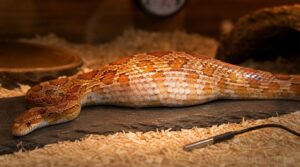
Ovulation in corn snakes isn’t subtle once you know what to watch. Your gravid female will show a visible mid-body swelling — the egg mass — roughly 30 days after mating.
This is your clearest physical confirmation. Before that, you may notice restlessness and increased heat‑seeking.
Begin monitoring ovulation and prelay shed indicators daily from week two post-mating so nothing slips past you.
Pre-Lay Shed Timing
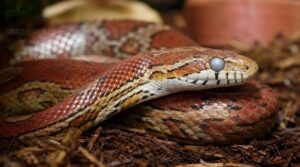
After ovulation, watch for the prelay shed — it generally follows 7–14 days before egg laying. Blue Phase Indicators include cloudy eyes and appetite decline, both clear prelay behavior signals.
You’ll also notice abdominal swelling and weight fluctuation as her body finalizes the clutch. Shed duration usually runs 7–10 days.
Monitoring ovulation and prelay shed indicators daily keeps your lay box ready exactly when she needs it.
Setting Up a Moist Lay Box
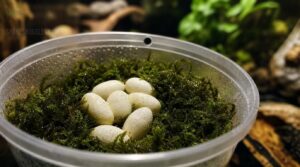
The right egg laying box setup makes all the difference. Use a shallow plastic tub lined with 2–3 inches of damp sphagnum moss or a perlite-based Substrate Mix.
Humidity Monitoring should target 70–85% — check it daily.
Ventilation Design matters too: add a small lid vent to prevent mold.
Cleaning Schedule between cycles.
Box Materials simple and functional.
Safe Egg Collection and Handling
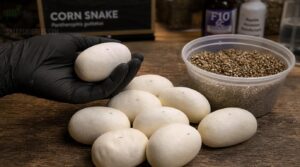
Timing is everything here. Egg Collection Timing window opens the moment the female finishes laying — don’t leave eggs sitting in the lay box longer than necessary.
Use clean, gloved hands and mark each egg’s top with a pencil dot: your Orientation Marking System prevents fatal flipping later.
Follow strict Contamination Prevention Measures and Shell Cleanliness Protocol — no washing, no wiping.
Transfer each egg with full support underneath.
Incubation Temperature and Humidity
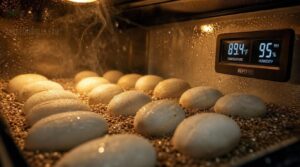
Once your eggs are safely transferred, the incubator takes over — and it has to be dialed in precisely. Set incubation temperature between 78–84°F, targeting 82°F as your sweet spot. Incubation humidity should be held at 85–95%. Use a calibrated thermometer and position your hygrometer at egg level for accurate readings.
Three things to get right from day one:
- Incubator Calibration — verify your unit holds steady before eggs go in; fluctuations beyond ±1–2°F affect development.
- Hygrometer Placement — mount it near the eggs, not the lid, where readings drift.
- Egg Rotation Avoidance — never reposition eggs once set; embryos attach to the shell’s inner wall quickly.
Candling Eggs for Fertility

Candling is your first real look inside the incubator. Around day 14, hold each egg over a bright, steady light source in a dim room — you’re scanning for Embryo Vascular Patterns: branching red vessels that confirm egg viability.
Keep each session under 60 seconds to protect egg incubation temperature and humidity guidelines.
| Candling Timing | What You See | What It Means |
|---|---|---|
| Day 3–4 | Faint early veins | Development starting |
| Day 7–10 | Prominent blood vessels | Strong viability confirmed |
| Day 14+ | Full vascular network or clear yolk | Fertile or Infertile Egg Identification |
No vessels, no embryo silhouette — that egg isn’t developing.
Managing Infertile or Collapsed Eggs
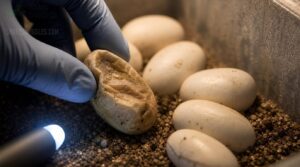
Once candling confirms an egg isn’t viable — flat, opaque, wrinkled — remove it immediately. That’s your Egg Disposal Protocol in action.
Dead eggs breed mold fast, threatening the whole clutch.
Use Sterile Handling Practices: clean gloves, no shaking.
Follow Egg Hygiene Guidelines by sealing discarded eggs before disposal.
Check incubator humidity and review Moisture Adjustment Tips if multiple eggs collapse — desiccation usually points to a heat or humidity drift.
Hatchling and Adult Aftercare
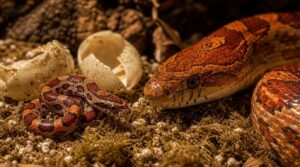
eggs have hatched — now the real work begins.
Getting those hatchlings off to a strong start, and bringing your female back to full health, take a different kind of attention than anything that came before.
Here’s what you need to handle in the weeks and months ahead.
Housing New Hatchlings Individually
Every hatchling needs its own space — shared tubs invite competition, stress, and identity chaos. Individual 6–10 quart tubs with proper microhabitat design give you control from day one.
Each enclosure needs:
- Thermal gradient — warm side 85–88°F, cool side 78–82°F via thermostat-controlled heat mat
- Ventilation management — airflow without drafts
- Bedding selection — paper towel substrate, clean and dry
- Water bowl placement — ground-level, easily accessible
First Shed and First Feeding
Most hatchlings shed within 7–14 days of hatching — that’s your green light for the first meal. Shed Observation and a quick Humidity Check confirm the shed is clean and complete.
For First Meal Prep, warm a frozen-thawed pinkie to 98–105°F (Prey Warmup), then offer it with tongs. Weight Monitoring after that first feeding confirms hatchling care is on track.
Hatchling Feeding Schedule
Once that first shed is behind them, consistency is everything. Feed every 5–7 days — that’s your Feeding Frequency baseline.
Start with pinkie mice around 1–2 g, then follow Prey Size Progression toward fuzzy mice as growth confirms digestion is solid. Use tongs for Prey Presentation Technique.
Weigh monthly, watch for sunken eyes as your Hydration Monitoring cue, and log everything.
Tracking Growth, Genetics, and Morphs
Tracking every hatchling from day one is how serious breeders build real programs. Log snout-vent length, weight, and morph phenotype monthly — that’s your Growth Curve Modeling and Phenotype Documentation foundation. Use individual IDs for Allele Frequency Tracking and lineage records.
Watch for:
- Morph Ratio Analysis per clutch
- Genetic Diversity Index across bloodlines
- Selective breeding outcomes for specific color morphs
- Record keeping and lineage tracking tied to hatch dates
Post-Laying Care for Female Corn Snakes
After laying, your female needs quiet more than anything else. Practice Stress Minimization — cut handling to essential checks only for the first 72 hours.
This is your Eggbound Vigilance window; watch for straining or a swollen midsection.
Keep temperatures stable for proper Temperature Recovery, offer Post-Lay Hydration via a clean shallow bowl, and resume feeding only once she’s moving normally.
Vet Alert Signs include open-mouth breathing or vent discharge.
Common Breeding Complications
Even experienced breeders hit walls. Egg Stasis and Follicular Stasis are the two most common reproductive failures — follicles develop but never ovulate, or eggs get trapped instead of laid.
Both need vet evaluation fast. Dystocia Risks rise sharply in underweight females.
Genetic Lethal Alleles reduce hatch rates even from clean-looking clutches. Watch incubation humidity closely — egg desiccation prevention is the difference between a viable egg and a collapsed one.
Recordkeeping for Future Breeding Seasons
Your records are the backbone of every future breeding decision. Assign each snake a unique ID and log all pairings, clutch labeling, morph outcomes, and health checks using consistent Data Standardization — grams, centimeters, standardized codes. Digital Log Templates keep genetic tracking and Morph Lineage Mapping searchable.
Apply Backup Strategies with cloud or off-site copies.
Over seasons, Health Trend Analytics turns raw documentation into smarter breeding management.
Frequently Asked Questions (FAQs)
How often do corn snakes reproduce?
Most corn snakes complete one breeding season per year, though healthy females in prime condition can produce two clutches annually.
Brood intervals depend heavily on environmental cues, reproductive health, and age-related output capacity.
How to breed corn snakes step by step?
Breeding comes down to timing, health, and precision.
Verify genetics with genetic testing. Pair healthy adults. Brumate properly. Introduce males post-warm-up. Set up a moist lay box for your gravid female. Incubate eggs with tight temperature and humidity management. Then provide dedicated hatchling care.
What are the behaviors of corn snakes breeding?
Males track females by following their pheromone trail. Courtship includes chin rubbing and tail alignment.
Seasonal activity peaks in spring, triggering pairing, egg laying behavior, and occasional male aggression displays near receptive females.
Are corn snakes easy to breed?
Yes — corn snakes are among the most forgiving reptiles to breed.
With proper habitat setup, pairing, and egg incubation, success rates run high. The real time commitment and cost considerations are modest compared to most reptiles.
How long do corn snakes breed for?
The window doesn’t stay open forever.
A corn snake’s breeding season runs roughly late January through March, with females capable of producing one to two clutches per season under proper conditioning.
How long does a corn snake stay pregnant?
Corn snakes don’t carry live young, so there’s no true gestation period. From fertilization to egg laying takes roughly 30–45 days. Incubation then runs another 55–65 days.
How do corn snakes breed?
Regarding breeding corn snakes, nature does the heavy lifting — but you set the stage.
Mating behavior and courtship in corn snakes follow internal cues tied to reproductive ecology and seasonal temperature shifts.
Can corn snakes reproduce?
Absolutely — corn snakes are oviparous reptiles with well-documented reproductive anatomy and hormonal cycles that make successful captive breeding highly achievable.
Their genetic viability, predictable mating behavior, and reliable egg laying give them strong population impact in herpetoculture.
How long does it take to breed a corn snake?
The full breeding cycle runs close to a year. Brumation Duration covers 60–75 days, the Mating Lay Interval adds 30–45 days, and the Incubation Length runs another 55–65 days before hatchlings emerge.
Can corn snakes breed in the winter?
Winter isn’t a breeding season — it’s a reset button. Corn snakes don’t mate during brumation. That deliberate cold pause regulates Winter Hormonal Cycles, and skipping it undermines Temperature-Dependent Fertility entirely.
Conclusion
A keeper who skips brumation pairs two healthy snakes in January and wonders why nothing happens. One who follows every step—cooling, conditioning, timing—opens an incubator in August to 14 writhing hatchlings. That’s the difference this corn snake breeding information makes when you apply it without shortcuts.
Biology won’t negotiate, but it will reward patience and precision. Do the groundwork right, and the results speak for themselves.