This site is supported by our readers. We may earn a commission, at no cost to you, if you purchase through links.

Rushing a corn snake into breeding too early is one of the most common mistakes keepers make—and it can cost a female her life. A snake can look healthy, feed well, and even show courtship behavior long before her body can safely handle egg production. Sexual maturity and breeding readiness aren’t the same thing, and confusing the two leads to egg binding, stunted growth, and failed clutches.
The breeding age for corns matters more than most beginners realize. Getting the timing right comes down to knowing exactly which physical benchmarks to hit—and why each one exists.
Table Of Contents
- Key Takeaways
- When Can Corn Snakes Breed?
- Male Corn Snake Breeding Age
- Female Corn Snake Breeding Age
- Breeding Size and Weight Markers
- Factors That Affect Maturity
- Safe First Breeding Checklist
- Frequently Asked Questions (FAQs)
- At what age can you breed a corn snake?
- Is 5 years old too old to breed?
- Can corn snakes breed all year round?
- How many eggs does a corn snake typically lay?
- Can corn snakes breed successfully without brumation?
- What role does genetics play in clutch size?
- How soon can a female breed again after laying?
- Do corn snakes show signs of breeding burnout?
- Conclusion
Key Takeaways
- Sexual maturity at 18 months doesn’t mean they’re breeding-ready — females need to reach at least 3 years, 300g, and 3 feet before their bodies can safely handle egg production.
- Males mature faster than females, but early hormonal onset doesn’t guarantee successful courtship — behavioral maturity and sperm quality both lag behind the first hormone surge.
- Size and weight matter more than age alone; an underweight female produces smaller clutches, thinner shells, and hatchlings with almost no energy reserves.
- Diet, temperature gradients, humidity, stress levels, and genetic lineage all shift the maturity timeline — poor husbandry can delay breeding readiness by weeks or months.
When Can Corn Snakes Breed?

Corn snakes don’t hit a single magic age where breeding is suddenly safe — it’s more nuanced than that.
Instead, readiness depends on a mix of size, weight, and overall health — factors covered in detail in this corn snake breeding timeline guide.
Captive snakes mature faster than wild ones, and males and females follow different timelines.
What actually matters when deciding if your snake is ready.
Average Breeding Age for Captive Corn Snakes
Most captive corn snakes reach the average breeding age somewhere between 18 and 24 months — but this statistical range shifts depending on husbandry. The maturity curve looks roughly like this:
- 18 months: males often ready
- 24 months: females approaching readiness
- 2–3 years: standard age guidelines for safe first breeding
- 3+ years: strongest clutch size correlation
Age distribution variability is real — plan accordingly. Follow the female breeding age guidelines to confirm they’re at least three years old and 300 g before the first breeding.
Sexual Maturity Versus Safe Breeding Readiness
Sexual maturity and safe breeding readiness aren’t the same thing — and confusing the two is where most problems start. A corn snake can hit sexual maturity age and show hormonal indicators as early as 18 months, but that doesn’t mean its metabolic health and energy reserves can handle reproduction.
Sexual maturity arrives at 18 months, but metabolic readiness for reproduction is another milestone entirely
Safe breeding practices and the rule of 3s exist for exactly this reason.
Why Females Usually Need More Time Than Males
Females simply carry a heavier biological burden. Follicle development takes longer, hormonal cycle length extends the window before ovulation, and molting frequency delay stretches overall development time. That’s why differences in male and female breeding ages exist — it’s physiology, not preference.
- Ovarian follicles mature slowly, requiring sustained nutrient reserve build-up
- Egg production energy demands stable fat reserves across the abdomen
- Female corn snakes’ heavier body condition must hold steady for weeks
- Hormonal cycles include natural anestrus pauses, delaying receptivity
- Sexual maturity age and breeding criteria for corn snakes diverge more sharply in females
Differences Between Captive and Wild Maturity Timelines
Captive corn snakes hit reproductive readiness around 18–24 months — steady prey availability, photoperiod control, and stable metabolic pacing remove the obstacles wild snakes face daily.
In the wild, parasite exposure, seasonal food gaps, and temperature swings push hormonal onset closer to 24–36 months.
Genetics and individual growth rate matter either way, but controlled conditions consistently compress the growth timeline.
Male Corn Snake Breeding Age

Male corn snakes tend to hit their stride earlier than females — often showing signs of reproductive readiness between 18 and 24 months. But maturity isn’t just a number on a calendar; it shows up in physical traits and behavior you can actually observe.
Check this corn snake breeding readiness guide to assess weight, length, and body condition alongside age.
Here’s what to look for before you consider pairing your male.
Typical Male Maturity Around 18–24 Months
Most male corn snakes hit their sexual maturity timeline between 18 and 24 months — faster than many keepers expect. A hormone surge drives growth acceleration during this window, pushing reproductive organ development into gear well before full adult size.
Some lines clear the weight threshold by 18 months under solid husbandry. Key markers to track include:
- Consistent weight gain past 250 g
- Proportionally longer tail base
- Increased activity and exploration
- Responsive behavior to female pheromones
Signs a Male is Reproductively Ready
When a male is truly ready, his body and behavior will both tell you. Watch for cloacal enlargement — the vent region firms up as sperm production ramps up. You’ll notice a pheromone surge triggering territorial marking and increased aggression around other males.
Maintaining the right environment matters too — proper hiding spots and humidity for snakes help keep him calm and hormonally primed throughout breeding season.
Courtship attempts become persistent and deliberate, signaling heightened reproductive intent.
Tail Length, Subcaudal Scales, and Courtship Behavior
Three physical markers tell you exactly where a male stands reproductively: tail length dimorphism, subcaudal scale count, and active male courtship displays.
- Longer tail — male corn snakes’ longer tails house the hemipenes; measure past the cloaca.
- Higher subcaudal scale count — usually exceeds females by 10–15 scales.
- Tail coloration signals — darker pigmentation intensifies during breeding weeks.
- Synchronized breeding movements — weaving, chin-rubbing, and tail-raising behavior confirm readiness.
Why Early Male Maturity Does Not Guarantee Ideal Breeding
Reaching sexual maturity early doesn’t mean a male corn snake is breeding-ready. Hormonal onset kicks in, but behavioral maturity lags. Young males often show incomplete courtship skills — their weaving and chin-rubbing lacks persistence females respond to.
Sperm quality issues and stress-induced performance drops are real risks. These factors, alongside reduced genetic fitness in offspring, underscore the dangers of premature breeding.
The misalignment between hormonal and behavioral development highlights why breeding age guidelines must be respected. Rushing the process compromises both reproductive success and offspring viability.
Female Corn Snake Breeding Age

Female corn snakes need more time than males before they’re ready to breed — and for good reason. Rushing that timeline puts real strain on their body, from failed clutches to serious health complications.
Here’s what you need to know before pairing your female.
Typical Female Readiness at 2–3 Years Old
Female corn snakes hit hormonal maturity markers between 18–24 months, but this doesn’t mean they’re ready to breed. The average breeding age for corn snakes sits closer to 2 to 3 years for good reason — seasonal activity spikes, growth velocity benchmarks, and nutrient intake optimisation all need time to align.
Safe breeding maturity requires more than just reaching a sexual maturity timeline. It demands that seasonal activity spikes, growth velocity benchmarks, and nutrient intake optimisation synchronise properly.
Ultimately, safe breeding maturity means more than a sexual maturity timeline in corn snakes.
Why The “Rule of 3s” Matters
The Rule of 3s isn’t just a teaching trick — it’s a genuine safety framework built around cognitive simplicity and audience engagement. It cuts through guesswork with clear, memorable thresholds:
- Be at least 3 years old
- Reach 300g minimum weight
- Measure at least 3 feet in length
- Show a healthy body condition score
These markers align presentation pacing with biology. Memory retention of three concrete benchmarks beats vague advice every time, making safe breeding decisions easier to apply consistently.
Minimum Recommended Weight, Length, and Age
Those Rule of 3s guidelines for female corn snakes translate directly into hard numbers. Here’s what safe breeding actually looks like:
| Metric | Minimum | Ideal |
|---|---|---|
| Age | 2–3 years old | 3 years old |
| Weight | 300g minimum weight | 450–900g |
| Length | 3 feet in length | 54–66 inches |
Growth rate benchmarks, lineage size differences, and seasonal weight variation all affect where your female lands — so use precise measurement methods and veterinary weight-monitoring guidelines before pairing.
Risks of Breeding Females Too Young
Breed her too early and you’re stacking the odds against yourself. The risks of early breeding aren’t minor inconveniences — they’re cascading failures:
- Egg binding and dystocia risk from underdeveloped oviducts
- Stunted growth as energy diverts from development to reproduction
- Lower hatch success from smaller, misshapen eggs
Hormonal stress disrupts body condition, female fecundity, and long-term fertility impacts follow.
Breeding Size and Weight Markers
Age alone doesn’t tell the whole story regarding breeding readiness. A corn snake’s size and weight are just as important — sometimes more so.
Here’s what to look for before you ever pair your snakes.
Minimum Length for Breeding Readiness

Length isn’t just a number — it’s your clearest signal that a corn snake is structurally ready to breed. Most lineages hit standardized length thresholds between 24 and 30 inches by their second year. Stress-induced stunting from poor husbandry can push that window back considerably.
| Length Range | Readiness Status |
|---|---|
| Under 20 inches | Not ready |
| 24–30 inches | Approaching readiness |
| 30+ inches | Eligible for assessment |
Lineage-specific length targets matter too — genetics shift the exact marker by a few inches either way.
Healthy Body Weight Before Pairing

Weight picks up where length leaves off. Your female needs at least 250–300 g before pairing — and that number should be stable for several weeks, not a recent spike. Calorie balance, hydration routine, and feeding consistency all drive weight stability.
Without solid energy reserves, her body simply can’t support vitellogenesis. Track weight every 1–2 weeks to confirm she’s genuinely ready.
Body Condition Scoring for Breeding Females

Numbers on a scale only tell part of the story. Body condition scoring gives you the full picture. Use palpation landmarks — midback, loin, and tail base — along with reference charts to place your female between 3.0 and 3.5 on a 1–5 scale.
Reassess every 4–6 weeks, especially during seasonal BCS shifts near brumation. Apply feeding adjustment strategies to hold that target range steady before pairing.
- Score below 3.0: delay breeding, increase energy density
- Score 3.2–3.5: ideal window for introduction
- Score above 3.5: reduce calories gradually, recheck next cycle
How Underweight Snakes Affect Clutch Quality

When a female enters the breeding season underweight, everything downstream suffers. Clutch size drops by up to 20 percent, while thinner shells form due to poor mineral allocation.
These deficiencies cascade into lower hatch rates. Delayed oviposition and reduced yolk reserves leave hatchlings with almost no energy buffer, severely compromising their survival prospects.
Solid body condition isn’t optional—it’s the foundation of clutch size and egg quality.
Why Obesity Can Also Harm Breeding Outcomes

Obesity in female corn snakes creates distinct metabolic challenges, not merely the inverse of being underweight. Excess body weight triggers hormonal disruption, impairing normal reproductive cycles through sustained metabolic stress.
This condition also degrades reproductive outcomes. Inflammatory impacts directly reduce egg quality and lower implantation success rates, compounding fertility issues.
Proactive monitoring through body condition scoring enables early intervention. Established weight and length benchmarks for breeding eligibility address both underweight and overweight risks, ensuring optimal health for reproduction.
Factors That Affect Maturity

Not every corn snake hits maturity on the same schedule — and that gap isn’t random. Several key factors directly shape how fast your snake grows and when it’s truly ready to breed.
Here’s what actually moves the needle.
Diet and Feeding Frequency During Growth
What you feed your corn snake—and how often—directly shapes how fast it reaches breeding condition. Hatchlings require prey every 7 days, while juveniles can extend intervals to 10–14 days as growth stabilizes.
Match prey size to 1.2–1.5x midbody width to ensure a safe nutrient balance. This prevents digestive issues and supports healthy development.
Consistent hydration management and obesity prevention are equally critical. Overfeeding does not accelerate maturity; instead, it causes fatty liver disease, jeopardizing the snake’s health.
Temperature Gradients and Growth Rate
Temperature is the throttle on your corn snake’s development. Gradient Shape Effects matter more than most keepers realize — a 75–85 °F range isn’t just comfortable, it’s the Ideal Gradient Range that drives enzymatic efficiency and consistent growth.
Key Heat Transfer Methods to control:
- Conduction (under-tank heat): warms belly tissue directly, boosting digestion
- Radiation (overhead lamp): creates thermal zones your snake actively seeks
- Thermal Inertia Impact: stable gradients buffer short-term temperature swings, preventing growth rate variability
Seasonal Gradient Adjustments — cooling for brumation, then warming gradually — directly influence breeding age variations.
Humidity, Shedding, and Overall Development
Humidity does more than prevent stuck sheds — it drives your snake’s entire growth timeline. Maintain a humidity range between 60–70% and practice Humidity Gradient Management by creating Microclimate Humidity Zones inside hides. This facilitates Skin Hydration Techniques that reduce Stress Shedding.
Shedding frequency as an age indicator reveals critical insights: juveniles shedding every 4–6 weeks signals healthy breeding readiness progress.
Genetic Lines That Mature Earlier or Later
Not every corn snake operates on the same internal clock. Genetic lineage shapes Growth Plate Timing and Hormonal Variants, leading to variations in development.
Early maturing lines achieve reproductive readiness 7–14 days sooner under identical conditions. These differences stem from QTL markers on specific chromosomes, which act as genetic drivers.
Selective breeding and crossline offspring often exhibit intermediate traits, landing somewhere in between parent lines. This highlights how genetics and individual growth rate play a more critical role than many keepers recognize.
Stress and Poor Husbandry Delaying Maturity
Genetics aren’t the only thing slowing a snake down. Poor husbandry hits just as hard.
Thermal fluctuation disrupts digestion and raises stress hormones. Handling stress and noise stress suppress appetite, stalling weight gain for weeks.
Feeding gaps create compounding setbacks. A dirty enclosure adds parasite pressure on top of that.
All of these factors affecting corn snake maturity timing push the average breeding age for corn snakes later than it needs to be.
Safe First Breeding Checklist
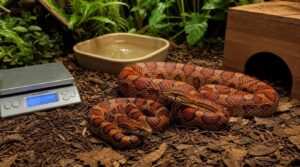
Before you pair your corn snakes, run through a short checklist — skipping even one step can cost you a healthy clutch. The criteria cover age, weight, health, timing, and what to watch for once eggs are laid.
Confirm before breeding day arrives: Ensure all prerequisites are met to maximize success.
Confirming Age, Size, and Weight Requirements
Before you pair your snakes, lock in three hard numbers: age, length, and weight. Your female should be at least 3 years old, 3 feet in length, and around 300 g.
Use a weight checkpoint chart alongside growth velocity tracking to confirm she’s hit those benchmarks consistently.
Hatch-date age estimates, scale count verification, and morph-specific size benchmarks help you verify body condition with precision — not guesswork.
Pre-breeding Health Screening
Once females clear the age, size, and weight benchmarks, health screening becomes essential. Numbers alone don’t tell the full story. Run these checks before pairing:
- Parasite screening via fecal flotation to protect offspring
- Respiratory exam for abnormal sounds or mucus
- Coelomic palpation to detect lumps or discharge
- Metabolic assessment including hydration, urine output, and shed consistency
- Genetic screening for heritable defects in the lineage
Veterinary health monitoring and body condition scoring confirm true reproductive readiness — not just size.
Seasonal Timing After Brumation
Timing is everything once brumation ends. The hormonal resurgence window opens as daylight length increases, triggering reproductive cycles—aim for 12–14 hours of light through gradual photoperiod extension.
Wait 7–10 days post-brumation, confirm a successful post-brumation shed, then begin post-brumation feeding with small meals.
Seasonal stress management matters here: don’t rush pairing. Breeding season timing works best when snakes are calm, fed, and metabolically reset.
Signs of Female Receptivity
Knowing when your female is truly ready matters more than the calendar. Watch for tail raising, vent swelling, and tail tucking paired with relaxed body curves. These physical cues indicate readiness.
Head tilts and sustained eye contact signal openness, while pheromone release intensifies near the vent, drawing the male in. These behavioral and chemical signals align with heightened receptivity.
Follicle swelling confirms follicular development, and chin rubbing indicates peak receptivity. These signs mark the critical window for mating.
Body condition remains central—a well-fed female shows all these signs cleanly, ensuring clarity in her readiness.
Monitoring Egg Laying and Egg-binding Risk
Once egg laying begins, stay alert — egg binding can escalate fast. Watch for these five warning signs:
- Repeated straining without eggs passing
- Abdominal swelling or a firm midsection
- Vent inspections revealing swelling or blockage
- Lethargy paired with appetite loss
- Abnormal straining patterns lasting over 24 hours
Nutrient deficiencies and poor body condition scoring increase risk considerably.
Prompt postlay recovery monitoring protects both egg viability and your female’s long-term health.
Frequently Asked Questions (FAQs)
At what age can you breed a corn snake?
You can breed a corn snake as early as 18 months, but waiting until 24–36 months gives you the best odds. Size and health matter more than the calendar.
Once your snakes are ready, a corn snake breeding and genetics guide can help you plan pairings and predict the morphs your hatchlings might show.
Is 5 years old too old to breed?
No, five years old isn’t too old — most corn snakes breed successfully through age seven or eight. Reproductive senescence and reduced hatchability become real concerns only after that window closes.
Can corn snakes breed all year round?
Technically, yes — but it’s not that simple. Warm winters keep snakes active year-round in southern latitude breeding zones.
Still, hormonal seasonality and photoperiod control drives true receptivity, not just temperature alone.
How many eggs does a corn snake typically lay?
A typical clutch size runs 12 to 34 eggs. Genetic influence and nutrition impact both egg quality and egg production. Well-fed females consistently hit the higher end.
Can corn snakes breed successfully without brumation?
Corn snakes can breed without brumation. Using photoperiod manipulation, hydration protocols, and behavioral cues, you can trigger alternative breeding cycles — though results vary.
Seasonal conditioning still improves success rates substantially.
What role does genetics play in clutch size?
Heritable clutch size is real. Your genetic line directly shapes how many eggs a female produces.
Maternal genetic effects and paternal genotype influence both clutch size and egg quality in measurable, predictable ways.
How soon can a female breed again after laying?
After laying, don’t rush her back into breeding. A proper Post‑lay Recovery window of 8–12 weeks allows Hormonal Reset, weight restoration, and follicle development before the next Brumation Refresh cycle begins.
Do corn snakes show signs of breeding burnout?
Corn snakes do show burnout signs. Watch for feeding refusal, weight loss, and courtship fatigue.
Repeated breeding raises egg-binding risk, drops sperm quality, and lowers body condition score — all threatening long-term fertility.
Conclusion
Like a bridge built before its foundation cures, breeding too soon guarantees collapse. The breeding age for corn snakes isn’t just a number on a calendar—it’s the sum of weight, length, health, and time working together.
A male ready at 18 months and a female solid at three years, hitting 250 grams minimum, gives every clutch a real chance. Respect those benchmarks, and your snakes will reward the patience.