This site is supported by our readers. We may earn a commission, at no cost to you, if you purchase through links.

Drop a snake into water for the first time, and it won’t panic. It’ll swim. No lessons, no hesitation—just instant, fluid motion.
That instinct catches most owners off guard, especially with land-loving species like ball pythons or corn snakes that never touch a pond in the wild. So can all snakes swim? Yes, every species carries this built-in ability, venomous and harmless alike.
But instinct only gets you so far. Skill, stamina, and comfort in water vary wildly from one snake to the next, and knowing the difference matters for your snake’s safety.
Table Of Contents
- Key Takeaways
- Can All Snakes Swim?
- Yes, but Skill Varies
- How Snakes Swim
- Why Snakes Enter Water
- Land Snakes in Water
- Aquatic Snakes Swim Better
- Can Snakes Swim Underwater?
- Can Snakes Bite While Swimming?
- Pet Snake Water Safety
- Frequently Asked Questions (FAQs)
- Are snakes good swimmers?
- Can snakes swim through water?
- Do terrestrial snakes swim?
- Can rattlesnakes swim underwater?
- What type of snakes can swim?
- Are there any snakes that can’t swim?
- Can snakes bite you underwater?
- How long can a snake stay underwater?
- Do all snakes like to swim?
- Can snakes swim backwards or only forwards?
- Conclusion
Key Takeaways
- Every snake is born knowing how to swim, thanks to a built-in reflex that kicks in the moment it touches water; no practice needed.
- Skill level still depends on the species, since aquatic snakes like sea snakes have bodies built for water, while land snakes like ball pythons can swim but tire out fast.
- A swimming snake can still bite, and water doesn’t weaken venom at all, so you should always keep your distance from snakes near ponds or lakes.
- If you’re letting a pet snake soak, keep the water shallow and warm, watch closely for stress signs, and never force a swim just because the snake technically can do it.
Can All Snakes Swim?
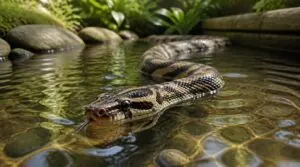
Yes, every snake can swim — and that’s not a guess, it’s just biology. Whether your pet is a ball python or a corn snake, it’s born with the instinct to move through water without any training. Here’s what you actually need to know about how that works.
For more on how habitat and temperament shape daily care, this snake species care requirements guide covers corn snakes and ball pythons in detail.
Short Answer for Owners
Yes — all snakes can swim. Every species carries a built-in swimming reflex, whether it lives near water or not.
Some are strong, confident swimmers. Others manage only short bursts before tiring out.
Your pet snake may occasionally soak or paddle in its water bowl, and that’s normal.
Venomous snakes swim too, so always keep a safe distance from wild ones near water.
Instinctive Swimming Reflex
Think of it like a built-in factory setting. Snakes are born with neonatal swimming patterns already wired in — no lessons required. The moment a newborn snake touches water, reflexive motor responses kick in automatically, triggering lateral body movements that keep it afloat and moving forward.
This survival instinct doesn’t need time to develop. It simply activates.
Venomous and Nonvenomous Snakes
Here’s something that might surprise you: venom status doesn’t affect swimming ability. Both venomous and nonvenomous snakes enter water equally well. A water moccasin and a harmless water snake look almost identical mid‑swim.
That’s worth remembering — especially near ponds or lakes. Never assume a swimming snake is safe just because it’s in the water.
Surface Swimming Basics
Watch a snake cross a pond and you’ll notice something almost graceful about it. The body forms a shallow S-shaped wave, pushing water backward with each curve — that’s lateral undulation at work.
A snake crossing water moves in a graceful S-shaped wave, pushing backward with each curve to glide forward
The head stays above the surface for breathing and sensing, while surface tension provides just enough lift to keep things moving smoothly forward.
Yes, but Skill Varies
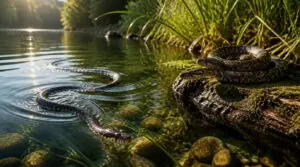
Here’s how different snakes stack up as it relates to swimming skill.
Aquatic Versus Terrestrial Species
Not all snakes are built the same for water. Aquatic species have laterally compressed bodies, smoother scales, and sealed nostrils — features that reduce drag and keep water out.
Terrestrial snakes carry full body weight on land, shaping their muscles and movement for solid ground. Both can swim, but one is clearly built for it.
Research on European natricine snakes shows a clear aquatic versus terrestrial locomotion trade‑off, with Natrix maura excelling in water and Natrix natrix on land.
Strong Swimmers
While all snakes can swim, some are true water specialists. Sea snakes and their kin sit at the top, built for marine propulsion efficiency and serious aquatic adaptation.
What makes them elite aquatic species?
- Deep diving endurance past 50 meters
- Specialized tail morphology for paddling
- High-speed hunting maneuvers underwater
- Sealed nostrils for submersion
- Smooth, drag-reducing scales
Occasional Swimmers
Not every snake sits at either extreme. Many terrestrial snakes fall somewhere in the middle — capable but casual.
Ball pythons, for example, can cross water confidently, but they don’t seek it out. Their snake swimming capabilities are real, yet unpracticed. Like an occasional swimmer returning after a long break, skill drift happens. Comfort varies with exposure.
Poor Endurance Swimmers
Think of a highly terrestrial snake tossed into open water — it’s not graceful. Fatigue-induced drag sets in fast.
- Core stability weakens quickly
- Stroke rate declines sharply
- Pacing skill is nearly absent
- Mental fatigue hits early
Snake locomotion falters without practice. Snake swimming capabilities exist, but endurance? Minimal.
How Snakes Swim
Watching a snake move through water, you’d almost think it was born for it — and in a way, it was. The mechanics behind that fluid motion come down to a few key movements working together. Here’s what’s actually happening when a snake hits the water.
Side-to-side Body Waves
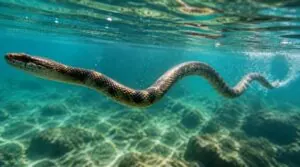
The motion behind snake swimming is elegantly simple. Their bodies move in a continuous S-shaped lateral undulation — a wave that travels from snout to tail, pushing water backward to drive the snake forward. This is undulatory swimming in its purest form.
| Wave Element | What It Does |
|---|---|
| Spine wave sequence | Passes motion from head toward the tail |
| Core muscle coordination | Times each contraction for smooth propulsion |
Each sideways flex generates thrust through propulsion wave mechanics, turning the entire body into a living paddle.
Head Above Water
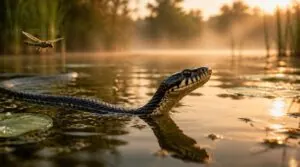
Here’s something worth picturing: a snake gliding across a pond, head held above the surface, calm and fully in control. That upright posture isn’t random. It keeps the nostrils clear for water surface breathing and lets the eyes scan for threats above and below.
- Surface scanning benefits include spotting predators before they get close
- Eyes above water help identify prey near the shoreline
- Breathing pause timing aligns with natural lulls in movement, so the body stays mostly submerged
- Raised heads also aid navigation through aquatic vegetation without tangling
Underwater Body Propulsion
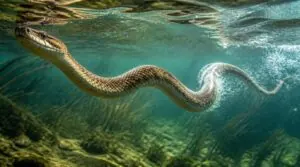
Once the head drops below the surface, the real work begins. Your snake’s entire body becomes the engine.
Longitudinal muscles fire in sequence, sending an S-shaped wave rippling from neck to tail.
That wave pushes water backward, driving the snake forward — the same physics behind how eels move.
No limbs needed. Just one long, coordinated pulse.
Tail Movement and Steering
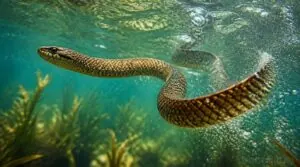
The tail isn’t just along for the ride. It works as a flexible steering rudder, using side-to-side sweeps to adjust direction without shifting the head.
As the S-shaped wave travels toward the tail, it generates extra forward thrust. Tail amplitude increases during turns, giving your snake precise yaw control — tight, responsive adjustments that keep it on course through the water.
Why Snakes Enter Water
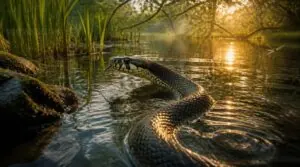
Snakes don’t enter water by accident — there’s always a reason behind it. Whether your snake is wild-caught or captive-bred, the same basic drives apply. Here’s what’s actually pulling them toward the water.
Escaping Predators
Water is one of a snake’s best escape tools. When a predator closes in, rapid flight bursts into a nearby stream or pond can mean the difference between life and death. Many terrestrial predators simply won’t follow.
- Snakes use sudden movement deception to startle threats
- Erratic retreat patterns confuse pursuing predators
- Camouflage survival tactics help once submerged
- Terrain-based evasion uses water as a natural barrier
- Brief stillness underwater completes the escape
Hunting Aquatic Prey
Food is a big reason snakes enter water. Many species hunt frogs, fish, and eels in wetlands and streams.
They detect prey through sensory vibration detection — picking up tiny water disturbances before striking. Then comes a quick, precise snap.
Suction feeding mechanics pull prey straight into the mouth, reducing any chance of escape.
Cooling Their Bodies
Snakes can’t sweat, so water is their air conditioning. When body heat climbs, many snakes slip into a stream or pond to cool down through direct conduction heat transfer with the water around them.
Here’s what that thermoregulation process looks like in practice:
- Microclimate selection — choosing shaded, shallow water over warm, open surfaces
- Partial submersion — letting cool water draw excess heat away from the body
- Behavioral timing — entering water during peak heat hours to manage metabolic heat buildup
Reaching New Habitats
Think of swimming as a snake’s ticket to somewhere new. Crossing a river, pond, or flooded stretch of land opens up habitat corridors that would otherwise block natural movement entirely.
Several snake species have been documented swimming between islands, proving that aquatic dispersal is a real survival strategy — not just a curiosity. Better connectivity means more snakes successfully colonizing suitable ground.
Shedding Support
Soaking in water isn’t just about hydration. Some snakes enter water specifically to support shedding their skin. The moisture softens old layers, making the process smoother.
Aim for 50–70% humidity in the enclosure and offer a shallow soaking dish.
If you spot stuck or patchy scales after a shed, a brief supervised soak — never forced — can help.
Land Snakes in Water
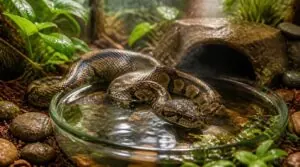
Just because your snake lives on land doesn’t mean water is off-limits. Most pet species can handle a splash — some better than others. Here’s how a few common land snakes hold up when things get wet.
Ball Pythons Swimming
Ball pythons can swim — and better than most people expect. In the wild, flooding and seasonal rains push them into water regularly across sub-Saharan Africa. They propel themselves using side-to-side muscular contractions, keeping their head up to breathe. Three key benefits of controlled water exposure:
- Eases shedding
- Enriches their environment
- Offers a natural escape behavior
Watch for lethargy or frantic movement — those are signs of aquatic stress.
Corn Snakes Swimming
Corn snakes can swim — they’re just not built for it long-term. Using lateral body undulation, they push through water with surprising ease, keeping their head raised to breathe. Their tail drives propulsion and steering while the front holds steady.
| Behavior | Purpose |
|---|---|
| Surface swimming | Crossing habitat gaps |
| Soaking | Shedding support and cooling |
| Head above water | Breathing and awareness |
Supervised shallow water keeps captive corn snakes safe.
Boa Swimming Ability
Boas are surprisingly capable swimmers — more so than most people expect. They use the same lateral undulation that moves them across land, powered by strong axial muscles. Their ability to trap air in their lungs gives them natural buoyancy control, keeping the head comfortably above the surface.
Here’s what drives boa swimming behavior:
- Crossing rivers to reach new territory
- Hunting amphibians along riparian habitat edges
- Cooling off during intense heat
- Escaping sudden threats on land
- Individual proficiency varying by snake and conditions
When Pet Snakes Soak
Most pet snakes don’t need regular soaking, but there are times when a warm bath genuinely helps.
Shedding is the most common reason — warm water loosens stuck skin fast. It can also encourage drinking and ease mild constipation.
Keep water 80–85°F, shallow enough that your snake’s head stays above the surface naturally.
Wait at least 48 hours after feeding before any soak.
When Swimming Causes Stress
Not every soak is stress-free. Sudden temperature shifts can startle your snake and spike its heart rate fast. Chlorine irritation from tap water affects skin and eyes.
Bright glare and noise from nearby equipment add real anxiety too.
Watch for tail whipping, frantic movement, or refusal to re-enter water — those are your clearest signs to stop.
Aquatic Snakes Swim Better
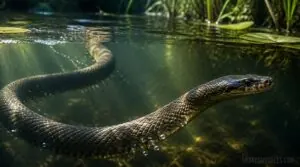
Some snakes don’t just tolerate water — they’re built for it. Aquatic and semi-aquatic species have bodies shaped by evolution specifically for life in and around water, giving them a clear edge over their land-dwelling cousins. Here’s a closer look at the standout swimmers you should know about.
And contrary to popular belief, whether a snake glides along the surface or swims fully submerged has nothing to do with venom — check out this breakdown of how snakes swim and stay buoyant in water to see what really drives the difference.
Water Snakes
If you’ve ever spotted a snake gliding across a pond, chances are it was a water snake. These freshwater snakes belong to the Natricinae subfamily and include roughly 200 species. They’re built for aquatic life — their camouflage patterning blends into reeds and muddy shallows perfectly.
Here’s what makes water snakes stand out:
- They hunt fish and amphibians using ambush tactics near shorelines
- Most are non-venomous, though the water moccasin is a notable exception
- They’re ovoviviparous, giving birth to live young already capable of swimming
- Their snake locomotion in water relies on lateral body waves for efficient movement
Sea Snakes
Water snakes stick to ponds, but sea snakes never leave the ocean. As true marine reptiles, they roam coral-rich Indo-Pacific habitats, powered by paddle-shaped tails.
They hold their breath for long dives, while salt glands swiftly flush excess sodium from seawater. Some even take in oxygen through their skin.
Their venom is quite potent, so admire these swimmers from afar.
Sea Kraits
Sea kraits live an amphibious lifestyle, splitting time between coastal habitat range and dry land.
The Yellow-Lipped Sea Krait sports bold black and white stripes, unlike fully marine sea snakes.
Specialized ventral scales help it crawl ashore for prey digestion on land and egg laying habits in burrows.
This marine reptile can hold its breath for long reef hunts.
Anacondas and Wetlands
Picture an anaconda gliding through flooded Amazon forest, at home in its wetland ecosystem. The green anaconda thrives in connected freshwater habitat across Amazonian and Orinoco basins, where:
- seasonal flooding boosts wetland prey diversity
- floodplains serve as anaconda breeding sites
- channels support habitat connectivity
Anacondas can hold their breath, perfecting aquatic hunting strategies—proof wetland conservation truly matters.
Paddle-like Tails
A paddle-shaped tail isn’t just for show. Sea snakes use this flattened tail morphology to push more water with every stroke, boosting thrust generation.
The tail propulsion works through undulation, with waves rolling from base to tip. That same motion lets snakes steer by angling the paddle.
It’s one of the smartest aquatic snake adaptations around.
Can Snakes Swim Underwater?
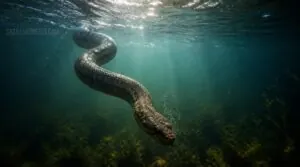
So far you’ve seen snakes paddle along the surface. But plenty of them go deeper than that, sometimes much deeper. Here’s what happens once a snake disappears below the waterline.
Breath-holding Ability
How long can a snake hold its breath? Longer than you’d guess.
Diving capacity depends on oxygen storage in blood and muscle, plus a slower metabolic rate underwater.
The diving reflex drops heart rate and redirects blood to essential organs.
CO2 tolerance varies by species: Burmese pythons last 30 minutes, anacondas about 10.
Submerged Hunting
Holding its breath isn’t just a a survival skill — it’s hunting time. Snakes rely on scent cue tracking and sharp sight to locate prey, then sit still using ambush camouflage tactics just below the surface.
Their aquatic prey selection includes fish, frogs, and salamanders.
Once prey drifts close, underwater strike speed takes over, often under a second, while submerged energy conservation keeps the snake ready for round two.
Diving Depth Differences
Not every snake dives the same depth, and that comes down to diving ability and habitat.
Land snakes barely dip below the surface, while sea snakes routinely cross the thermocline, diving down to 50 meters to reach cooler, prey-rich layers.
Freshwater species stay shallower than coastal ones.
Maximum dive limits depend heavily on breathholding capacity and respiratory adaptations built for prolonged dives.
Underwater Hiding Behavior
Going deep isn’t just about reaching food. It’s also about staying hidden.
Snakes use submerged nesting sites, tucking into crevices or debris near the bank. Burrow safety tactics add cover, with muddy tunnels muffling ripples. Aquatic camouflage methods, like matching dull tones to rocky bottoms, and thermal hiding strategies help too.
Combined with quiet, stealth movement patterns, this snake behavior helps both predator evasion and underwater hunting strategies—often for just a few minutes at a time.
Can Snakes Bite While Swimming?
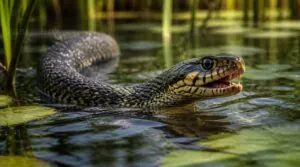
A swimming snake hasn’t given up its defenses just because it’s in the water. It can still strike if it feels threatened, cornered, or surprised. Here’s what every snake owner should keep in mind before getting close to one.
Defensive Bites in Water
If you encounter a snake in water, you may trigger a defensive bite without warning. Submerged bite risks spike when a snake can’t escape, since it reacts to you like a predator.
That’s human-snake conflict near water in short: venomous water snakes and nonvenomous ones alike will strike to defend themselves. Bites still cause aquatic infection hazards. Stay safe.
Venom Still Matters
Water doesn’t wash venom away. A venomous snake stays just as dangerous swimming as it is on land — fangs still deliver toxins, whether neurotoxins that affect nerves or hemotoxins that wreck blood and tissue.
Yes, rattlesnakes can swim, and so can the water moccasin.
Both are surprisingly capable swimmers — you can see just how well-adapted rattlesnakes are in the water at this closer look at rattlesnake swimming behavior.
Venom potency depends on species, size, and how much they inject during a defensive strike.
Avoid Handling Wild Snakes
So if venom doesn’t fade in water, why would anyone reach for a swimming snake? Don’t. Wild snake bites often happen because someone tried to grab or move one.
- Never grab a snake near a pond or ditch.
- Risk of Salmonella infection from contact is real.
- Many species face legal handling restrictions.
- Call wildlife removal services instead.
- Let it swim away on its own.
Safe Distance Tips
So how close is too close when encountering wild snakes near water? Keep at least a full body length between you and the animal—about 6 feet of clear space.
If you startle one, back away on a diagonal path instead of turning around, giving it a safe retreat path.
This simple gap prevents sudden strikes and keeps both you and pets out of harm’s way.
Pet Snake Water Safety
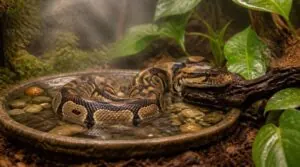
So what does safe water exposure actually look like for your pet snake? It’s less about letting them swim and more about giving them the right setup. Here’s what to keep in mind.
Shallow Soaking Bowls
Picking the right bowl matters more than you’d think. Look for wide, shallow designs with water just 1 to 2 inches deep — enough to cover the body, not the head.
Ceramic and ribbed-free stainless steel resist stains and clean easily. Smooth, non‑porous finishes prevent bacteria buildup, while textured bases and rounded rims add grip and safety.
Supervised Water Exposure
At first dip, never leave your snake alone. Stay within arm’s reach, watching for monitoring stress indicators like gaping or rapid breathing.
Keep water lukewarm — safe water temperature matters. Follow proper session progression, starting at five minutes. Keep handling safety tools and emergency vet contacts nearby. Even though snakes can swim instinctually, supervision keeps water navigation safe, unlike true aquatic habitats their morphology wasn’t built for.
Avoid Forced Swimming
Just because your snake can swim doesn’t mean it should have to. Snakes instinctually swim as a survival mechanism — predator avoidance, not entertainment.
Voluntary immersion benefits your snake; forced sessions don’t.
- Watch for rapid gaping
- Limit dips to minutes
- Offer a dry exit always
- Match exposure to species
- Stop at first distress sign
Preventing exhaustion matters more than impressing anyone with snake anatomy and movement.
Signs of Distress
A stressed snake doesn’t always show it loudly — sometimes it’s just quiet trouble. Watch for respiratory distress (rapid breathing, gaping), a dropped head, or skin irritation after water time.
If these signs catch you off guard, practical ways to calm a nervous snake can help you respond before the stress escalates.
| Sign | What You’ll See | What It Means |
|---|---|---|
| Breathing | Rapid, irregular | Respiratory strain |
| Posture | Limp, head down | Exhaustion |
| Skin | Redness, sores | Trauma |
Even instinctive swimmers tied to predator avoidance can overdo it. Monitor recovery closely.
When to Call a Vet
So how do you know when "wait and see" turns into "call the vet right now"? Trust your gut.
Persistent gaping, wheezing, or lethargy past a day signals real trouble — maybe drowning recovery gone wrong or a brewing waterborne infection. Abnormal swimming, open-mouth breathing, or a snake that won’t right itself need urgent care.
When in doubt, call. Better safe than sorry.
Frequently Asked Questions (FAQs)
Are snakes good swimmers?
Yes, most snakes swim well. Innate swimming reflexes kick in from birth, driving undulatory propulsion through the water.
Skill varies by species and morphology, though—sea snakes show top‑tier aquatic locomotion, while some land dwellers manage only modest buoyancy control.
Can snakes swim through water?
On land they slither; in water they glide. Lateral undulation drives every stroke, muscles firing in sequence while surface tension and buoyancy control keep them afloat — true aquatic locomotion built right into snake propulsion mechanisms.
Do terrestrial snakes swim?
Absolutely. Terrestrial swimming instincts kick in when water crossing becomes necessary. Garter snakes, rat snakes, and even rattlesnakes can swim, using natural buoyancy to stay afloat. It’s pure survival through swimming, plus a handy way to disperse to new ground.
Can rattlesnakes swim underwater?
Picture a rattlesnake gliding below the surface like a tiny submarine. They truly can dive briefly, using buoyancy control and breath-holding for short underwater stretches, mixing submerged hunting tactics with quick aquatic escape strategies before surfacing for air.
What type of snakes can swim?
Every type counts, but skill varies widely.
Marine habitat specialists like sea snakes excel, freshwater snakes and semiaquatic snake species hunt confidently, while terrestrial dispersal methods help land snakes cross water using basic locomotion and natural predator evasion strategies.
Are there any snakes that can’t swim?
No anatomical swimming barriers exist in snakes. Even highly terrestrial snakes instinctively swim thanks to a universal swimming reflex. They simply can’t breathe underwater, so swimming stays a survival skill, not a permanent lifestyle, for most species.
Can snakes bite you underwater?
Like a cornered animal anywhere, a startled snake strikes first and asks questions later. Yes, snakes can bite underwater—water doesn’t block fangs or venom glands, and most underwater bites are defensive, not predatory, so keep your distance.
How long can a snake stay underwater?
It depends on the species. Most land snakes hold their breath 1 to 10 minutes; semi-aquatic ones manage Thanks to skin-based underwater respiration, sea snakes can hold their breath for 8 hours in rare cases.
Even skilled hunters like pythons can stay submerged for up to 20 minutes while stalking prey, a surprising feat explored in this guide to how long snakes can hold their breath underwater.
Do all snakes like to swim?
Not really. Snakes instinctively swim, but liking it is another matter. Aquatic species show real water comfort, while terrestrial ones tolerate brief dips. Individual temperament varies too — instinct gets them moving; enjoyment is a different story.
Can snakes swim backwards or only forwards?
Mostly forward. Scale orientation grips best moving ahead, so backward swimming is rare and energetically costly. Muscle undulation favors a forward-propagating wave—efficient locomotion in water, not reverse, since propulsion directionality limits true backward movement.
Conclusion
Every snake on Earth could be dropped into a lake tonight and paddle off like it’s been done this a thousand times before—that’s how deep the instinct runs.
So, can all snakes swim? Absolutely. But instinct isn’t the same as ease. Your ball python might survive a swim; a water snake thrives in one.
Know your species, read its body language, and let water stay a choice, never a test. That difference keeps your snake safe.