This site is supported by our readers. We may earn a commission, at no cost to you, if you purchase through links.

A snake that hasn’t passed waste in two weeks after eating isn’t being stubborn—something has gone physically wrong inside its digestive tract. Impaction, unlike simple constipation, means hardened material has formed a near-complete blockage, and that distinction matters enormously for how you respond.
Left unaddressed, the pressure builds until bacterial sepsis or intestinal perforation becomes a real possibility.
The good news is that caught early, an impacted snake home remedy protocol—controlled soaking, corrected temperatures, substrate changes—can resolve mild cases before they escalate. Knowing the difference between a safe home approach and a dangerous one is where most keepers go wrong.
Table Of Contents
- Key Takeaways
- What is Snake Impaction?
- Signs Your Snake is Impacted
- Common Causes of Snake Impaction
- Safe Home Care Steps
- Warm Soaks for Impacted Snakes
- Home Remedies to Avoid
- Preventing Future Snake Impactions
- Frequently Asked Questions (FAQs)
- How do you treat a snake bite on a dog?
- Can acupuncture help a dog recover from a snake bite?
- What is a snake impaction?
- How do you know if a snake is impacted?
- How to naturally unblock constipation?
- What can cause impaction in snakes?
- What does Epsom salt do to snakes?
- How to help a constipated snake with home remedies?
- What will flush out a snake?
- How to help impaction in reptiles?
- Conclusion
Key Takeaways
- True impaction — a near-complete physical blockage — differs critically from constipation, and that distinction determines whether warm soaks and husbandry corrections are enough or whether your snake needs veterinary intervention immediately.
- Warm soaks at 98–104°F for 15–30 minutes, two to three times daily, combined with correct enclosure temperatures and humidity between 50–70%, form the foundation of safe home management for mild cases.
- Common "remedies" like Epsom salt baths, mineral oil, human laxatives, and firm abdominal massage can worsen dehydration, cause intestinal perforation, or mask a deteriorating condition — skip them entirely.
- If your snake shows no improvement within 48–72 hours, or develops lethargy, regurgitation, or visible abdominal swelling, veterinary care isn’t a last resort — it’s the appropriate and necessary next step.
What is Snake Impaction?
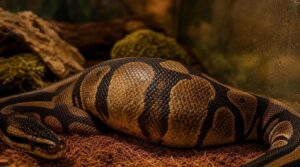
Snake impaction isn’t just bad constipation — it’s a full or near-complete blockage that can turn serious fast.
Unlike constipation, a true impaction means nothing is moving through — check out snake impaction signs and treatment options to know what to watch for before it becomes an emergency.
Understanding what’s actually happening inside your snake helps you make smarter decisions about when to act at home and when to call a vet.
Here’s what you need to know.
Difference Between Constipation and Impaction
Constipation and impaction aren’t the same thing — and that distinction matters clinically. Constipation describes difficult or infrequent stool passage, where stool flow mechanics are slowed but the bowel isn’t physically blocked.
Impaction is harder: a palpable mass presence of hardened waste that won’t move. Progression risk factors like dehydration and poor husbandry can push a constipated snake straight into full blockage territory.
Why Impaction Can Become an Emergency
Once a blockage takes hold, the timeline can shift fast. Retained waste becomes a breeding ground for bacteria, raising sepsis risk as systemic toxins enter circulation.
Pressure builds against intestinal walls, increasing the chance of bowel perforation.
Your snake may show a distended abdomen, hard mass on palpation, or early respiratory compromise — all clinical signs of intestinal blockage in snakes that demand prompt attention, not watchful waiting.
Where Blockages Commonly Occur
Impaction doesn’t settle in one spot — it can develop anywhere from the Esophageal Region down through the Duodenal Area, Ileal Segment, Colon Passage, and Cloacal Vestibule. That said, the large intestine and lower colon are where compacted material most commonly stalls.
Externally, you’ll often notice abdominal swelling, a distended abdomen, cloacal swelling, or a hard mass on palpation near the vent.
Why Home Care Has Limits
Knowing where blockages stall is useful, but it doesn’t change what you can actually do at home. The Diagnostic Imaging Gap is real — you can’t confirm what’s stuck or how severe it is without radiographs.
Dehydration Management, Temperature Control Issues, and Procedural Safety Risks compound quickly, and Medication Access Restrictions mean the tools that truly resolve impaction stay firmly in veterinary hands.
Signs Your Snake is Impacted

Catching impaction early makes all the difference between a straightforward home fix and an emergency vet visit. Your snake can’t tell you something’s wrong, so the signs in its behavior and body are the only clues you’ll get.
Here’s what to watch for.
No Bowel Movement After Feeding
After feeding, your snake’s gut should move material steadily toward the cloaca — but gut transit delay changes that picture. If post‑meal observation reveals no fecal or urate output within the expected window, snake impaction may already be developing.
Urate consistency offers an early clue: chalky, hardened plugs signal dehydration. Track water intake and apply temperature and humidity management for reptiles before symptoms worsen.
Loss of Appetite
When your snake stops showing interest in food, that shift often signals internal distress long before anything visible appears. Reduced appetite tied to infection influence, medication side effects, or hormonal changes can compound an existing blockage.
Watch for:
- Refusing prey multiple feeding cycles in a row
- Stress triggers like handling immediately post-feed
- Nutrient deficiency signs such as lethargy between meals
Hydration therapy and warm soaks support recovery early.
Swollen Lower Abdomen
When the lower third of your snake’s belly looks visibly fuller than usual, don’t dismiss it. That swelling may reflect gas distension, fluid accumulation, abdominal masses, or early cloacal swelling — each pointing toward snake impaction.
Hernia detection and diagnostic imaging help distinguish causes precisely.
Before a vet visit, warm soak and hydration therapy can offer temporary comfort without replacing professional home care and warm soak treatment guidance.
Hard Lump Near The Vent
hard mass near the vent isn’t always what it looks like. It could be a cyst-like mass, hemorrhoid-type swelling, trauma-induced bump, or early abscess — and palpation diagnosis matters here.
Watch for these cloacal swelling distinctions:
- Firm, smooth lump — possible urates or fecal impaction
- Painful, reddening tissue — abscess warning signs
- Soft, localized swelling — hemorrhoid-type changes
- Post-handling firmness — trauma-induced bump
- Persistent lump despite warm water soak — veterinary evaluation needed
Straining Without Passing Waste
Repeated straining with nothing to show for it — clinically called tenesmus — is one of the clearest red flags of snake impaction.
Your snake may exhibit cloacal pushing repeatedly, yet produce no waste or only partial leakage of liquid around a hardened blockage.
These pressure sensations and incomplete evacuation attempts signal that the digestive tract is genuinely obstructed, and that’s an urgent veterinary need, not a wait-and-see moment.
Lethargy or Weakness
A snake that’s suddenly quiet, sluggish, and unresponsive isn’t just "tired" — it’s telling you something is seriously wrong. Lethargy and weakness from impaction reflect dehydration stress, metabolic imbalance, and temperature stress compounding together.
Watch for:
- Reduced movement or staying in one spot
- Weak grip or inability to reposition normally
- Diminished alertness even during handling
Home care and warm soak treatment can help early on, but persistent lethargy signals circulatory issues or neurological signs that require immediate veterinary attention.
Regurgitation or Breathing Difficulty
When lethargy gives way to regurgitation, the situation escalates quickly. If your snake is bringing food back up or showing open mouth breathing after meals, that’s post-feeding respiratory stress — not a digestive quirk.
Airway aspiration signs, like wheezing during feeding or swallowing difficulty indicators, mean stomach contents may be entering the airway. stop feeding immediately and contact a reptile vet.
In reptiles, similar airway reflux can reach the lungs, mirroring findings in humans.
Common Causes of Snake Impaction
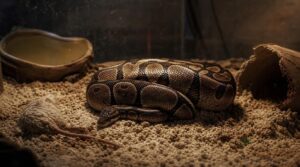
Impaction rarely happens out of nowhere — there’s almost always something in the enclosure setup that sets it in motion.
Understanding the root causes makes it much easier to fix the problem and stop it from coming back.
Here are the most common reasons snakes end up blocked.
Dehydration and Hardened Urates
Dehydration is the most overlooked driver of impaction — when your snake doesn’t drink enough, urine concentration rises, triggering crystal nucleation and forming dense urate plugs that behave like cement inside the colon.
Disrupted pH balance accelerates this process.
Hydration monitoring matters: offer lukewarm water daily, maintain enclosure humidity between 50–70%, and watch for a hard mass near the vent.
Low Enclosure Temperatures
Beyond hydration, low enclosure temperatures are equally disruptive. Your snake’s digestive system runs on heat — without proper thermal gradient optimization, gut motility slows considerably.
Poor heat source placement, inadequate thermostat probe position, and nighttime temperature drops can push conditions below the preferred range. Thick bedding blocks floor heat, leaving your snake too cold to move waste efficiently.
Loose Substrate Ingestion
Loose substrate ingestion is another underappreciated driver of snake impaction. Fine particles — sand, coconut fiber, walnut shells — demonstrate significant Substrate Particle Clumping once hydrated inside the gut, reducing Hydration Mobility and slowing reptile digestion. Juvenile Ingestion Risk is especially higher given narrower intestinal passageways. Substrate Material Digestibility varies, but mineral-based options rarely pass cleanly.
Watch for these substrate-related risk factors:
- Feeding directly on loose bedding increases substrate ingestion per meal
- Fine-grain sands compact into dense masses when moistened internally
- Juvenile snakes swallow particles more readily during aggressive feeding responses
- Prevention through proper husbandry means prioritizing Feeding Container Use consistently
Oversized Prey or Overfeeding
Feeding prey that exceeds your snake’s stomach capacity limits isn’t just uncomfortable for the animal — it directly raises the risk of intestinal blockage. When digestion slows under excessive metabolic load impact, partially processed material can accumulate and compact.
Overfeeding compounds this, especially during growth stage feeding when prey handling stress is highest. Following prey size guidelines and consistent feeding schedule timing protects your snake from impaction.
Small Enclosures and Poor Exercise
Inadequate enclosure size does more harm than it might seem. Limited movement space from enclosure size constraints reduces muscular peristalsis — the rhythmic contractions that physically push waste toward the vent.
Thermal gradient issues compound this: when hot and cool zones overlap, your snake can’t thermoregulate properly, slowing digestion further.
Stress related inactivity keeps the snake motionless longer, and substrate ingestion risk increases when the same cramped area is repeatedly traveled.
Inadequate Water Dish Size
water dish that’s too small quietly sets the stage for reptile dehydration. Limited dish capacity means water runs out faster, rim reachability becomes difficult as levels drop, and soaking — a key hydration behavior — simply isn’t possible.
Tip-resistant design matters too; a tipped bowl leaves your snake without water entirely.
Biofilm build-up accelerates in smaller volumes, reducing hydration frequency.
Prevention through proper husbandry starts with sizing the dish correctly.
Safe Home Care Steps
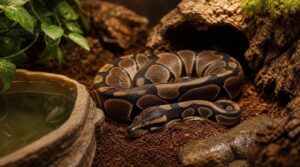
When your snake is impacted, the first thing you can do is make their environment as supportive as possible. A few simple enclosure adjustments can take real pressure off their digestive system while you monitor them closely.
Here’s where to start.
Move The Snake to a Simple Setup
Think of this move as creating a diagnostic window. Transfer your snake to a small, smooth-sided container with a reliable thermostat maintaining a clear temperature gradient — warm zone at 82–85 °F, a cooler retreat available.
Thoughtful enclosure design here means prioritizing airflow management and eliminating loose substrate to reduce ingestion risks. Controlled container size keeps observation straightforward, so you won’t miss subtle changes in posture or output.
Use Paper Towels or Newspaper
Once you’ve moved your snake to a temporary container, substrate selection and ingestion risks become your first practical decision.
Paper towels are the clear choice here — their absorbency efficiency pulls moisture away quickly, minimizing bacterial buildup, while their flat surface facilitates hygiene protocols and makes waste visible at a glance.
Fiber transfer risk is minimal with single-use disposal, and disposal waste impact stays low since soiled sheets go straight in the trash.
Check The Warm and Cool Zones
Temperature is doing more work than you might realize right now. Accurate thermostat probe placement ensures your heat source calibration reflects what your snake actually contacts — not just ambient air.
Run surface temperature mapping across both sides: the warm zone should hold 82–86°F, the cool zone 77–80°F. gradient stability checks and cool zone verification confirm that preferred-range thermal regulation is genuinely achievable throughout the enclosure.
Increase Humidity Safely
Humidity works alongside thermal regulation — once your warm and cool zones are confirmed, bring the humidity range to 50–70% using incremental mist increments rather than saturating the enclosure at once. Hygrometer calibration matters here.
- Practice Substrate Dryness Checks daily — damp bedding signals that mold risk monitoring is overdue.
- Prioritize Airflow Optimization to prevent condensation.
- Adjust output gradually, recheck readings, then hold.
Provide Fresh Water for Soaking
Once humidity is stable, your next move is water — specifically, giving your snake regular access to clean, warm soaking water.
Use a dedicated soak vessel separate from the enclosure, and commit to fresh water replacement before and after every session.
Consistent water level matters too; shallow but sufficient depth facilitates warm water soaking therapy for snakes without submersion risk.
Container hygiene routine — rinse, disinfect, rinse again — ensures water cleanliness assurance that protects an already stressed digestive system.
Pause Feeding Until Waste Passes
With fresh water in place, shift your focus to feeding timing — specifically, pausing it entirely. Feeding an impacted snake adds volume to an already blocked tract, increasing pressure and straining.
Hold off until waste passes cleanly through the vent:
- Prioritize hydration over prey item size or feeding schedule
- Waste monitoring confirms recovery before resuming meals
- Vet consultation guides stress reduction when soaking isn’t working
Warm Soaks for Impacted Snakes
A warm soak is one of the gentlest tools you have when your snake is impacted.
Done correctly, it relaxes the muscles, softens hardened waste, and encourages the digestive tract to get moving again.
Here’s exactly how to do it safely, from water temperature to knowing when the soaks just aren’t cutting it anymore.
Correct Water Temperature
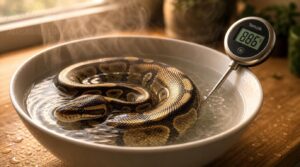
Getting the water temperature wrong can turn a helpful soak into a harmful one. Aim for 98–104°F (36–40°C) — warm enough to relax muscles and soften compacted waste, but well below scald-risk thresholds. Always verify with a digital thermometer; hand-feel isn’t reliable. Stir the water thoroughly before placing your snake to eliminate hot pockets.
| Condition | Target Range |
|---|---|
| Safe soak temperature | 98–104°F (36–40°C) |
| Too cool (ineffective) | Below 82°F |
| Scald risk threshold | Above 113°F |
Top off warm water every 10 minutes to prevent temperature drop.
Safe Soak Depth
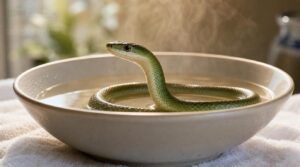
Depth matters just as much as temperature in warm water soaking therapy for snakes. Set the water line so it covers the lower abdomen while keeping your snake’s head above water throughout — this facilitates vent clearance, allows waste observation, and dramatically reduces aspiration risk.
- Water should reach the lower third of the body, not the neck
- Head above water must be maintained without you holding it there
- Water line consistency prevents gradual submersion during the soak
- Container depth should support snake stability without allowing rolling or wedging
How Long to Soak
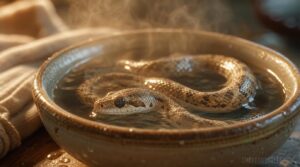
Session Duration Guidelines are straightforward: keep soaking in warm water for 15–30 minutes per session.
Size-Based Timing matters here — smaller snakes cool faster, so cap them at 15 minutes.
The Temperature Decay Effect shortens the effective soak time as water cools, so refresh it midway.
Watch for Stress Indicators, such as frantic movement.
Hit Escalation Thresholds if hydration and warm water soaking therapy for snakes yield no results within two sessions.
How Often to Repeat Soaks
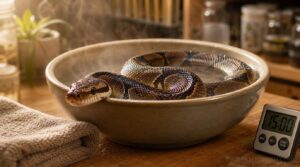
Repeat Interval Guidelines suggest two to three sessions daily — no more. Maximum Daily Sessions cap at three.
After each round of soaking in warm water for 30 minutes, dry your snake thoroughly; Vent Hygiene Concerns are real, and excess moisture invites skin irritation.
Evaluating Soak Effectiveness is simple: Stop Soak Signs appear when waste passes.
No output after two attempts? Shift to veterinary care immediately.
Supporting The Snake During Soaks
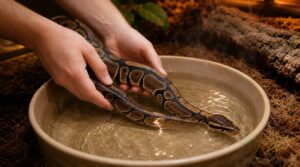
How you handle your snake during a soak matters as much as the water temperature itself. Gradual submersion reduces panic — lower the snake slowly, supporting its full body length with a steady Body Stabilizing Grip rather than dangling it by the head or tail.
- Keep water shallow enough for easy head elevation
- Stay present throughout; Supervised Soak Safety isn’t optional
- Practice careful Water Contact Management — fresh water only, no additives
- Prioritize Comfort During Handling before, during, and after
Signs The Soak is Helping
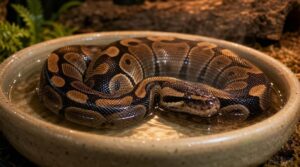
Progress during warm water soaking therapy for snakes shows up in small but unmistakable ways.
Watch for easier waste passage — even a small amount of fecal material or urates signals the blockage is moving. Relaxed body posture replaces tense coiling, decreased abdominal swelling becomes visible, and normal breathing rhythm returns.
Increased activity level after the soak confirms your snake’s reptile gastrointestinal health is responding.
When Soaking is Not Enough
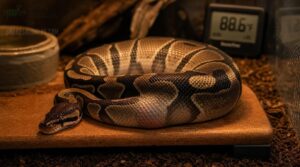
Warm water soaking therapy for snakes works well for mild cases, but some blockages are simply beyond what a soak can fix. If your snake shows any of these signs, Urgent Vet Referral is no longer optional:
- Straining persists despite 48 hours of soaking
- Lower-abdomen swelling visibly worsens
- Lethargy or regurgitation develops
- Temperature Zone Optimization and Substrate Replacement Strategy haven’t improved conditions
- Veterinary Diagnostic Imaging reveals a mass requiring Surgical Removal Coeliotomy or Targeted Enema Therapy with fluid therapy and supportive care in reptile medicine
Home Remedies to Avoid
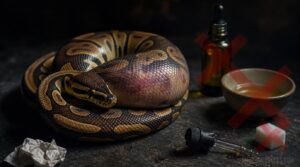
When your snake is impacted, it’s tempting to try anything that promises quick relief — and the internet has no shortage of suggestions. But some of these popular home remedies can make things substantially worse, even when they sound harmless.
Here are the ones you’ll want to avoid entirely.
Epsom Salt Baths
Epsom salt might seem like a harmless bath preparation step — after all, magnesium sulfate benefits people regularly. But your snake’s skin is nothing like yours.
Even diluted, this compound can disrupt fragile osmotic balance, worsening reptile dehydration rather than relieving it. Skin sensitivity reactions, including irritation and inflammation, are real risks.
Warm water soaking therapy for snakes works best plain — no additives needed.
Vegetable Oil or Mineral Oil
Oils carry a similar appeal — natural, accessible, seemingly harmless.
But vegetable oil’s nutritional profile and mineral oil’s hydrocarbon chemical composition make both poor choices for reptile safety.
Neither provides reliable lubrication for a true blockage, and both can delay diagnosis.
Fluid therapy and osmotic laxatives administered by a veterinarian address impaction’s hydration impact far more precisely than any oil your pantry holds.
Force-Feeding or Assist Feeding
Force-feeding carries risks that oils don’t — aspiration risk climbs sharply when food or liquid enters the airway instead of the esophagus, potentially causing pneumonia. Proper head positioning (level or slightly lowered) and strict veterinary supervision are non‑negotiable here.
Stress management matters too; a struggling snake is an injured snake.
Don’t attempt this at home without professional technique guidance.
Human Laxatives
Human laxatives — osmotic laxatives, stimulant laxatives, bulk-forming fiber agents, lubricant softeners — are formulated for human gut physiology and carry serious risks when given to snakes:
- Osmotic agents pull water into the bowel, worsening dehydration in an already compromised snake
- Stimulant laxatives can trigger violent intestinal contractions, risking perforation
- Lubricant softeners interfere with normal mucosal function
- Dosing is impossible to calibrate safely without reptile-specific pharmacokinetics
- Laxative safety depends entirely on matching the drug class to the cause — something only diagnostics can confirm
Fluid therapy, not improvised pharmaceuticals, is the appropriate first step.
Essential Oils or CBD Products
Reaching for essential oils or CBD when your snake is impacted may feel instinctive, but both carry real clinical risks. Oil Toxicity Risks aren’t theoretical — concentrated compounds irritate reptile skin and respiratory tissue in closed enclosures. CBD Dosage Uncertainty makes safe application impossible, since no veterinary standard exists. Carrier Oil Contamination spreads across substrate, coating the vent region and causing Vent Area Irritation that complicates monitoring. Labeling Inconsistency means two "natural" bottles aren’t interchangeable.
| Product Type | Primary Risk |
|---|---|
| Essential oils | Respiratory and skin irritation |
| CBD tinctures | No safe reptile dosage established |
| Carrier oils (MCT, plant-based) | Substrate contamination, vent contact |
| Herbal antidotes / plant-based snake venom remedies | No clinical validation |
Natural treatments, alternative medicine, and traditional snakebite first aid — including plant-based snake venom remedies — don’t resolve true intestinal blockages. Warm soaks and veterinary fluids do.
Massaging Too Firmly
Pressing too firmly on your snake’s abdomen does more harm than good. Aggressive ventral palpation risks Tissue Bruising, Nerve Compression, and Muscle Damage to delicate internal structures protected by little more than skin and scale. Circulatory Disruption and Abdominal Organ Stress can follow, intensifying the very discomfort you’re trying to relieve.
Gentle handling — not forceful massage — is the safe boundary here.
Delaying Veterinary Care
Waiting is itself a choice — and rarely a safe one.
Progression Risks compound quickly when impaction goes unaddressed: what starts as a manageable blockage can escalate into sepsis, organ failure, or a complication requiring surgery costing $800–$3,000.
Untreated snake impaction can spiral from a simple blockage into sepsis, organ failure, or a surgery costing thousands
Diagnostic Delays shorten the window for less invasive treatment. Emergency Timing matters.
Veterinary financial assistance programs like CareCredit exist — don’t let cost alone postpone the care your snake urgently needs.
Preventing Future Snake Impactions
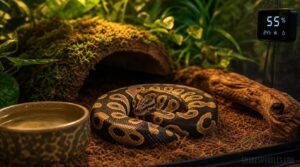
Once your snake is feeling better, the real question becomes: how do you make sure this doesn’t happen again?
The good news is that most impactions are preventable with a few consistent husbandry habits. Here’s what to keep in mind going forward.
Maintain Species-Specific Temperatures
Temperature isn’t just comfort — it’s digestion. Without proper Thermal Gradient Design, waste sits too long in the gut and hardens.
Match your setup to your snake’s Species Target Ranges:
- Cool side: 77 to 86F, warm side: 82 to 88F
- Confirm Surface Air Match using digital thermometers in both zones
- Set Thermostat Probe Placement on the warm-side surface
- Allow a gentle Nighttime Temperature Cycle — never below minimums
Thermal gradient management keeps digestion moving.
Keep Humidity in The Proper Range
Humidity works hand-in-hand with heat — get one wrong and the other suffers.
For most species, keeping humidity between 50–70% promotes healthy digestion and prevents urate plugs from hardening.
Use a hygrometer with proper Hygrometer Placement — mid-tank, away from vents — to get accurate readings.
During shedding season, nudge humidity higher, then ease it back.
Watch for condensation on glass: that’s your ventilation balance signaling an adjustment is needed.
Choose Low-Risk Substrates
Substrate choice is one of the most controllable impaction risk factors you have. Materials like crushed walnut shells and coconut coir carry real ingestion risks — fine particles transfer easily during feeding.
- Paper substrate benefits: visible, replaceable, zero ingestion risk
- Non-clumping materials: prevent compacted debris near the vent
- Low-dust options: reduce particle intake through mouth and nostrils
- Easy-clean bedding: reptile carpet allows complete, residue-free removal
Moisture-resistant substrate, smart substrate selection, and awareness of ingestion risks keep substrate safety simple.
Use a Large Water Bowl
Once substrate risks are addressed, hydration becomes your next line of defense. A water dish large enough for partial submersion facilitates warm water soaking therapy for snakes and reduces reptile dehydration through passive soaking.
Prioritize bowl capacity, a non-slip base, and stability weight to prevent tipping.
Ceramic or stainless steel ensures material hygiene.
For placement temperature, position the bowl away from direct heat.
Feed Properly Sized Prey
Hydration helps digestion, but what you feed matters just as much as how you house your snake.
Prey that exceeds your snake’s widest body point strains swallowing mechanics and increases partial impaction risk — and complete obstruction follows when oversized meals can’t move through.
Prey Girth Ratio guidelines, follow Prey Weight Guidelines, and use a Prey Size Calculator to apply Growth Stage Scaling and Species Specific Dimensions accurately.
Avoid Feeding on Loose Substrate
What you feed matters — but where you feed matters just as much. Loose substrate ranks among the leading risk factors contributing to reptile digestive impaction when prey contact picks up particles before your snake strikes.
Feeding Bowl Placement, Raised Edge Dishes, and the Tongs Feeding Method all limit that contact. Bare Bottom Feeding using Prey Isolation Techniques — a separate container with paper towels — remains the most reliable prevention through proper husbandry.
Schedule Reptile Vet Checkups
Even the most attentive husbandry has blind spots — that’s where a reptile veterinarian becomes your early-warning system. Initial exam timing matters: schedule a visit within days of acquiring your snake. From there, build an Annual Wellness Plan, or shift to Semiannual Monitoring for seniors or high-risk species. Age-Based Scheduling helps your vet calibrate frequency appropriately.
Your vet visit checklist:
- Initial physical exam and parasite screening at acquisition
- Annual or twice-yearly wellness exams based on age and species
- Veterinary diagnostic imaging and blood work when symptoms emerge
- Urgent Trigger Alerts — act same-day for straining, lethargy, or regurgitation
- Discuss Veterinary cost considerations for reptile emergencies and financing options upfront
Track Feeding, Shedding, and Defecation
Think of your snake’s log as an essential chart — it tells you when something’s off before symptoms escalate. Record each feeding date, shedding cycle, and defecation timing alongside humidity tracking and weight monitoring entries.
A shift in any pattern — delayed waste, missed shed, or weight loss — signals a substrate ingestion risk or husbandry gap worth investigating immediately.
Frequently Asked Questions (FAQs)
How do you treat a snake bite on a dog?
Get your dog to an emergency vet immediately — antivenom administration and IV fluid therapy are the real treatments. Skip herbal antidotes and traditional snakebite first aid.
Keep your dog calm during emergency vet transport.
Can acupuncture help a dog recover from a snake bite?
Carefully considered, acupuncture can complement snakebite treatment through targeted Pain Management Protocol, but antivenom remains the priority. Venom Antidote Timing is critical — acupuncture provides comfort, not cure.
What is a snake impaction?
Snake impaction is a clinical condition where a digestive blockage prevents normal waste from passing through your snake’s digestive tract — caused by fecalith formation, foreign body accumulation, or motility impairment from dehydration.
How do you know if a snake is impacted?
Ironically, snakes are masters at hiding discomfort — by the time you notice something’s wrong, the problem has often been building for days.
Watch for absent bowel movements, swelling midbody, reduced activity, and cloacal inspection abnormalities.
How to naturally unblock constipation?
Naturally relieving constipation starts with hydration, fiber-rich diet choices like prunes, oats, and leafy roughage, plus probiotic supplementation, aloe vera gel, apple cider vinegar, and herbal teas — all working together to restore normal digestive motility.
What can cause impaction in snakes?
Dehydration, low temperatures, foreign material ingestion, improper substrate moisture, inadequate water quality, irregular feeding schedule, excessive handling stress, and improper temperature gradient are the leading causes of snake impaction.
What does Epsom salt do to snakes?
Epsom salt causes osmotic dehydration, skin irritation, and electrolyte disruption in snakes.
Its laxative effect can worsen an impacted reptile’s condition — a clear veterinary contraindication requiring fluid therapy and supportive care instead.
How to help a constipated snake with home remedies?
Getting your snake "moving again" starts with warm soaks at 85–90°F for 15–20 minutes daily, pausing feeding, and boosting hydration through a larger water dish and proper humidity.
What will flush out a snake?
Warm soaks, proper hydration, and a correctly sized water dish are your first line of defense.
For severe cases, veterinary enema treatment and fluid therapy deliver the controlled flush your snake actually needs.
How to help impaction in reptiles?
Helping a reptile through impaction starts with hydration monitoring, enclosure optimization, and prompt diagnostic palpation. Fluid therapy and stress reduction, combined with proper temperature and humidity management, support recovery effectively.
Conclusion
Think of your snake’s digestive system as a one-way conveyor belt—when something jams the line, every step you take either clears the blockage or compounds it. An impacted snake home remedy works only when applied correctly and is abandoned the moment it stops working.
Warm soaks, corrected temperatures, and substrate changes are tools, not guarantees.
If your snake isn’t improving within 48 to 72 hours, a reptile veterinarian isn’t a last resort—it’s the right call.