This site is supported by our readers. We may earn a commission, at no cost to you, if you purchase through links.

Run your hand along a rough green snake’s back and you’ll feel tiny ridges, like brushed suede. Try the same with a smooth green snake, and your fingers glide over scales polished as glass. That single difference in texture comes from keeled versus smooth scales, and it’s often the fastest way to tell these two lookalikes apart.
Both wear the same vibrant green, both eat insects, both mean you no harm in the garden. But size, habitat, and hunting style split sharply once you look past the color.
Knowing what’s the difference between rough and smooth green snakes means knowing where to look first, and it starts with what’s under your fingertips.
Table Of Contents
- Key Takeaways
- Rough Vs. Smooth Green Snakes Compared
- Scale Texture, Size, and Body Shape
- Range, Habitat, and Climbing Differences
- Diet, Behavior, and Reproduction Differences
- Temperament, Safety, and Pet Suitability
- Frequently Asked Questions (FAQs)
- Are rough green snakes aggressive?
- What is the friendliest green snake?
- Are smooth green snakes harmless?
- How can I tell the two species apart in the wild?
- Are there any differences in the lifespan of these two species?
- Are there any notable behavioral differences between the two snake species?
- How long do green snakes live?
- When do green snakes mate and reproduce?
- Are green snakes venomous or dangerous?
- What predators hunt green snakes?
- Conclusion
Key Takeaways
- The fastest way to tell these snakes apart is by touch: rough green snakes have ridged, keeled scales, while smooth green snakes have glossy, smooth ones. If you’re still unsure after feeling the scales, a quick look at smooth vs. keeled scales will show you exactly what to run your fingers for.
- Rough green snakes are larger (22–32 inches) and arboreal, favoring wooded edges and branches, while smooth green snakes are smaller (14–20 inches) and stick to grasslands and ground-level hunting.
- Both species eat mostly insects, but smooth green snakes also target soft-bodied prey like slugs and snails that rough green snakes rarely touch.
- Both snakes are nonvenomous, shy, and harmless to humans, relying on camouflage and quick retreat rather than biting when startled.
Rough Vs. Smooth Green Snakes Compared

Rough and smooth green snakes look almost identical at a glance, and that’s exactly why so many people mix them up. Once you know where to look, though, telling them apart gets easy fast. Here’s a quick side-by-side breakdown to get you started.
If you’d rather not risk that kind of confusion, this guide to distinguishing corn snakes from copperheads shows how the same careful, detail-focused approach helps with other commonly confused species.
If you’re curious how other commonly confused reptiles stack up, this boa constrictor vs python comparison guide breaks down similar look-alike traits in a clear, practical way.
If you want to dig deeper, this guide to popular green snake breeds breaks down the key traits that set these lookalikes apart.
At-a-Glance Comparison Chart
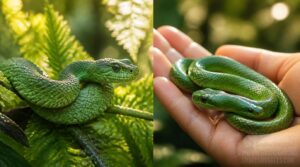
Two green snakes, one question: which is which? Keeled scales mark the rough green snake (Opheodrys aestivus); smooth, glossy scales mark Opheodrys vernalis.
| Trait | Rough Green Snake | Smooth Green Snake |
|---|---|---|
| Scales | Keeled, matte | Smooth, glossy |
| Length | 22–32 in | 14–20 in |
| Habitat | Wooded, arboreal | Grassy, ground-level |
Scientific Names and Classification
Names tell the story here. Both snakes belong to genus Opheodrys, but binomial naming splits them by species epithet: Opheodrys aestivus for rough, Opheodrys vernalis for smooth.
| Rank | Rough Green Snake |
|---|---|
| Genus | Opheodrys |
| Species | aestivus |
| Family | Colubridae |
| Code | Zoological |
Each name traces back to a designated type specimen, anchoring identity under nomenclature rules.
Fastest Identification Clues
Run a finger down the back for the quickest test: keeled scales feel ridged, smooth scales glide. Opheodrys aestivus grows longer with a whip-like tail; Opheodrys vernalis stays stockier.
| Clue | Rough | Smooth |
|---|---|---|
| Scale texture | Keeled | Smooth |
| Length | 22-32 in | 14-20 in |
| Tail | Longer | Shorter |
Scale Texture, Size, and Body Shape
Once you get close enough to look past the color, the differences between these two snakes start showing up fast. Scale texture, size, and overall build each tell you something useful, and none of them require special equipment to check. Here’s what to look for, one trait at a time.
Relying on any single feature can mislead you, so it helps to cross-check what you’re seeing against a broader venomous snake identification guide before drawing conclusions.
For a closer look at head shape and coloring side by side, this ball python vs boa constrictor comparison guide breaks down exactly what sets them apart.
Keeled Versus Smooth Scales
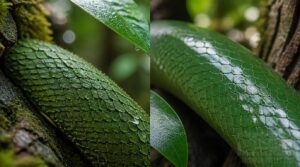
Run a finger down a rough green snake’s back and you’ll feel it: tiny raised ridges called keeled scales, each one catching light unevenly for a duller, matte look. Smooth green snakes lack that ridge entirely—flat, glossy scales reflect light evenly, giving them a shinier sheen. That texture difference isn’t just cosmetic; it affects grip, camouflage, and how each snake interacts with branches, bark, or open grass.
Keeled scales give rough green snakes a matte grip, while smooth green snakes gleam with flat, glossy scales
The scale texture relates to the β-keratin filament formation that underlies reptile scale structure and function.
Length and Body Build

Size comparison tells you plenty before you even check scale texture in snakes. Rough green snakes stretch 22 to 32 inches, occasionally past 40, with a slender, laterally compressed build that’s slender and agile.
Smooth green snakes stay shorter, 14 to 20 inches, with a stockier, almost strong and formidable frame—less sleek and shiny in profile, thicker through the midbody despite the glossy scales.
Tail Proportions
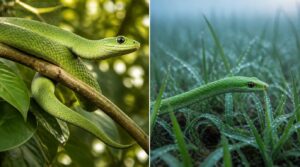
That whip-like tail tells its own story. The Rough Green Snake shows a tail length ratio near 0.25–0.35, its proximal tail thick for climbing power, tapering distally for grip.
The Smooth Green Snake carries a shorter, stockier tail suited to ground sprints. Tail musculature and a 30–40 degree tail angle reflect each species’ arboreal habitat versus grassland lifestyle—built for their insectivore diet’s hunting style.
Head and Eye Size

Look closely and you’ll spot the eyes first. Rough Green Snakes carry larger, more prominent eyes, framed by keeled scales that shadow the socket. Their head width runs proportionally greater, with an angular jaw line tapering toward the snout.
Smooth Green Snakes show a flatter head profile, rounder jaw, and smaller eyes—smooth scales soften the whole face, useful clues in any snake identification guide for bright green snakes sharing arboreal habitat.
Chin and Belly Color
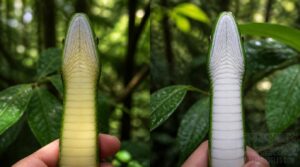
Flip either snake over and the belly tells its own story. Rough Green Snake bellies show a gentle gradient from pale jawline into light yellow, while Smooth Green Snake undersides stay whitish and uniform, chin to vent.
Watch for chin hue variation and seasonal belly tones—shedding or warm months can nudge yellowish, but that gradient contrast remains your best clue.
Range, Habitat, and Climbing Differences

Where you find a green snake often says as much as how it looks. Rough and smooth green snakes split off into different regions, habitats, and even heights above the ground. Here’s how their locations, hideouts, and daily movements set them apart.
Northern Versus Southern Ranges
Where you spot a rough green snake depends heavily on latitude. Northern populations live cooler, shorter-season lives, often at 200–1200 meter elevations, while southern groups across the Piedmont, Coastal Plain, and broader MidAtlantic and Southeast bask through longer, hotter days.
- Northern snakes emerge later, after snowmelt
- Southern snakes stay active nearly year-round
- Elevation zones shift snake behavior north to south
- Thermoregulation drives daily activity in both regions
Grasslands Versus Wooded Edges
Where these snakes settle says a lot about who they are. Smooth green snakes favor grasslands and meadows, soaking up sun and open sky. Rough green snakes prefer shady, layered edge habitats bordering open forests, where shrubs meet grass. That zone, with its mixed microclimate, shapes each species’ camouflage and hunting range differently.
Ground-Level Versus Arboreal Activity
That habitat split plays out in how each snake actually moves. Rough green snakes favor climbing efficiency, using vertical escape routes and canopy foraging for insects. Smooth green snakes stick to soil surface hunting, relying on ground retreat when threatened.
- Rough green snakes: strong ventral grip, branch travel
- Smooth green snakes: leaf litter camouflage, low grasses
- Both: diurnal hunters
- Both: use ground refugia in cool weather
Where Each Species Hides
Grass Hideouts shelter smooth green snakes low to the ground, while rock shelters, cracked bark, and tree edges hide rough green snakes above it.
Both use ground cover—logs, debris, mossy banks—especially along wetland margins. Rough green snakes sleep coiled in shrubs; smooth green snakes press into leaf litter. Seasonal shifts push both toward ground refugia once temperatures cool.
Identifying Backyard Visitors
Finding a green snake near your garden bed or compost pile? Check the scales first: keeled, textured scales mean a Rough Green Snake; smooth, glossy ones point to a Smooth Green Snake. Note the location, too, ground-level in grass suggests the latter, while shrubs or bark favor the former.
Both are nonvenomous, harmless garden snakes, active mostly during daylight hours.
Diet, Behavior, and Reproduction Differences
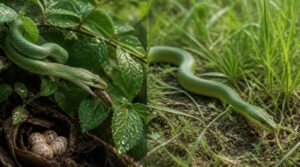
Once you know how each snake looks and where it lives, the next clue is how it makes a living. Diet, hunting style, and reproduction reveal just as much about a snake’s identity as its scales do. Here’s what sets these two apart once you look past their shared green skin.
Shared Insect-Based Diet
Both species share a menu built almost entirely on insects and small invertebrates, making them true insectivorous snakes. Crickets, moths, and caterpillars top the list, providing high-quality protein and beneficial fats.
This diet flexibility helps: as natural pest management, these snakes help curb insect population booms in gardens, meadows, and woodland edges alike.
Unique Prey Preferences
Snails, slugs, and earthworms set smooth green snakes apart at the dinner table, prey rough green snakes rarely touch. Both favor soft-bodied prey and insect larvae, but smooth green snakes work moist wetlands edges for these ground invertebrates.
- Slugs and snails (smooth green snake specialty)
- Caterpillars and larvae (shared favorite)
- Small salamanders (occasional smooth green snake catch)
Seasonal prey shifts favor whatever’s abundant nearby.
Ground Versus Branch Hunting
Where each snake hunts says everything about how it eats. Rough green snakes stay arboreal, stalking vines and bark for prey too big for ground foragers, while smooth green snakes search horizontally through grass and duff. Neither constricts; both grab and swallow live.
Cool snaps send smooth green snakes into ground refugia, safe from chilly winds up top.
Egg Clutch Differences
Egg-laying habits split along expected lines. As an oviparous reptile reproduction strategy, both species deposit eggs in early summer, but clutch size range differs: rough greens usually manage 6-12 eggs, smooth greens 3-12.
Nest site selection favors rotting logs and leaf litter. Maternal health impact matters too—well-fed females lay larger clutches, and larger clutches often mean a hatchling size link to smaller young.
Seasonal Activity Patterns
Warm days rewrite the whole schedule. Both species mate in the spring, favoring sunny 75-85°F windows, then settle into diurnal behavior, active dawn to dusk as photoperiod lengthens.
- Peak courtship: late spring
- Egg-laying: early summer, 3-12 eggs
- Thermal regulation drives afternoon basking
- Prey availability cycles boost summer foraging
- Cooler autumn triggers sheltering behavior shifts
Temperament, Safety, and Pet Suitability
If you’re wondering whether a green snake makes a safe backyard neighbor or a good pet, temperament is the place to start. Both species are calm by nature, but they still have their own quirks worth knowing before you handle one. Here’s what to expect from each, from first encounter to daily care.
Nonvenomous and Generally Shy
Good news if you’re wary of snakes in the yard: both species are nonvenomous and shy by nature, fleeing rather than fighting.
| Trait | Rough Green Snake | Smooth Green Snake |
|---|---|---|
| Temperament | Shy, arboreal escape | Shy, ground escape |
| Human Interaction | Rarely bites | Rarely bites |
| Camouflage | Green blends into leaves | Green blends into grass |
Their instinct favors camouflage and quick retreat over confrontation.
Defensive Responses
A startled green snake rarely bites first. Both species raise the head into an alert S-shaped posture, freeze against foliage, and rely on camouflage before anything else.
If pressure continues, expect a bluff strike or tail vibration against leaves, mimicking bigger threats. These displays fade fast in yards where the same snake meets familiar footsteps repeatedly.
Handling Tolerance
That bluff-strike phase, once it passes, opens a window for calm handling—if you read the snake correctly.
Rough green snakes need gentler support and shorter sessions; their skin startles fast. Smooth green snakes tolerate brief handling better when calm. Watch for tongue flicking or gaping—stress signals meaning stop. Individual variation is real: some snakes recover in minutes, others need days before trying again.
Captive Feeding Challenges
Handling stress often carries over into feeding, so the two challenges rarely stay separate. Both species can refuse unfamiliar prey, and their fast metabolism demands frequent, precisely timed meals. Enclosure temperature and humidity must stay within tight ranges, or capture success drops.
A limited prey spectrum also risks nutritional imbalance, so reptile enthusiasts should rotate insect sources thoughtfully.
Species-Specific Care Needs
Once feeding is dialed in, care diverges by species. Rough green snakes need higher humidity regulation and moist substrate to protect keeled scales; smooth green snakes tolerate drier air but want a wider temperature gradient, 78–88°F, with roomier vertical enclosure setup. Both need daily water access, correct prey sizing, and UVB exposure.
Given habitat loss, consider wildlife rehabilitation advice before collecting wild individuals.
Frequently Asked Questions (FAQs)
Are rough green snakes aggressive?
For a snake with such a fearsome name, this one’s remarkably gentle. Rarely aggressive, rough green snakes prefer camouflage and quick retreat over confrontation—biting only happens under real handling stress, when firmly grasped or cornered with no escape route.
What is the friendliest green snake?
Both species share gentle, shy temperaments, but rough green snakes edge out as friendlier — their arboreal calm and tolerance for slow, infrequent handling make them more approachable for patient beginners than their ground-dwelling, equally timid smooth cousins.
Are smooth green snakes harmless?
Small and mighty, yet gentle: yes, they’re harmless nonvenomous snakes. They rarely bite, rely on camouflage and fleeing, and pose no real bite risk—making backyard encounters safe while they quietly help with pest control.
How can I tell the two species apart in the wild?
Run a finger down the back for a scale texture check—keeled feels ridged, smooth feels glossy. Compare size, body shape, eye prominence, and chin color wash too; these quick clues reveal true snake identification despite similar camouflage adaptation.
Are there any differences in the lifespan of these two species?
Not much separates them, actually. Both average 4 to 6 years in the wild, occasionally reaching 7 to 8, with habitat stress, prey access, and genetic diversity driving most variation more than species identity does.
Are there any notable behavioral differences between the two snake species?
Yes. Rough greens show quicker alertness and bold escape tactics, even tail pumping when threatened, while smooth greens rely on quiet camouflage, calmer handling tolerance, and looser social behavior, favoring ground refugia over branch-climbing during cool weather.
How long do green snakes live?
Like a candle burning at different rates, wild green snakes flicker out fast: rough green snakes last 6-8 years, smooth green snakes 4-6, while captives, sheltered from predators, often double that.
When do green snakes mate and reproduce?
Rough greens breed April through June; smooth greens mate May through July. Females lay 3 to 12 eggs, hatching in 27 to 30 days, usually one clutch yearly, though warm climates sometimes allow two.
Are green snakes venomous or dangerous?
Neither species carries venom. Both are completely nonvenomous and harmless to humans, rarely biting unless handled roughly. True danger comes from misidentifying venomous lookalikes elsewhere, so learning local species keeps backyard encounters calm and safe.
What predators hunt green snakes?
Hawks, herons, and owls hunt from above, while raccoons, foxes, and cats stalk from the ground. Larger snakes, big spiders, and even centipedes add pressure—habitat loss only narrows a green snake’s cover and safety margin further.
Sourcing a captive-bred individual from a reputable California red-sided garter snake breeder keeps both the hobbyist and the wild population on the right side of state law.
Conclusion
Two rows of scales, one keeled and one smooth, hold nearly every clue you need. Rough green snakes stretch to 45 inches and hunt low grass; smooth green snakes stay slimmer and climb shrubs after spiders.
Whats the difference between rough and smooth green snakes? Mostly texture under your thumb, not temperament. Both remain gentle, harmless neighbors in your garden. Once you’ve felt that ridge or that polish, you’ll never mistake one for the other again.