This site is supported by our readers. We may earn a commission, at no cost to you, if you purchase through links.
A hatchling ball python weighs less than a AA battery and can suffer a fatal impaction from a single wrong bedding choice. That risk sits at the center of every enclosure decision you’ll make in a neonate’s first year, long before feeding schedules or heat gradients matter.
Skin sensitivity, humidity swings, and substrate ingestion drive most early health complications veterinarians see in juvenile snakes. The right reptile substrate for baby snakes isn’t a matter of preference; it’s a variable that directly shapes hydration, shedding quality, and gut safety.
What follows breaks down which materials earn their place in a neonate enclosure, which ones carry hidden risks, and how to set up bedding that helps rather than threatens a young snake’s development.
Table Of Contents
- Key Takeaways
- Best Substrates for Baby Snakes
- Top 6 Baby Snake Substrates
- How to Choose Safe Bedding
- Setting Up Baby Snake Substrate
- Cleaning and Replacing Substrate
- Frequently Asked Questions (FAQs)
- What is the best bedding for baby snakes?
- What substrate can you use for snakes?
- What substrate for juvenile ball pythons?
- What is the best substrate for a children’s python?
- How often should baby snake substrate be misted?
- Can different substrates be mixed in one enclosure?
- Is heating tape safe under naturalistic substrates?
- How does substrate choice affect snake enclosure odor?
- Conclusion
Key Takeaways
- Neonate snakes require substrates matched to species-specific humidity needs, since delicate skin and developing respiratory systems make hydration, shedding quality, and gut safety directly dependent on bedding choice.
- Paper towels and unprinted newspaper are the safest options for hatchlings and quarantine setups, while coconut husk, coconut fiber, aspen, and cypress mulch suit longer-term housing based on each species’ humidity and burrowing requirements.
- Pine and cedar substrates must always be avoided due to aromatic terpenes and thujone content that cause respiratory irritation and potential liver toxicity in young snakes.
- Preventing impaction depends on controlling particle size, capping substrate depth at three inches, isolating feeding areas, and maintaining a consistent cleaning schedule—daily spot cleaning, weekly replacement for aspen, and deep cleaning every three to six months.
Best Substrates for Baby Snakes
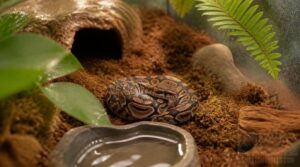
Choosing the right substrate for your baby snake means balancing hygiene, humidity, and safety all at once. Not every option works for every species or stage of life, so knowing your choices matters. Here are five substrates worth considering, each suited to different needs.
If you’re still working out the basics of enclosure setup, our guide to creating the ideal snake terrarium environment covers how substrate choice ties into humidity and temperature control.
Paper Towels for Neonates
Paper towels are still the best option for neonate snakes, since their delicate skin can’t tolerate the oils or dust found in naturalistic bedding.
Choose unscented, thick cellulose towels — they absorb quickly, resist fiber transfer, and dry fast after cleaning. Store them in closed containers to keep bedding free of dust and microbes.
Replace daily; this simple reptile husbandry habit protects fragile skin while keeping humidity monitoring straightforward.
Unprinted Newspaper Option
When towels aren’t available, unprinted newspaper works well for quarantine or short-term neonate housing. Its inkless composition avoids chemical exposure while absorbing moisture quickly and drying fast, supporting basic humidity regulation.
Layer sheets for extra absorbency, replace daily, and you’ve got sanitary, cost-effective quarantine bedding—ideal for reptile husbandry on a budget, though it shouldn’t serve as a long-term sole substrate.
Coconut Husk for Humidity
Once you need more than a quick quarantine fix, coconut husk becomes the standout choice for humidity regulation. Its hygroscopic fibers buffer moisture, releasing it slowly for microclimate stability.
- Damp, earthy fiber holding gentle warmth
- Tiny aeration voids letting air move
- Soft texture cushioning a coiled hatchling
- Slow-drying layers preventing fungal blooms
- Steady dampness easing shedding troubles
This natural coconut husk is sourced from sustainable plantations to guarantee high quality. This substrate moisture retention suits serious exotic pet care.
Aspen for Dry Species
Some species, like ball pythons, thrive in drier microclimates where coconut husk’s dampness works against them. Aspen shavings are non-toxic, free of the aromatic oils found in cedar or pine, though dustier than fiber substrates—ventilate accordingly.
Expect weekly replacement to curb mold and odor. Depth matters too: a few inches allows for light burrowing, unlike flat paper options, for hatchlings seeking cover.
Coconut Fiber for Burrowing
For hatchlings that dig rather than hide, coconut fiber earns its keep. Derived from coconut husk, it offers a soil-like texture ideal for burrowing animals, with a neutral pH (6.0–7.5) that won’t irritate skin.
It’s highly absorbent, supporting humidity retention while resisting compaction—preserving tunnel stability and gas exchange below the surface. Compressed bricks expand a lot once hydrated, a convenient trait for setup.
Top 6 Baby Snake Substrates
Choosing the right bedding gets a lot easier once you can compare real products side by side. Here are six substrates worth knowing, each suited to different species, humidity needs, and care routines. Take a look at what makes each one work.
1. Zoo Med Aspen Snake Bedding
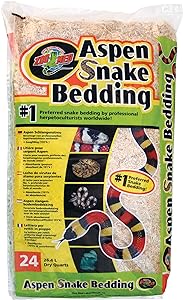
Zoo Med’s aspen bedding earns its spot through a 191% absorbency rating paired with a low-dust, 99.9% dust-free formula—critical for young snakes’ developing respiratory systems.
Made from renewable aspen wood without cedar or added oils, it stays odorless while supporting burrowing behavior. The 24-quart bag suits enclosures for snakes, lizards, and tortoises alike.
Spot cleaning is straightforward, though waste-heavy setups demand more frequent attention. For drier-climate species, this substrate offers a soft, naturalistic base without the toxic aromatics found in pine or cedar shavings.
Lifting hides regularly and spot-checking beneath damp areas, as outlined in this guide to spot cleaning snake substrate effectively, keeps bacterial buildup in check between full enclosure changes.
| Best For | This bedding is best for reptile and small mammal owners—including keepers of snakes, lizards, tortoises, turtles, birds, and tarantulas—who want a natural, low-dust substrate that supports burrowing and nesting. |
|---|---|
| Material Type | Aspen Wood |
| Moisture Handling | High Absorbency |
| Odor Control | Odorless |
| Sustainability | Renewable Wood |
| Weight | 5.4 lbs |
| Reptile Suitability | Snakes, Lizards, Tortoises |
| Additional Features |
|
- Made from renewable aspen wood, with no cedar or toxic oils
- High 191% absorbency rating keeps enclosures drier
- Low-dust formula helps protect respiratory health
- Intended for indoor use only
- May need frequent spot cleaning in high-waste enclosures
- At 24 quarts, larger enclosures may require multiple bags
2. Organic Coconut Chip Reptile Substrate
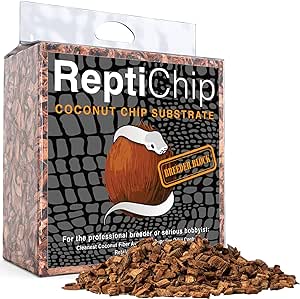
A compressed brick of 100% organic coconut husk chips expands into roughly 72 quarts once hydrated, giving you budget-friendly storage until setup day. The odor-absorbing fibers encapsulate waste effectively, while the dust-free processing protects developing respiratory tracts.
Chips retain humidity without turning soggy, which suits ball pythons and other tropical species needing consistent moisture. You will need to break the block apart manually and adjust water levels species-by-species—there’s no universal soak time that fits every enclosure.
| Best For | This substrate is best for reptile and amphibian keepers housing tropical species like ball pythons, geckos, and tortoises who need consistent humidity and burrowing-friendly bedding. |
|---|---|
| Material Type | Coconut Husk |
| Moisture Handling | High Humidity Retention |
| Odor Control | Odor-Absorbing |
| Sustainability | Compostable |
| Weight | 10 lbs |
| Reptile Suitability | Ball Pythons, Geckos |
| Additional Features |
|
- Expands to a generous 72 quarts, giving great value and compact storage before use
- Odor-absorbing, dust-free chips help encapsulate waste and protect respiratory health
- Retains humidity well without becoming soggy, ideal for tropical enclosures
- Requires manually breaking apart the compressed brick before use
- Hydration and moisture levels must be adjusted per species, with no universal soak time
- Setup takes more prep time compared to ready-to-use substrates
3. Natural coconut husk reptile substrate
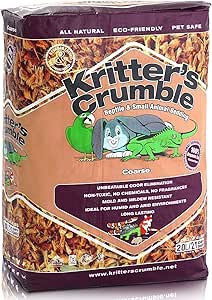
Loose, uncompressed coconut husk fiber offers a ready-to-use alternative when you’d rather skip the soaking-and-expansion step of compressed blocks. Its fibrous matrix promotes airflow while trapping moisture in pore spaces, so humidity stays steady without waterlogging.
Dry processing keeps dust minimal, protecting your snake’s respiratory tract. The clumpy texture that forms when dampened creates natural microhabitats ideal for juvenile burrowing, and spot cleaning remains straightforward since waste sits visibly atop the fibers rather than hiding within compacted material.
| Best For | This loose coconut husk substrate is best for reptile, amphibian, and arachnid keepers who want a natural, chemical-free bedding that works well in both humid and arid enclosures. |
|---|---|
| Material Type | Coconut Husk |
| Moisture Handling | High Absorbency |
| Odor Control | Odor Elimination |
| Sustainability | Biodegradable |
| Weight | 2.24 lbs |
| Reptile Suitability | Reptiles, Amphibians |
| Additional Features |
|
- 100% organic and biodegradable, with no added oils, fragrances, or chemicals
- Traps moisture effectively while still allowing airflow, keeping humidity stable without getting soggy
- Ready to use straight from the bag, no soaking or expanding required like compressed blocks
- Product listing has conflicting details about model and age range, which can make it confusing to shop for
- Any reptile waste needs to be removed before the used substrate can go into garden compost
- Clumpy texture that forms when damp may require more frequent spot-checks to catch hidden waste in humid setups
4. Zoo Med Cypress Mulch Bedding
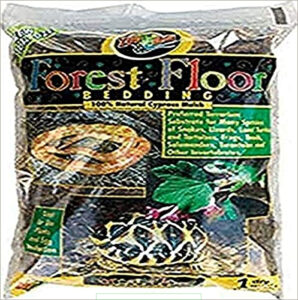
Few substrates capture that forest-floor look quite like this one, and that aesthetic isn’t purely cosmetic—darker, textured chips help skittish neonates feel concealed rather than exposed.
Cypress mulch’s moisture retention helps maintain the 65–75% humidity many tropical species require, with surface layers staying damp while lower depths remain breathable. Available in 8- and 24-quart bags, it suits enclosures of varying sizes. Keep depth around 2–3 inches, stir weekly to prevent odor, and inspect chip size carefully—larger pieces pose ingestion risks if feeding occurs in the main enclosure.
| Best For | Keepers of tropical snakes, lizards, amphibians, tortoises, and tarantulas who need reliable humidity control and a natural forest-floor look for their enclosure. |
|---|---|
| Material Type | Cypress Mulch |
| Moisture Handling | Moisture Retention |
| Odor Control | Not Specified |
| Sustainability | Natural Material |
| Weight | 10.6 lbs |
| Reptile Suitability | Snakes, Lizards |
| Additional Features |
|
- Holds moisture well, making it easy to maintain 65–75% humidity for tropical species
- Natural cypress texture gives a realistic forest-floor look while helping shy neonates feel secure
- Comes in 8- and 24-quart sizes, so it fits enclosures both big and small
- Needs regular upkeep, like weekly stirring, to avoid odor buildup
- Chip size should be checked carefully, since larger pieces can be an ingestion risk during feeding
- Moisture levels need ongoing monitoring rather than a set-and-forget approach
5. Zoo Med Eco Earth Coconut Fiber
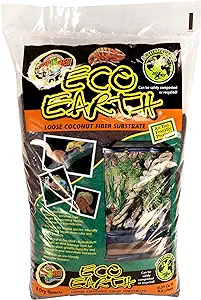
Coir made from ground coconut husk, Eco Earth trades cypress mulch’s chunky texture for a fine, soil-like consistency that’s gentler on burrowing neonates.
Dampened properly, it buffers humidity gradually rather than spiking it, which suits species needing stable 65-75% moisture levels. It absorbs waste odor well between spot cleanings and pairs nicely with drainage layers like HydroBalls in bioactive builds. Available loose or compressed, it’s compostable afterward—though loose bags offer easier day-to-day handling for beginners than bricks requiring rehydration.
| Best For | Eco Earth is best for reptile and amphibian keepers who need stable, gradually buffered humidity for tropical or burrowing species, especially neonates that benefit from a fine, soil-like substrate. |
|---|---|
| Material Type | Coconut Husk |
| Moisture Handling | High Moisture Retention |
| Odor Control | Odor Absorption |
| Sustainability | Compostable |
| Weight | 2.9 lbs |
| Reptile Suitability | Reptiles, Amphibians |
| Additional Features |
|
- Fine, soil-like texture is gentle on burrowing neonates and easy to tunnel through
- Buffers humidity gradually, helping maintain stable 65-75% moisture levels for tropical species
- Absorbs waste odor well between spot cleanings and is fully compostable afterward
- Requires proper dampening before use to perform as intended
- Compressed bricks need rehydration, which is less convenient than loose bags for beginners
- Technical data listing (material and color) is inaccurate or non-descriptive, which can confuse buyers
6. Kempf Compressed Coco Coir Pith
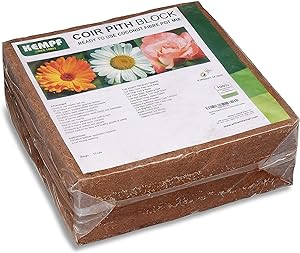
If Eco Earth’s loose bags feel like the easier day-to-day option, Kempf’s compressed brick format suits keepers who want tighter storage and shelf life before use. Each brick expands to roughly 9 quarts—about 2.25 gallons—once hydrated, and holds moisture up to eight times its volume, releasing it slowly to buffer humidity swings.
Purely organic coconut husk fiber, free of synthetic additives, it rehydrates into the same soil-like texture neonates burrow into comfortably, making it a practical peat moss alternative for keepers building custom substrate blends.
| Best For | Reptile keepers who want a compact, long-lasting coco coir option that’s easy to store until they’re ready to build a custom substrate blend. |
|---|---|
| Material Type | Coconut Fiber |
| Moisture Handling | Moisture Retention |
| Odor Control | Odor Absorption |
| Sustainability | Compostable |
| Weight | 9.07 g |
| Reptile Suitability | Burrowing Animals |
| Additional Features |
|
- Compressed brick format saves storage space and keeps well before hydration
- Holds moisture up to eight times its volume, releasing it slowly to help buffer humidity
- Made from 100% organic coconut husk fiber with no synthetic additives
- Requires hydration and breaking apart by hand before use
- Expands to a smaller volume (about 9 quarts) than loose bag alternatives
- Needs a container large enough to manage the expansion process
How to Choose Safe Bedding
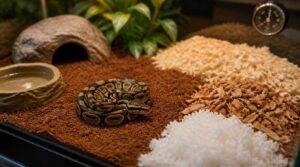
Picking the right substrate isn’t just about looks—it’s a safety decision that affects your snake’s health every day. A few key factors separate a good choice from a risky one. Here’s what you need to check before filling that enclosure.
Match Species Humidity Needs
Get the humidity right before anything else. Species humidity profiles vary widely: tropical pythons want 60–80%, corn snakes prefer 40–60%, desert species need only 20–40%. Use a digital hygrometer at both enclosure ends.
Coconut husk and coconut fiber, both naturally absorbent, hold moisture well for humid species, balancing substrate moisture against your misting schedule and each snake’s natural habitat.
Avoid Pine and Cedar
Once humidity’s dialed in, the next question is what the substrate is actually made of.
Pine and cedar are off-limits, full stop. Both release aromatic terpenes causing respiratory irritation and mucous membrane inflammation in hatchlings. Cedar’s thujone content adds toxicity concerns, affecting liver function with prolonged exposure.
Stick with aspen, coconut husk, or cypress mulch—safer natural substrates, even for the best substrate for ball pythons.
Check Particle Size
Ruling out pine and cedar grips toxicity, but safety doesn’t stop there—particle size matters just as much.
- Fine dust under 1mm risks ingestion
- Coarse pieces over 5mm hinder shedding
- Sieving screens out unsafe fractions
- Even distribution prevents waste-trapping clumps
Aspen, coconut husk, cypress mulch, and coconut fiber all perform well when properly sized—key for the best substrate for ball pythons and consistent humidity retention.
Reduce Impaction Risk
Impaction rarely stems from a single cause; it’s the cumulative effect of texture, depth, and diet exposure. Particle Size Control, Substrate Depth Guidelines, and Feeding Area Isolation work together to keep gut obstruction risk low.
| Risk Factor | Safer Substrate | Action |
|---|---|---|
| Large chunks | Coconut husk, aspen | Sieve fines |
| Contact during meals | Any absorbent bedding | Feed separately |
| Excess depth | Natural substrates | Cap at 3 inches |
Support Health Monitoring
Choosing bedding that reveals health status matters as much as choosing bedding that feels natural. Light-colored sanitary bedding exposes urate consistency and stool frequency instantly—critical for spotting dehydration or parasites early. Pair this with:
- Continuous Monitoring of basking behavior
- Hydration Dashboard checks via water bowl levels
- Temperature Thresholds logged daily
- Sleep Pattern Analysis noting activity shifts
Natural substrates work too, provided waste management stays disciplined.
Setting Up Baby Snake Substrate
Choosing the right substrate is only half the job—setting it up correctly matters just as much for your baby snake’s health. A few key steps make the enclosure safe, functional, and easy to maintain from day one. Here’s what you need to get right when putting it all together.
Start With Quarantine Bedding
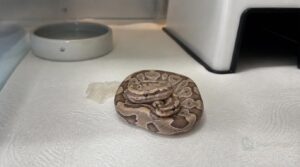
Every new snake deserves its own clean slate before joining the collective. Isolation substrate choice matters here: paper towels or unprinted newspaper work best, letting you track waste and shedding without cross contamination risks. Change bedding weekly, sooner if soiled.
This quarantine setup creates your health monitoring baseline—confirming normal appetite and behavior before any main enclosure move begins.
Add Three-inch Depth
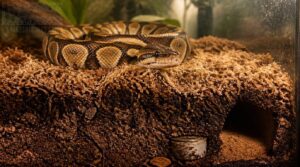
Skimping on depth is the most common mistake new keepers make. Three inches minimum gives you real Depth Benefits: a proper Moisture Gradient (dry surface, moist below), Burrowing Support for natural exploration, Feeding Stability so debris stays buried, and better Health Monitoring overall.
Whether you’ve chosen aspen, coconut husk, or coconut fiber, this depth applies—it’s the current best substrate for ball pythons and other burrowing species alike.
Create a Humid Hide
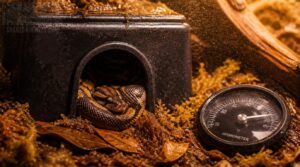
Think of it as a tiny sauna your snake retreats to when its skin feels tight before shedding.
A humid hide is a tiny sauna your snake retreats to when its skin feels tight before shedding
Humid Hide Design: use an opaque container with one smooth entry hole, lined with damp sphagnum moss or coconut fiber.
- Place on the warm side
- Fill 2-4 inches deep
- Mist to raise humidity
- Check with a hygrometer
- Avoid standing water
Target 70-90% humidity—keep it damp, never soggy.
Keep Feeding Areas Clean
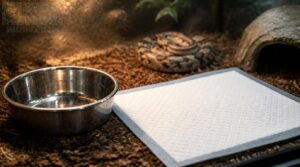
Feeding Surface Sanitization matters more than most keepers realize—leftover prey scent lingers, drawing bacteria straight into your substrate.
| Task | Frequency | Why It Matters |
|---|---|---|
| Spill Mat swap | Each feeding | Blocks cross-contamination |
| Bowl disinfection | Weekly | Builds microbial resistance |
| Deep ventilation check | Monthly | Prevents mold buildup |
Prompt food waste removal and feeding equipment disinfection protect even the best substrate for ball pythons from silent contamination.
Monitor Shedding and Waste
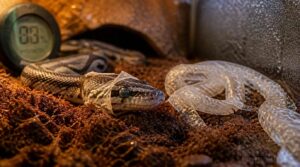
A clean feeding station means little if you’re not watching the snake itself.
Shedding Cycle Tracking tells you when to raise humidity toward 65–75%, since retained skin often signals dehydration. Pair this with Waste Hotspot Mapping—note where droppings cluster, spot checking daily, and swap soiled bedding fast.
Together, these habits catch Scale Retention Check issues and support Impaction Prevention before problems take hold.
Cleaning and Replacing Substrate
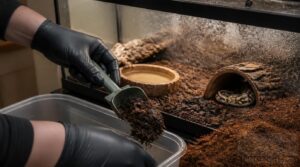
Even the best substrate won’t protect your snake if it isn’t kept clean. A good cleaning routine depends on what material you’re using and how it behaves over time. Here’s what to watch for and how often to act.
Factors like your snake’s activity level and body temperature—explored in depth in this guide on how long snakes can hold their breath—also influence how quickly waste builds up in the enclosure.
Since substrate also plays a role in how snakes regulate their body temperature through coiling, choosing a material that stays dry and odor-free helps support both hygiene and natural behavior.
Spot Clean Waste Daily
Daily spot cleaning keeps snake waste from turning into a bacterial or mold problem, especially in reptile enclosure bedding for neonates. Grab a flashlight, check corners and hides, and remove soiled spots within five minutes.
Wear gloves, use paper towels, and sanitize tools afterward. Health tracking logs noting waste color or frequency help you catch issues early—essential whether you’re raising ball pythons or any humidity-sensitive species.
Replace Paper Towels Often
Spot cleaning buys you time, but full replacement is what actually keeps reptile enclosure bedding safe. Swap paper towels every 3 to 4 days, sooner if soiled by snake waste or humidity buildup.
- Damp, discolored patches
- Lingering odor near hides
- Curling or thinning texture
Frequent towel changes support hygiene compliance while keeping disposal costs and environmental impact reasonably low.
Change Aspen Weekly
Aspen shavings need a full swap every week, not just spot checks, since they hold moisture differently than paper towels.
Unlike coconut husk, aspen lacks anti-microbial properties, so mold sets in fast when humidity climbs for tropical species.
This matters most for keepers replicating habitat replication setups similar to those used for the best substrate for ball pythons, where terrarium maintenance depends on consistent humidity control.
Watch for Mold Growth
Musty odors near the enclosure often signal mold before you ever see it, so trust your nose as much as your eyes.
Humidity above 70%, especially with cypress mulch or coconut husk, invites spores fast. Keep a hygrometer running.
Improve ventilation, fix leaking water bowls immediately, and wear gloves when handling suspect substrate—the same caution ball python keepers apply to prevent respiratory issues.
Deep Clean Every Few Months
Every three to six months, give the enclosure a full reset rather than routine spot cleaning. A Quarterly Maintenance Schedule works well: strip old bedding (aspen, coconut husk, or cypress mulch), run the Substrate Sanitization Process on surfaces, then apply your Humidity Reset Protocol.
This deep clean doubles as Health Check Procedure—inspect for parasites and shedding issues—while cutting odor, since prevention beats masking a musty enclosure later.
Frequently Asked Questions (FAQs)
What is the best bedding for baby snakes?
Bedding down the right choice means weighing hygiene against habitat: paper towel wins for neonates and quarantine, while aspen suits dry-loving species like the best substrate for ball pythons, and coconut husk or cypress mulch retain humidity for tropical hatchlings.
What substrate can you use for snakes?
Your options include paper towel, newspaper, aspen, coconut husk, and cypress mulch. Each varies in moisture retention, particle size, and burrowing opportunities—so match your choice to species needs while minimizing ingestion risks and mold potential.
What substrate for juvenile ball pythons?
Comfort in, humidity held, growth supported: coconut husk remains the best substrate for ball pythons. It balances moisture retention with burrowing opportunities, while paper towel or aspen suit those prioritizing easy health monitoring and simpler substrate rotation.
What is the best substrate for a children’s python?
For children’s pythons, coconut husk or cypress mulch work best—both support moisture retention and mild burrowing. Paper towel suits quarantine setups. Similar to the best substrate for ball pythons, prioritize humidity control and low ingestion risk over aesthetics.
How often should baby snake substrate be misted?
Once daily suits humid setups; drier climates need twice-daily misting. Match frequency to substrate moisture retention—coconut husk holds humidity longer than aspen. Increase misting during shedding, but avoid over-misting, which invites mold and respiratory risk.
Can different substrates be mixed in one enclosure?
Yes—variety creates stability. Layered substrate zones pair coconut husk’s moisture retention with drier aspen or paper towel patches, forming a humidity gradient that prevents impaction, provided feeding area separation keeps particles away from a ball python’s strike zone.
Is heating tape safe under naturalistic substrates?
Only with proper insulation barriers—naturalistic substrates like coconut husk or cypress mulch can trap heat unevenly.
Always verify tape placement, inspect regularly for wear, and maintain clearance from flammable, moisture-retentive materials to prevent fire risk or thermal damage.
How does substrate choice affect snake enclosure odor?
Odor management hinges almost entirely on moisture buffering effects: coconut husk and cypress mulch trap and slow-release smells, while dry paper towel dries fast but turns pungent quickly. Aspen offers middle ground, though dust and odor rise together—less ideal than the best substrate for ball pythons.
Conclusion
The choices you make this month will echo through every shed cycle for years to come. Getting the reptile substrate for baby snakes right isn’t a small detail—it’s the foundation your snake’s health rests on.
Skip the shortcuts. Skip the pine, the loose sand, anything that invites impaction. Choose bedding that matches your species’ humidity needs, keep it clean, and watch closely. That quiet diligence, more than any single product, is what carries a hatchling safely into adulthood.