This site is supported by our readers. We may earn a commission, at no cost to you, if you purchase through links.

A newborn boa slides into the world ready to hunt, while a python hatchling cracks out of an egg its mother incubated for weeks by shivering around it nonstop. That single difference tells you these snakes split evolutionary paths some 50 million years ago, one lineage settling in the Americas, the other spreading across Africa, Asia, and Australia.
Confusing boa constrictor vs python is easy. Both ambush prey, both coil with bone-crushing precision, and both can grow long enough to give a first-time owner pause.
But get past the size and the muscle, and you’ll find real, testable differences in anatomy, range, and temperament, the kind that matter if you’re choosing which one to bring home.
Table Of Contents
- Key Takeaways
- Boa Constrictor Vs Python: Key Differences
- Boa Constrictor Vs Python Size and Appearance
- Habitat, Range, and Hunting Behavior
- Reproduction, Development, and Lifespan
- Boa Constrictor or Python: Which Pet Fits You?
- Frequently Asked Questions (FAQs)
- What are the differences between a Boa vs. a Python?
- Does a boa or Python make a better pet?
- What is the difference between a Python and a constrictor?
- What is the difference between a python and a boa constrictor?
- Which is more aggressive, python or boa?
- Who would win boa vs python?
- Is python a constrictor?
- What do boa constrictors eat in the wild?
- How do pythons hunt for their prey?
- What is the lifespan of pythons and boas?
- Conclusion
Key Takeaways
- Boas give birth to live young while pythons lay eggs and coil around them to keep them warm, a split that traces back to two lineages parting ways some 50 million years ago.
- Pythons carry heat-sensing pits along their lips and extra skull bones that boas mostly lack, giving them sharper prey detection in the dark.
- Geography split these snakes for good: boas settled across the Americas while pythons spread through Africa, Asia, and Australia, and their ranges never naturally overlap.
- Boas tend to suit first-time owners better thanks to their calmer temperament and lower costs, while pythons vary widely by species and often demand more experienced handling.
Boa Constrictor Vs Python: Key Differences
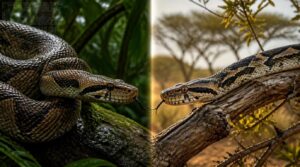
At a glance, boas and pythons can look like the same snake wearing different scales. But once you know what to check, telling them apart gets easy. Here’s what actually sets them apart, point by point.
If snake ID mix-ups worry you, the same careful, feature-by-feature approach works well for other lookalikes, like this guide to spotting the difference between a corn snake and a copperhead.
For a closer look at how heat-sensing pits, tooth count, and color patterns stack up side by side, this detailed guide to python and boa differences breaks it all down.
At-a-Glance Comparison Table
Five traits, one table, zero guesswork. Boa constrictors and pythons split on reproductive methods, size, and range.
| Trait | Boa Constrictor | Python |
|---|---|---|
| Reproduction | Live birth (ovoviviparous) | Egg-laying (oviparous) |
| Size | 6–10 ft, up to 100 lbs | 10–20+ ft, up to 250 lbs |
| Range | Americas | Africa, Asia, Australia |
| Heat sensing | Largely absent | Labial pits present |
| Habitat | Forests, scrublands | Rainforests, wetlands |
When comparing these traits, writers should stick to a single main contribution so readers can quickly grasp the main distinction between the two snakes.
Boa Species Versus Python Family
That table only hints at the real split: one snake, many families. Boa constrictor is a single species, while "python" covers over 40 species under Pythonidae.
| Group | Classification | Species Count |
|---|---|---|
| Boa | Genus Boa | 3 species |
| Python | Family Pythonidae | 40+ species |
| Range | Geographic distribution | Americas vs Old World |
Taxonomy and Evolutionary Relationship
Boidae and Pythonidae split roughly 50 million years ago, each carving its own path through reptile evolution. Both belong to superfamily Henophidia, sharing vestigial pelvic spurs, remnants of ancient hind limbs.
| Trait | Boidae | Pythonidae |
|---|---|---|
| Skull bones | Simpler | Supraorbital present |
| Pelvic spurs | Smaller | More prominent |
| Teeth | Premaxillary present | Absent |
New World Versus Old World
Geography splits these two groups as sharply as their skeletons do. Boa constrictors trace their biogeographic origins to the New World, while pythons stayed rooted in the Old World.
| Region | Snake |
|---|---|
| New World | Boa constrictor |
| Old World | Python |
| Divergence driver | Climate influence |
That continental split shaped separate habitat preferences over millions of years.
Live Birth Versus Egg-Laying
Where geography splits these snakes apart, biology seals the deal. Boas practice viviparous reproduction, birthing 25 live young after 100-120 days. Pythons lay eggs, then coil around clutches, shivering to warm them.
Despite a persistent myth, snakes don’t give birth through their mouths, and hatchlings from both groups emerge ready to hunt almost immediately.
This egg-guarding behavior also determines hatchling sex, a temperature-driven process explored in why snakes are more active after dark.
| Trait | Boa | Python |
|---|---|---|
| Mode | Live birth | Egg-laying |
| Gestation | 100-120 days | Incubation |
| Neonates | Independent instantly | Hatch, then roam |
Boa Constrictor Vs Python Size and Appearance
Size is often the first thing people notice, but it’s not the whole story. Boas and pythons differ in build, coloring, and even the fine details of their skulls and scales. Here’s what actually sets them apart when you look closely.
Adult Length and Weight Ranges

Numbers tell the real story here. Boas run 10 to 16 feet, 15-70 pounds; pythons stretch further, 10-20 feet, 20-100+ pounds.
| Species | Wild Length | Weight |
|---|---|---|
| Boa constrictor | 10-16 ft | 15-70 lbs |
| Reticulated python | 20+ ft | 100+ lbs |
| Ball python | 3-4 ft | Under 10 lbs |
Captive specimens often stay smaller, proof that growth rates bend to habitat, not just genetics.
Body Shape and Sexual Dimorphism
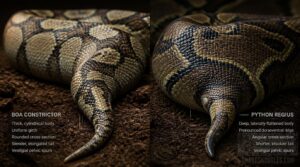
Pick up a boa and a python side by side, and shape tells you plenty before you even check the tag. Boas run thick and cylindrical; pythons show more dorsoventral depth.
| Trait | Males | Females |
|---|---|---|
| Tail length | Longer | Shorter, stockier |
| Body girth | Slimmer | Broader (egg-bearing) |
| Vestigial pelvic spurs | Larger | Smaller |
Color Patterns and Markings
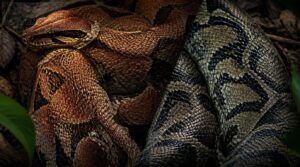
Color is where identification gets fun. Boas wear warm, earthy tones: tan to reddish-brown grounds broken by dark saddle-shaped blotches running the spine. Pythons trend cooler and sharper, olive or gray with black-edged patches forming chain-like or reticulated networks.
Look closer and you’ll spot head and neck markings too: a dark eye stripe, sometimes a faint collar separating skull from body pattern.
| Feature | Boa Constrictors | Pythons |
|---|---|---|
| Ground Color | Reddish-brown, tan | Olive, gray, yellow |
| Pattern Style | Saddles, blotches | Chain-like, reticulated |
| Geographic Influence | New World warmth | Old World, region-specific |
Color shifts with age, shedding, and habitat, aiding camouflage and identification alike.
Heat-Sensing Pits and Head Scales
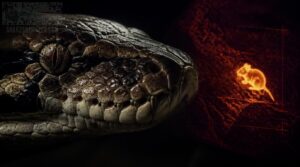
Ever wonder how a python finds prey in pitch dark? Labial pits along its lip scales sense infrared, detecting heat as tiny as 0.003°C. Boas mostly lack these.
| Feature | Boas vs Pythons |
|---|---|
| Heat Pits | Absent vs Present |
| Detection | Limited vs Infrared |
| Skull | Simpler vs Supraorbital bones |
| Head Scales | Smooth vs Fragmented |
Teeth, Skull Bones, and Spurs
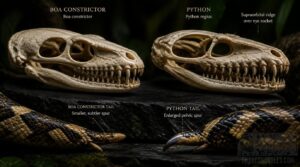
A boa’s grip and a python’s grip come from surprisingly different hardware. Both rely on backward-curved teeth locking prey in place, but python skulls carry extra supraorbital bones boas lack, and pelvic spurs, those vestigial hind limb remnants, sit larger and more visible on pythons.
| Trait | Boa | Python |
|---|---|---|
| Skull bones | Simpler joining | Supraorbital present |
| Spurs | Smaller | Larger, visible |
| Teeth | Curved, replacing | Curved, replacing |
Habitat, Range, and Hunting Behavior

Where a snake comes from shapes almost everything about how it lives and hunts. You’ll see that boas and pythons took very different paths, from continents apart to the way they stalk a meal. Here’s what sets them apart, region by region and habit by habit.
Native Ranges and Climate Zones
Geography draws the clearest line here. Boas claim the New World, ranging from southern Texas through Central America into northern Argentina. Pythons rule the Old World: Africa, Asia, and rare Mediterranean pockets of Europe.
Both favor tropical wet and dry zones, savannas, and wetlands near river basins, but this fifty-million-year geographic isolation shaped two families built for similar climates through entirely separate paths.
Preferred Habitats and Adaptations
Within those ranges, both snakes lean on the same toolkit: tropical forests, savannas, and wetlands offering dense cover for ambush hunting.
- Thick, muscular bodies for powerful constriction
- Ground and tree movement to stalk prey
- Heat-sensing mouth pits for low-light detection
- Camouflage scales blending with leaf litter and bark
These traits make both families formidable ambush predators, built for stillness before the strike.
Ambush Hunting and Constriction
Patience is the real weapon here. Both snakes stay motionless until prey wanders close, then strike with split-second precision.
Once teeth grip flesh, coil tension control takes over: loops tighten around the thorax, restricting breathing first. Muscular contraction rhythm syncs with each struggle, gradually secure until movement stops.
Prey Choices and Feeding Habits
Once the coils relax, the real work begins: digestion. Both snakes target warm-blooded prey, sized to their own girth.
- Prey weighs 1-6% of body weight
- Hunting peaks at dusk and night
- Feeding frequency drops as snakes mature
- Dry seasons shift diets toward small mammals
Juveniles eat weekly; adults may wait a month between meals.
Native and Invasive Populations
Where a boa lives naturally rarely matches where it ends up causing trouble. Native range runs from southern Mexico to northern Argentina, but escaped or released pets have built invasive populations across Caribbean islands and Pacific regions.
Once established, they trigger real ecological impact: displacing native snakes, hammering bird and mammal numbers, and forcing costly control programs.
Reproduction, Development, and Lifespan
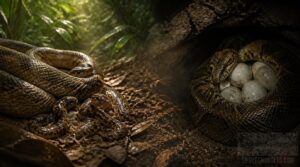
How a snake enters the world says a lot about its biology, and boas and pythons couldn’t take more different paths. One gives birth to live young, the other guards a clutch of eggs, and that split shapes everything from birth size to how long you might expect one to live in your care.
Here’s what actually separates them, from the first days of life through the years ahead.
Live Young Versus Egg Clutches
Here’s the split that matters most: boas are ovoviviparous, giving birth to live young, while pythons are oviparous, laying eggs. That single trait shapes everything downstream, from litter size variation to newborn independence level.
If you’re weighing which suits you better, this guide to the difference between a python and a boa breaks down what live birth versus egg-laying means for keepers.
Both offer zero parental care after birth or hatching. No brooding, no feeding, no guidance. Every hatchling and neonate is on its own from day one.
Gestation and Egg Incubation
Time works differently for each snake. Boa constrictors carry young through a gestation period of 100 to 120 days, then deliver live young, fully formed and ready to move.
Pythons take a different route. After laying eggs, females coil around the clutch, shivering to hold incubation temperature steady until hatching, weeks of quiet, deliberate effort with zero parental care afterward.
Litter and Clutch Sizes
Numbers tell their own story here. Boas, being ovoviviparous, average 25 live young per litter, ranging 10–65. Pythons, laying eggs instead, vary wildly by species.
- Boa constrictor: 10–30 newborns
- Boa imperator: 12–40 offspring
- Reticulated python: 25–50 eggs
- Small python species: as few as 1 egg
Maternal condition and food availability drive clutch size variation year to year.
Newborn Size and Independence
Born or hatched, newborn constrictor snakes hit the ground running, almost. Neonate weight ranges from 25 to 150 grams, and hatchlings measure 12 to 18 inches regardless of whether mom laid eggs (oviparous) or gave live birth (ovoviviparous).
Independent locomotion onset happens within one to two weeks, alongside the first feeding timeline and an early initial shedding phase, all temperature-dependent milestones every captive breeding program tracks closely.
Captive Lifespan and Health Risks
A well-kept boa or python can outlive a family dog by decades, some pushing past 40 years. Lifespan factors include stable husbandry, quality diet, and consistent vet care.
A well-kept boa or python can outlive a family dog by decades, some living past 40 years with proper care
Watch for:
- Wheezing or lethargy (respiratory infection)
- Sudden weight loss (parasites, poor feeding)
- Retained shed (low humidity)
- Loss of appetite (Inclusion Body Disease, stress)
Quarantine new snakes and reduce stress through proper enrichment. Prevention beats treatment every time.
Boa Constrictor or Python: Which Pet Fits You?
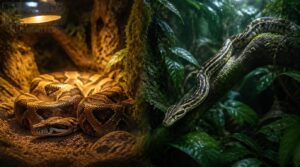
Choosing between a boa and a python comes down to more than looks. Temperament, space, and long-term costs all shape which snake fits your life. Here’s what you need to weigh before deciding.
Boa Temperament and Handling Needs
If calm handling is a language, boas speak it fluently once trust builds. Support their full body, approach from the side, and skip short daily sessions until they settle. Watch for hissing or tail thrashing, those are your cues to stop. Avoid handling near feeding time or shedding. Genetics and early socialization shape temperament, so patience pays off.
Python Temperament by Species
Boas aren’t one-size-fits-all, and neither is python temperament. Ball python stays calm and is easy to handle. Burmese python runs skittish with new setups. Indian python stays shy but warms up over time. Carpet python shows genuine curiosity, while green tree python guards its space, needing patience before it relaxes around you.
Enclosure Space and Climate Needs
Personality aside, your setup has to earn its keep. A boa or python needs floor space 2-3 times its length, warm and cool zones (32-34°C basking, 24-28°C cooler side), and humidity around 50-70%.
Get this wrong and you’ll see:
- Stress-driven refusal to eat
- Respiratory illness from poor humidity
- Burns from unshielded heat sources
Feeding and Veterinary Costs
A good enclosure only controls half the budget. Food and vet care shape the rest, and boas run cheaper: about $560 yearly versus higher python costs tied to species and size.
| Expense | Boa | Python |
|---|---|---|
| Annual food | $560 | $130-$400+ |
| Routine vet | $500 | $200-$400 |
| Insurance | $198/yr | $180-$240/yr |
Emergencies push costs past $1,000 fast, so insurance matters more than it seems.
Best Choice by Experience Level
Match the snake to your skill, not your wish list. First-timers do best with a boa constrictor, thanks to steadier temperament by species and easier handling safety.
- Beginners: boa constrictor
- Intermediate: manageable enclosure size needs
- Experienced: python morphs, larger space
- Priority: handling safety tips matter
- Commit: 20-30 year lifespan commitment
Frequently Asked Questions (FAQs)
What are the differences between a Boa vs. a Python?
Two skeletal blueprints, two destinies. Skull anatomy splits them first: pythons carry extra bones and heat-sensing pits boas mostly lack. That single divergence echoes outward, shaping reproduction method, geographic origin, and size comparison between these constriction specialists.
Does a boa or Python make a better pet?
Your answer hinges on experience and care difficulty. Boas forgive rookie mistakes and suit beginners. Pythons demand precise enclosure space, strict humidity, and larger feeding schedules, rewarding experienced keepers with striking species diversity and constriction power.
What is the difference between a Python and a constrictor?
Think of "constrictor" as a job title, not a family name, like calling someone "a doctor" without saying which specialty. Pythons hold that job too, but diverge from boas in taxonomy (Pythonidae vs Boidae), heat sensing, and oviparous reproduction.
What is the difference between a python and a boa constrictor?
Family tells the story: Boidae versus Pythonidae. Boas give live birth in the Americas, while pythons practice oviparous reproduction across Africa, Asia and Australia, using heat-sensing pits, bigger spurs, and extra skull bones pythons possess.
Which is more aggressive, python or boa?
Neither snake hunts for trouble. Temperament matters more than species, though large pythons can deliver a more forceful defensive strike when cornered, while boas usually just coil, hiss, and hold their ground.
Who would win boa vs python?
In pure size matchups, larger pythons usually win thanks to greater mass and constriction strength. Reticulated or Burmese pythons can overpower boas easily, though wild encounters between these species almost never happen since their native ranges never overlap.
Is python a constrictor?
Yes. A python is a true constrictor, coiling around prey and squeezing until breathing stops. It keeps breathing itself throughout, injects no venom, then swallows its meal headfirst once the prey stops moving entirely.
What do boa constrictors eat in the wild?
Your boa relies on ambush tactics, targeting warm-blooded prey like rodents, birds, and opossums.
Diet shifts geographically and seasonally, with rainy months bringing more feeding opportunities.
Prey size grows with age, and constriction remains the kill method every time.
How do pythons hunt for their prey?
A python waits motionless, letting heat-sensing pits locate warm prey in total darkness. It strikes fast, then coils tight, using muscle contractions timed to each exhale until breathing stops entirely.
What is the lifespan of pythons and boas?
Picture a snake outliving the dog that once feared it. In the wild, predation and habitat loss cap most at 10-20 years, but with steady enclosure size and health monitoring, captive boa constrictors and pythons often reach 25-30+ years.
Conclusion
Nobody actually needs a nine-foot snake to feel powerful, yet here you’re, still reading. That’s fine.
The real answer to boa constrictor vs python was never about size, it’s about honesty. Can you handle live birth versus egg tending, docile coils versus a reticulated python’s attitude problem? Your climate, your space, and your nerves decide this, not internet debates. Pick the snake that matches your life, not your ego, and you’ll own one for decades.