This site is supported by our readers. We may earn a commission, at no cost to you, if you purchase through links.

Picture a mother python coiled tight around her clutch, barely moving for weeks. It looks like devotion—maybe even feeding. But nothing passes between her body and those eggs except warmth.
So do snakes nurse their young? The answer is no, and the biology behind it explains a lot. Snakes never evolved mammary glands, so lactation isn’t just rare in this group—it’s anatomically impossible from the start.
Instead, hatchlings arrive with their own built-in food supply: a yolk sac. What happens next reveals just how independent baby snakes really are from their very first breath.
Table Of Contents
- Key Takeaways
- No, Snakes Do Not Nurse Their Young
- Why Can’t Snakes Produce Milk?
- How Do Baby Snakes Feed?
- Do Mother Snakes Provide Parental Care?
- Common Snake Nursing Myths Debunked
- Frequently Asked Questions (FAQs)
- How long does a mother snake stay with her babies?
- How long do you have if a baby rattlesnake bites you?
- Do snakes have feelings for their babies?
- Do snakes recognize their siblings?
- Do any snake species show maternal protection?
- How long do baby snakes stay together?
- What predators threaten newborn snake survival?
- Do snakes recognize their own offspring?
- Can baby snakes survive without parents?
- How long do baby snakes stay near their mother?
- Conclusion
Key Takeaways
- Snakes can’t nurse their young because they never evolved mammary glands, making milk production biologically impossible rather than just rare.
- Hatchlings survive on a built-in yolk sac for early nutrition, then hunt and fend for themselves within hours or days of birth, with no lessons needed.
- Behaviors like python egg-brooding or cobra nest-guarding look like nurturing but are really about temperature control and predator defense, not feeding.
- "Snake milking" actually refers to venom extraction for antivenom research, a common mix-up that fuels the nursing myth.
No, Snakes Do Not Nurse Their Young
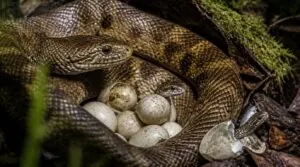
Let’s clear up one of the most persistent myths in the snake world right away. Snakes simply aren’t built for nursing, no matter how much their care instincts might resemble it. Here’s exactly why that’s true, broken down into three key points.
For the full biological breakdown of why snakes can’t nurse their young, it comes down to their total lack of mammary tissue in the first place.
Snakes Never Produce Milk
Snake milk sounds like something out of folklore, and that’s because it is. Snakes don’t nurse their young—not once, not ever. There’s no udder, no droplet, no dairy-style secretion anywhere in their biology.
Reptile lactation simply doesn’t exist. Snakes lack mammary glands entirely, so the hormonal pathways mammals use to make milk never evolved. No glands, no milk—it’s that straightforward. They rely on yolk reserves and immediate independent feeding for survival. Learn about snake feeding behavior
Nursing Requires Mammary Glands
Milk demands actual machinery: lobes, lobules, and alveolar cells that make secretions under prolactin’s direction. Nipples with ductwork channel that fluid outward.
Snakes lack mammary glands entirely—no tissue, no hormonal cascade, no structure capable of producing snake milk. Without that architecture, reptile lactation stays biologically impossible. It’s not behavioral neglect; it’s anatomy. Snakes don’t nurse their young, full stop.
Instead, hatchlings emerge fully self-sufficient, drawing on leftover yolk reserves before instinct alone drives them to hunt, a strategy explored in why snakes never nurse their young.
Protection is Not Nursing
Watching a python coil around her clutch, you might assume something maternal—even nutritive—is happening. It isn’t.
That’s nest guarding behavior, not feeding. Mothers manage:
- Thermoregulation for eggs, shivering to hold steady heat
- Predator deterrence tactics through defensive maternal posturing
- Communal brooding strategies among unrelated females
Protection ensures survival. Snakes don’t nurse their young—lacking mammary glands guarantees offspring independence remains standard reptile behavior.
Why Can’t Snakes Produce Milk?
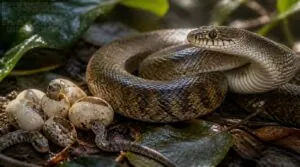
Understanding why milk is off the table for snakes means looking at biology, not behavior. It’s less about what mother snakes choose to do, and more about what their bodies simply can’t. Here’s what actually separates them from every nursing mammal you’ve ever known.
Snakes Lack Mammary Tissue
Here’s the anatomical reality: snakes lack mammary glands entirely, so reptile lactation is a myth, not a hidden trait.
| Trait | Snakes |
|---|---|
| Mammary tissue | Absent |
| Milk production | Impossible |
| Nursing behavior | None |
This evolutionary milk loss predates snake ancestry itself. Without glandular tissue, snake milk simply can’t exist—snakes don’t nurse their young, period.
Instead, hatchlings rely on instinct alone, hunting tiny prey almost immediately—here’s a closer look at what newborn snakes actually eat in their first days of life.
Reptile and Mammal Differences
Since snakes and mammals split evolutionary paths millions of years ago, their biology diverged sharply—explaining why reptile lactation never developed.
- Thermoregulation: cold-blooded vs. warm-blooded
- Skin: dry scales vs. insulating fur
- Heart: three chambers vs. four
- Brain: simpler cortex vs. complex processing
- Senses: heat-pit detection vs. tactile reliance
These differences confirm snakes don’t nurse their young; they simply lack mammary glands, making snake milk biologically impossible.
No Milk-Like Secretions
Here’s a myth worth squashing outright: snake skin doesn’t ooze anything nourishing. That shed, oily film? Just keratin and lipids for waterproofing—not a milk substitute. No glands, no secretions, no exceptions. Reptile lactation simply doesn’t exist, full stop.
Snakes don’t nurse their young because they lack mammary glands entirely, and no evolutionary workaround ever filled that gap.
Yolk Provides Early Nutrition
Forget milk—embryos run on yolk sac nourishment, packed with lipids, proteins, and minerals for tissue growth.
- Lipids fuel energy
- Proteins build tissue
- Carbs power early cell division
- Minerals support bone development
Transport proteins shuttle these nutrients straight to the embryo, sustaining it through incubation until hatchling yolk reserves carry it those first independent days.
How Do Baby Snakes Feed?
So if a mother’s milk is off the table, how does a newborn snake actually get its first meal? The answer says a lot about how tough and self-sufficient these animals are from day one. Here’s what really happens in those first hours and days of a snake’s life.
Short-Term Yolk Reserves
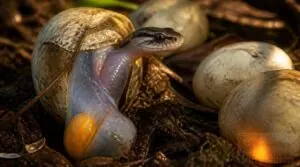
Before that first strike or slither, a hatchling snake is already running on stored fuel: vitellogenic yolk absorbed before birth. This yolk sac nourishment carries lipids and proteins, fueling the growth initiation phase during those first vulnerable days.
Nutrient transfer efficiency depends on incubation temperature, meaning yolk dependency isn’t uniform—it’s a metabolic support function bridging birth and independent hunting.
Independent Feeding From Birth
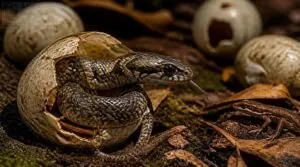
No mother snake sticks around to teach table manners. From the moment they emerge, hatchlings are self-sufficient neonates, drawing on yolk nutrients while locating and capturing prey solo. There’s no waiting period, no supervised practice runs.
Immediate prey capture isn’t optional—it’s survival. Maternal instincts simply don’t extend to feeding lessons here; independent feeding from birth is the rule, full stop.
Instinctive Hunting Behaviors
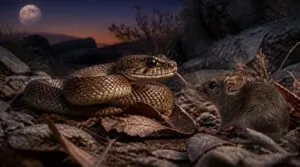
Nobody hands a hatchling a hunting manual—yet it strikes like a seasoned predator within hours. Heat-sensing pits detect warm bodies, while scent trails and vibrations fill in the gaps.
Hunting relies on:
- Ambush strike timing
- Concealment and patience
- Prey-size assessment
- Predator avoidance instincts
These aren’t learned skills. They’re hardwired, ensuring neonate survival through immediate, independent foraging from the very first hunt.
Venom and Constriction Abilities
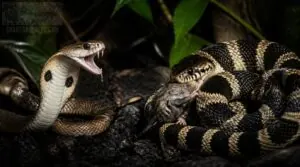
Fangs work from birth—no maternal instincts required, no lessons needed. Venom potency varies by species, sometimes exceeding adult levels per milligram.
| Method | Mechanism | Example |
|---|---|---|
| Venom | Neurotoxic/hemotoxic injection | Cobras |
| Constriction | Blood flow compression | King snakes |
| Combined | Rare hybrid strategies | Some vipers |
Fang structure diversity and constriction force enable independent survival immediately—proof snakes don’t nurse their young.
Species-Appropriate Whole Prey
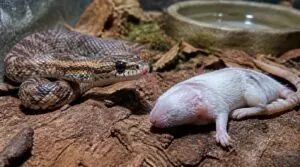
Once fangs and coils prove useless without food, snakes turn to whole prey—size-matched to a hatchling’s girth so it swallows safely. This delivers complete nutrition: bone, organ, blood, no supplements needed. Seasonal and frozen options keep feeding consistent year-round.
Handled properly, whole prey completes what yolk started, proving again that offspring independence, not maternal care, defines snake survival.
Do Mother Snakes Provide Parental Care?

So no milk, no nursing—but that doesn’t mean mother snakes ignore their eggs or young entirely. Some species show surprising dedication, guarding nests or coiling protectively for weeks at a time. Here’s what real snake parental care actually looks like, species by species.
Python Egg Brooding
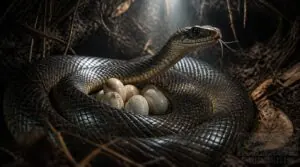
When female pythons wrap around their clutch, they’re running a living thermostat. This postural adjustment pattern shifts with humidity: tight coiling conserves heat and moisture, looser wraps allow better embryo gas exchange. It’s a real tradeoff.
Brooding costs her dearly—up to 30% body mass lost through maternal fasting effects over 50-80 days. That’s dedication, not nursing.
A brooding python may lose up to 30% of her body mass over 50-80 days—dedication, not nursing
King Cobra Nest Guarding
Pythons brood by body heat; king cobras go further, building an actual nest. She stacks vegetation into a mound up to 1 meter tall, forming an egg chamber that decomposition warms naturally.
She won’t leave. Guarding continues 60-90 days, using hood displays and hissing for predator deterrence—dedication that boosts hatchling survival, still no nursing involved.
Brief Rattlesnake Family Groups
Huddles, not litters, describe rattlesnake families best. After live birth, neonates cluster near mom for maternal warmth sharing and brief bonding—no pack, no fathers.
- Rock crevices sheltering tangled young
- Shared warmth against cold nights
- Sibling proximity offering predator vigilance
- Mom nearby, rarely feeding anyone
Filial cannibalism sometimes occurs when resources run thin, proving neonate independence arrives fast, group thermoregulation aside.
Protection Without Food Provisioning
Since snakes don’t nurse their young, what maternal care looks like is guarding, not grocery runs.
| Strategy | Purpose |
|---|---|
| Nest site guarding | Deters predators |
| Alarm signals | Warns of threats |
| Microhabitat selection | Buffers temperature |
This is protection without food provisioning—brood attendance built on vigilance, not venomous offspring being spoon-fed anything.
Early Offspring Independence
How fast does maternal attendance end? Almost immediately. Once eggs hatch or live birth happens, parental investment stops, and neonates rely on yolk reserves plus instinctive hunting.
Independent prey capture starts within days—garter snakes and vipers alike. This isn’t neglect; it’s evolutionary design. Offspring survival rates hinge on instinct, not lessons, proving early offspring independence is standard, not rare, across snake species.
Common Snake Nursing Myths Debunked
You’ve probably heard a few of these snake-nursing claims repeated as fact, sometimes even from well-meaning pet owners. Most trace back claims repeated as fact, sometimes even from well-meaning pet owners. Most trace back to simple mix-ups—words like "milking" or behaviors like guarding get misread as something maternal they’re not. Let’s clear up exactly where these myths come from, one by one.
Live Birth Does Not Imply Nursing
Watch a garter snake give birth and it looks mammalian—wriggling babies, no eggshells in sight. But live birth isn’t nursing. Viviparous species skip egg-laying, yet embryos still grow on yolk alone. Some vipers have placenta-like tissue, but it controls only gas exchange, never nutrients. No mammary glands means no milk, ever. Birth method changes nothing about lactation.
Snake Milking Means Venom Extraction
Here’s a phrase that trips up plenty of readers: "milking a snake." No udders involved—snake milking means venom extraction, not nursing. Trained specialists gently restrain venomous species, guiding glands to release venom into sterile vials for antivenom production and medical research. Safety protocols protect handler and snake alike. It’s science, not sustenance.
Guarding is Often Misidentified
A python coiled around her eggs looks devoted—but that’s protective presence, not nursing. Guarding is often misidentified as feeding behavior, when it’s really about warmth regulation and deterring predators.
Rattlesnakes guard neonates 7-10 days; king cobras patrol nest mounds for months. No milk, no food changes hands—just vigilant, temporary bodyguarding until offspring can fend for themselves.
Baby Snakes Need No Lessons
No mentor snake teaches a hatchling to strike or squeeze—instinctive hunting skills arrive prewired.
- Yolk reserve nutrition fuels the first days
- Immediate prey capture starts within hours
- Self-sufficient foraging begins without guidance
- Venom or constriction works from birth
- Neonatal independence replaces any lesson plan
Snakes don’t nurse their young, and reptiles without mammary glands couldn’t teach feeding even if they tried.
Why Nursing Myths Persist
No lesson plans, no report cards—so where do nursing myths even come from? Blame cultural stereotypes and old media tropes casting maternal behavior as universal across species.
Historical rituals and institutional habits strengthen shaky assumptions, while online misinformation spreads faster than facts. Reality check: snakes don’t nurse their young—mammary gland absence makes reptile lactation biologically impossible, full stop.
Frequently Asked Questions (FAQs)
How long does a mother snake stay with her babies?
Think of a lighthouse keeper’s brief nightly rounds, not a permanent post. Maternal guarding period varies by species: rattlesnakes linger 7-14 days, pythons leave after egg incubation ends, and most snakes offer zero posthatching attendance, favoring immediate offspring independence.
How long do you have if a baby rattlesnake bites you?
Not long at all: call emergency services immediately.
Baby rattlesnake venom potency can exceed adult levels, with symptoms starting within 30 minutes. Never assume "small snake, small danger"—neonate venom delivery is fully functional, and delays worsen outcomes fast.
Do snakes have feelings for their babies?
Rattlesnake moms guard newborns for 7-10 days, boosting survival by 67%. That’s instinct, not affection. Snakes lack emotional capacity for true parental bonding—maternal recognition is brief, offspring attachment nonexistent, and independence begins almost immediately after birth.
Do snakes recognize their siblings?
Timber rattlesnakes do, using chemical communication to spot sisters. Sibling pairs share hibernacula and form kin groups, showing group defense and even brief maternal care—proof snake sociality runs deeper than the "solitary reptile" myth suggests.
Do any snake species show maternal protection?
Forget the "cold, careless reptile" trope: maternal instincts run surprisingly deep in some species. Python egg incubation behavior involves months of coiling, while protective maternal coiling and brief neonatal guarding show devotion—minus any nursing whatsoever.
How long do baby snakes stay together?
Most hatchlings disperse within hours, though some cluster briefly for up to two weeks. Rattlesnakes show this pattern most: siblings stay close until their first shed, then scatter toward solo, independent lives.
What predators threaten newborn snake survival?
Picture a nest at dawn, shadows circling overhead: that’s predation pressure in action. Hawks and owls strike first, while raccoons, foxes, and even larger snakes exploit hatchlings’ weak camouflage survival tactics near human dwellings and waterways alike.
Do snakes recognize their own offspring?
Not in any bonding sense. Maternal recognition isn’t necessary once young snakes go it alone. Chemical cues let siblings identify each other via the vomeronasal system, driving kin preference and sibling association—separate from snakes not nursing their young at all.
Can baby snakes survive without parents?
Talk about being thrown into the deep end: baby snakes hit the ground running, armed with venom, hunting reflexes, and yolk reserves. Fully self-sufficient neonates, they disperse and hunt alone—no maternal care required, ever.
How long do baby snakes stay near their mother?
Not long at all. Most maternal guarding lasts days, rattlesnakes stretch it to a week, and pythons rarely exceed two weeks—brief thermoregulation and shelter sharing before juvenile dispersal begins and independence takes over completely.
Conclusion
That coiled python isn’t a nursing mother—she’s a living thermostat, guarding warmth instead of offering milk. So do snakes nurse their young? Never. Their biology closed that door millions of years ago, replacing lactation with yolk, instinct, and immediate self-sufficiency.
A hatchling doesn’t need lessons or feedings; it needs only its first strike. That’s not neglect—it’s evolution’s version of tough love, engineered with precision. Nature didn’t skip a step here. It simply wrote snakes a different survival script entirely.