This site is supported by our readers. We may earn a commission, at no cost to you, if you purchase through links.

Picture a snake so green it looks photoshopped into the rainforest canopy — that’s a green tree python for you, coiled on a branch like it owns the place. Green shows up in the snake world more than any other color, and there’s a solid reason why: it’s the best camouflage for life among leaves.
From breathtaking arboreal hunters to easygoing backyard species, popular snake breeds that are green span four continents and wildly different lifestyles. Some grow to 6 feet and ambush bats mid-flight. Others stay pocket-sized, munching crickets in your garden.
Whether you’re hooked on herpetology or hunting for your next pet, you’re about to meet eight species worth knowing.
Table Of Contents
- Key Takeaways
- 8 Popular Green Snake Breeds and Species
- How Popular Green Snakes Compare
- Where Green Snake Species Live
- Green Snake Diet, Behavior, and Safety
- Which Green Snakes Make Good Pets?
- Frequently Asked Questions (FAQs)
- What kinds of snakes are green?
- What snake is worth $100,000?
- Which green snake is the friendliest?
- Which green snake is poisonous?
- What is the average lifespan of green snakes?
- Can green snakes be kept as pets?
- What are the ideal living conditions for green snakes?
- How do green snakes defend themselves?
- Are there any common misconceptions about green snakes?
- What diseases commonly affect green snakes?
- Conclusion
Key Takeaways
- Green shows up more than any other snake color because it’s simply the best camouflage for a life spent hiding among leaves.
- These snakes span four continents and wildly different lifestyles, from tiny backyard bug-hunters like the rough green snake to massive constrictors like the 500-pound green anaconda.
- Not every green snake is safe to handle—species like the eastern green mamba and boomslang carry serious venom, while others like green tree pythons and anacondas rely purely on constriction.
- If you’re thinking about a pet, rough and smooth green snakes make great beginner choices, while emerald tree boas and green tree pythons demand real experience with humidity and enclosure setup.
8 Popular Green Snake Breeds and Species
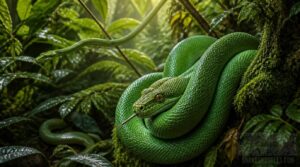
From rainforest canopies to backyard gardens, green snakes show up in more shapes and sizes than you’d expect. Some are gentle, some are venomous, and a few are downright massive. Here are eight standout species worth knowing, starting with one of the most striking climbers around.
Take the green tree python’s neon coils, for instance, a jungle showstopper that proves color can be just as fierce as fangs.
Green Tree Python
Picture a hatchling glowing bright yellow, then slowly shifting to emerald green within a year — that’s the green tree python for you. Native to New Guinea and northern Australia, this arboreal snake spends its days coiled on branches, using a prehensile tail for grip and stability.
Adults reach 4 to 6 feet, sporting a diamond-shaped head built for precise strikes. That ontogenetic color change isn’t just cosmetic — it helps juveniles match different forest layers than adults.
Heat-sensing pits detect warm-blooded prey nearby. In captivity, reptile husbandry demands humidity between 70-80% and careful thermoregulation. Habitat fragmentation threatens wild populations, making responsible captive breeding programs increasingly important for this striking species. For more details on their incubation period, see the incubation period details.
Emerald Tree Boa
From bright green tree pythons, we head into the Amazon Basin, where the emerald tree boa rules the canopy at night.
- Grows 4-6 feet, stout-bodied
- Bright green with pale camouflage markings
- Born reddish-orange, greens within a year
- Ambushes prey while coiled on branches
- Gives live birth—no eggs involved
Habitat loss threatens wild populations, so captive breeding matters more than ever.
Rough and Smooth Green Snakes
Back on U.S. soil, meet two woodland regulars: Opheodrys aestivus (rough) and Opheodrys vernalis (smooth), common across the eastern United States.
| Trait | Rough vs. Smooth |
|---|---|
| Scales | Keeled/ridged vs. flat/glossy |
| Diet | Crickets, caterpillars, spiders |
| Habitat | Woodlands, grasslands |
| Care | Easy, beginner-friendly |
Both stay slender and harmless—perfect starter snakes!
Asian Vine Snake
Swap woodland floors for treetops, and you’ll meet Ahaetulla prasina—the Asian vine snake. This slender hunter thrives across Southeast Asia’s forests, blending into vines with uncanny arboreal adaptation.
- Pencil-thin body, pointed snout
- Green, olive, or yellow tones
- Feeds on lizards, frogs, birds
- Mildly venomous, rarely aggressive
- Females guard eggs until hatching
Stealthy, graceful, and endlessly fascinating!
Boomslang, Eastern Green Mamba, Green Anaconda
Three snakes, three totally different vibes.
Run a hand across a rough green snake instead and you’ll feel keeled, textured scales—a tactile contrast explained well in this rough vs smooth green snake comparison.
The Boomslang hides in African trees, hunting birds with hemotoxic venom that causes serious bleeding.
East Africa’s Eastern Green Mamba stretches 7 feet, striking fast with neurotoxins.
Meanwhile, South America’s Green Anaconda skips venom entirely—it’s a 500-pound river giant that just squeezes prey until it’s lights out.
No venom needed: South America’s Green Anaconda is a 500-pound giant that simply squeezes prey into stillness
How Popular Green Snakes Compare
Green isn’t just one color in the snake world—it comes in wildly different packages. Size, scale texture, and even body shape set these species apart from each other. Here’s how they stack up side by side.
Adult Size and Length
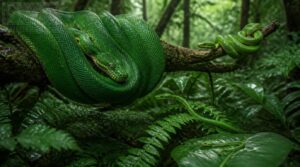
Size varies wildly among green snakes! Emerald Tree Boas hit 6–8 feet, while Green Tree Pythons stay smaller, around 3.3–6.6 feet.
- Rough Green Snake: 22–42 inches
- Smooth Green Snake: 12–22 inches
- Asian Vine Snake: 3–6 feet
Females usually outsize males, sometimes by 20–40%. Growth speed differs too — pythons and boas need 2–4 years reaching full length, while smaller species mature faster.
Green Shades and Markings
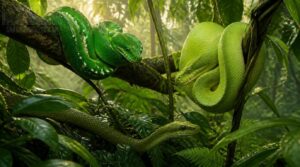
Green isn’t just green — it’s a whole spectrum. Green Tree Pythons shift lime to emerald with age, while Emerald Tree Boas flash white oval markings against dark backs. Rough Green Snakes and Smooth Green Snakes run olive to bright lime, often with faint stripes. Vine snakes stay solid and slender.
Habitat shapes it all — brighter canopy dwellers, deeper-shaded coastal types.
Rough Versus Smooth Scales
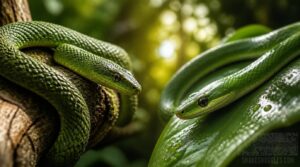
Run your finger down a Rough Green Snake and you’ll feel it — keeled scales with raised, gritty texture. Smooth Green Snakes glide glassy and silk-smooth instead.
That texture affects more than touch:
- Grip — rough scales aid arboreal locomotion on branches
- Heat absorption — texture alters surface interaction with sun
- Shedding — rough skins often leave textured remnants behind
For pet snake care, rough scales snag substrate; smooth ones glide easier.
Slender Versus Heavy Bodies
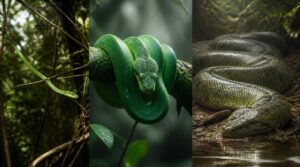
Picture a pencil next to a fire hose — that’s your Body Shape Comparison in short. A Smooth Green Snake stays whip-thin for tight-space arboreal locomotion, while a Green Anaconda bulks up for raw power.
Green Tree Pythons and Emerald Tree Boas split the difference: lean enough to climb, strong enough to constrict. Girth dictates Movement Speed Differences, Prey Size Preferences, and even your Enclosure Space Needs.
Juvenile Color Changes
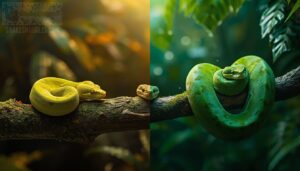
Ever seen a snake switch outfits mid-life? That’s ontogenetic color change in action. Green Tree Python hatchlings start neon yellow, shifting emerald within 6–12 months as pigments redistribute.
Emerald Tree Boas go blue-to-green early on. Lighting and warmth speed this timeline — good news for keepers tracking captive observation indicators like scale sheen and steady feeding habits in arboreal species.
Where Green Snake Species Live

Green snakes didn’t end up green by accident—their home turf shaped them that way. From soggy river basins to breezy coastal canopies, each species picked a corner of the world that fits its lifestyle perfectly. Here’s where you’ll actually find these striking snakes hanging out, continent by continent.
North American Woodlands
Sprawling across roughly 300 million acres, eastern woodlands are where you’ll spot both the rough green snake and smooth green snake, hunting insects by day.
Oak-hickory forests and fire ecology keep understories healthy, while wildlife corridors combat habitat loss.
Conservation status stays stable here thanks to habitat restoration efforts and soil health management supporting these harmless, bug-loving neighbors.
African Coastal Forests
Trade oak canopies for salt air, and you’re now in African Coastal Forests, stretching from Somalia to Mozambique. The Eastern Green Mamba and lesser-known Western Green Mamba rule these treetops.
- Endemic reptile species like arboreal snakes
- Mangrove natural processes supporting fisheries
- Forest elephant corridors through transitional habitat
- Bird migration pathways along the coast
- Coastal habitat threats from development
The Green Vine Snake and African Green Water Snake round out this striking neighborhood.
Asian and Australian Rainforests
Head east past those mangroves and you’ll land in New Guinea and northern Australia, home turf for the green tree python (Morelia viridis). Monsoon rains fuel thick canopy layering here—biodiversity hotspots packed with endemic species.
The Asian vine snake slips through this same vegetation, pencil-thin and quick. Conservation efforts race to protect these rainforests from logging pressure.
South American Rainforests
Cross the Pacific and you’re in the Amazon Basin—9 countries, 7 million square kilometers of pure green sprawl. Emerald tree boas coil motionless in the canopy; green anacondas patrol floodplain waters below. Indigenous communities have read this forest for generations. It’s a biodiversity hotspot storing 100-150 billion tons of carbon.
- Emerald tree boa
- Green anaconda
- Amazon Green Racer
- River floodplain ecosystems
- Amazon canopy dwellers
Arboreal Versus Aquatic Habitats
Where a green snake lives shapes everything about how it moves. Arboreal snakes grip bark and weave branches; aquatic species like green anacondas rely on swimming, not climbing.
Canopy hunters ambush from shadows above—water dwellers pursue prey through open currents below. Grip vs swim locomotion defines their world.
Sadly, habitat loss threatens both, making conservation status increasingly urgent.
Green Snake Diet, Behavior, and Safety

Living somewhere striking is only half the story—what these snakes eat, how they hunt, and whether they’re dangerous matters just as much. Some stalk quietly from a branch while others actively chase down a meal, and their schedules couldn’t be more different. Here’s what you need to know about their habits and how much caution each one really demands.
Insects and Other Invertebrates
Bite-sized, crunchy, endless — that’s the buffet waiting in the grass. Rough and smooth green snakes stick almost entirely to invertebrates:
- Crickets
- Caterpillars
- Spiders
- Grasshoppers
- Soft-bodied grubs
Asian vine snakes join in too, their pencil-thin bodies built for stalking lizards and frogs among leaves. This insect-heavy diet keeps these nonvenomous, arboreal hunters thriving without ever needing bigger prey.
Birds, Reptiles, and Mammals
Feathers, scales, and fur all end up on the menu once you move past insect-eaters. Emerald tree boas take bats and marsupials; eastern green mambas strike birds with fast-acting neurotoxic venom; green anacondas tackle capybaras and caimans.
| Species | Typical Prey |
|---|---|
| Emerald Tree Boa | Bats, rodents, marsupials |
| Eastern Green Mamba | Birds, small mammals |
| Green Anaconda | Fish, capybaras, caimans |
| Boomslang | Birds, eggs |
Ambush Versus Active Hunting
Patience or pursuit? Green snakes split into two camps. Emerald tree boas ambush from canopy perches, striking through camouflage. Rough green snakes actively forage grasslands for insects. Ambush saves energy; active hunting expands range.
Five reasons this matters:
- Constriction hunting demands stealth
- Camouflage effectiveness varies by species
- Foraging efficiency shifts with prey density
- Predator avoidance shapes strategy
- Both minimize scent detection
Daytime Versus Nocturnal Activity
Ever wonder why some snakes vanish by noon? It’s all about the clock they’re wired to.
Eastern green mambas patrol by day, basking for warmth before hunting. Emerald tree boas flip the script, hunting after dark when temperatures cool.
Green tree pythons split the difference—active by day but sunbathing on branches. Green vine snakes prefer dawn and dusk, when light sensitivity peaks and foraging windows open wide.
Venomous Versus Non-Venomous Species
Green doesn’t mean safe. The eastern green mamba injects fast-acting neurotoxic venom through hollow fangs, while the boomslang‘s bite causes dangerous bleeding.
Others, like green tree pythons, rely purely on constriction—no venom glands needed.
- Neurotoxic venom disrupts nerves
- Constriction relies on muscle
- Bite patterns reveal fang type
- Antivenom treatment saves lives
- Nonvenomous species still bite hard
Which Green Snakes Make Good Pets?
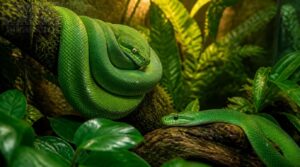
Not every green snake belongs in a terrarium, and that’s a good thing to know before you fall for one. Some make great first pets, others test even seasoned keepers, and a few should just stay wild and free. Here’s how they stack up.
Beginner-Friendly Green Snakes
So, which green snakes fit a first-time keeper? The rough green snake and smooth green snake top the list—small, calm, and happy with an insect based diet of crickets.
A green tree python works too, given proper humidity control.
Handle gently, keep enclosures simple, and you’ve got beginner friendly snakes that won’t overwhelm you.
Advanced Arboreal Species
Ready to level up? The emerald tree boa and green tree python demand real skill—prehensile tails, canopy navigation, ambush strikes from vertical perches.
- Emerald tree boas: nocturnal ambush hunters
- Asian vine snakes: mild venom, precise strikes
- Convergent evolution shaped both like eastern green mambas, boomslangs
These microhabitat specialists reward patient, experienced keepers only.
Dangerous Wild-Only Species
Skill only gets you so far—some snakes simply aren’t pets. Boomslangs, eastern green mambas, and green anacondas belong in the wild, full stop.
Boomslang fangs reach 3.5mm, delivering hemotoxic venom that causes internal bleeding. Mambas bring fast-acting neurotoxins. Antivenom exists but isn’t always accessible fast enough.
Encounter risks are real. Habitat loss threatens wild populations too—admire these giants from a distance, not your living room.
Enclosure and Climate Requirements
Now for the pets you can actually keep—tree pythons and emerald boas need tall, planted enclosures at least 150cm high, with climbing branches for vertical space.
Set a warm-to-cool temperature gradient (28-32°C down to 24-26°C), plus a nighttime dip. Humidity runs 60-90% depending on species—mist often.
Keep lighting cycles natural: 12-14 hours on, rest dark.
Feeding, Handling, and Temperament
Bond building takes patience, not force. Feed captive bred green tree pythons every 7-10 days; skip live prey to cut injury risk.
Handling safety guide:
- Wait until digestion settles
- Support the body fully
- Skip the head
- Cap sessions at 10 minutes
- Wash hands first
Temperament shifts with enclosure stress—cluttered, humid setups calm nerves; bare tanks breed skittish, bite-prone snakes.
Frequently Asked Questions (FAQs)
What kinds of snakes are green?
The same color that helps a snake vanish can also make it impossible to miss. Green snake identification spans harmless garden dwellers like the rough green snake and smooth green snake to giants like the green anaconda and arboreal hunters like the emerald tree boa and Asian vine snake.
What snake is worth $100,000?
That jaw-dropping price tag belongs to a super pastel yellow belly ball python. Rare morph rarity, verified genetics, and breeder lineage drive market demand—pushing auction prices into six figures within the reptile pet trade.
Which green snake is the friendliest?
Honestly? The rough green snake takes the crown. Docile, nonvenomous, and quick to retreat rather than strike, it’s ideal for beginners wanting gentle handling, calm temperament, and low-stress interaction without the size or care demands bigger species require.
Which green snake is poisonous?
Not all green snakes are cuddly, right? The eastern green mamba and boomslang top the venomous list, packing neurotoxic and hemotoxic venom. Green anacondas aren’t venomous—just powerful constrictors. Always seek antivenom and medical care after any bite.
What is the average lifespan of green snakes?
Longevity swings wildly by species. A pampered emerald tree boa or Asian vine snake can top 20 years, while wild rough green snakes and smooth green snakes rarely see past 6–8, thanks to predators, weather, and food scarcity.
Can green snakes be kept as pets?
Yes, several beginner-friendly snakes fit pet life beautifully, provided you nail their enclosure setup, humidity, and feeding schedule.
Check legal ownership rules first, though—some species stay restricted, and wild-caught snakes rarely adapt well to captivity.
What are the ideal living conditions for green snakes?
Picture a leafy skyscraper, built just for climbing. That’s what your snake needs: tall arboreal enclosures with real climbing space, a steady temperature gradient, humidity control matching its natural habitat, and fresh water always within reach.
How do green snakes defend themselves?
When trouble strikes, you’ll see camouflage take center stage first—that leafy coloring works wonders for predator avoidance. If spotted, expect freezing, fast escapes, threat displays, defensive bites, or musk release, depending on the species’ size and temperament.
Are there any common misconceptions about green snakes?
Plenty of myths swirl around here. Not every green snake is venomous — most rely on camouflage, not toxins. Color doesn’t signal danger, size varies wildly by species, and several nonvenomous types make genuinely beginner friendly snakes for patient keepers.
What diseases commonly affect green snakes?
Something’s brewing under that beautiful green skin. Respiratory infections, parasitic infestations, skin fungus, and even viral hemorrhagic disease stalk these snakes—especially with poor humidity, damp substrate, or nutritional deficiencies weakening immune function and driving up parasite load in captivity.
Conclusion
Green isn’t one color out here—it’s camouflage, warning, survival wearing countless shades. From the emerald tree boa’s coiled ambush to the garden snake’s quiet crunch through crickets, popular snake breeds that are green prove nature rarely repeats itself.
Some demand expert hands; others thrive in a beginner’s terrarium. Whatever draws you in, respect their wild instincts. Once you’ve seen that green flash in the leaves, you’ll never look at a branch the same way again.