This site is supported by our readers. We may earn a commission, at no cost to you, if you purchase through links.

Imagine this: you’re ten miles down the highway, the heater is off, and your ball python is curled up in a bag at 68°F. Not great. Snakes can’t make their own heat, so a chilly car slows their digestion and weakens their immunity fast.
Cold isn’t the only danger. Park in the sun, or tape a heat source too close, and heat stress sets in just as quickly. Nobody wants a burned or overheated snake on a road trip.
Keeping snakes warm during car trips takes a little planning, but it’s easy. Start with the temperatures your snake actually needs.
Table Of Contents
- Key Takeaways
- Choose Safe Travel Temperatures for Your Snake
- Prepare a Secure, Insulated Snake Travel Container
- Top 3 Products for Snake Car Trips
- Keep Your Snake Warm During Car Trips
- Monitor Warmth and Prevent Overheating During Travel
- Frequently Asked Questions (FAQs)
- What temperature is too cold for snakes to be out?
- Can a snake survive in a hot car?
- Is 90 degrees too hot for a snake?
- How to travel with a snake in a car?
- How long can a snake safely stay in a car?
- Should I stop for breaks on long trips?
- Can I leave my snake in a parked car?
- What should I pack in a snake travel kit?
- Is it legal to transport snakes across state lines?
- Conclusion
Key Takeaways
- Aim for 75-85°F in the carrier for most pet snakes, keep a cooler spot so your snake can move away from heat, and treat anything above 90°F as an emergency and pull over.
- Use a secure, ventilated, insulated rigid container with your snake in a tied cloth bag inside, and buckle it in on the car floor away from vents.
- Tape hand warmers or heat packs to the outside of the container or wrap them in fabric, and NEVER let a heat source touch your snake, since direct contact can burn it.
- Warm the car before loading, monitor the temperature every 30-60 minutes with a thermometer, never leave your snake in a parked car, and stop for breaks every 4-6 hours.
Choose Safe Travel Temperatures for Your Snake

You can’t just hope your snake rides out the trip, so let’s pick the right numbers first. Snakes can’t make their own heat, which means reptile thermoregulation depends entirely on you while you drive.
If your snake has already stopped eating after a cool stretch, these common snake won’t eat symptoms can help you tell whether temperature is the culprit.
For most ball pythons, corn snakes, and kingsnakes, aim for 75-85°F ambient. Add a gentle warm spot around 88-92°F, never above 105°F. Tropical boas want 80-90°F, while garter snakes do fine at 65-75°F.
Now the WARNING part. Below 65°F, digestion slows and immunity drops. Above 95°F for long, heat stress sets in.
Good temperature control also means a thermal gradient inside the travel carrier, so your snake can shift away from heat. Keep the secure lid closed, and check readings every 30-60 minutes. You’ve got this.
Prepare a Secure, Insulated Snake Travel Container
Now that you’ve got your numbers, let’s build a carrier that holds them. Start with a rigid plastic container that lets your snake lie flat without much extra room. Too much space means too much sliding around.
Place your snake in a cloth bag, tie it off, and set the bag inside the container. That’s your backup if the plastic cracks. Line the bottom with shredded paper or paper towels to cushion every bump.
Next, make small air holes on the long ends with a soldering iron, then cover them with fine mesh under the secure lid. Tape around the edges, too.
Top 3 Products for Snake Car Trips
Now that your container plan and temperature targets are set, let’s talk gear. Below are three trusted travel products that make car trips safer and calmer for your snake. Take a look, and pick what fits your setup best.
1. Karlie Transport Box IATA Live Animal
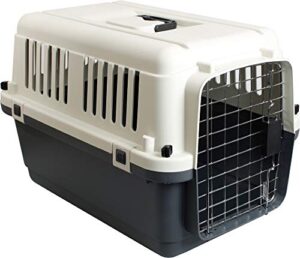
Picture a snug little cabin on wheels, with your snake tucked safely inside while the road hums along beneath. That’s the Karlie Transport Box.
Since temperature stability matters even more on long journeys, it’s worth reading this guide to shipping snakes internationally before you plan your route and packing.
It’s a sturdy plastic box with a changeable metal door. The two halves nest together, so storage is easy. Thumbscrews hold everything shut, which keeps trips by car, train, or plane secure. Measuring 62 x 40 x 41 cm, it holds up to 10 kg.
Assemble it with the included safety screws. NEVER skip that step!
| Best For | Owners of small pets up to 10 kg who need a secure, airline-approved box for travel, vet visits, or short-term confinement. |
|---|---|
| Material | Plastic and metal |
| Weight | N/A |
| Dimensions | 62 x 40 x 41 cm |
| Max Load | 10 kg |
| Durability Limitation | Hinge may need adjustment |
| Heat Duration | N/A |
| Additional Features |
|
- Sturdy plastic build with a changeable metal door
- Upper and lower halves nest together for compact storage
- Thumbscrews keep it secure on trains or planes, and it is approved for air travel by European airlines
- Only suitable for pets up to 10 kg
- Must be assembled properly with the included safety screws
- The metal door hinge may need adjusting to line up correctly
2. Exo Terra Small Breeding Box
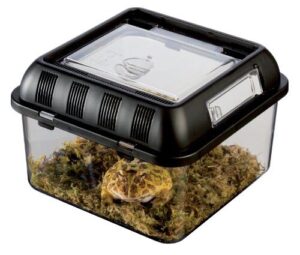
Need a smaller option for a snake? Meet the Exo Terra Small Breeding Box.
It’s a clear plastic box, just 8 x 8 x 5.5 inches and 0.2 kg, so it’s easy to carry. Side-angled ventilation slits keep air moving, and the feeding door lets you offer food without unstacking anything.
Handle it gently, though. The bottom corners may crack under stress, and reviews on long-term durability are mixed. Plastic won’t hold heat, so pair it with a warm source.
| Best For | Keepers of small reptiles, roaches, tarantulas, or tortoise hatchlings who need a stackable box for housing, breeding, or transporting live animals and feeders. |
|---|---|
| Material | Plastic |
| Weight | 0.2 kg (7.05 oz) |
| Dimensions | 8 x 8 x 5.5 inches |
| Max Load | N/A |
| Durability Limitation | Bottom corners may crack |
| Heat Duration | N/A |
| Additional Features |
|
- The feeding door lets you offer food without unstacking the units.
- The stackable design works for both display and breeding setups.
- Side-angled ventilation slits keep air flowing, and the box is light at 0.2 kg.
- The bottom corners may crack under stress.
- Reviews on long-term durability are mixed.
- At 8 x 8 x 5.5 inches, it only suits small reptiles or invertebrates.
3. Hot Hands Hand Warmers 6 Pairs

Hand warmers need no batteries or outlet. Each air-activated pack gives up to 10 hours of warmth, and your six pairs cover a long drive. Shake one open about 30 minutes before you leave, since it needs time to warm up.
Here’s the catch. NEVER let a warmer touch your snake. Direct contact can easily burn delicate skin. Tape it to the outside of the container, or wrap it in several fabric layers. Each pack is single-use, so pack extras.
| Best For | Outdoor enthusiasts, commuters, and anyone who needs a battery-free, portable heat source, including reptile owners who want to keep a snake warm on a long drive by taping a pack to the outside of its container. |
|---|---|
| Material | Acrylonitrile Butadiene Styrene |
| Weight | 50 g |
| Dimensions | N/A |
| Max Load | N/A |
| Durability Limitation | Single-use disposable |
| Heat Duration | Up to 10 hours |
| Additional Features |
|
- Air-activated, so no batteries or outlet are needed
- Delivers up to 10 hours of continuous warmth, enough to cover a long drive
- Six pairs in the package, so there are plenty of extras
- Disposable and single-use only, so each pack must be replaced
- Heat stops after about 10 hours and cannot be extended
- Needs about 30 minutes to warm up and must never touch a snake directly, since contact can burn delicate skin
Keep Your Snake Warm During Car Trips
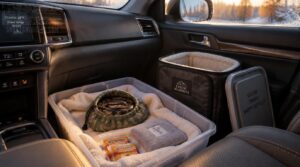
You can keep your snake cozy on the road with a little planning. Start by choosing to warm your vehicle ten minutes before you load up. Snakes hate a cold shock, and honestly, who doesn’t?
Then build your setup:
- Line the tote with a towel for a soft, snug nest.
- Tuck hand warmers beside your snake’s bag, never touching it.
- For long drives, add microwaveable heat packs for gentle, steady warmth.
- Snap on the secure lid so nobody wanders off.
- Slide everything into an insulated outer carrier to hold the heat in.
Place it on the car floor, away from vents. NEVER let heat packs touch your snake directly. Your little noodle just wants to feel gently warm, not toasted.
Monitor Warmth and Prevent Overheating During Travel
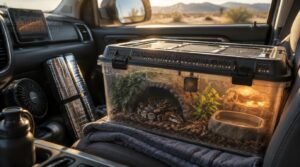
Picture a tiny sauna on wheels. Sun pours through the window, and your snake’s box slowly turns into an oven. Not great, right?
Sunshine through the car window can quietly turn your snake’s travel box into a tiny oven on wheels
Good temperature control for pets starts with watching the numbers. Clip a Bluetooth sensor inside your secure escapeproof container and keep the readout in sight. Keep a cooler spot too, so the warm zone never covers the whole box. Switch off portable heat sources once the car warms up. Thermal stress in reptiles builds fast.
| Temperature | What it means | Your move |
|---|---|---|
| 65-85°F | Comfortable | Keep going |
| 85-90°F | Getting hot | Cool the cabin |
| Above 90°F | DANGER | Pull over now |
Spot gaping or frantic pushing? Cool gradually and call your vet. Note how long it lasted and what you did.
Frequently Asked Questions (FAQs)
What temperature is too cold for snakes to be out?
Remember 60°F. Below it, cold stress in captive snakes climbs, and under 50°F digestion stalls. Outside the ideal temperature zone, temperature control for pets matters. For reptile travel safety, pack hand warmers. Don’t gamble, friend.
Can a snake survive in a hot car?
On an 85°F day, your car hits 104°F in 10 minutes. Your snake likely won’t survive that.
Watch for gaping, limpness, or frantic thrashing. Cool it gradually, call a vet, and NEVER leave it behind.
Is 90 degrees too hot for a snake?
90 degrees is a tightrope. Is 90 degrees too hot for a snake? Sometimes.
Fine for pythons, but corn snakes need the ideal temperature zone. Watch reptile overheating symptoms, use safe heating methods, insulated thermal buffering.
How to travel with a snake in a car?
Think of your snake as a tiny, warm-blooded passenger in a cold-blooded body. Pack a ventilated reptile transport box with ventilation holes, add hand warmers outside it, warm your vehicle first, and buckle the box in.
How long can a snake safely stay in a car?
Worried that’s too long? It isn’t. Snakes can ride 8 to 10 hours if the car temperature stays in its ideal temperature zone, with ventilation holes open, avoiding overheating, and temperature gradient maintenance in transit.
Should I stop for breaks on long trips?
Should you stop? Break every 4-6 hours, never past 8, to ease travel stress. Probe temperatures against car interior extremes, secure the box with a seatbelt, and plan overnight stop checks. Avoid overnight air freight.
Can I leave my snake in a parked car?
No, NEVER leave your snake in a parked car. Car temperature can climb 40°F in an hour, and snakes can’t cool themselves. If you must stop, take your snake along. Call your vet right away.
What should I pack in a snake travel kit?
Start with a small travel container, then add extra bedding and a spill-proof water dish. Pack a snake bag, microwavable heat packs, a reptile-safe heat pack, extra insulation, a digital thermometer, a first aid kit, and a power bank.
Is it legal to transport snakes across state lines?
Usually, yes, but check first. Federal law bans interstate transport of four large constrictors, though courts limited that rule. States add their own permits.
Get a health certificate, vet health clearance for travel, and confirm legal compliance before interstate travel.
Conclusion
Picture Maya pulling into a rest stop after three hours, ball python tucked in a snug box, warm at a steady 80°F. Nothing dramatic happened. That’s the goal.
Mastering keeping snakes warm during car trips comes down to three habits: check the temperature, insulate the container, and never let a heat source touch your snake. Keep a thermometer handy. Do that, and your snake just rides along, calm and cozy, like a tiny, scaly passenger.