This site is supported by our readers. We may earn a commission, at no cost to you, if you purchase through links.

A snake that escapes isn’t just a problem for your household. It’s a sign the enclosure failed before the animal ever moved in. Temperature drift, inadequate locks, and wrong substrate cause more harm than neglect, because keepers often don’t notice until damage is done.
Setting up a safe snake enclosure habitat means making precise decisions at every step: vertical clearance matched to your species, ventilation that moves air without stressing the animal, and thermal gradients held to within 2°C. Every element is load-bearing.
This guide walks you through each phase, in order, so nothing gets skipped.
Table Of Contents
- Key Takeaways
- Choose a Secure, Species-Appropriate Snake Enclosure
- Add Safe Substrate, Hides, Water, and Enrichment
- Install Thermostatically Controlled Heating and Lighting
- Set and Verify Temperature, Humidity, and Airflow
- Cycle, Clean, and Maintain The Snake Enclosure
- Frequently Asked Questions (FAQs)
- What do you put at the bottom of a snake enclosure?
- How to set up a snake habitat?
- Do snakes like vertical or horizontal tanks?
- What is the best habitat for a snake?
- How to properly set up a snake enclosure?
- What not to put in a snake enclosure?
- What should I have in my snake enclosure?
- What makes a good snake habitat?
- How to safely transport a snake to the vet?
- What type of water dish is best?
- Conclusion
Key Takeaways
- Enclosure failures — not neglect — cause most snake health crises, with temperature drift, weak locks, and wrong substrate being the primary culprits you need to control before your snake moves in.
- Every element of the habitat is interdependent: substrate, heat, humidity, ventilation, and security must all be calibrated together, because one weak link cascades into the others.
- Thermostat-controlled heating with a verified dual-zone gradient (28–32°C warm side, 22–26°C cool side) isn’t optional — your snake can’t regulate its own body temperature, so you’re its only safety net.
- Run two full 24-hour stability tests, including a simulated power outage, before introducing your snake — a habitat that looks ready isn’t proven ready until it holds its conditions without you watching.
Choose a Secure, Species-Appropriate Snake Enclosure
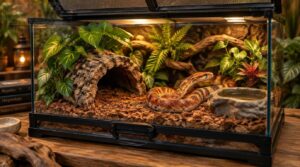
The enclosure you choose determines everything that follows, so getting this decision right matters. Species, adult size, and habits should drive your choice before you consider price or aesthetics. Here’s what to evaluate across three critical factors.
Understanding your reptile’s native climate and behavioral patterns—temperature gradients, humidity needs, lighting—will sharpen your decision considerably, and this guide to reptile tank habitat design breaks down how those factors translate into enclosure choices.
Size and Vertical Space
For arboreal climbing species, enclosure size needs height exceeding 1.5 times your snake’s length. Vertical complexity should fill 60-80% of the space, so add climbing structures and place broad ledges every 15-20 cm.
In any snake habitat with large constrictors, confirm ramps support at least twice body weight and keep vertical bar spacing at 2-3 cm to prevent head entrapment.
Materials and Ventilation
Once dimensions are set, material choice determines humidity retention and airflow. PVC cages handle moisture better than glass terrariums; acrylic offers clarity with moderate insulation.
- Position intake vents low, exhaust vents high
- Keep drafts under 0.2 m/s with proper ventilation design
- Fit fine mesh panels to prevent escapes
- Select UV-resistant, moisture-rated shell materials
- Clean vent screens monthly to prevent blockage
Locks, Location, and Placement
Good ventilation design means nothing if your locks fail. Fit hasp-style or keyed latches rated for at least 1,000 N of force, using stainless steel shackles to resist picking. Position locks so no gap allows finger access.
Pairing secure locks with proper cage placement further reduces stress and escape risk — optimal snake cage positioning tips can help you find a spot that supports stable humidity alongside physical security.
Place the enclosure at least 30 cm above floor, away from drafts, sunlight, and high-traffic zones. Maintain 5 cm clearance on all sides.
Add Safe Substrate, Hides, Water, and Enrichment
With your enclosure chosen, what goes inside determines whether your safe snake enclosure habitat works. Start with substrate selection: enzyme-treated coconut fiber or reptile carpet at 2–4 inches. Don’t use cedar or pine; both release toxins.
You’ll need two hiding places. Position one on the cool side, one on the warm end. Non-porous, enclosed hides disinfect easily.
Prioritize these five points for water quality and habitat enrichment:
- Change water daily and scrub the dish with toxin-free soap
- Use a shallow dish with a rim under one-third of your snake’s body diameter
- Replace substrate every 6–12 months, or sooner when soiled
- Rotate enrichment items like cork bark and branches every 2–4 weeks
- Anchor all structures securely and inspect weekly for wear
Install Thermostatically Controlled Heating and Lighting
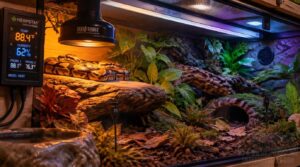
Because your snake can’t regulate its own body temperature, thermostat-controlled heating isn’t optional. Run a dual-zone setup: a basking spot dialed to species-appropriate temperatures and a separate ambient heat source that creates a true temperature gradient from warm end to cool.
A proper gradient also supports digestion and immune health—see the full tricolor hognose snake temperature and care guide for exact basking and ambient ranges by life stage.
Place your thermostat probe directly in the heat zone, never in open air. Ambient air readings lag behind surface temps and let your basking area overshoot. Set high and low alarms on your thermostat so you catch dangerous swings before they do real damage.
Pair your heating with a consistent day/night cycle using a programmable timer. For species requiring UVB, UVB bulb placement matters: position it along the enclosure’s length at manufacturer-specified distances to prevent both deficiency and photokeratitis.
Set and Verify Temperature, Humidity, and Airflow
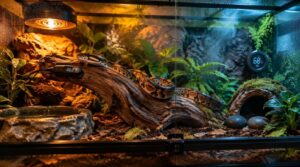
Once your thermostat-controlled heating is running, verification isn’t optional. Place probes at the warm-side middle of the enclosure to capture accurate basking temps, then map your temperature gradient across three points: hot, warm, and cool.
Solid humidity control depends on calibrated hygrometers. Test yours against a salt standard first. For colubrids, aim for 40-60%; tropicals need 60-80%. Position sensors near both the basking and cool zones.
Monitor these four variables daily for the first two weeks:
- Hot-side temp: 28-32°C (day)
- Cool-side temp: 22-26°C (night)
- Humidity at both enclosure ends
- Ventilation airflow for cross-draft stability
Set alarm thresholds immediately: alert if temperature drifts more than 2°C from setpoint or humidity drops below 35% or exceeds 80% for more than two hours.
Cycle, Clean, and Maintain The Snake Enclosure

Getting your enclosure built and calibrated is only half the job. Long-term safety depends on consistent maintenance routines that start before your snake ever arrives and continue throughout its life. The steps below cover everything from pre-arrival stability testing to handling power outages.
Pre-Arrival Stability Testing
Don’t bring your snake home to a habitat you’ve never stress-tested. Run two full 24-hour logging cycles before arrival, confirming temperature stays within ±2°C of your setpoint and humidity holds within its target band with under 5% fluctuation.
Use at least two independent sensors, calibrated beforehand. Simulate a six-hour power outage and confirm full recovery before you introduce your animal.
Cleaning and Disinfection
The cleanest-looking habitat can harbor the most dangerous bacterial contamination. Even visually spotless enclosures can silently host harmful pathogens, so reviewing guidance on safe reptile enclosure cleaning and disinfection helps ensure your routine actually eliminates the risks you can’t see.
The cleanest habitat can hide the deadliest contamination
Spot-clean daily, removing waste, shed skin, and uneaten food. Every 6 to 8 weeks, do a full deep clean using F10SC at 1:250 or a 10% bleach solution, maintaining 10 minutes of contact time. Rinse all surfaces thoroughly, then air out the habitat for 24 hours before reintroducing your snake.
Always verify you’re using reptile-safe disinfectant cleaners, as ammonia-based products are toxic to reptiles even in trace amounts.
Health and Habitat Troubleshooting
Problems rarely announce themselves loudly. If your snake refuses food, verify your temperature gradient immediately: a probe misplaced a few inches can show acceptable readings while the actual zone runs dangerously hot.
Low humidity control causes incomplete sheds. Persistent wheezing signals respiratory health issues requiring a vet. Revisit your substrate selection when ammonia odors appear, and re-check your escape proofing.
Bioactive Enclosure Maintenance
Your bioactive enclosure isn’t static. Enclosure maintenance here means keeping a living system properly balanced. Turn the substrate every 6-8 weeks, inspect for mold weekly, and track isopod numbers monthly; a drop signals a substrate hygiene failure.
Nontoxic plants and leaf litter provide shedding support while holding moisture. Reintroduce a microfauna inoculant after cleanings, and keep ammonia below 0.25 mg/L.
Power Outage Preparedness
That living system you’ve built doesn’t tolerate sudden temperature swings. When power fails, microclimate management turns manual.
A power backup UPS rated for 4–24 hours keeps your thermostat and sensors online. Prioritize the warm side first for thermal shock prevention. If temperature drifts more than 2°C in 10 minutes, reptile safety demands an audible alarm and a documented response plan.
Frequently Asked Questions (FAQs)
What do you put at the bottom of a snake enclosure?
A ball python kept on cedar shavings will quickly develop serious respiratory damage. Don’t use pine or cedar substrates. Instead, choose coconut fiber or aspen shavings at 2–5 cm deep to maintain good substrate hygiene.
How to set up a snake habitat?
Think of a safe snake enclosure habitat as a precision instrument. Get enclosure size, a reliable temperature gradient, consistent humidity control, a clean species-appropriate substrate, and escape-proof locks dialed in before you’ve introduced your snake.
Do snakes like vertical or horizontal tanks?
It’s a ladder versus a highway. Arboreal species need vertical vivarium height to climb and hide at multiple levels; terrestrial snakes need horizontal enclosure space for locomotion. Match your enclosure type to your snake’s lifestyle.
What is the best habitat for a snake?
What separates a thriving snake from one that’s chronically stressed? The right snake enclosure built specifically for your species, with precise temperature gradients, appropriate humidity levels, compatible substrate options, and secure lids that won’t fail.
How to properly set up a snake enclosure?
Like a well-built system, every layer of reptile husbandry connects. Your snake enclosure needs a temperature gradient, humidity control, secure lids, proper substrate, and stable lighting all working in concert before your snake ever arrives.
What not to put in a snake enclosure?
Over 60% of captive snake illnesses trace directly back to poor enclosure choices. Avoid pine and cedar substrates, heat rocks, toxic adhesives, and sharp décor.
Wrong materials cause substrate impaction, scale rot, and respiratory infections.
What should I have in my snake enclosure?
Your vivarium setup needs a species-appropriate enclosure, secure hides, safe substrate, a water bowl, and a controlled heat source. Add enrichment, monitor temperature and humidity daily, and keep feeding, quarantine, and power backup plans ready.
What makes a good snake habitat?
Research suggests over 70% of captive snake health problems tie directly to enclosure conditions. A successful snake enclosure requires the right size, a reliable temperature gradient, consistent humidity control, safe substrate, and secure lids throughout.
How to safely transport a snake to the vet?
Use a rigid, ventilated tub with secure locking lids to prevent escapes. Line it with soft, non-abrasive material, apply an external heat pack to maintain stable temperatures, and have your paperwork ready before you arrive.
What type of water dish is best?
Think of the water dish as your snake’s lifeline in the enclosure. Choose a wide, shallow stainless steel bowl: it’s non-porous, rust-resistant, and easy to sanitize, making it the safest choice for any reptile habitat.
Conclusion
Think of the enclosure as a living body: every organ has a role, and one failure cascades into the next. Setting up a safe snake enclosure habitat means no single element is optional. Substrate, heat, humidity, locks, and airflow are interdependent.
Your snake can’t flag a problem. You catch it, or you don’t. Build with precision, verify before arrival, and the habitat will do its job for years without asking anything of you but consistency.