This site is supported by our readers. We may earn a commission, at no cost to you, if you purchase through links.

Most snake owners spend hours picking the right substrate, lighting, and hides—then drop the water dish wherever it fits. That single careless choice can quietly drive scale rot, bacterial blooms, and chronic dehydration.
Where the bowl sits inside the enclosure shapes water temperature, evaporation rate, and humidity swings, which directly impact how often your snake actually drinks.
Cool side, warm side, or somewhere in between—each position comes with real trade-offs.
Getting the best placement for a snake water dish in an enclosure isn’t complicated, but it does require knowing what each zone does to the water and to your snake.
Table Of Contents
- Key Takeaways
- Choose The Best Bowl Location
- Follow The Temperature Gradient
- Balance Humidity and Evaporation
- Keep Access Safe and Clear
- Match Placement to Snake Species
- Maintain a Clean Water Station
- Frequently Asked Questions (FAQs)
- How do you care for a snake when shedding?
- How do I choose a terrarium for a snake?
- How do you keep a snake safe?
- Where do snakes hide?
- Where should a snakes water bowl be?
- What are signs of too much humidity for pythons?
- Can multiple snakes share one water dish?
- Should water dishes be elevated off the substrate?
- How often should dish placement be rotated?
- Does dish size affect ideal placement location?
- Conclusion
Key Takeaways
- The cool side of the enclosure is the safest default for your water dish — it slows evaporation, limits bacterial growth, and keeps humidity stable without the risks that come from heat exposure.
- Your snake learns water locations by habit, so once you find a good spot, keep it there — inconsistent placement leads to searching, not drinking.
- Species and life stage matter: ball pythons and corn snakes do well with cool-side corner placement, while high-humidity species like rainbow boas and burrowing snakes need mid-zone or elevated setups tailored to their behavior.
- A clean, non-porous bowl placed at least 2–5 cm from any heat source — and checked daily on the warm side — is the baseline that keeps your water station safe and your snake reliably hydrated.
Choose The Best Bowl Location
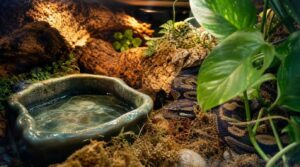
Where you put the water dish matters more than most keepers think.
Placement affects humidity, hygiene, and whether your snake actually uses it — all covered in this guide to choosing the right water dish for snakes.
The wrong spot can stress your snake, spoil the water faster, or throw off your humidity.
Here’s how to read your enclosure and choose the right location.
Why The Cool Side is Usually Safest
The cool side of the enclosure is your safest default for water dish placement. It enables consistent hydration without forcing your snake into uncomfortable thermal choices. Water stays cooler longer, slowing evaporation and reducing biofilm growth between cleanings. You’ll also avoid thermal shock prevention problems caused by overheated bowls. Less moisture near heat sources means better humidity management and lower scale rot risk — energy savings included.
If your snake lingers in its water dish despite a well-placed bowl, understanding why snakes sit in their water dish can help you catch early signs of humidity imbalance or discomfort.
When a Middle-zone Placement Works Better
Sometimes the cool side isn’t the right call. If your snake spends most of its time mid-enclosure, mid-zone placement means shorter travel to water — no crossing thermal extremes just for a drink. You’ll also get more consistent water temp and balanced moisture spread across the enclosure.
For multi-zone suitability, especially in larger setups, zone-based placement reduces stress and facilitates natural zonal hydration. This approach supports the creation of distinct hydration areas within the enclosure.
When Warm-side Placement May Be Useful
Warm side placement isn’t always wrong. Some snakes show a clear thermal drinking preference — they warm up first, then drink right where they are. Post-bask hydration is real.
Reduced travel distance matters when your snake patrols the warm end. Nighttime water warming also helps in rooms that cool down considerably.
Activity-aligned drinking keeps your snake hydrated on its own schedule.
Avoiding Direct Contact With Heat Lamps, Mats, and Basking Spots
Even if warm-side placement works for your snake, the bowl can’t sit directly under a heat source. Guarded lamp fixtures and thermostat heat regulation control surface temperatures, but radiant heat still warms water fast.
Heat mat barriers and safe distance spacing — at least 2–5 cm — reduce that risk. Protective heat shields help, but physical separation is your real safeguard.
Keeping The Bowl Easy for Your Snake to Find
Snakes learn water locations through repetition. Consistent positioning is crucial—moving the bowl too often can cause your snake to search instead of drink. Using a wide shallow bowl placed in a corner enhances stability, reinforcing familiarity.
Key strategies include:
- Keep the same spot after every clean
- Use a High Contrast Color bowl against the substrate
- Maintain Scent Familiarity by reusing the same bowl
- Guarantee an Unobstructed Approach from at least one side
- Choose a Standard Bowl Shape your snake already recognizes
Follow The Temperature Gradient
Where you put the water dish inside the temperature gradient matters more than most keepers realize. Get it wrong and you’re dealing with warm, stale water, spiked humidity, or a snake that simply won’t drink. Here’s how to place it right, zone by zone.
Place The Dish Within The Enclosure’s Cool-to-warm Layout

Your enclosure already has a built-in roadmap — the cool-to-warm layout, use it. Thermal inertia means water holds its temperature longer on the cool side, buffering against airflow streams that carry heat across the enclosure.
Zone-based placement respects that gradient. Set your bowl where substrate conduction stays low and temperature lag works in your favor, keeping water fresh longer between changes.
Keep Water Away From Intense Heat Sources
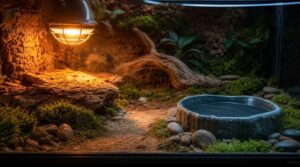
Heat lamps and mats don’t just warm a basking spot — radiant heat risk spreads further than expected. Mat conductive warmth travels through the enclosure floor, heating any bowl sitting too close. This proximity creates unintended hazards.
Maintain a 2–5 cm bowl placement buffer between water dishes and heat sources. This gap prevents thermal shock and mitigates evaporation rate control issues before they arise.
Prevent Rapid Evaporation From Warm-side Placement
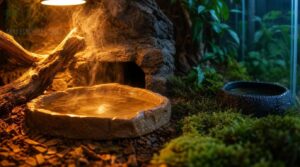
Warm-side water dish placement creates a slow drain on time and water supply. Every degree of warmth increases evaporation, while dry airflow above the bowl exacerbates the issue.
Five strategies to combat this include:
- Switch to a narrower, deeper bowl — Reduced Surface Area cuts evaporation fast.
- Use Insulated Bowl Walls to block heat transfer.
- Apply Airflow Shielding with nearby decor.
- Rely on a Shallow Dish Design only on the cool side.
- Build a Water Temperature Buffer by checking water temp after every move.
Smart humidity management starts with strategic placement.
Use Zone-based Placement in Large Enclosures

Large enclosures need more than one water source. Zone Passage Paths—the routes your snake naturally travels between cool and warm ends—often get overlooked when placing dishes.
Map your snake’s Behavioral Zone Mapping patterns first, then build Multi-zone Water Stations along those routes. This approach ensures hydration points align with natural movement.
Peripheral Zone Access keeps water reachable without forcing crossings through exposed or overheated floor space.
Zonal hydration zones simply work better than a single bowl.
Monitor Water Temperature After Repositioning The Dish
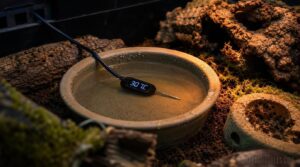
Moving a dish changes everything around it — don’t assume the water temperature stays the same. Allow a full stabilization interval of 10–30 minutes before trusting any reading.
- Probe placement: submerge fully at center, never touching the bottom or rim
- Depth influence: shallower water shifts temperature faster than deeper fills
- Airflow impact: nearby vents or lamps accelerate warming or cooling
- Temperature logging: record readings at 0, 10, and 30 minutes after repositioning
Consistent monitoring equipment and zone-based placement maintain an accurate thermal gradient.
Balance Humidity and Evaporation

Where you place the water dish does more than just offer your snake a drink — it directly shapes the humidity inside the enclosure. A small shift from cool side to warm side can change how fast water evaporates and how much moisture builds up in the air.
Here’s what you need to know about getting that balance right.
For safe bedding choices, explore our beginner’s guide to reptile substrates, including why aspen beats aromatic wood shavings.
How Cool-side Placement Affects Humidity
Cool-side placement naturally cuts evaporation — a simple evaporation cutback that keeps microhumidity stability within reach. Water sitting in cooler air loses moisture more slowly, delivering lowered vapor flux and consistent ambient moisture without constant refilling.
That translates to reduced humidity spikes throughout the day. For species needing 40–60% humidity, placement of water bowls on the cool side makes humidity control almost easy.
How Warm-side Placement Raises Evaporation
Flip that around, and warm side placement tells a different story. A surface temperature boost occurs rapidly—the bowl absorbs radiant heat, steepening the vapor pressure gradient between water and enclosure air. Three things follow:
- Convection currents pull moisture away quickly.
- Heat-driven water loss spikes daily.
- A localized humidity spike forms near the bowl.
This creates a scenario where humidity management through bowl placement actively undermines your efforts.
Using Water Dish Placement During Shedding
Shedding changes the equation. During a shed cycle, raise enclosure humidity to around 70% and shift your dish toward the mid-zone. This aids soaking-induced hydration and gives your snake stress-free soaking access on its own schedule.
Dish depth optimization matters here — keep it shallow. Proper depth ensures safety and accessibility during this vulnerable period.
Watch soaking behavior during pre-shed periods. Behavioral monitoring reveals whether your humidity management using water bowls is actually working. Adjust strategies based on observed activity to maintain optimal conditions.
Preventing Condensation on Enclosure Walls
Condensation shows up when warm, moist air hits a surface cooled past its dew point — typically corners and glass panels first.
Five ways to stop it:
- Apply Insulation Techniques to exterior walls to stabilize surface temperatures
- Maintain Air Seal Integrity around doors, lids, and cable pass-throughs
- Use Ventilation Control to distribute humidity evenly, not pool it
- Practice Heat Source Shielding so radiant heat doesn’t cause uneven wall cooling
- Do Surface Temperature Monitoring regularly, especially after repositioning your dish
Avoiding Humidity Levels That Encourage Mold or Bacteria
Humidity above 70% doesn’t just feel damp — it actively feeds mold and bacteria. Placing your water dish on the cool side of the enclosure is critical. This single choice enables moisture monitoring and microbial prevention.
| Placement Zone | Risk Level |
|---|---|
| Cool side | Low bacterial growth |
| Mid zone | Moderate humidity buildup |
| Warm side | High evaporation, mold risk |
| Near heat source | Rapid surface drying failure |
Combine cool-side placement with airflow management and ventilation strategies to keep surfaces dry and prevent contamination.
Keep Access Safe and Clear
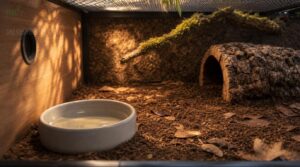
Where you put the water dish matters, but so does what surrounds it.
Your snake needs a clear, calm path to reach it without encountering obstacles or hazards. Here’s what to keep in mind when setting up the area around the bowl.
Leave Open Floor Space Around The Bowl
Don’t crowd your water bowl — give it room to breathe. A clear approach path width of at least 25 cm lets your snake reach the dish without bulldozing substrate into it.
Good decor clearance and a proper bowl access angle reduce splash and keep your cleaning buffer zone dry.
These adjustments ensure fast routine maintenance for water bowl placement and dish size modifications.
Avoid Blocking Hides, Tunnels, or Climbing Routes
Your water bowl shouldn’t block where your snake needs to go. Keep hide entrance access clear — a dish parked in front of a tunnel kills the sweep clearance your snake needs to exit fast.
Pinch point prevention matters too: bowls wedged between walls and decor trap movement.
Sightline preservation and climbing corridor space protect every route, ensuring stress-free navigation.
Use Corner Placement to Save Enclosure Space
Corner placement is one of the smartest enclosure design moves you can make. Tucking the bowl into a wall junction resolves Corner Space Efficiency and Reduced Central Clutter in one shot — freeing up floor space for hides and movement.
Wall Junction Utilization means two sides brace the dish, cutting spill risk. You gain stability while maintaining accessibility.
This approach delivers Dual-side Access, Edge Clearance Maximization, and cleaner zone-based placement without sacrificing reach.
Place The Bowl Where The Snake Can Approach Calmly
Think about where your snake already travels. Place the bowl along its natural travel lane alignment — between a hide and the cool zone — so it encounters water without crossing exposed open space. Hide proximity and low-profile approach paths reduce stress substantially. Quiet zone placement means the snake drinks calmly, on its own terms. That’s the difference between a snake that hydrates consistently and one that avoids the bowl entirely.
Place the water bowl along your snake’s natural path, and it will drink on its own terms
Keep Water Away From Electrical Cords and Fixtures
Electrical components and water don’t mix — ever. Route cords behind or above the enclosure, never near the bowl’s splash zone. Use GFCI installation at every outlet powering heat or lighting. These steps ensure critical separation between electricity and moisture sources.
Keep power supplies and adapters outside any drip path, maintaining distance from water exposure. Leak barriers around breeding tubs provide an additional safeguard, containing spills before they reach electrical zones.
Smart cord routing and deliberate outlet protection eliminate one of the most preventable safety hazards in reptile keeping.
Match Placement to Snake Species
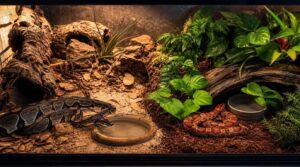
Not every snake plays by the same rules, and where you place the water dish really depends on the species you’re keeping. Each one has its own humidity needs, behavior patterns, and preferred hang-out spots in the enclosure.
Here’s how to get placement right for the most common species keepers work with.
Ball Python Water Dish Placement
Ball pythons thrive when water bowls are placed on the cool side of the enclosure, where the substrate’s thermal inertia maintains steady temperatures of 76–80°F. This placement ensures stability without compromising the heat source. Zone-based positioning further aids humidity regulation by preventing excessive moisture near warming elements.
For optimized airflow and substrate moisture control, corner positioning is recommended. This strategic placement balances environmental conditions while minimizing disruption to the snake’s habitat.
Key implementation steps include:
- Cool-side corner placement
- Heavy ceramic for stability
- Visual cue integration near a hide
- Seasonal placement tweaks during shed cycles
Corn Snake Water Dish Placement
Corn snakes run drier than ball pythons — target 40–60% humidity, and cool-side water bowl placement helps you stay there. Anchor a heavy bowl along the wall near a hide. That cuts observation stress and keeps substrate moisture low. Match water depth and enclosure scaling to your snake’s size for smart sizing and positioning water bowls for corn snakes.
Boa Constrictor Water Dish Placement
Boas run bigger than corn snakes, so your placement strategies for water dishes in breeding enclosures shift considerably. Placement of water bowls on the cool side of the enclosure works best—use zone-based placement, keep UVB proximity in mind, and add visibility markers near nighttime access points.
For managing water access competition among multiple snakes, elevated platforms with water temperature control prevent boas from fouling shared dishes.
Rainbow Boa Water Dish Placement
Unlike boas, rainbow boas demand serious humidity management using water bowls in reptile enclosures — their 75–90% humidity target makes water bowl placement non-negotiable.
- Bowl Size Selection: Use a soaking-capable bowl, placed in the center or warm-side.
- Misting System Coordination: Middle-zone placement balances misting cycles.
- Water Temperature Checks: Avoid hot-spot proximity.
- Seasonal Humidity Tweaks: Shift placement strategies for water dishes in breeding enclosures seasonally.
Burrowing Snake Water Dish Placement
Burrowing species like hognose and sand boas need a completely different approach. Because they constantly bulldoze substrate, a standard ground-level bowl fills with debris quickly. Set your bowl on an Elevated Tile Platform — slate works well — to create an Anti-Bulldozing Surface that stays clear. Use a Heavy Ceramic Bowl to prevent tipping.
| Placement Strategy | Bowl Type | Key Benefit |
|---|---|---|
| Elevated Tile Platform | Heavy Ceramic Bowl | Stops substrate contamination |
| Cool-side zone-based placement | Rimless Bowl Design | Easy access for snakes at night |
| Near the wall with Night-Vision Marking | Weighted ceramic | Snakes locate the bowl reliably |
Humidity management through bowl placement stays simple on the cool side — evaporation stays controlled without surprise spikes.
Adjusting Placement for Hatchlings, Juveniles, and Adults
Age-specific depth and dish size change as your snake grows. Hatchlings need a wide, shallow bowl—no deeper than ¾ inch—with zone-based placement near the cool side for accessibility during growth stages. Juveniles shift toward middle thermal comfort zones, while adults require a size-appropriate bowl on the cool side, where water temperature remains consistent.
Always follow species-specific water bowl recommendations and adhere to safe guidelines for maintaining a water dish gap from heat sources throughout every life stage.
Maintain a Clean Water Station
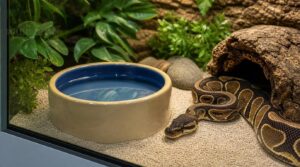
Placement gets your snake to the water — but cleanliness keeps that water safe once they’re there.
A dirty dish undoes every good decision you’ve made about location, material, and humidity. Here’s what to stay on top of.
Choose Stable, Non-porous Bowl Materials
The bowl material you pick quietly determines how clean your water station stays long-term. A nonporous surface won’t trap bacteria between cleanings.
Here are five materials worth knowing:
- Stainless steel — its durability is unsurpassed; resists rust and odors.
- Glazed ceramic — ceramic glaze seals the surface, making it easy to sanitize.
- Borosilicate glass — its heat resistance withstands temperature swings without cracking.
- Silicone — its flexibility makes cleaning straightforward; medical-grade only.
- HDPE plastic — its durability holds up, but composite weight adds stability.
Prevent Tipping With Heavy or Weighted Dishes
A tipped bowl mid-enclosure is a mess waiting to happen. Heavy ceramic bowls settle firmly because its weighted base keeps the center of gravity low.
Rubberized footing grips the floor, while an anti‑tip lip catches substrate if your snake nudges the edge.
A low‑profile stand adds contact area without raising dish weight overhead.
| Feature | Best Option |
|---|---|
| Dish weight | Heavy ceramic or weighted plastic |
| Base grip | Rubberized footing |
| Edge design | Anti‑tip lip |
| Height | Low‑profile stand |
Replace Water Based on Placement and Evaporation
Where your bowl sits directly controls how fast you’re refilling it. Warm-side water bowl placement drives a faster evaporation rate, demanding daily water changes during breeding or shed cycles. Cool-side placement slows placement water loss noticeably.
- Evaporation Monitoring: Check and touch-test the dish daily
- Refill Scheduling: Expect faster loss within the first 1–3 days after repositioning
- Mineral Buildup Check: Residue at dish edges signals high evaporation — clean sooner
Clean Around The Bowl to Prevent Wet Substrate
Wet substrate starts small—a damp ring under the dish that spreads, before you notice. A consistent spot cleaning routine prevents this: wipe splashes immediately, replace waterlogged substrate, and maintain a dry buffer zone around the bowl. Splash control and substrate barrier placement both reduce leak detection surprises.
| Issue | Cause | Fix |
|---|---|---|
| Wet substrate ring | Water seeping outward | Dry buffer zone around bowl |
| Biofilm buildup | Splash residue | Wipe bowl exterior each refill |
| Substrate saturation | Poor water bowl placement | Raise bowl on tile or mat |
Substrate moisture management is your frontline defense against bacterial contamination in reptile habitats. Adjust your cleaning schedule to match placement—warm-side bowls need daily checks.
Inspect Bowl Edges, Cracks, and Surface Damage
Even after cleaning, damage hides in plain sight. Run your fingers along the rim—edge chip detection starts there. Any glaze wear evaluation should catch surface crazing too, that spider-web cracking that traps bacteria.
To evaluate dish damage and replacement criteria, follow this:
- Tap the bowl—hollow sounds signal structural cracks
- Check rim stability by pressing gently; wobble means retire it
- Scan for micro-crack identification along seams and interior lip
- Inspect for surface crazing evaluation across the glaze
- Replace ceramic or resin immediately if cracks exceed 1 mm—a cracked dish isn’t safe
Evaluating resin versus ceramic bowls for durability matters: resin flexes but scratches; ceramic holds shape but chips. Both fail when damaged. Ensuring safety with nonporous water bowls means material considerations for reptile water dishes go beyond looks—integrity is everything.
Adjust Placement if Contamination Happens Often
If damage isn’t the problem but the water keeps turning cloudy, placement is key. Positioning the bowl away from substrate splash zones and high-traffic lanes minimizes debris transfer. Reducing draft airflow around it and increasing feeding distance from the dish further curb contamination sources.
Even moving it 5–10 cm can significantly improve water clarity — the clearest indicator of reduced bacterial contamination risk.
Frequently Asked Questions (FAQs)
How do you care for a snake when shedding?
Shedding is like a snake stepping out of old armor — it needs the right conditions to do it cleanly.
Keep humidity up, offer a warm-water soak around 87–89°F, and add friction objects like logs for clean release.
How do I choose a terrarium for a snake?
Choose the right terrarium by matching Terrarium Size to your snake’s adult length, prioritize ventilation options, escape prevention, and lighting compatibility.
Material choice affects humidity management and temperature gradient maintenance long-term.
How do you keep a snake safe?
Keeping a snake safe means ensuring enclosure escape prevention, using secure lid mechanisms, choosing toxin-free decor, and practicing safe feeding practices.
Smart water bowl placement and stress reduction complete the picture.
Where do snakes hide?
Snakes hide in log shelters, leaf litter, rock crevices, burrow tunnels, and human structures like wall voids or sheds — anywhere dark, snug, and undisturbed feels safe to them.
Where should a snakes water bowl be?
Place it on the cool side, near a hide, away from heat sources. Cool-side bowl elevation slows bacterial growth, reduces evaporation, and keeps water fresh longer between changes.
What are signs of too much humidity for pythons?
Watch for condensation buildup on enclosure walls, crinkled skin with a shiny look, open-mouth breathing or respiratory distress, scale rot, and mold growth.
All these signs signal dangerously high humidity levels encouraging bacterial growth.
Can multiple snakes share one water dish?
Technically, yes — but it’s a bad idea. Shared bowls raise contamination risks, make hydration monitoring nearly impossible, and create competition stress. Give multiple snakes individual bowls. Disease transmission drops immediately.
Should water dishes be elevated off the substrate?
Yes, elevating the dish on a platform helps with wick prevention, mold reduction, and stable water quality — especially for burrowing species needing burrow moisture control.
How often should dish placement be rotated?
Like a thermostat you rarely touch, your rotation schedule should respond to conditions, not a calendar. Let behavioral cues guide you — move the dish when your snake ignores it, water evaporates too fast, or you’ve changed the heat source.
Does dish size affect ideal placement location?
Dish size absolutely affects placement. A larger footprint access point needs more clearance from walls and hides.
Bigger surface area heating and size humidity spread mean cool-side placement becomes less optional — it’s essential.
Conclusion
A bowl in the wrong spot doesn’t just sit there—it quietly works against your snake, day after day. Getting the best placement for a snake water dish in enclosure means reading your setup honestly: heat zones, humidity, and natural paths. Understanding those details ensures clean water becomes a resource your snake actually uses.
That small decision, made thoughtfully, is one of the quietest forms of good care you can give.