This site is supported by our readers. We may earn a commission, at no cost to you, if you purchase through links.

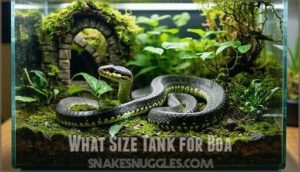
A boa constrictor pressed against the glass of a tank that’s clearly too small isn’t thriving—it’s surviving, and barely. Most new owners get the enclosure wrong not out of neglect, but because pet store recommendations often lag years behind what current care standards actually require. A 40-gallon tank might look roomy when your boa is still a foot long, but that same snake can hit six feet within two years. Getting the minimum enclosure size for your boa right from the start saves you money on unnecessary upgrades and, more importantly, spares your snake the stress of cramped quarters. The right dimensions, materials, and interior layout make every difference between a boa that feeds well and one that paces the glass at 2 a.m.
Table Of Contents
- Key Takeaways
- Minimum Boa Enclosure Size Chart
- Boa Size and Growth Planning
- Best Enclosure Shapes and Materials
- Space Needs for Healthy Boas
- Common Boa Housing Mistakes
- Frequently Asked Questions (FAQs)
- Can any snakes be kept in a 10 gallon tank?
- Can I put a snake in a 20 gallon tank?
- Can boas share space with other reptiles safely?
- How does lighting affect boa enclosure setup?
- What plants are safe inside a boa enclosure?
- How often should a boa enclosure be cleaned?
- Does enclosure size change during boa breeding season?
- Conclusion
Key Takeaways
- Size your boa’s enclosure using the formula snake length × half its length × half its length — a 6-foot boa needs at least a 6×3×3 ft space, and no smaller tank will cut it long-term.
- Pet store recommendations often lag behind current care standards, so plan around your boa’s adult dimensions from day one instead of upgrading reactively as it grows.
- PVC and wooden vivariums outperform glass for humidity and heat retention, but whatever material you choose, double-latch security and escape-proof ventilation aren’t optional.
- Cramped quarters don’t just limit movement — they trigger chronic stress that disrupts feeding, digestion, shedding, and immunity, making proper enclosure size a direct health issue.
Minimum Boa Enclosure Size Chart
Getting the enclosure size right is the single most important decision you’ll make for your boa. The numbers aren’t arbitrary — they’re based on your snake’s actual body length and how it grows over time. Here’s a breakdown of the minimum dimensions for each life stage.
As a rule of thumb, boa constrictor enclosure size by age and length scales directly with your snake, so measuring your boa regularly takes the guesswork out of upgrades.
Baby Boa Dimensions
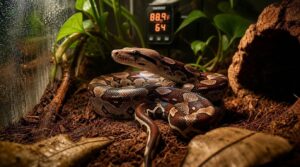
Most baby boa constrictors arrive small — usually 12 to 18 inches long — but they still need thoughtful housing from day one.
| Life Stage | Minimum Dimensions | Approximate Volume |
|---|---|---|
| Neonate (under 2 ft) | 2 ft L × 1.5 ft W × 1 ft H | ~20 gallons |
| Early Juvenile | 4 ft L × 2 ft W × 2 ft H | ~40 gallons |
| Growing Juvenile | 6 ft L × 3 ft W × 3 ft H | ~75 gallons |
For a baby boa constrictor, the minimum recommended dimension starts at 2 feet long. That’s enough room to stretch, thermoregulate, and feel secure without being overwhelmed by open space. Neonates often experience first molt within two weeks, so stable humidity between 50–60% matters immediately. Feed every five to seven days, and handle gently but consistently to build trust early. Remember that the enclosure length plus width should at least match the boa’s total length for proper space.
Juvenile Boa Dimensions
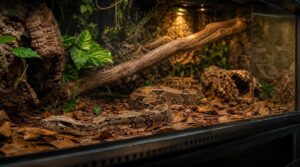
Once your boa hits 2 feet, space requirements jump fast. Juvenile boas (2–5 ft) need at least 4 ft L × 2 ft W × 2 ft H — roughly a 40-gallon footprint. Females grow larger due to sexual dimorphism, so size up sooner if yours is female.
Adult Boa Dimensions

Adult boas usually reach 6–8 feet at maturity, though females often grow larger due to sexual dimorphism — sometimes by a foot or more. Plan your enclosure around snake length × half snake length × half snake length, which works out to a minimum 6 ft L × 3 ft W × 3 ft H for a proper enclosure size.
| Boa Length | Minimum Enclosure Size |
|---|---|
| 5–6 ft | 5×2.5×2.5 ft |
| 6–8 ft | 6×3×3 ft |
Large Boa Custom Sizes
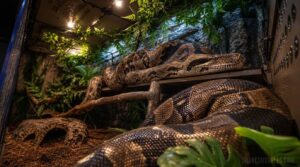
Once a boa pushes past 8 feet, standard tanks simply can’t cut it anymore. Custom enclosures become your only real option — and that means minimum enclosure size jumps to 8 ft × 4 ft × 4 ft or larger.
| Boa Length | Minimum Enclosure Size |
|---|---|
| 8–10 ft | 8×4×4 ft |
| 10+ ft | Custom build ≥10×5×5 ft |
Modular designs help here — they let you expand length without rebuilding everything. PVC copes with humidity challenges well and holds up structurally. Factor cost considerations early; custom enclosures aren’t cheap, but neither are vet bills from a stressed, cramped snake. Build in enrichment space from the start.
Length-Based Sizing Formula
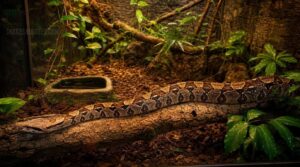
The math behind enclosure sizing is simpler than it sounds. Snake length × half its length × half its length gives you minimum dimensions — so a 6-foot boa needs at least a 6×3×3 ft enclosure. Always add an 18–24 inch safety margin for movement.
For species-specific guidance, consult this snake enclosure size guide before finalizing your materials list.
If you’re housing multiple boas, boa constrictor racks for multi-snake households can help you scale up without sacrificing that critical space-per-snake ratio.
| Boa Length | Minimum Floor Space | Height |
|---|---|---|
| Under 4 ft | 4×2 ft | 2 ft |
| 4–8 ft | 6×3 ft | 3 ft |
| Over 8 ft | 8×4 ft | 4 ft |
Boa Size and Growth Planning
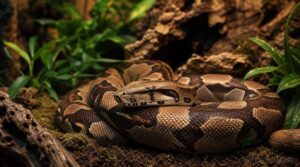
Boas grow fast, and your housing plan needs to keep up. Getting the sizing right from the start means fewer stressful moves and a healthier snake overall. Here’s what to know at each stage of your boa’s growth.
Measuring Your Boa Correctly
Getting an accurate length is the foundation of everything. Measure your boa when it’s relaxed and warm — resting length, not stretched or coiled. Use a flexible tape from snout tip to tail tip. Record girth too, at the widest point behind the shoulders. Log both in a growth chart monthly so you’re never guessing when enclosure dimensions need to change.
When to Upgrade
Once your boa starts pressing against the walls or can’t fully stretch out, that’s your signal. Baby boas under 12 months need an upgrade the moment their enclosure length hits 24 inches — the basking zone simply can’t maintain a proper 85–90 °F range in a space that tight. Juvenile size guidelines shift again at 36 inches, with adults needing at least 48 inches of floor length.
Juvenile Growth Spurts
Young boas can nearly double in length within their first two years. Growth velocity peaks between 12–24 months, driven by hormonal triggers that accelerate bone and muscle development fast. That means your enclosure size can feel right one month and dangerously cramped the next.
Watch for these signs your juvenile boa is outgrowing its space:
- Pacing or repeatedly nosing the glass
- Inability to fully extend during activity
- Increased feeding aggression signaling energy demands rising
- Visible muscle tension from restricted movement
Nutritional demands spike during these growth stages — adequate protein and calcium directly affect how quickly and healthily your juvenile boa develops. Track length monthly so your size guidelines stay accurate.
Permanent Adult Enclosures
Once your boa hits 4–5 feet, you’re thinking long-term. Permanent adult enclosures should measure at least 6 ft × 3 ft × 3 ft — and for boas exceeding 8 ft, custom enclosure dimensions of 8 × 4 × 4 ft become the baseline. Build for the snake they’ll be, not the one they are today.
Avoiding Frequent Moves
Every move is a reset. Snakes thrive on stability, so the goal is to move as few times as possible across your boa’s life. A modular enclosure system lets you expand the space without relocating the animal. Keep a growth log — tracking length monthly helps you anticipate the next size threshold before it’s urgent, not after.
Best Enclosure Shapes and Materials
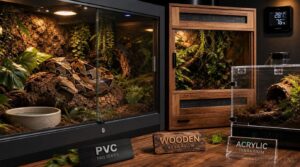
Once you’ve nailed down the right size, the next question is what that enclosure is actually made of — and the shape it takes. Not every material works equally well for boas, and the wrong choice can make temperature and humidity harder to control. Here are the main options worth knowing.
Floor Space Priority
When choosing an enclosure shape, floor space comes first. Boas are ground-dwellers — they spend most of their time moving horizontally, not climbing. That means a long, wide footprint matters more than height. Use the formula snake length × half length × half length to size correctly. Keep décor minimal near the substrate so your boa has clear, unobstructed lanes to move and thermoregulate comfortably.
Glass Tank Pros
Glass tanks are a solid starting point for many boa keepers. Clear, unobstructed visibility lets you monitor your boa’s behavior and color daily. Tempered glass panels resist accidental bumps, and non-porous surfaces wipe clean fast. They’re widely available, affordable, and compatible with most lighting setups — no special adapters needed. For juveniles especially, a glass terrarium offers great value without compromising care.
Wooden Vivarium Pros
Wood does something glass can’t — it holds heat. Wooden vivariums excel at thermal insulation, keeping your boa’s temperature gradient stable overnight without overworking your heating equipment. They also handle humidity control naturally, making that 50–60% range easier to maintain. Custom-built enclosures can include built-in hides and mounted equipment, fitting your exact space. Seal everything with a VOC-free sealant, and you’re set.
PVC Enclosure Pros
PVC is where practicality wins. Unlike wood, it won’t warp or delaminate in humid conditions — making it a smart long-term pick for boas that need consistent moisture levels.
- Lightweight build makes repositioning easy
- Non-porous surface simplifies cleaning and disinfecting
- Modular design allows expansion as your boa grows
- Pest and mold resistance keeps conditions cleaner
- Cost efficiency lowers upfront and maintenance spending
Escape-Proof Design
A boa that wants out will find any weakness you leave it. That’s why escape-proof enclosure design starts with layered security, not just a single latch.
Double latch systems use two independent locks — if one gets jostled, the second holds. Pair that with reinforced corner joints and anti-pry shields along door edges, and you’ve closed most escape routes.
Micro-mesh screening and secure ventilation channels keep airflow moving without creating gaps a curious snout can exploit.
Space Needs for Healthy Boas
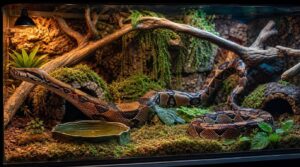
Getting the size right is only part of the equation — how you use that space matters just as much. Your boa needs room to move, hide, climb, and regulate its own body temperature every single day. Here’s what to focus on inside the enclosure.
Room for Thermoregulation
A boa can’t regulate its own body temperature — it depends entirely on you to build the right thermal environment. Your enclosure needs a clear warm-to-cool gradient: 88–92 °F on the basking side, 78–82 °F on the cool end. Keep these zones accessible at all times:
- A stable basking spot for warming up fast
- A cool retreat for slowing down safely
- Nighttime temps dropping to 70–75 °F to mimic natural cycles
Thermostat regulation prevents dangerous heat spikes, while infrared temp checks confirm your substrate is distributing warmth evenly — not creating hidden hot zones.
Proper Hide Placement
Hides aren’t decorative — they’re essential. Place a warm side hide directly over your heat source so your boa can thermoregulate without exposure. Add a cool side retreat on the opposite end. A humidity moist hide in the middle, packed with damp sphagnum moss, promotes healthy shedding. Each hide should sit flush on the substrate with no gaps larger than your boa’s head.
Climbing Support
Boas aren’t strictly ground-dwellers. Many show semiarboreal tendencies, especially juveniles — and ignoring that means missing an easy enrichment win. Add horizontal branches at staggered heights, using diameters between 1.5 and 3.5 inches so your boa can wrap comfortably. In a 4x2x2 enclosure, one mid-height branch and one near the top covers most adults well.
Substrate Depth Needs
Think of substrate as the foundation beneath everything else — and depth matters more than most keepers realize. Aim for at least 2–4 inches to support natural burrowing behavior and even thermal layering. Deeper substrate, around 12 inches, helps regulate temperature swings and gives your boa cooler zones to retreat into. Here’s what to prioritize with substrate selection:
- Moisture-retaining substrates like coconut fiber need sufficient depth to prevent surface compaction and support stable humidity.
- Loose, medium-grain options require deeper layers so burrowing behavior stays comfortable and natural.
- Organic mixes with soil components benefit from 12-inch depths to keep microbial activity healthy without anaerobic pockets.
- Maintenance schedules should include depth checks every 6–12 months — compacted substrate loses its thermal and skin health benefits fast.
Adequate depth reduces skin abrasion, facilitates full-body movement, and keeps shedding on track.
Stress From Tight Spaces
A cramped enclosure doesn’t just limit movement — it actively works against your boa’s health. Confined quarters trigger cortisol spikes and elevated heart rate, keeping your snake in a near-constant low-grade stress state. That stress shows up as pacing, glass-chewing, and stereotypic behaviors that signal frustration. Poor ventilation compounds this fast, stacking heat stress on top of everything else.
A cramped enclosure doesn’t just limit your boa’s movement — it traps it in chronic stress
Common Boa Housing Mistakes
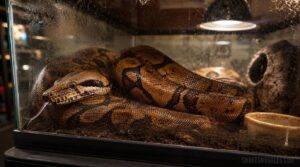
Even experienced keepers make housing mistakes that quietly stress their boas over time. Most of these problems come down to a few recurring oversights — the kind that are easy to miss until your snake starts showing signs of trouble. Here’s what to watch for.
Tanks Too Short
Short tanks are one of the most damaging mistakes you can make. When enclosure dimensions fall short, your boa can’t move in a straight line — and that matters more than you’d think. Straight movement aids digestion, assists hydration cycles, and reduces chronic stress. Tight spaces trigger glass-chewing and pacing, clear signs something’s wrong.
Poor Lid Security
Glass tanks are easy to overlook here — but a loose lid is its own hazard. Gaps as small as 2–5 mm give a boa enough pry space to push free. Check every latch weekly. Watch for:
- Sagging hinges creating micro-gaps over time
- Corroded lock pins loosening with each cleaning cycle
- Aged rubber seals shrinking and losing contact
Use four clamps minimum on glass enclosures.
Weak Temperature Gradient
A loose lid lets your boa escape — a weak temperature gradient keeps it sick from the inside. Boas need a clear thermal zone split: a warm basking side at 88–92 °F and a cool side at 78–82 °F. Without that range, your boa can’t thermoregulate properly, and digestion, immunity, and shedding all suffer.
Overcrowding Multiple Boas
Boas are solitary creatures — they don’t share space well. Putting two or more together might seem efficient, but it triggers real social stress effects: elevated cortisol-like responses, reduced feeding, and dominance aggression over basking spots and hides. Close contact also accelerates disease transmission risks, from respiratory infections to parasites. Overcrowding quietly stunts growth and chips away at each boa’s long-term health.
Delaying Custom Builds
Waiting too long to commission custom-built enclosures is one of the most avoidable mistakes boa keepers make. Enclosure manufacturers often have lead times of 2–6 months — and that’s before any design revisions, permit delays, or material shortages hit. Plan ahead:
- Measure your boa every three months
- Order before your boa outgrows its current setup
- Confirm supplier lead times upfront
- Lock in dimensions early to avoid costly redesigns
- Budget for unexpected coordination gaps between builder and delivery
A plastic storage tub buys short-term time, but it’s not a long-term fix. Start the process early.
Frequently Asked Questions (FAQs)
Can any snakes be kept in a 10 gallon tank?
A 10-gallon tank works for only a handful of species — think ring-necked snakes or DeKay’s brownsnakes. For boas, even hatchlings, it’s too small from day one.
Can I put a snake in a 20 gallon tank?
Yes — but only for a baby boa under 2 feet. A 20-gallon tank works short-term, but juvenile and adult boas quickly outgrow it, turning cramped quarters into a health risk.
Can boas share space with other reptiles safely?
Most boas do best alone. Predation and stress risks are real — a boa can injure or kill smaller reptiles. Disease transmission through shared substrate adds another serious layer of danger.
How does lighting affect boa enclosure setup?
Lighting acts like a hidden dial controlling your boa’s behavior. Stick to a 12-hour photoperiod, keep UVB zones defined, and use 5000–6500K daylight bulbs paired with a ceramic heat emitter at night.
What plants are safe inside a boa enclosure?
Stick to non-toxic varieties like pothos, spider plant, and Boston fern. They’re safe if your boa nibbles and naturally boost humidity — a win for shedding and overall enclosure health.
How often should a boa enclosure be cleaned?
Think of your enclosure like a kitchen — let it go too long, and problems stack up fast. Spot clean twice weekly, deep clean monthly, and replace substrate showing moisture or odor immediately.
Does enclosure size change during boa breeding season?
For most keepers, enclosure size doesn’t permanently change during breeding season. You may temporarily house a pair together in a larger space, but once mating is done, separate them.
Conclusion
Getting the minimum enclosure size boa owners actually need isn’t just a numbers game—it’s the whole playing field. A snake that can stretch out, thermoregulate properly, and retreat to a secure hide isn’t just comfortable; it’s behaviorally balanced and far easier to keep healthy long-term. Skip the undersized starter tanks, plan for your boa’s adult dimensions from day one, and build an enclosure worth growing into. Your snake can’t ask for more space—but now you know it needs it.