This site is supported by our readers. We may earn a commission, at no cost to you, if you purchase through links.

Your snake doesn’t know the difference between a hook and a hand. It only knows what happens next. Reach in the wrong way, and that sleepy ball python becomes a feeding-response gamble.
Daily care depends on clear signals, and snake handling hooks for daily feeding routines are the tool that sends them. A hook says "movement." Tongs say "food." Blur those cues, and you risk a strike, a regurgitated meal, or a stressed animal that stops trusting your enclosure.
Good news: you can fix this with the right hook, a short training routine, and a few firm habits. Start with the hook itself.
Table Of Contents
- Key Takeaways
- Choose The Right Snake Hook for Your Snake’s Size and Enclosure
- Separate Handling Cues From Feeding Cues: Hooks Vs. Tongs
- Start Gentle Hook Training With Supported Mid-Body Contact
- Use Snake Hooks Safely Around Feeding Routines
- Clean and Inspect Snake Hooks to Prevent Injury and Scent Transfer
- Frequently Asked Questions (FAQs)
- Should you handle your snake every day?
- What can I use instead of a snake hook?
- What are some good snake hooks?
- How many days after feeding can I handle my snake?
- Can you handle your snake on feeding day?
- How often should snake hooks be fully replaced?
- Can hook training work for venomous snake species?
- What hook materials reduce wrist fatigue during handling?
- Do experts recommend hook training for all snakes?
- How much do quality snake handling hooks cost?
- Conclusion
Key Takeaways
- Give your hook and your tongs one job each, hook for "we’re moving" and tongs for "food is here," so your snake never has to guess what’s coming.
- Pick a hook sized to your enclosure and animal, with a rounded, scale-friendly tip, and train gently by supporting the mid-body in sessions under two minutes.
- Keep feeding predictable by feeding in the home enclosure with tongs, then leaving your snake alone for 48 to 72 hours afterward to avoid regurgitation and defensive strikes.
- Wash, inspect, and dry your hook after every feeding so food scent doesn’t linger and cracks, corrosion, or fatigue don’t turn into an injury.
Choose The Right Snake Hook for Your Snake’s Size and Enclosure
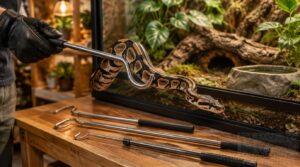
Shaft length decides how much control you actually have. Match your hook size to the enclosure, not to your comfort level. In a tank under 24 inches wide, a 15 to 24 inch hook gives you precision. Racks and large enclosures call for 30 inches or more, so telescoping hooks earn their spot in your kit.
If space is tight, a guide to feeding tongs for small-apartment snake keepers can help you pick a length that works without crowding your enclosure.
Weight matters too. Keep it under 6 ounces and your wrist won’t complain after daily handling.
Now match the tool to the animal. A ball python at 4 to 6 feet needs a reinforced shaft that won’t bend. Juveniles and small colubrids do better with thinner shafts. Choose a scalefriendly hook tip, rounded or open J-shaped, so mid-body support never scrapes scales or punctures.
Separate Handling Cues From Feeding Cues: Hooks Vs. Tongs

Once your hook fits, teach it a job. Your snake reads behavioral cues fast, so each tool needs one meaning. Snake handling hooks say "we’re moving," while tongs say "food is here." Blur that line and you invite strikes.
| Tool | Signal | Use |
|---|---|---|
| Hook | Move | Lift, reposition |
| Tongs | Food | Present prey |
| Hook | Not food | Between meals |
| Tongs | Stationary | Hold prey above substrate |
Keep feeding cue separation strict. Handle with the hook at least 24 to 48 hours before or after meals, which protects handling safety and prevents regurgitation. Hold tongs still, prey suspended above the substrate, so it mimics natural movement without your scent. Consistency, not cleverness, builds this. Tools aren’t interchangeable. Pick one per task, every time, and your snake learns.
If you’re raising a young boa, what baby boas eat and how often they should be fed will help you pick the right prey size and keep that tong-feeding routine consistent.
Start Gentle Hook Training With Supported Mid-Body Contact
Your hook now means "we’re moving," so teach that message slowly. Work inside the home enclosure with the snake calm and settled, and clear the space around it first.
Slide the hook under the thickest part of the mid-body, never near the head, neck, or tail. Lift gradually and support the underside with your free hand. Use just enough pressure to guide, not squeeze.
Keep sessions under two minutes. Skip shed cycles and digestion, and train at the same time each day so the cue stays predictable.
Watch your snake, not the clock. A strike, musk, or retreat means stop. Relaxed movement is your green light, while tight coiling or thrashing isn’t. Let the snake settle fully before you step away. That’s your safety margin.
Hook training builds trust, not tolerance.
Use Snake Hooks Safely Around Feeding Routines

Your hook isn’t just a tool, it’s a signal, and feeding time is where that signal can get muddled. The four points below show you how to keep handling and feeding cleanly separate. Follow them and you’ll cut down on defensive strikes and food-response bites.
If you also work outdoors, a sturdy snake handling hook built for field work gives you extra reach and control while keeping your hands safely away from the animal.
Daily Checks, Not Daily Feeding
Your hook is for looking, not for feeding. Snake handling hooks belong to your daily checks, so keep them tied to quick visual inspection only.
Lift gently, scan for shed, injuries, and body condition, then set your snake down. Skip any hunger cues. Feeding schedule consistency matters more than daily feeding, and snake hook safety starts with that clear line.
Feed in The Home Enclosure
Enclosures your snake already knows make feeding safer, because familiar scent boundaries lower stress and reduce defensive strikes.
Pair snake handling hooks with hook training, then set up:
- Lay tile or heavy paper as a solid feeding surface.
- Park the water bowl away from the strike zone.
- Lock the lid before the snake notices prey.
That’s real snake handling safety.
Use Tongs for Prey Presentation
Grab your tongs, not your hook, when it’s feeding time. Grip the thawed prey near the midsection and keep 6 to 12 inches between your hand and the snake’s head. Wiggle it gently, present it head-first, and hold steady until the snake locks on.
Keep prey scent off your fingers, and wash your tongs afterward. Clean tools protect snake handling safety.
Avoid Handling After Feeding
Picture a python curled tight around a lump the size of a rolled sock, sides pulsing as it digests. That’s a recently fed snake, and it’s not in the mood for company.
Leave it alone. Handling now risks:
- Regurgitated meals, wasted and stressful
- Slowed digestion from cooler air
- Defensive strikes, so keep bite prevention techniques sharp
- Disrupted snake feeding schedule
Clean and Inspect Snake Hooks to Prevent Injury and Scent Transfer

Think of your snake hook as a chef’s knife: it only works well when it’s clean, sharp, and sound. Skip snake hook cleaning and the metal becomes a scent carrier, teaching your snake that the hook means food.
A snake hook works like a chef’s knife, but if you skip cleaning it, the metal carries food scent and teaches your snake that the hook means dinner
Right after each feeding, wash the hook in hot soapy water, then soak it in a 1:32 bleach solution for five minutes. Rinse thoroughly. Wipes work between sessions, but they’re a stopgap, not a substitute.
Next comes snake hook inspection. Check the tip for pitting, cracks, or deformation, and look for corrosion at metal junctions. Make sure rivets are tight and moving parts don’t wobble.
Some hooks are made from extruded Lexan polycarbonate rod rather than aluminum, so check for stress cracks or clouding in the plastic as well.
Dry it completely. Store it in a dedicated, dry container, away from prey and substrate. Good tool hygiene means wash, inspect, and dry the hook, every time.
Frequently Asked Questions (FAQs)
Should you handle your snake every day?
Daily handling won’t turn your snake into a puppy, so don’t. Keep hook training sessions short, and let feeding days stay quiet. Snake handling hooks and snake hook safety support stress reduction, not constant contact.
What can I use instead of a snake hook?
Think of a hook as one tool in a crowded toolbox. Longhandled tongs work for feeding, gloves protect during quick moves, and the Wamlet Snake Grabber Hook Tool, with its soft gelatinous coating, is good for gentle guiding.
What are some good snake hooks?
Your snake doesn’t care about brand names, only whether the hook feels safe. Pick snake handling hooks for beginners with a ball tip, rubberized grip, and the right hook size. Keep longhandled tongs for feeding.
How many days after feeding can I handle my snake?
Think 24 hours is enough? That’s a myth. Wait 48 to 72 hours after feeding, and a full 72 hours for boas and pythons. Handling sooner stresses your snake and risks regurgitation, so be patient.
Can you handle your snake on feeding day?
Feeding day is a closed door, not a handshake. Skip hook training and midbody contact; digestion stress invites regurgitation. Wear safety glasses for feeding, and wait 48 hours before handling. Temperament management starts with patience.
How often should snake hooks be fully replaced?
Your hook is a guardian, and guardians tire unseen. For daily feeding, replace it every six months, not when it looks worn. Fatigue hides inside metal, so plan around snake hook durability and material selection.
Can hook training work for venomous snake species?
A Puff Adder lies coiled like a loaded spring.
Hook training still works, but you’ll need short sessions, slow movements, and a long hook. That distance control prevents defensive strikes, even when prey scent lingers.
What hook materials reduce wrist fatigue during handling?
Think stainless steel is safer? Not always, since it’s heavy.
Smart hook material selection favors aluminum for lighter lifts, plus a nonslip grip. Good hook ergonomics, within your hook weight capacity, keeps your wrists fresh.
Do experts recommend hook training for all snakes?
Experts don’t push hook training on every snake. It’s snake temperament management: calm corn snakes often need none, while food-reactive or defensive animals benefit most. Match reptile behavior training to the individual, not the species.
How much do quality snake handling hooks cost?
A hook is your reach, not your grip.
Budget hooks run $15 to $35, while stainless steel costs $60 to $ This price comparison favors snake handling hooks for beginners: start mid-range, $30 to $
Conclusion
Picture Dana, who taps her corn snake with a hook, waits, then offers a mouse with tongs. No strikes, no confusion.
That’s the payoff of snake handling hooks for daily feeding routines: clear signals, repeated calmly. Pick a hook that fits your snake, keep tongs for food, and feed in the home enclosure. Skip handling after meals. Clean your tools every time.
Your snake reads every move. Make each one say exactly what you mean.