This site is supported by our readers. We may earn a commission, at no cost to you, if you purchase through links.
A snake coiled at your feet, mouth agape, hissing with enough force to fill the air—and doing absolutely nothing. No strike, no venom, no contact.
What you’re witnessing isn’t hesitation; it’s a precisely calibrated performance, one refined across millions of years of evolutionary pressure.
Venom synthesis demands days of metabolic energy, and a fractured fang mid‑strike carries consequences that outlast any single threat.
Snake bluffing without biting isn’t a fallback behavior—it’s the preferred strategy.
Understanding the mechanisms behind these displays tells you exactly when to hold your ground and when to give ground quietly.
Table Of Contents
- Key Takeaways
- What is Snake Bluffing?
- Why Snakes Bluff Without Biting
- Common Snake Bluffing Behaviors
- Bluff Strike or Real Bite?
- Safe Responses to Bluffing Snakes
- Frequently Asked Questions (FAQs)
- How to handle a snake so it doesn’t bite you?
- Can hognose snakes fake death after bluffing?
- Do baby snakes bluff as effectively as adults?
- Which non-venomous species most convincingly mimic rattlesnakes?
- How does temperature affect a snakes bluffing intensity?
- Can bluffing behavior be reduced through consistent handling routines?
- Conclusion
Key Takeaways
- Snakes bluff instead of biting because making venom costs them days of energy and a broken fang can be deadly, so intimidation is almost always the smarter move.
- A bluffing snake layers tricks like puffing up, hissing, tail-shaking, and fake lunges to look bigger and scarier without ever risking contact.
- You can usually tell a bluff from a real attack by watching the snake’s body: relaxed jaw, shallow S-curve, and lunges that stop short, all mean it’s putting on a show, not preparing to strike.
- If you back away slowly, give the snake plenty of space, and never trap it in a corner, you’ll almost always defuse the situation before it escalates to a real bite.
What is Snake Bluffing?
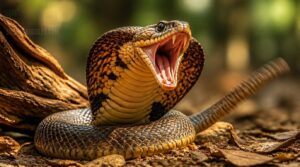
When a snake faces a threat it can’t outrun, it doesn’t panic — it performs. Snake bluffing is a precisely calibrated set of defensive behaviors designed to intimidate without ever making contact, and once you understand the logic behind it, you’ll read these signals completely differently.
Having the right reptile handling equipment on hand means you can respond to these bluffing displays with calm, deliberate movements instead of instinct-driven reactions.
Here’s what’s actually happening when a snake stands its ground.
Defensive Warning Behavior
When a snake feels cornered, it doesn’t default to biting — it performs. Defensive warning behavior is a precisely orchestrated intimidation display: the snake expands its neck to enlarge its silhouette, gapes its mouth without committing to contact, and emits sustained hissing by expelling air through the glottis, each signal calibrated to communicate threat without physical escalation.
Human defensive behavior research shows a comparable decision‑tree hierarchy, where threat magnitude and type dictate responses such as flight, freeze, or hide, echoing the snake’s warning displays.
Bluffing Versus Aggression
Understanding the line between bluffing and aggression changes everything. A bluffing snake relies on intentional deception — false strikes, defensive posturing, and mock charges — to manufacture threat without committing.
True aggression is different: tight coiling, head centered, body primed. Strategic timing and risk assessment drive both.
Recognizing snake body language and behavioral credibility tells you which performance you’re watching.
Why Snakes Avoid Biting
Biting is, in biological terms, a last resort. Venom production carries real metabolic costs — synthesizing toxins demands energy that could otherwise fuel digestion, thermoregulation, or reproduction. Depleting stored venom through a defensive bite also compromises future hunting success.
A dry bluff attack, by contrast, preserves that resource entirely, making intimidation the smarter calculation when a threat can be deterred without contact.
Common Bluffing Situations
Knowing why snakes bluff is only half the picture — knowing when they do it sharpens your awareness considerably.
Enclosure stress triggers rank among the most common causes in captive settings, particularly when temperature gradients are inadequate or hides are absent. Sudden movement reactions are equally reliable escalators: approach a resting Crotalus atrox too quickly, and that defensive display ignites almost reflexively.
Why Snakes Bluff Without Biting

Snake bluffing isn’t random panic — it’s a calculated strategy shaped by survival pressures that go back millions of years. Every hiss, lunge, and rattle fulfills a specific biological purpose you’ll recognize once you know what to look for. Here’s why snakes choose intimidation over biting:
Venom Conservation
Venom is among the most metabolically expensive substances a snake produces, so deploying it carelessly is a biological gamble no successful predator can afford.
This is the engine behind venom economy — the calculated restraint that makes a dry strike or bluff lunge far more advantageous than an actual envenomation.
Each drop drawn from venom reserves represents energy that took days to synthesize.
That’s why snakes are so reluctant to strike defensively — and why following safe venomous snake handling best practices helps ensure they never feel the need to.
Injury Avoidance
Every strike — real or false — carries mechanical risk, because fang tips are remarkably fragile structures that can fracture on impact. A bluff strike or false strike lets the snake broadcast a clear defensive display while keeping those delicate fangs intact.
Think of it as safe movement patterns applied biologically: controlled, deliberate, contact‑free.
Predator Deterrence
Predator deterrence is where snake bluffing truly becomes an art form. Rather than committing to a costly false strike, a bluffing snake layers multiple simultaneous signals — visual mimicry, acoustic warnings, and olfactory deterrents — to overwhelm a predator’s threat-assessment system before contact occurs.
Consider what that layered defense actually deploys:
- Silhouette simulation through hood expansion makes the snake appear far larger than its actual mass
- High-contrast color bands near the head function as biological stop signs, triggering hardwired avoidance reactions in predators
- Sustained hissing, produced by controlled air expulsion through the glottis, adds an unmistakable acoustic dimension to the defensive display
- Cloacal chemical releases create a lingering olfactory deterrent field that persists after the snake retreats
- Environmental defense — using shadows, rocks, and vegetation — amplifies the snake’s warning posture by controlling sightlines
What makes this notable is the economy of it. Snake body language achieves deterrence through information overload rather than physical force, compelling a predator to recalculate risk without either animal sustaining injury.
Stress and Fear Responses
When a bluffing snake rears into its S-curve, it isn’t acting alone — your amygdala fires before your conscious mind registers the threat. Cortisol peaks within 20–30 minutes, sustaining that physiological arousal long after the snake retreats.
That prolonged hormonal vigilance actually mirrors the snake’s own stress response, both of you locked in a mutual appraisal of danger, each interpreting the other’s posture.
Energy-saving Defense
Think of a bluff strike as nature’s energy-efficient survival shortcut. Producing venom is metabolically expensive — deploying a false strike instead preserves that biochemical resource entirely.
Venom conservation lets the snake reserve its toxins for actual prey capture, where they’re genuinely indispensable. For a bluffing snake, intimidation isn’t a weakness; it’s elegant, calculated economy.
Venom is too costly to waste—for a bluffing snake, intimidation is not weakness, it is economy
Common Snake Bluffing Behaviors
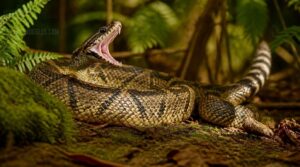
When a snake feels cornered, it doesn’t stay silent — it performs. Every species has its own repertoire of threat displays, each one a calculated move designed to make you back off before things escalate to an actual bite. Here are the most common bluffing behaviors you’ll encounter and what each one is really telling you.
Hissing and Puffing
When a snake hisses, it forces air through its glottis and larynx, causing throat tissues to vibrate into that unmistakable, continuous rasp — a sound ranging from low to mid frequencies depending on body size.
Puffing amplifies the threat visually: rapid air expulsion swells the anterior body, broadening the silhouette dramatically.
Together, these signals communicate imminent defense without a single strike.
Tail Vibrating
Tail vibrating picks up where hissing leaves off. Caudal muscle contractions fire in rapid succession, shaking the tail tip tens to hundreds of times per second — a localized tremor that leaves the upper body free to retreat or recoil. Tail scale amplification turns that motion into a flickering visual cue no alert predator can ignore.
Acoustic mimicry tactics make this especially notable. Copperheads and rat snakes vibrate their tails against dry leaves, generating a rasping sound that closely resembles a rattlesnake’s warning. Predator misdirection follows naturally: attention shifts toward the tail, away from the head — a deliberate visual false tail strategy that exploits the predator’s own recognition memory.
Bluff intensity varies with threat level. Repeated vibrations signal an escalating warning, not a singular bluff.
Neck Flattening
When a snake flattens its neck, it’s doing something far more calculated than a simple flinch. Lateral neck muscles contract, pulling the cervical profile wide, transforming a slender silhouette into an exaggerated hood that signals unmistakable warning.
Cobras execute this with iconic precision; colubrids like grass snakes achieve subtler versions. That silhouette exaggeration exploits a predator’s hardwired threat-assessment — bigger means danger.
Mouth-closed Lunges
A neck-flattening display dominates space visually — but a mouth-closed lunge commands it physically. This false strike is a closed-mouth forward surge that stops short of contact, testing your reaction without committing venom.
Jaw muscles tighten visibly, weight shifts onto the anterior body, and the snake reads your response before deciding whether the bluff needs escalating.
S-shaped Posture
The lunge stops short — but the S-shaped posture is what makes a snake look unstoppable before it even moves. By raising the front third of its body into a coiled S curve, a snake increases perceived length dramatically, commanding space through sheer visual presence.
Eastern diamondbacks hold this stance for prolonged standoffs — predator intimidation at its most architectural.
Bluff Strike or Real Bite?
Reading a snake’s intent isn’t guesswork — it’s a skill built on knowing what to look for. The difference between a bluff strike and a genuine bite comes down to specific, observable cues that your snake’s body is already broadcasting. Here’s what those signals actually look like.
Body Posture Clues
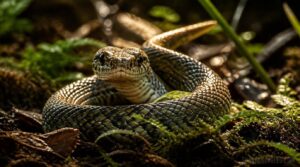
Reading a defensive posture correctly is a skill worth mastering.
Watch the neck angle: a forward tilt with a tucked chin signals caution, not commitment. Eye gaze stays locked on you, unblinking, while the trunk arches into a shallow S-shaped posture.
The tailbase lifts, jaw muscles stay tense but closed—classic bluff body language, not an imminent strike.
Strike Distance Limits
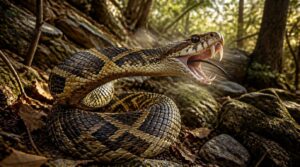
Every snake you encounter operates within an invisible boundary — the minimum strike distance — and crossing it is what separates a bluff from a genuine threat.
- Species size matters: larger snakes strike from greater distances than smaller ones
- Metabolic state shifts range: a cold, sluggish snake has a shorter effective reach
- Terrain compresses distance: rocks, debris, or dense vegetation reduce accuracy and usable range
- Target motion accelerates response: fast movement pulls a snake toward its limit faster
- Safe response: maintain at least twice the snake’s body length — roughly six feet — as clearance
A false strike, or dry strike, often occurs right at this threshold, where the snake lunges without venom injection to test your proximity before committing fully.
Repeated Warning Lunges

When a snake repeats its forward lunges in quick succession — rather than committing to a single decisive strike — you’re witnessing a precisely calibrated threat display, not an attack.
Each lunge in this defensive cadence is closed-mouthed, deliberately short of contact, and paired with body puffing and auditory hissing that intensifies with each repetition, amplifying snake intimidation without venom expenditure.
Escalation Warning Signs
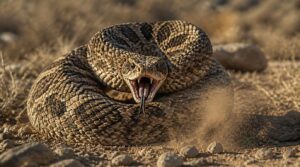
The moment a snake’s bluff shifts to genuine threat, the behavioral cues stack rapidly. Watch for these escalating warning signals:
- Verbal intensity cues: hissing becomes sustained and louder
- Physical tension indicators: body coils tighten, head centers
- Agitation behavioral shifts: lunges shorten the gap progressively
- Proximity invasion risks: the snake advances rather than holding position
Dry Strikes Explained
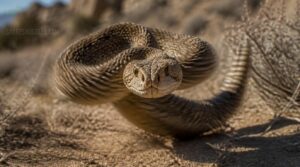
A dry strike is a closed-mouth lunge that stops just short of contact — the snake’s version of a warning shot. Rather than deploying venom, the snake uses rapid lunging physics to create psychological impact, conserving metabolically expensive toxin entirely. The lunge itself is shorter than a true bite, often ending before skin contact, yet it’s startlingly convincing.
| Feature | Dry Strike | Real Bite |
|---|---|---|
| Mouth position | Closed or barely open | Fully open, fangs extended |
| Venom release | None | Delivered on contact |
| Strike distance | Shortened, pulls back early | Full body-length extension |
| Muscular effort | Lower energy expenditure | Maximum muscular engagement |
| Follow-through | Snake retreats after lunge | Snake may hold or recoil |
This defensive behavior preserves venom for actual prey capture while still delivering a deterrent powerful enough to stop most predators cold.
Safe Responses to Bluffing Snakes

When a snake shifts into bluffing mode, your next move determines whether the situation de-escalates or turns into something you didn’t want. The good news is that you have more control here than you might think — and it comes down to a handful of deliberate, practiced responses. Here’s exactly what to do when a snake starts bluffing.
Give Extra Space
Distance is power here. The moment a snake settles into defensive body posturing, you want at least 1.5 body lengths of buffer zone—more if terrain allows.
Use lateral movement rather than backing straight away, and let it retreat toward natural cover. Check obstacle clearance behind you first; tripping near a snake mid-false strike turns a bluff into real danger.
Avoid Sudden Movements
Spacing alone won’t save you if you spook the animal with a fast hand or quick pivot. Steady body control beats speed every time.
- Move at a controlled walking pace
- Minimize sudden shifts in posture
- Keep arms low, avoid abrupt pivots
- Reduce silhouette movement against open ground
Calm movement reads as non-threat, lowering false strike odds and reinforcing genuine bite prevention.
Never Corner Snakes
Even the steadiest hands can inadvertently trap a snake between you and a wall, triggering an immediate threat display. Always verify your snake has an unobstructed path to its hide before you open the enclosure. Enclosure retreat options aren’t optional — they’re the architecture of bite prevention itself.
Reduce Handling Stress
Keeping sessions to five to ten minutes dramatically reduces cortisol spikes — research confirms gentle, consistent handling cuts stress hormones by 20 to 40 percent.
Move slowly, read your snake’s body language closely, and end the session before any defensive behavior escalates.
A snake that never reaches the false-strike threshold trusts you more deeply over time.
Improve Enclosure Comfort
Chronic stress is the hidden driver behind most bluff displays — and your enclosure design controls it.
Maintain a warm basking zone of 88–92°F alongside cooler retreats at 78–82°F, so your snake thermoregulates actively rather than sitting coiled in anxiety.
Multiple secure hiding structures, species-appropriate substrate depth, and a consistent 12-hour light cycle transform the enclosure from a stressor into a sanctuary.
Frequently Asked Questions (FAQs)
How to handle a snake so it doesn’t bite you?
Master the snake’s body language first: read its defensive body posturing, choose hooks or tongs over bare hands, inspect gear beforehand, hold safe distance, and move slow, calm, and deliberate—never cornering it.
Can hognose snakes fake death after bluffing?
Yes — once hissing fails, the Eastern Hognose Snake escalates into full thanatosis, flipping belly-up, gaping its mouth, and feigning a limp corpse to complete its predator deception until danger passes.
Do baby snakes bluff as effectively as adults?
Baby snakes bluff, but far less powerfully. Their hisses are softer, their postures smaller, and hatchling evasion tactics favor rapid retreat over sustained display — juvenile bluffing effectiveness genuinely grows with body mass and experience.
Which non-venomous species most convincingly mimic rattlesnakes?
Gopher snakes lead convincingly, vibrating tails on dry leaves while flattening their heads to mirror rattlesnake silhouettes. Western hognose snakes and indigo snakes follow closely, deploying Batesian mimicry through posture, coiling, and acoustic illusion.
How does temperature affect a snakes bluffing intensity?
Heat turns up the dial: warmer bodies mean faster muscle performance, sharper displays, and bolder posturing.
Desert species intensify this fastest.
Cold temperature latency slows everything down—sluggish, half-hearted warnings, since the thermal energy impact governs every ounce of bluffing intensity.
Can bluffing behavior be reduced through consistent handling routines?
Absolutely. Predictable handling schedules, gradual exposure, and adapted routines drive genuine habituation—monitoring stress cues along the way. Master this behavioral conditioning, and you’ll command calmer responses, fewer defensive displays, and a snake that trusts your hands instead of fearing them.
Conclusion
Every bluffing display is a snake’s negotiation—an ancient contract written in posture, breath, and sound that says: leave me be, and no one pays the price.
- Recognizing snake bluffing without biting means you’ve learned to read that contract fluently. Freeze, widen your distance, and let the performance conclude on its own terms. The snake isn’t your adversary; it’s an ectothermic survivor running a system that has outlasted every predator it’s ever faced—including, ideally, you.