This site is supported by our readers. We may earn a commission, at no cost to you, if you purchase through links.

Ninety-six percent of U.S. universities ban pets from dorms—yet a growing number of reptile-keeping students are finding their way around that rule through snake-friendly exemptions. Schools like Eckerd College permit non-venomous snakes under six feet, and more campuses are quietly following suit.
The catch? Getting it right takes more than campus approval. A corn snake or ball python needs stable heat gradients, proper humidity, and an escape‑proof enclosure—all squeezed into a space roughly the size of a walk‑in closet.
Nail the setup, and your snake stays healthy, your roommate stays calm, and your RA stays off your back.
Table Of Contents
Key Takeaways
- Before you buy a single piece of gear, confirm your campus allows snakes — nearly 96% of U.S. universities ban pets outright, and showing up with a corn snake at a no-pets school ends badly.
- Getting your enclosure’s heat gradient right (warm side 28–32°C, cool side 22–26°C) isn’t a comfort bonus — it’s the difference between a healthy snake and vet bill you can’t afford.
- Escape-proof latches, two hides, and opaque side panels aren’t optional extras — they’re what keep your snake calm, your roommate unbothered, and your RA off your case.
- Corn snakes and ball pythons are the two species worth considering for dorm life — manageable size, forgiving feeding schedules, and temperaments that won’t stress out a shared living space.
Check Dorm Snake Rules First
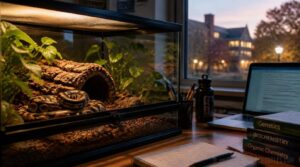
Before you buy a single hide box or heat mat, you need to know whether your campus even allows snakes. Most U.S. dorms don’t — roughly 96% of universities ban pets outright — so the rules at your school are the first thing worth looking up. Here’s what to check before you commit.
Campus Pet Policy Limits
Before you buy a single hide or heat mat, know this: nearly 96% of U.S. universities ban pets in dorms entirely. Most only allow fish — if that.
Before falling for a scaly roommate, check what keeping a garter snake actually involves — and confirm your local wildlife rules allow it.
A few exceptions exist, like Eckerd College, which permits non‑venomous snakes under six feet.
Check your specific housing handbook first, because showing up with a corn snake at a no‑pets school ends badly. Review the campus’s animal attendance requirements to guarantee compliance.
Registration Requirements
Once your school gives the green light, the paperwork starts.
You’ll need to complete a Pet Program Registration Form through the Office of Student Experience before your snake ever crosses the dorm threshold. That means uploading proof of legal acquisition, the snake’s species, and prior ownership documentation — all before the academic year begins.
Missing a single item triggers automatic denial.
Roommate Approval
Getting registration done is only half the battle — your roommate’s sign-off matters just as much. Most campuses require written roommate approval before any animal moves in.
That means a real conversation, not just a quick text. If your roommate has allergies or a phobia, explore alternative housing early. A signed roommate agreement protects both of you all semester.
Species and Size Restrictions
Not every snake makes the cut on campus. Venomous species are banned universally, and exotic or non-native snakes face heavy scrutiny.
Most dorms only allow corn snakes or ball pythons. Many campuses enforce a six-foot length limit, and some restrict snakes over 36 inches entirely.
Always check local wildlife laws too — they apply on top of campus rules.
Backup Housing Plan
Even the best-laid plans can unravel, so have a backup housing plan ready before your snake arrives on campus.
- Identify a friend or off-campus contact who can temporarily house your snake
- Keep a compact transport container stocked and ready to go
- Store your emergency supply kit with heat packs and water
- Document an alternative enclosure location in writing
Choose Space-Saving Enclosure Styles
Dorm rooms don’t leave much wiggle room, so your enclosure choice matters more than you’d think. The good news is there are several smart options designed to fit tight spaces without cramping your snake’s comfort. Here are the styles worth considering.
Whichever style you choose, keeping your snake healthy starts with knowing the warning signs—a good read on ball python illness and stress indicators can help you spot when the climate inside that miniature ecosystem isn’t quite right.
Front-opening Terrariums
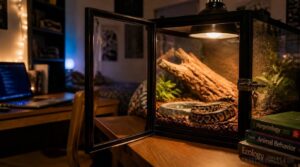
Front-opening terrariums are honestly one of the smartest picks for dorm life. You’re not wrestling with a heavy lid every feeding day — just swing open the door and you’re in.
Lockable latch security keeps curious roommates out, while humidity seal integrity around the door frame keeps conditions stable.
Check that your desk setup allows full door clearance when opened.
Secure Glass Tanks
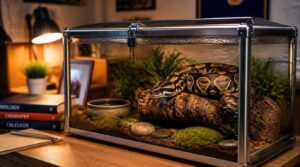
Glass tanks are a solid dorm option when fitted right. Look for tempered glass panels — they’re up to five times stronger than standard glass and far less likely to crack under pressure. If one does crack, laminated safety glass won’t shatter into sharp shards, which matters in a shared living space.
- Low-iron glass offers crystal-clear visibility
- Silicone-sealed seams prevent leaks and hold humidity
- Steel frame braces keep the tank stable on desks
- Locking mesh lids block escape attempts cold
Stackable PVC Cages
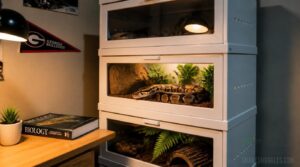
If square footage is your biggest constraint, stackable PVC cages might be your best friend. Each unit stacks vertically with interlocking edges, so you’re building up rather than out.
Front-swinging acrylic doors lock tight and give you a clear view without opening anything.
Smooth, moisture-resistant PVC panels wipe clean in minutes — a real win on busy study nights.
Compact Starter Habitats
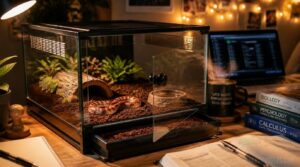
A compact starter habitat is the sweet spot between "too cramped" and "taking over your desk."
These small-footprint setups feature front-opening doors for one-handed access, removable substrate trays for quick cleanouts, and modular ventilation panels that keep airflow balanced without drying things out.
They’re sized right for juvenile snakes — practical, escape-resistant, and genuinely budget-friendly.
Bioterium 38L Terrarium
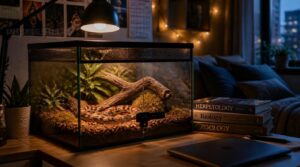
Need a setup that won’t eat your dorm room? The Bioterium 38L Terrarium delivers a true compact footprint at roughly 40x25x25cm, perfect for small space pet options.
Its passive airflow design and mesh vents control humidity naturally, while the locking lid security blocks roommate mishaps.
Three reasons it works for college student pet care:
- Removable tray for easy substrate management
- Front access for stress-free handling
- Built for small specimen suitability
Match Enclosure Size to Species
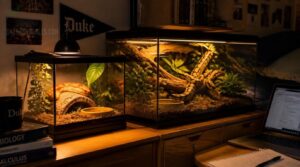
Getting the enclosure size right is one of the most important things you’ll do for your snake’s health and comfort. It’s not one-size-fits-all — corn snakes and ball pythons have different space needs, and juveniles versus adults are a whole other conversation. Here’s what to know for each situation.
Corn Snake Housing
Corn snakes are one of the best small-space pets for college students — manageable, calm, and perfectly suited to dorm life. Adults need a 40-gallon tank, roughly 36 × 18 × 18 inches.
| Life Stage | Enclosure Size |
|---|---|
| Juvenile | 20–30 gallons |
| Adult | 40+ gallons |
Ball Python Housing
Ball pythons need more floor space than height. Go with a setup like the Ball Python Enclosure V2, sized for full coiling and turning.
Keep substrate deep enough for burrowing, run a thermal gradient (28–32°C warm side), and add a hydration basin for soaking.
Solid sides cut visual stress — a calmer snake makes for calmer roommates.
Juvenile Versus Adult Needs
Your snake’s age changes everything. Juveniles are stress-sensitive and need more frequent feeding — sometimes every five to seven days — while adults eat larger prey less often.
Younger snakes also run hotter metabolically, so maintain tighter temperature control across more of the enclosure.
Adults are more forgiving but crave predictability. Sudden dorm disruptions hit juveniles harder, so enrichment and routine matter most early on.
Horizontal Floor Space
Floor space is where theory meets reality. A compact starter habitat usually takes up 1.5 to 2.5 square feet — manageable in a cramped dorm room if you plan smart.
Place the enclosure along a wall, leaving at least 6 inches of clearance on each side for airflow and safe maintenance without turning your room into an obstacle course.
Vertical Climbing Space
Vertical space matters more than you’d think — especially for corn snakes, which love to explore upward.
A taller enclosure with textured climbing surfaces and a few sturdy branches gives them real enrichment. You don’t need towering walls; just 8–12 inches of vertical room above the substrate lets your snake stretch, climb, and feel genuinely at home.
Keep Heat and Humidity Stable
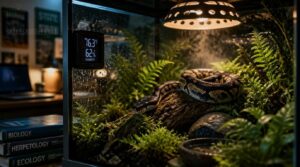
Temperature and humidity aren’t just comfort features for your snake — they’re survival basics. Get them wrong, and you’re looking at a sick, stressed animal that no dorm RA is going to sympathize with. Here’s what you need to keep things stable:
Temperature and humidity aren’t comfort extras — get them wrong and you’ve got a sick snake and an angry RA
Warm and Cool Zones
Think of your enclosure as a miniature climate with two distinct neighborhoods.
The warm zone sits at 28–32°C, fueling your snake’s digestion and daily activity. The cool zone stays around 22–26°C, giving it a place to recover and regulate.
Position your heat source on one end only — that natural temperature gradient lets your snake choose exactly what its body needs.
Thermostat-controlled Heating
Without a thermostat, your heat source runs unchecked — and that’s a real burn risk.
Connect every heating element to a thermostat that uses a digital sensor, which holds temperatures within about 0.5°C of your target. Many modern units support adaptive scheduling, automatically adjusting warmth based on your routine.
That’s precise, reliable protection that your snake depends on daily.
Safe Nighttime Heat
Nighttime is when most heat accidents happen — your snake’s still relying on that warm zone while you sleep.
Use a ceramic heat emitter connected to your thermostat; it warms without light, protecting your snake’s circadian rhythm. A dual-sensor thermometer tracks both zones overnight. Keep a backup heat source ready — emergency heat backups matter more at 3 a.m.
Humidity Monitoring
Humidity is the silent killer of a good shed. Corn snakes need 40–60% relative humidity — let it slip, and you’ll deal with stuck sheds or respiratory issues fast. A digital capacitive hygrometer gives you stable, real-time readings without constant fiddling. Unlike analog sensors, digital ones rarely drift and don’t need monthly salt-test calibration to stay trustworthy.
Smart alert systems notify your phone the moment humidity drops out of range — genuinely useful when you’re in a lecture hall across campus. Choose a monitor with data logging so you can spot trends, not just react to crises.
Dorm-safe Ventilation
Good ventilation keeps your enclosure’s humidity stable without letting it creep into mold‑friendly territory. Aim for 5 air changes per hour in your dorm room — a quiet inline fan under40 decibels manages this without bothering your roommate.
Pair it with a compact HEPA air purifier (CADR 100+) to catch shed skin particles and odors before your RA notices.
Prevent Escapes and Reduce Stress
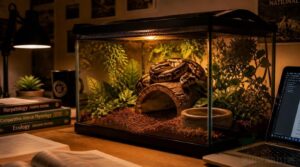
snake that feels secure is a snake that stays put—and a snake that stays put means one less midnight panic for you. Getting the enclosure details right makes all the difference between a stressed animal and a settled one.
Here’s what to focus on to keep your snake safely in its home and comfortable enough to thrive.
Locking Lids and Doors
Snakes are expert-level escape artists, so escape-proof latching isn’t optional — it’s your first line of defense. Front-opening terrariums with secure lid mechanisms beat basic top-opening tanks every time. Look for heavy-duty hardware like sliding bolt latches or key-lockable clips. Check these regularly:
- Latches that click firmly shut
- No warped frame gaps
- Corrosion-free metal hardware
- Tamper-resistant locking clips
Two Secure Hides
Once the locks are sorted, the next layer of stress-prevention is giving your snake somewhere to hide.
Place two secure hides — one on the warm side, one on the cool side. Both connect via a shallow tunnel so your snake moves between microclimates without venturing into open air.
Textured interiors and nonporous materials make cleaning quick and shedding comfortable.
Opaque Background Panels
Hides sorted? Now block the chaos outside the glass.
Tape or clip opaque background panels to the back and sides of your enclosure. This does three things:
- Cuts visual stress from room lighting and foot traffic
- Helps lock in a stable thermal microclimate
- Keeps cords and heat mats hidden from nosy RAs
PVC or acrylic panels — usually 3–5mm thick — resist moisture and wipe clean easily.
Easy Cleaning Setup
With the panels handled, think about the mess underneath. Between classes, you don’t have hours for tank maintenance.
Pick non-porous surfaces that wipe clean with mild soap. Use reptile carpet or paper towel liners — swap them in seconds. Choose spill-proof water bowls, rinse weekly, and stick to a 15-minute wipe-down routine. Low-maintenance setups mean more study time, less scrubbing.
Quiet Dorm Placement
Where you put the tank matters as much as what’s in it. Pick a corner away from the door and foot traffic — it cuts hallway disturbances and gives your snake calm, dim hours to settle.
If you’re in a quiet hall, you’re already set: thinner mechanical hums, less chaos.
Bonus? Pet ownership eases homesickness, and reptile enclosure safety locks keep things secure either way.
Frequently Asked Questions (FAQs)
Do snakes prefer vertical or horizontal enclosures?
Most snakes prefer horizontal space over vertical. They need room to stretch, thermoregulate, and explore along the ground. Climbing features are great extras — but floor space always comes first.
How much does a dorm snake setup cost?
A dorm snake setup runs $180–$520 upfront. Budget roughly $100–$300 for an enclosure, $40–$120 for heating, and $40–$100 for hides, substrate, and a water dish.
Where can I buy affordable used snake tanks?
Facebook Marketplace and campus bulletin boards are your best starting points. Thrift stores and reptile rescue outlets often stock used tanks for $20–$ Hobbyist swap meets let you inspect before buying.
Which snake species are best for beginners?
Forget "exotic" — beginners need boring, in the best way.
Corn snakes top the list: calm, easy-care, weekly mouse meals.
Ball pythons and rosy boas follow closely behind, prized for gentle temperaments, manageable sizing, and forgiving feeding schedules that fit hectic student life.
How often do corn snakes need to eat?
Young corn snakes eat every 5 to 10 days, while adults settle into a 7 to 14 day reptile feeding schedule. Match prey size to your snake’s width, log meals, and watch weight—appetite naturally dips with cooler dorm temps.
What substrate works best for dorm enclosures?
Think of substrate as your snake’s bedsheets: comfort matters. Coconut coir wins for dorms—great moisture retention, low dust irritation, minimal odor control hassle.
Skip sand (impaction risk). It’s budget‑friendly, low‑maintenance, and keeps humidity steady for easy shedding.
Conclusion
Think of your dorm room as a miniature ecosystem—every element you control ripples outward, keeping your snake calm, healthy, and hidden from drama.
Nail your snake enclosures for college dorms with locked lids, dialed‑in heat gradients, and two solid hides, and you’ve basically built a stress‑free island inside a chaotic sea of finals and roommates.
Get the setup right once, and your snake won’t ask for much else—just warmth, security, and the occasional frozen mouse.